
Type: Advice Update

Moving on: Opening a bank account whilst your’re in prison

This month, we’ve written another article for Inside Times ‘Through the Gate’ section which focuses on opening a bank account whilst your’re in prison.

A copy of the article can be found below.

I’m currently in prison and want to open a bank account ready for when I’m released. Can I do it while still in prison?

Many people in prison don’t have a bank account. It’s a fundamental necessity of modern life and therefore resettlement; whether you’ll be going into a paid job on release or claiming JSA, you’ll need a bank account for any money to be paid into.

That’s why it’s a good idea to try and open an account before you’re released. When you open an account, bear in mind that generally:

  • You’ll need to give the prison as your address;
  • Authorised staff from the prison can inspect financial records that come into the prison;
  • You won’t be allowed to open an account which offers credit facilities;
  • You won’t be allowed to have in your possession any cheque book or debit card that is associated with the account.

With the above in mind, you should look to open a basic bank account. A basic account will allow you to have wages and benefits paid into it, will give you a debit card and will enable you to set up direct debits to pay bills. It won’t provide you with an overdraft facility.

Does your prison have a banking arrangement in place?

Back in 2005, Unlock identified that many people coming out of prison didn’t have access to a bank account and often missed out on securing employment as a result of this. Over the next 9 years, we worked with various banks and prisons to set up specific arrangements in 74 prisons to make the process of getting an account much simpler. In 2014, there were 114 prisons with links to a high street bank, and we handed over the day-to-day responsibility to the National Offender Management Service (NOMS) to sustain this work.

Speak to your personal officer or the resettlement department to find out whether there is a banking arrangement in place and whether you would be eligible to open an account. Some prisons prioritise those that are nearing the end of their sentence. If you are eligible, you should be provided with details of how you make an application.

What can you do if your prison doesn’t have an arrangement in place?

If your prison doesn’t have a specific arrangement in place, there is nothing stopping you from applying to other banks, but it can be a lot more difficult. It might help if you apply to a bank close to the prison – you can always change branch at a later date if you wish to. Ask your personal officer or resettlement department for a list of local banks.

It should be stressed that the attitude of staff can vary between banks and also branches and therefore, if you’re refused by one, don’t give up – try somewhere else.

Proving your identity whilst in prison

For many people in prison and on release, the biggest problem they face when applying to open a bank account is providing identification. Even if the bank is happy to open an account for you, you will still need to meet the individual bank’s ID requirements. Most will ask you to prove your name with another piece of ID to prove your address. This can often be expensive.

As part of our banking project, we helped to overcome the problem that people with no ID face. We created an ID form which can be signed by the Governor, which will prove who you are. Further details about the form and how it is used by the prison can be found in PSI 44/2011.

Feedback on individual prisons

When we handed the banking project back to NOMS in 2014, 114 prisons had links with a high street bank and 5936 basic bank accounts had been opened for people in prison in 2013-14 alone. What began as a small charitably funded project, ultimately ended up as a national campaign which attracted significant political and media interest.

If you believe that the prison you are in does have a banking arrangement, but it’s either not being delivered or you’re not able to access it, then we’d like to hear from you as this will help us in our work to make sure people are able to open a basic bank account before release from prison.
 

Monthly summary – April 2017

Welcome to our monthly summary for April 2017.

This provides a summary of:

  1. the latest updates to our self-help information site for people with convictions
  2. recent posts to our online magazine, theRecord
  3. discussions on our online forum
  4. other news and developments that might be of interest to people with a criminal record

Have you just stumbled across this? You can receive these updates direct to your inbox every month for free by signing up to our mailing list (make sure you choose to receive ‘news for people with convictions’)


Updates to our information site

Here’s a summary of the updates that we’ve made recently to the theInformationHub. There are links within each update to where you can find more information about the update. There are also links next to many of the updates, which link to threads on our online forum where you can discuss these with other people with convictions. 

Criminal record checks for employment

  • An overview of the Disclosure and Barring Service – We’ve produced some new information giving an overview of the Disclosure and Barring Service. This includes what its responsibilities are and the options open to you if you wish to appeal something that’s been disclosed on your DBS Certificate.
  • Enhanced DBS certificates – We’ve updated this page to include details of the timescales involved in producing a certificate and how to escalate your DBS application if it has been with the local police force for over 60 days.
  • Enhanced DBS checks for delivery drivers – We’ve written an advice post which sets out the criteria a role would have to meet to enable an organisation to carry out an enhanced DBS check for a delivery driver job.

Work and volunteering

  • Looking for friendly employers – We’ve been made aware that the Kingfisher Group (B&Q and Screwfix) have blanket bans on the recruitment of people with unspent convictions for certain types of offences. We’ve updated our list of friendly employers to reflect this.

Travel

  • Travelling to Australia – As a result of changes to the Australian Immigration Act 1958 which came into effect in February 2017, we’ve updated this page and included a new section relating to travelling to Australia if you’ve been convicted of a sexual offence.
  • Travelling abroad while on licence –  We’ve added some new links to this page to include a personal experience of an individual who has been able to travel abroad whilst on licence.

Other areas of life

  • Compensation as a victim of crime – Following recent media stories we’ve updated this page and set out details of when a compensation award could be refused or reduced.

theRecord posts

Below are links to recent posts to our online magazine, theRecord. These are often linked to from the practical information that we have, to help give some personal experiences.

Success – Building my own dreams – What I’ve learnt from becoming self-employed‘I knew that having a conviction was going to make finding a job difficult but I wasn’t prepared for just how difficult it would prove. I resigned from my previous job (at my employers suggestion) when news of my court appearance became public. I had a well-paid job, wife, house and a decent car; within months I had lost everything …..’

SuccessGetting permission from probation to travel to my brother’s wedding whilst on licence‘From the day I received my custodial sentence, I was determined to turn my life around and make sure that I never went back to prison. I kept my head down all the time I was inside and upon release I’d already lined up a job volunteering for a charity who  worked with ex-offenders …..’

Struggled and stigmaI am being punished for something I haven’t done – Insurance problems for family members‘It was my first time in a court. My husband Mark was on trial. It was his first offence. He was pleading guilty. We didn’t know how things would go …..’

Discussions on our online forum

Below are links to recent posts to our online forum. If you’d like to join in the discussion but are not currently a forum member, find out how you can join here.

I need some advice – James gtr manchester wanted some help in coping with his feelings of isolation and loneliness following his conviction. Do you have any advice you can offer him.

Compensation for criminal injuries – Frances has highlighted details of some research undertaken by Anglia Ruskin University on how people with convictions are being denied compensation if they’ve been the victim of a violent crime. Have you had any personal experience of this.

Other news and developments

Below are links to other news and developments that might be of interest to people with a criminal record. For more news, check out the news and media section of our main website.

Some examples of people we’ve helped

We’ve written case studies setting out examples of some of the people we’ve helped to overcome the problems they’ve faced as a result of their criminal record.

Spring 2017 Newsletter – What we’ve been up to

We’ve published our spring 2017 newsletter which provides an update of the news from Unlock over the last three months.

An overview of the Disclosure and Barring Service

We’ve produced some new information giving an overview of the DBS. This includes what it’s responsibilities are, the options open to you if you wish to appeal something that’s been disclosed on your standard or enhanced DBS certificate, details about how to stop ineligibile checks and details about the DBS complaints escalation process.

For more information

  1. For practical self-help information – More information is available on our criminal record checks for employment
  2. Questions – If you have any questions about this, you can contact theHelpline
  3. Policy – Read about the policy work we’re doing on this issue – Stopping unlawful/ineligible DBS checks


Are you a delivery driver? Has your employer asked you to do an enhanced DBS check?

Over the past couple of weeks, we’ve had several enquiries from delivery drivers who’ve been asked by their employers to agree to an enhanced DBS check because they will be delivering to schools/care homes. The reasons often given by the employer for these types of check is that drivers will be delivering on a regular basis to these establishments and may have the opportunity to have unsupervised contact with a child or vulnerable adult. We’ve looked into this issue and sought further guidance from the Disclosure and Barring Service.

The criteria for an enhanced DBS check with a barring list check would be for those roles which involve regulated activity, for example healthcare professionals, social workers, teachers etc.

With regard to regulated activity and driving, the DBS state that the following roles would be considered to be regulated activity and would require an enhanced DBS check with barring:

Roles relating to adults

  • Any driver or any assistant who transports an adult (including any carer) because of their age, illness or disability to or from places where they have received, or will be receiving, healthcare, relevant personal care or relevant social work for the purpose of enabling the adult to receive that healthcare, personal care of social work.
  • Patient Transport Service drivers or assistants; Ambulance Technicians or Emergency Care Assistants.

Roles relating to children

  • Driving a vehicle being used for conveying children and their carers or supervisors under a contract or similar arrangement when carried out by the same person frequently.

As can be seen from the above, a delivery driver does not fall under regulated activity. The majority of schools maintain appropriate safeguards by asking that deliveries avoid playtime and lunch periods when children might be generally unsupervised around the school grounds. Most schools would ensure that they provide someone appropriate to supervise a driver as he carries out his delivery duties.

The frequency of visits applies only to ‘teaching, training, caring or supervising’ children and are not duties that would be undertaken by a delivery driver. The driver’s role is to deliver goods not take responsibility for children in the school.

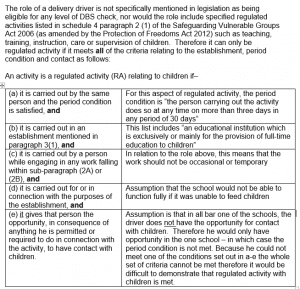
We’ve set out below a snapshot of the advice we received from the DBS.

Snapshot of DBS advice

Therefore we would suggest that if your employer asks you to have an enhanced DBS with barring check, you should challenge this through the DBS.

For more information

  1. For practical self-help information – More information is available on our criminal record checks for employment section
  2. Questions – If you have any questions about this, you can contact theHelpline
  3. Policy – Read about the policy work we’re doing on this issue – Stopping unlawful/ineligible DBS checks

Monthly summary – March 2017

Welcome to our monthly summary for March 2017.

This provides a summary of:

  1. the latest updates to our self-help information site for people with convictions
  2. recent posts to our online magazine, theRecord
  3. discussions on our online forum
  4. other news and developments that might be of interest to people with a criminal record

Have you just stumbled across this? You can receive these updates direct to your inbox every month for free by signing up to our mailing list (make sure you choose to receive ‘news for people with convictions’)


Updates to our information site

Here’s a summary of the updates that we’ve made recently to the theInformationHub. There are links within each update to where you can find more information about the update. There are also links next to many of the updates, which link to threads on our online forum where you can discuss these with other people with convictions. 

Criminal record checks for employment

  • Establishing what level of check an employer carry out – We’ve updated this page to include details of the eligibility tool which has been introduced online by the Disclosure and Barring Service.
  • Latest news from the Disclosure and Barring Service (DBS) – We’ve put together an advice post setting out changes the DBS are planning to introduce over the next 12 months which might be important to people with convictions.

Disclosing criminal records to employers

  • Moving on: Disclosing criminal records to prospective employers – when and how? – We’ve written an article for Inside Time’s ‘Through the Gate’ section which focuses on disclosing convictions to prospective employers if you’re about to leave prison.

Specific offences

  • Motoring offences – We’ve introduced a landing page which brings together our information, advice, resources and useful links relating specifically to motoring offences.

Travel

  • Travelling to the UK – We’ve updated this page to reflect the recent extension of criminal record certificates for Tier 2 (General) visa applicants (i.e. those working in education, health and social care sectors and their adult dependants).
  • Travelling to Canada – As a result of the number of enquiries our helpline has received regarding the Canadian eTA process, we’ve produced some additional information on how to answer the questions relating to criminal records.

Courts and sentencing

  • Criminal legal aid/contributions to legal aid – If you’re found guilty at Court, the Legal Aid Agency (LAA) can ask you to agree to pay all your legal fees by way of a Capital Contribution Order. This updated information sets out how the LAA can put a charge on your house to recoup this money.

theRecord posts

Below are links to recent posts to our online magazine, theRecord. These are often linked to from the practical information that we have, to help give some personal experiences.

Success – ‘Be prepared – Facing up to my past and volunteering as a Scout Leader’  – ‘Almost 20 years ago, I received two convictions; one for criminal damage and one for carrying an offensive weapon in a public place. This sounds absolutely terrible but, if I explain, you might get a better understanding of what happened   ….’

Struggles and stigma – I’m hoping that the law doesn’t destroy my future – Pushing for changes to the filtering process – ‘In support of your current campaign in the Supreme Court this February, I would like to describe my case which is an example of how the law for individuals with more than one conviction falls foul of expectations when it comes to human rights and what’s fair ….’

SuccessA city of possibilities – Living and working in Singapore with a criminal record – ‘I’m 40 years old and most people that know me would consider me to be a ‘pillar of the community’. However, this hasn’t always been the case and, as a young man, I received several cautions and also had a short stay in a Young Offenders Institution ….’

Discussions on our online forum

Below are links to recent posts to our online forum. If you’d like to join in the discussion but are not currently a forum member, find out how you can join here.

Applying to university – Btur was interested to hear from anybody who has experience of applying to university with a criminal record. Has anybody been through the process and got any information they can share?

Coping with being marginalisedCan anybody help P? He’s looking for information and advice to help him to deal with other people’s reactions to his conviction and to move on with his life.

Other news and developments

Below are links to other news and developments that might be of interest to people with a criminal record. For more news, check out the news and media section of our main website.

Has an employer wrongly checked your official criminal record?

As part of our Fair Access to Employment project, we’re asking individuals to contact us if they are able to provide examples of employer’s who have carried out inappropriate levels of criminal record checks. Details of the information we’re looking for can be found here.

Should employer’s ask about convictions on their application forms? Unlock discusses with Three Counties Radio

Christopher Staey talked to Three Counties Radio about whether employers should be discouraged from asking about convictions at the application stage, allowing applicants to be judged on their skills and abilitiies first.

Watch our oral evidence to the Justice Committee inquiry into the disclosure of youth criminal records

On the 15th March, Christopher Stacey gave evidence to the Justice Committee inquiry into the disclosure of youth criminal records. Watch the session here.

Your finances in and out of prison – BBC Radio 4 Money Box live

Christopher Stacey took part in a special Money Box phone in about the financial advice you can expect to receive on release from prison and what businesses can do to get ex-offenders back into employment.

Latest news about the Disclosure and Barring Service

Over the course of the next 12 months the Disclosure and Barring Service are planning to introduce several changes that might be important to people with convictions.

Basic criminal record checks

From autumn 2017, you will be able to apply to the DBS for a basic criminal record check if you live or work in England or Wales.

These checks are currently managed by Disclosure Scotland who will continue to process them for anyone living or working in Scotland.

A basic criminal record check shows unspent cautions and convictions and is used by many employers as part of their recruitment process. If you’re self-employed you can apply for a basic check for yourself.

There’ll be more details on this over the next couple of months, and we’ll post these under the basic tag.

Standard and enhanced criminal record checks

The DBS intend to introduce online standard and enhanced checks which will allow employers and organisations to:

  • Create an online account with the DBS
  • Manage DBS applications online
  • Track the progress of DBS applications online and do status checks

Standard and enhanced checks show spent and unspent convictions (other than those which are eligible for filtering), plus additional information that the police may hold.

You can use the DBS eligibility tool to establish which criminal record check is right for the job you’re applying for.

DBS compliance visits

The DBS will soon be starting a programme of work which will involve assessing the levels of compliance for all Registered Bodies (RB’s). By using responses to self assessment questionnaires and data from applications that have been submitted, together with inspection visits Registered Bodies who are non-compliant will be identified.

The DBS state that they will provide support and guidance to those non-compliant RB’s, but will take steps to suspend or cancel RB’s who are unable to comply with the obligations set out in the DBS Code of Practice.

Hopefully, this will mean that we will see less RB’s requesting ineligible checks which can result in an RB receiving information they are not legally entitled to see and possibly an applicant being inappropriately investigated for trying to work in an activity they are barred from.

If you’ve come across an organisation that you believe has carried out an ineligible check please let us know by emailing advice@unlock.org.uk with the details.

For more information

  1. For practical self-help information – More information is available on our criminal record checks for employment section.
  2. Questions – If you have any questions about this, you can contact our helpline.
  3. Policy – Read about the policy work we’re doing on stopping unlawful/ineligible DBS checks.

New eligibility tool by the DBS – How you can establish what level of check an employer is allowed to carry out

The most nerve-racking part of applying for a job if you have a criminal record can be finding out that an employer will be doing a criminal record check.

Sometimes this can be the first mention of criminal records in the recruitment process, or you might have already had to self-disclose but you weren’t sure exactly of the detail.

It can be particularly unsettling if the employer doesn’t make it clear what level of check they’ll be doing.

That’s why we’ve just updated our information on establishing what level of check an employer can carry out. This should help you to work out for yourself what check an employer can do for the job that you’re applying for. In particular, this covers a process that we’ve put together, and now includes the details of an eligibility tool which has recently been published online by the Disclosure and Barring Service. By answering a series of questions, the eligibility tool should help you to quickly check whether a role you are applying for is eligible for a standard or enhanced DBS check.

If you’ve gone through the establishing eligibility process and are confident that an employer could be doing an ineligible check, then you should challenge this through the DBS.

For more information

  1. For practical self-help information – More information is available on our criminal record checks for employment section.
  2. Questions – If you have any questions about this you can contact our helpline.
  3. Policy – Read about the policy work we’re doing on stopping unlawful/ineligible DBS checks.

Moving on: Disclosing criminal convictions to prospective employers – when and how?

This month, we’ve written another article for Inside Times ‘Through the Gate’ section which focuses on disclosing criminal convictions to prospective employers if you’re about to leave prison.

A copy of the article can be found below.

I’m just about to leave prison and I’m worried about disclosing my conviction to potential employers; are there any tips you can give me?

Irrespective of the skills and experience you might have, the addition of a criminal record can make job hunting a lot more difficult. There are many employers that are friendlier than others towards people with criminal records, but whatever type of employer you’re applying to, the key to success will be how well you disclose your criminal record.

Preparing to disclose

Before you start thinking about what, when and how to disclose, make sure you’re fully prepared.

  • Understand your criminal record – Even though your conviction will stay on the Police National Computer (PNC) until you’re 100 years old, you might not need to disclose it forever. You can find out what’s on your record, and how it might appear on any criminal record checks, by applying for a copy of your police record (it costs £10 and is known as a Subject Access Request).
  • Work out if or when your record becomes ‘spent’ – Providing your prison sentence wasn’t over 4 years then your conviction will become spent at some point under the Rehabilitation of Offenders Act (ROA). For most jobs, you won’t need to disclose your conviction once it’s spent.
  • If an employer asks, know if you need to tell them – You only have to disclose your record if an employer asks; many will at some point in the recruitment process. If your conviction is unspent, then legally you’ll need to disclose it. If you don’t disclose when asked, an employer could revoke the job offer, you could be dismissed and you might receive a further conviction.

When should I disclose?

Every employer will have a slightly different recruitment process, and the point you get asked about your criminal record may be different for every job you apply for. You may be asked on an application form, at interview or after you’ve received a conditional offer. Try to find out what the employers process is and think about what you’d feel most comfortable with. We’re part of the ‘ban the box’ campaign and many national companies have signed up to this by removing the question about criminal records from their application form, instead asking later in the recruitment process.

How should I disclose?

You’ll need to be ready to tell an employer about the offence, when it happened, what was happening in your life at the time and what’s been happening since. Think about the concerns an employer might have about your conviction and decide how to tell your story to address these concerns. Practice your disclosure so that you’re ready when asked.

Some application forms will merely have a ‘tick-box’ whilst others will have space to explain your conviction. Generally, we wouldn’t advise that you disclose any specific details on the form. We’d suggest you tick the “Yes” box and then add a sentence such as “Happy to discuss if selected for interview”.

If you’re asked to provide details at application stage, you might choose to send a self-disclosure statement alongside your application. We wouldn’t normally advise this unless it’s specifically requested. If you disclose in this way, make sure that you send your letter to the correct person (if necessary, contact the company and find out who this is) and put it in a sealed envelope marked ‘confidential’. Keep a copy as evidence of what you’ve disclosed.

If you’re invited to attend an interview, you’ll need to be prepared to talk about your criminal record in case they ask you at this stage. Employers often ask questions to get a better understanding of what you might have previously disclosed. Try to give as much information as you can to allow the employer to make a properly informed decision.

Unlock’s top tips for disclosing

  • Whenever possible, try to disclose your record face-to-face; this tends to be the most effective way.
  • Know your criminal record well so that you can talk confidently about it. Any signs of hesitation or vagueness may make you look dishonest. If it helps, take a self-disclosure statement with you to the interview, which you can refer to if you need to.
  • Think in advance about the questions an employer might ask you. Prepare your answers so that you can talk about your criminal record in a positive way.
  • Answer the employer’s questions directly and honestly giving the right level of detail. Explain any mitigating circumstances which led to your offending but avoid ‘making excuses’. Talk about what you’ve learnt and how you’ve become a better person.
  • Your best chance of getting a job is to always be honest, upfront and positive. You may have a criminal record but if you can convince an employer that it’s not related to the job and that it won’t stop you from being a great employee then you’re in with a shot.


Monthly summary – February 2017

Welcome to our monthly summary for February 2017.

This provides a summary of:

  1. the latest updates to our self-help information site for people with convictions
  2. recent posts to our online magazine, theRecord
  3. discussions on our online forum
  4. other news and developments that might be of interest to people with a criminal record

Have you just stumbled across this? You can receive these updates direct to your inbox every month for free by signing up to our mailing list (make sure you choose to receive ‘news for people with convictions’)


Updates to our information site

Here’s a summary of the updates that we’ve made recently to the theInformationHub. There are links within each update to where you can find more information about the update. There are also links next to many of the updates, which link to threads on our online forum where you can discuss these with other people with convictions. 

Criminal record checks for employment

  • Eligibility for an enhanced DBS check if you work as a contractor in a school or care home – We’ve produced an advice post which sets out the definition of regulated activity and the criteria which needs to be met to enable an employer to do an enhanced DBS check with a check of the children’s and/or adult barred list.
  • Disclosure of police intelligence on enhanced checks – We’ve updated this page to make it easier to navigate and added some additional links to other parts of the site.

Housing

  • Getting a mortgage – We’ve updated this information to better reflect the problems faced in getting a mortgage if you have an unspent conviction.

Specific offences

  • Removing historical convictions and cautions for consensual gay sex from criminal records – We’ve written an advice post to reflect the decision by the Government to posthumously pardon gay and bisexual offences which have now been decriminalised.

theRecord posts

Below are links to recent posts to our online magazine, theRecord. These are often linked to from the practical information that we have, to help give some personal experiences.

Success – Officer G – a prison officer in a million‘I’ve been watching the news over the past couple of weeks which has shown some disturbing images of prison riots. Prison officers being interviewed in the press say that cuts in staffing mean they don’t have time to deal with individual prisoner’s requests and issues  ….’

Struggles and stigma – Just because an employer doesn’t ask about criminal convictions don’t assume they won’t find out – especially if you’re under MAPPA – ‘I’d like to bring to everyone’s attention the issues you may encounter if you’re not entirely clear about the types of restrictions or conditions that exist on your licence or the input that other agencies may have which you might not have been made aware of. This is my story ….’

SuccessThere are people in the caring profession that care about people with criminal convictions: Getting a job in a care home – ‘As a youngster growing up my life was extremely chaotic. A mixture of getting in with the wrong crowd and being mentally unwell meant that I picked up a series of convictions ….’

Discussions on our online forum

Below are links to recent posts to our online forum. If you’d like to join in the discussion but are not currently a forum member, find out how you can join here.

Whats the chances of success when you apply to come off the register? – CC has responded to the information we posted about the police forces who are most likely to approve requests to come off the SOR and the ones least likely. He’s also provided some ideas for how the length of time somebody spends on the register could be better determined by an individual’s success in rehabilitation. Let us know what you think.

Travelling to the USA – JohnL  has posted a question asking whether anybody has successfully applied for an ESTA and travelled to the USA ‘trouble free’ after coming off the register. He’s going to be travelling to the US for a conference with his boss and is obviously quite nervous about this. Has anybody got any experience of this. 

Other news and developments

Below are links to other news and developments that might be of interest to people with a criminal record. For more news, check out the news and media section of our main website.

Unlock responds to Law Commission review of DBS filtering system

At the beginning of the month, the Law Commission recommended a wider review of the criminal record disclosure system. Download the full report and read Christopher Stacey’s reponse here.

Unlock welcomes new official open recruitment employer guide

The Department for Work and Pensions in partnership with Business in the Community have just published a guide, ‘Strengthening your workforce with talent from disadvantaged groups’, which provides a step by step guide to helping employers achieve open recruitment. It contains a specific section on people with criminal records.

Unlocking the potential of UK’s ex-offenders

A recent article published by NatWest suggests that one remedy to fill the UK’s skills gap could be to hire more ex-offenders and discusses what is the best way to go about it. Read the full article here.

Piece in The Economist – “In Britain, criminal records dog offenders for decades”

Unlock has contributed to an article in The Economist making the point that “the long memory of the law may limit the chance of rehabilitation”.

Government “exploring” incentives for businesses that take on ex-offenders

The Work and Pensions Committee has published the Government’s response to its report on the support for ex-offenders leaving prison. This indicates that the Government has accepted the case made for many of the Committee’s recommendations and is looking for ways to take them forward. Download the Government’s response here.


Is it always necessary to have an enhanced DBS check if you’re working as a contractor in a school or care home?

Our helpline often receives calls from individuals who, as part of their work, are required to go into schools or care homes (for example plumbers and electricians). Many employers will insist that you have an enhanced Disclosure and Barring Service check with a check of the barred list because of the type of establishment that you will be working in. But, are employers always entitled to do this level of check?

The DBS offer three levels of criminal record check:

  1. Standard
  2. Enhanced
  3. Enhanced with a check of the children’s barred list, the adults barred list or both

An employer is only entitled to do an enhanced check with a check of the barred list if an individual will be engaging in regulated activity.

The DBS have confirmed that in order to be in regulated activity for children, your role would need to meet the following criteria:

  • Take place in a specified establishment (e.g. a school)
  • The work must be carried out for the purpose of the school
  • The work must be unsupervised
  • The work must involve the opportunity to have contact with children (i.e. there must be children present on the premises at the time the work is carried out).

Therefore if you’re a plumber working in the boiler room of a school and supervised at all times by the school caretaker, then an employer would not be able to do an enhanced check with barring.

However, they may still be able to request an enhanced check without barring. This is because ‘infrequent’ work within a school can entitle eligibility as long as there is the opportunity for contact with children. So, if you’re a plumber who would be working unsupervised in different parts of the school and may come into contact with children, then an employer could ask you to have an enhanced check without barring.

If you’re working in an adult care home, an enhanced check without barring could be carried out providing you were working in the care home once a week or more, four or more times in a 30 day period or overnight and there would be the opportunity for you to come into contact with vulnerable adults.

The DBS have recently launched their eligibility tool which may help you to establish what type of check an employer can do for a job you’re applying for.

If you believe that an employer could be carrying out an ineligible check then you can challenge this through the DBS.

For more information

  1. For practical self-help information – More information is available on our criminal record checks for employment section
  2. Questions – If you have any questions about this, you can contact theHelpline
  3. Employment Project – Find out more information about our Fair Access to Employment project

We want to make sure that our website is as helpful as possible.

Letting us know if you easily found what you were looking for or not enables us to continue to improve our service for you and others.

Was it easy to find what you were looking for?

Thank you for your feedback.

12.5 million people have criminal records in the UK. We need your help to help them.

Help support us now