Author: Unlock Admin

Announcement on staff changes

With the agreement of trustees, Angela Cairns has decided to step down from her position as CEO of Unlock. Following two years with Unlock, Angela is taking some time out to explore other interests and career opportunities. The charity wishes her well for her future career.


Jo Easton, Unlock’s current Director of policy and advocacy, has agreed to become acting CEO to lead the charity in its vital work in building a fairer future for people with criminal records.


Statement from Mark Rowe, Chair of Trustees, Unlock

Call for evidence: recruitment agencies and criminal records

Unlock works with employers to promote Fair Chance Recruitment for people with criminal records.

Through our helpline, we hear that there can be some challenging ‘grey areas’ when applying for work via a recruitment agency.

We hear that there can be confusion around whether, how and when to disclose a criminal record when fulfilling an agency contract. We understand that this can lead to disappointment and unfair treatment, where an agency and an employer take different approaches to criminal records.

We want to hear from people who have sought work via a recruitment agency with a criminal record. Please tell us:

  • Why did you decide to find work via an agency?
  • Were you asked about criminal records when you joined the agency?
  • Did the agency find work for you? If so, what was the role/ company?
  • Were you asked to share your criminal record for the new role?
  • What happened next? Did your criminal record affect your agency employment? If so, how?
  • Anything else that you’d like to let us know

The information you provide will not be shared without your permission, and will help us to make recruitment practice fairer for people with criminal records.

Email us in confidence at research@unlock.org.uk

You can find information here if you are currently looking for work through a recruitment agency.

Unlock responds to consultation on employment support and services

The Institute for Employment Studies (IES) is an independent centre for research and consultancy, exploring key issues in employment and HR. The IES aims to improve policy and practice in employment and related fields. Learn more about the IES here.

In November 2022, the IES launched the Commission on the Future of Employment Support to develop evidence-led proposals for reform of the system of employment support and services. The first step for the Commission was to launch a consultation to gather evidence on the successes and challenges of existing employment services, and explore how the current system might be reformed.

Employment services have an important role to play in supporting people with criminal records to navigate the UK labour market. Unlock’s response to this consultation highlights the following:

  • People with criminal records are disadvantaged in the UK labour market. Poor policy, practice and attitudes to people with criminal records are prevalent in every sector and create unnecessary barriers for those seeking employment
  • The challenges a criminal record poses to employment can be exacerbated by existing inequalities in the UK criminal justice system. Measures to improve labour market outcomes for disadvantaged groups will be less effective if challenges relating to criminal records are unresolved.
  • Employers should be encouraged to assess people by their skills and suitability for a role first, before exploring the relevance of any criminal record
  • Employment services should develop specialist understanding of the issues faced by people with criminal records. Without this, individuals and employers navigate a complex system alone.
  • Support for employers should include guidance on the relevant legal frameworks, internal policy design and what fair practice can look like. Well-developed policies relating to criminal records are a far more effective recruitment tool than an over-reliance on criminal record checks or blanket refusals. Employers need specialist support to develop these policies effectively.


Find our full response here.

Call for participants: university applications

Want to ‘fix’ labour shortages? Start seeing the person, not their past

Last week, Dominic Raab called for employers to recruit people in and leaving prison to help plug the skills gap in an array of sectors, from haulage to hospitality. The Secretary of State rightly recognises this is a group of people who are unemployed and underemployed. In encouraging employers to give people a fair chance to get a job, the government is taking steps – albeit baby ones – to change the narrative around employing people with criminal records.  

Whilst we welcome these signs of change from government, they need to translate into more than just words of encouragement. A secure job, somewhere to live and support from family and friends are key to anyone living a positive life. Yet people with criminal records face challenges to this; long periods where they have to disclose their record to employers, housing providers and insurance companies – and even once a conviction is spent, someone’s past can resurface at the click of a Google search button.  When half of employers admit they would discriminate against someone with a criminal record, this matters.

Recent announcements from the government do nothing to address the barriers that stand between the almost 12 million people with a criminal record and a normal life. If we’re serious about getting people back into the workforce and into society, we need to make fundamental changes to a system that leaves people trapped in their past.  

We can’t view people as simply disposable assets who are rolled out at a time of crisis. People with criminal records are not part of a reserve army of labour. Nor will they all necessarily be able to work in an abattoir, drive an HGV lorry or make you the perfect coffee. But everyone deserves the chance of a job, a safe place to live and a sense of connection to their community.  

At Unlock, we want people to be employed because of their skills, experience and ability first and foremost. For this to happen, society needs to believe in rehabilitation, to believe that people can and do change. We need a criminal records disclosure system which is not unnecessarily punitive and arbitrary.

The Police, Crime, Sentencing and Courts Bill going currently going through parliament goes a small way to reducing the time periods some people will have to disclose their criminal record, but it doesn’t go far enough. As we continue to campaign for further change, we ask employers to make a difference by seeing the person first – and recognising that in most cases, there is no need to ask someone about their criminal record before you meet them.  

If you’re an employer and want to find out more about criminal records and fair recruitment, visit our Recruit website.

Applying for a job with probation? Do you know what you need to disclose?

People with criminal records are often keen to use their experience to help others in prison or on probation. Lived experience of the criminal justice system is now recognised as an asset by many employers in the sector – including Her Majesty’s Prison and Probation Service (HMPPS).

Last year they published the Probation Workforce Strategy 2020-2023 which states their intention to select the most capable candidates regardless of their background and enhance their recruitment approach to attract the right people in the right places, including ex-offenders, where appropriate, and those with broad and varied life experience.

HMPPS are now recruiting probation officers so if you are interested in helping others move on positively in their lives, now is your chance.

Knowing what to disclose

If you’ve got a criminal record and you’re applying for a new job or volunteering role, it’s always important to know if and what you need to disclose.

Make the mistake of over or under-disclosing and you run the risk of your application being unsuccessful.

Prison and probation roles are exempt from the Rehabilitation of Offenders Act 1974 so cautions and spent convictions can be taken into consideration. You will need to disclose these during the application process. However, these jobs are not exempt from the filtering rules and applicants do not need to disclose filtered cautions or convictions.

Find out if your criminal record is filtered

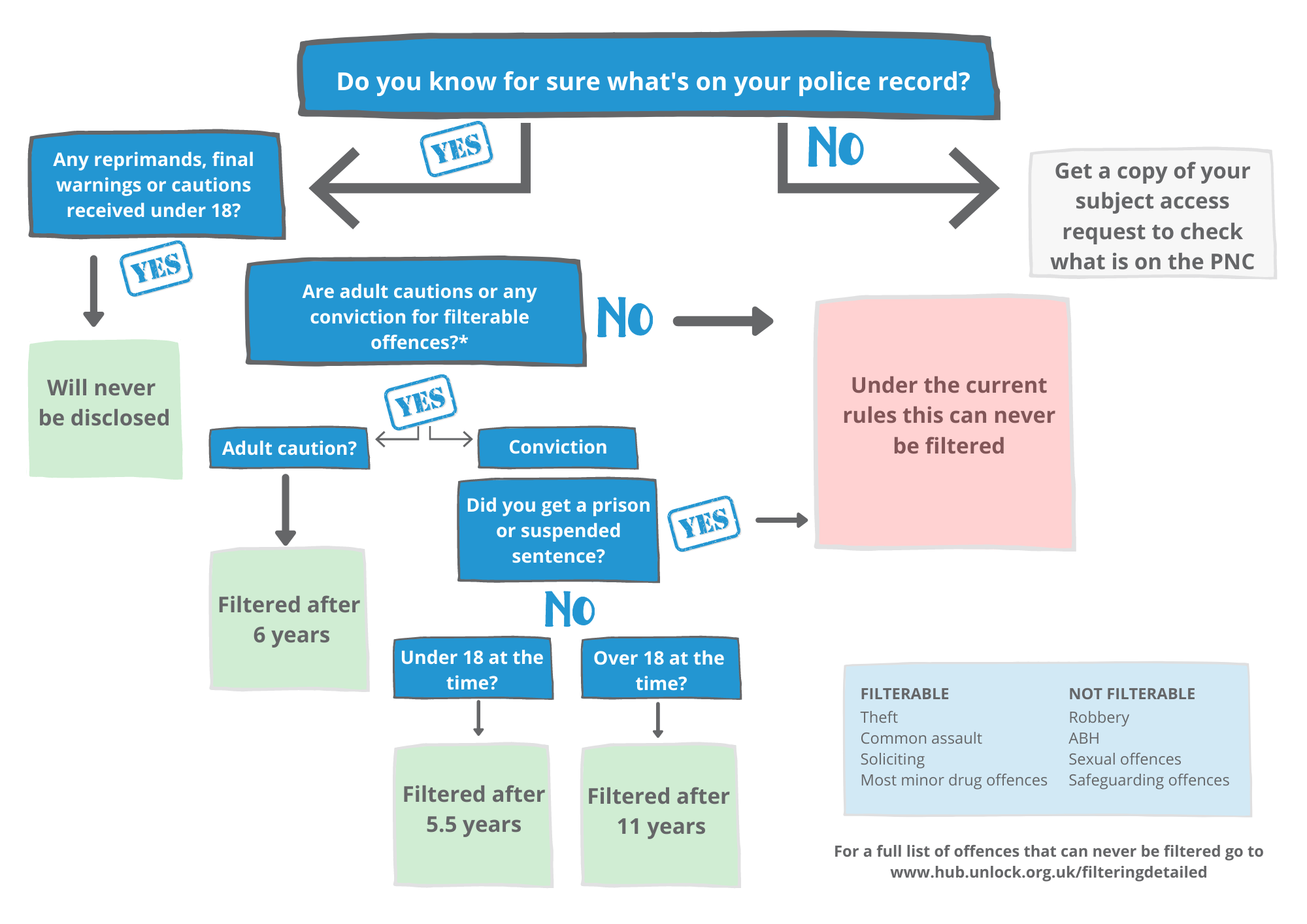
Some cautions and spent convictions can become ‘protected’. Once protected, they are ‘filtered’ meaning they won’t be disclosed on standard or enhanced DBS checks.

Filtered cautions and convictions do not appear on a standard or enhanced DBS check and don’t need to be disclosed (except for a very few jobs – see below). However, they are not ‘removed’ or ‘wiped’ from police records.

The filtering rules changed in November 2020 so use our guidance to work out whether your caution or conviction is filtered.

Are any jobs exempt from the filtering rules?

There are a small number of jobs that are exempt from the filtering rules but these do not include jobs in the prison or probation service. The application of these rules to sensitive employment – namely as a police support worker – was tested in court in 2017.

Jobs that are exempt from the filtering rules include:

  • judicial appointments
  • constables and police cadets
  • employment in the Serious Fraud Office or National Crime Agency
  • HMRC Commissioners
  • The Official Solicitor and their deputy
  • certain appointments to the office of Public Trustee
  • any office, employment or other work which is concerned with the establishment of, operation of, or access to a database under section 12 of the Children Act 2004.

Do I need to disclose a filtered criminal record for a probation role?

The recruitment site says:

You must disclose all convictions, cautions and absolute or conditional discharges – however long ago they occurred

But this is not quite right.

Prison and probation roles are covered by filtering rules, meaning applicants are legally entitled to withhold this information. We contacted HMPPS’s Operational Support Group to confirm. They told us that:

Filtered cautions and convictions do not need to be disclosed, as these are not considered as part of the vetting decision making process.

As the vetting process does not take into account filtered cautions/convictions, collecting this information could be considered excessive and therefore a breach of the General Data Protection Regulations.

For more information

Looking back at 2020 – A month-by-month review of developments for people with criminal records

With Christmas nearly here and 2020 coming to an end, it’s a good time to reflect on the last 12 months and some of the key moments for people with criminal records.   

It’s certainly been a year like no other, but once again it’s been an incredibly busy year for Unlock, with lots of positive news and progress that benefits people with cautions and convictions. 

As you can see in the month-by-month developments below, there have been some major strides forwards in reforming the criminal records disclosure system. Changes introduced in November to which cautions and convictions show up on higher-level DBS checks will mean over 45,000 people a year will now have a clear DBS check and be free of the stigma of their past. And proposals by the Ministry of Justice to reduce some disclosure periods under the Rehabilitation of Offenders Act are welcomed, although we are calling for the reforms to go further 

But it’s not all been positive either. There continue to be new and extended policies and practices that treat people with criminal records unfairly and punish people long after they’ve served their sentence. And at a time when many people have lost their jobs, now more than ever it’s vital that Unlock continues to work hard to provide support and a voice for people with criminal records, so the charity looks forward to yet another strong year in 2021 –  please help Unlock to continue its vital work 

For the charity itself: 

On a personal note, it was announced earlier this month that after 12 years at Unlock I will be moving on from the charity in early February to take up the role of Director of Support and Development at Clinks. It’s going to feel bittersweet for me to move on from Unlock but I’m incredibly proud of my time at the charity and it has been an absolute privilege to have been co-director of such an amazing and unique charity for the last seven years. The trustee board have decided to take this opportunity to recruit a CEO to help the charity deliver on its next phase of work, so keep an eye out for more details on this. 

On a practical note, our helpline will be closed for the Christmas holidays from 4pm today (Friday 18 December) and will reopen at 10am on Tuesday 5 January 2020. Our information site has details on what to do if you have questions over the festive period.  

In the meantime, on behalf of everyone at Unlock, I would like to wish you a very merry Christmas and a happy and safe New Year.  

All the best, 

Christopher Stacey  

Some key developments month-by-month 

In January we launched, together with Transform Justice, the #FairChecks movement to help push for a fresh start for the criminal records system. We also launched a collaboration with the University of Nottingham with a funded PhD opportunity to carry out systematic and in-depth analysis of policy and practice around applicants with criminal records across UK universities. And a year after the UK’s highest court found current rules on criminal records checks breach human rights laws, Unlock, Liberty and Just for Kids Law denounced the Government for failing to fix this broken system. 

In February wraised concerns as it was revealed that The Charity Commission has refused more than half of the applications it has received from people with criminal convictions who wish to serve as trustees or senior managers 

In March the Department of Justice (DoJ) in Northern Ireland announced it was making changes to what is disclosed on standard and enhanced criminal record checks, in response to the Supreme Court ruling in January 2019.

In Aprilwe produced some new information which set out the latest information and advice on Covid-19 and how it impacts on those with a criminal record.

In May Nicola Collett, a PhD student at Keele University, wrote about how her research is progressing into the potential influence of a criminal record acquired between the ages of 10-25, later on in adulthood. (She also wrote another update in September)

In June co-director Christopher Stacey shared some thoughts on the current Black Lives Matter protests, the criminal justice system, racial discrimination and the impact of criminal records.

In July the government responded to Supreme Court ruling with plans to change criminal records disclosure regime. We also published a report that highlights potentially hundreds of unlawful criminal record checks by employers each year.

In August new guidance for taxi licensing authorities recommends exclusions for even minor convictions

In September we responded to Ministry of Justice plans to make reforms to the Rehabilitation of Offenders Act 1974We also published a joint report with the Prison Reform Trust which found over half of employers would feel more confident hiring people with sexual convictions if they had access to management advice, or if they believed that the applicant wouldn’t reoffend.  

In October we published new information on what you need to know if you are an EU citizen and have a criminal record 

In November, after years of campaigning by Unlock, there was a momentous day for tens of thousands of people with old and minor criminal records.  Changes to the law have come into effect, meaning many people will no longer have their old and minor cautions and convictions show up when they apply for jobs or voluntary roles that involve standard or enhanced DBS checks. 

In December we published our full response to the government’s recent white paper proposing amendments to the Rehabilitation of Offenders Act. We also put out a call for evidence as we want to hear from people who were prosecuted for historic gay offences and who have not yet applied for a pardon. Thousands of men still have to live with the fallout from a system which attacked them for their sexuality, and to escape that they are expected to apply to the same government which persecuted them. We are hoping to show that the process of disregards and pardons is unfair and discriminatory. 

Unlock Annual Report 2019-20

We are delighted to publish the Unlock Annual Report 2019-20.

Compiling our report this year was quite a task as we had so much to say about our work and achievements – from developing our trustee board to supporting volunteers, and from providing direct support to individuals to fighting for system change and a society that lets people move on from their past.

It was a remarkable year with many successes despite the arrival of Covid-19. The impact of the pandemic was mitigated as far as possible and we quickly adapted to remote working and continued delivery of our work. Without doubt, people with criminal records now face additional challenges as jobs are lost and new ones hard to find when disclosing a conviction so often means rejection.

For some 45,000 people this will at least be made easier by the change to the ‘filtering rules’ on 28 November, meaning that for jobs and voluntary roles that involve a standard or enhanced criminal record check issued by the Disclosure and Barring Service, childhood cautions will no longer be disclosed, and a rule that meant someone with more than one conviction had all their convictions disclosed, regardless of offence or length of time, has been abolished.

For people who have been held back from employment and volunteering to help others because of mistakes they made years ago, the impact will be life changing.  Unlock along with others have long campaigned for this, fighting the government all the way to the Supreme Court. Many people have written to us to express what it means to them:

“I’ve spent the morning in tears because I’m so overjoyed… I will be forever grateful to Unlock and you for helping me. I cannot believe that from next week I will be able to apply for teaching jobs without the worry of dragging up my childhood traumas… Good luck with the continued fight for a better justice system.” 

 “I would just like to say a huge thank you to everyone there for the life changing work that you all do. You may never fully know just what an impact your work has on peoples’ lives. I will be forever grateful to you and thank you all from the bottom of my heart.”

There’s much more work to be done to further reform disclosure law along with the other vital work we carry out to enable people to live their best lives. 2020-21 promises to be another busy year ahead.

Of course, none of this would be possible without the support, faith and generosity of our funders, donors and volunteers, to whom we extend our sincere gratitude.

Thank you for taking the time to read our 2019-20 annual report

Julie Harmsworth
Co-director

A momentous day for tens of thousands of people with old and minor criminal records

Today is a momentous day for tens of thousands of people with old and minor criminal records. 

The stigma and embarrassment of a criminal record means many people simply don’t apply for jobs or voluntary roles that would require them to disclose their old and minor convictions or cautions. It’s a toxic form of punishment to keep punishing people forever and far too people many are unnecessarily anchored to their past as a result.  

That’s why today is such a big day. Changes to the law have come into effect, meaning tens of thousands of people every year will no longer have their old and minor criminal records show up when they apply for jobs or voluntary roles that involve standard or enhanced DBS checks . 

There are two main changes to what convictions and cautions are removed from standard and enhanced DBS checks. These are referred to as the filtering rules. 

The first change is that childhood cautions will no longer be automatically disclosed. Up until now, about 25,000 childhood cautions were disclosed every year, so this change will help thousands of people move on from minor things they did when they were a child.  

The second change is that a so-called ‘multiple conviction rule’ is being abolished. This arbitrary rule had meant that people with more than one conviction on their record had them all disclosed, no matter what the offences were, and no matter how long ago they were, simply because there was more than one. From the experience of Unlock’s helpline, we know this rule had meant that lots of people with minor convictions from decades ago were still finding them showing up on their check. According to Home Office data, these changes will mean around 45,000 people a year will now have a clear standard or enhanced DBS check. But this estimate is based on people that had previously applied for checks – and given we know many people are simply put off applying through fear and embarrassment, the number that will benefit from these changes will be even higher still.  

How we got here

It’s been a long road to get to this point. I was part of an independent panel that was set up back in 2010 to advise the Home Secretary on this issue, and the system of filtering that was brought in in 2013 made a difference to a lot of people, but we could see that there were problems, which is why we set about advocating for further change. When it was clear the government were resisting that, it took a number of legal challenges to get them to listen. 

And being honest, it is hard to give the government much credit for bringing forward these changes. They have contested the legal cases all the way up to the Supreme Court, the highest court in the land. Unlock supported those various legal challenges, and formally intervened in the Supreme Court for the first time in our history, because of the significance of the case. The result was a landmark ruling against the government. Even then, it’s taken the government nearly two years to get to this point of actually making the changes.  

But we are where we are, and I’m genuinely delighted for the thousands of people that have been in contact with us over the years waiting for changes like this to happen. It’s difficult to do justice to the struggles, shame and stigma that they have feltFinally, today is the day when that injustice ends and many thousands of people will be free of the stigma of their past. For every one of you that benefits from today’s changes, I want to thank you for all of the support you have given to Unlock’s work on this over the years.  

Unlock’s guidance for individuals and employers

The changes being made today are actually quite simple, but the rules around what gets disclosed on checks are still quite complicated, so it’s important that you find out what these changes mean for you. We’ve been busy working on updating our guidance for individuals and employersand that is all available from this page of our website. You can:

The need for further reform

But there’s still a lot more to do. Despite today’s changes, we are still left with a criminal records system where many people with old and minor criminal records are shut out of jobs that they are qualified to do because of a mistake they made years ago. For example, Unlock research found that over a five year period, 380,000 checks contained childhood convictions, with nearly 3,000 checks including convictions from children aged just ten. Many of these childhood convictions will continue to be disclosed forever, despite today’s changes.  

At a time when we’re facing significant economic uncertainty, people with criminal records are finding it harder than ever to find work. The government must commit to a wider review of the criminal records disclosure system to ensure all law-abiding people with criminal records are able to move on into employment and contribute to our economic recovery. 

That’s why Unlock is continuing to call for a root and branch review of the criminal records system to reduce the length of time a record is revealed. Everyone should have the opportunity to achieve their potential and make a positive contribution to society. Everyone deserves the chance to build a good life. The #FairChecks site is a crucial way for you to show your MP that you support reform of the criminal record disclosure system. 


We want to make sure that our website is as helpful as possible.

Letting us know if you easily found what you were looking for or not enables us to continue to improve our service for you and others.

Was it easy to find what you were looking for?

Thank you for your feedback.

12.5 million people have criminal records in the UK. We need your help to help them.

Help support us now