Despite relaxing the recruitment rules to allow for a more inclusive and diverse police force, the police still have very strict entry requirements.
It’s important to be aware of the criteria that the police use to make their recruitment decisions and whether you are likely to meet them. Some convictions/cautions will result in an outright rejection whilst others will be considered on a case by case basis.
Entry routes for police constables
There are currently four main routes into the police service.
Apprenticeship – You can join as a constable and follow an apprenticeship in professional policing practice. This route will usually take three years and will involve both on and off-the-job learning.
Degree-holder entry – If you already have a degree (it doesn’t matter which subject) you can join and follow a work-based programme, supported by off-the-job learning. This route will usually take two years.
Pre-join degree – If you’d prefer to study first, you can do a three year degree in professional policing (at your own expense) and then apply to a police force and follow a shorter on-the job training programme.
‘Traditional’ Initial Police Learning Development Programme (IPLDP) – This is the original route into the police force and is gradually being replaced with the three new entry routes set out above. You will need to apply directly to the force and then undertake a two year programme.
What is the eligibility criteria for the role of a police officer?
The College of Policing has produced guidance for the recruitment of police officers which can be found here.
There are various criteria you must meet in relation to age, financial situation and tattoos/body piercings but our information will concentrate on criminal records.
Criminal records
The checks they carry out
Police force’s will carry out thorough checks on you, your spouse or partner, close relatives such as parents, in-laws, children or others residing or associated with you. They will check the Police National Computer (PNC), Criminal History System (CHS), Criminal Information System (CIS), local intelligence and other relevant non-conviction databases. Where appropriate they will also check military and police professional standards databases as well.
Depending on the role that you may be carrying out when you join the police force, a Counter Terrorism Check (CTC) may be carried out.
If you are applying to a police force outside the area where you live, your residing force may be asked to conduct checks on you using their systems and local intelligence databases.
The Rehabilitation of Offenders Act 1974 does not apply to the police. Therefore, you will need to disclose all spent and unspent convictions, including those that are filtered. The police will conduct a search of the PNC, so they will be aware of all cautions/convictions (even those which would be eligible for filtering).
A case heard at the Court of Appeal in October 2020 ruled that all would-be police officers must disclose all convictions and cautions including those received as a child. The judges stated that disclosure is “necessary in a democratic society” to prevent crime.
Police forces will use the guidance provided to assess each application on an individual basis and eligibility will depend on the nature and circumstances of the offence.
In May 2019, the College of Policing produced a guide to APP Vetting which provides information on the vetting procedures which are applied to police forces in England and Wales.
The Rehabilitation of Offenders Act 1974 (Exceptions) Order 1975 does not apply to police officers. Police forces are therefore entitled to ask applicants to reveal spent convictions during the recruitment or vetting process.”
For vetting purposes, a check will be made of the Police National Computer, the Police National Database and other intelligence databases. Any cautions or convictions which are ‘protected’ (eligible for filtering off standard and enhanced DBS checks) would also need to be disclosed.
How are convictions/cautions dealt with?
On 12 October 2017 the new Police Vetting Code of Practice was published, replacing the previous 2012 policy. The Code applies to all police forces in England and Wales.
It emphasises the importance of maintaining high ethical and professional standards and of police officers acting with the utmost integrity, for which purpose a thorough vetting regime is essential. It sets out a number of principles, including Principle 12 which states:
Public confidence may be affected if an officer has a previous conviction or caution, therefore there is a rebuttable presumption that a person will not be suitable for appointment as a police officer or special constable if they have a previous conviction or caution for a criminal offence, especially if it relates to dishonest or corrupt practices, or violence. Factors that may weigh against this presumption being applied in individual cases include the nature and severity of the offence, the person’s age at the time they committed the offence, and the length of time since the offence was committed. Each case must be considered on its own merits including both the individual’s role in the offence and the nature of the conviction or caution. This presumption applies to police staff roles with designated powers or roles where there is a likelihood of being in the evidential chain.”
The Code adds that an application for a position as a police officer, or as a member of police staff where the person may be in the evidential chain, are to be rejected in all cases where an offence, whether committed as an adult or child, resulted in a custodial sentence (including a suspended sentence) or where the applicant is a registered sex offender or subject to a registration requirement.
Undisclosed convictions
Where the police suspect that you have failed to declare a conviction or caution, enquiries will be made to ascertain whether the conviction or caution is attributable to you. Enquiries will be made to the relevant court to ensure that the conviction has not been overturned on appeal. Where it is established that you have deliberately failed to disclose a conviction or caution, then your application will probably by rejected.
If you disclose an outstanding charge or summons, your application will probably be put on hold until the outcome is known, at which point it will be considered in accordance with the guidance above.
HM Forces convictions
If you are a serving member of the armed forces and have been convicted of any criminal offence by a military tribunal, this will be recorded on the PNC. This will include any aspect of a conditional discharge. Any convictions obtained whilst in the armed forces will be considered in accordance with the guidance.
Relatives and associates with criminal convictions or cautions
Where your relatives or associates are found to have unspent convictions or cautions for recordable offences, the following will be considered:
The likelihood that your performance and discharge of duty will be adversely affected e.g. through adverse pressure or a conflict of interests.
The nature, number and seriousness of the offences or involvement in criminal activity and the time over which these took place.
Whether the circumstances are likely to bring discredit to or embarrass the Police Service or Police Force.
Vetting for candidates who have been living or are resident abroad
The police will carry out recruitment vetting procedures on all applicants to determine your suitability to have access to sensitive and classified information. This applies to all applicants (including United Kingdom nationals who have been living abroad, Commonwealth and foreign applicants).
If you are living or have recently lived abroad then the police will make checks looking for at least a 3 year checkable history.
If you cannot be vetted then your application will not be successful.
Vetting for non-police personnel
The police will carry out recruitment vetting procedures on all “persons employed for the purposes of, or to assist the constables of, a police force established under any enactment”. You can be asked about both unspent and spent cautions and convictions and they can be considered in the vetting process. However, you shouldn’t be asked to disclose protected (filtered) cautions and convictions and they shouldn’t be considered in the vetting process.
Discuss this with others
Read and share your experiences on our online forum.
Below you will find links to useful websites relating to this page. More specific details (including addresses and telephone numbers) of some of the organisations listed below can be found here.
This page was last fully reviewed and updated in November 2016. If you’ve spotted something that needs updating, please let us know by emailing the details to advice@unlock.org.uk
The aim of this page is to give you an overview of how your criminal record can affect your employment, and what remedies are available should something go wrong.
The information contained here is intended to be very basic; if it doesn’t answer your questions, or you have any doubts about whether or not you should raise an issue with your employer or commence legal proceedings, we would recommend that you seek legal advice.
There are some instances where it may be appropriate (or necessary) for Unlock to take on your case and provide you with individual help and support.
Employers can be influenced by a great deal of prejudice when dealing with someone who has a criminal record.
Despite the fact that 1 in 3 of the adult male population has a criminal record, not all employers are entirely clued up on what their obligations are when dealing with those who have a criminal record.
If you have an unspent conviction, you have very little legal protection when applying for work.
However, it is unlawful for an employer to subject you to any ‘prejudice’ because of a conviction if it is now spent, for jobs where the Rehabilitation of Offenders Act (ROA) 1974 applies. In practice, this should not arise very often, as it would be difficult for an employer to discover a spent conviction without a standard or enhanced Disclosure and Barring Service check(which should only be done for roles exempt from the ROA), or through your own admission.
It is possible that an employer could learn of your conviction inadvertently (e.g. through others), so it’s important to know what legal rights you have.
Seeking employment with a spent conviction
The general rule
The Rehabilitation of Offenders Act 1974 (ROA) allows most convictions to be considered spent after a set period of time. Unless you receive a prison sentence of over 4 years or have any type of indefinite order, your conviction will become spent at some point.
Once your conviction is spent, this entitles you (for jobs where it applies to), in basic terms, to portray yourself as somebody who has never been convicted, i.e. it allows you ‘to legally lie’ (subject to the exceptions listed below).
Spent convictions should not be used as evidence in employment tribunals, without the consent of the person concerned and questions should not be asked that would elicit or hint at such information.
If your contract of employment asks you to disclose your convictions, you would not be required to disclose any that are spent (see section 4(3) of the ROA). As a general rule, you would not be breaching any employment contract if you failed to disclose a spent conviction and, if you were dismissed for failing to disclose a spent conviction, then you may have legitimate grounds to bring a case of unfair dismissal.
The exceptions
Certain jobs do require you to disclose spent convictions, as these jobs are exempt from the ROA.
However, you should only disclose when you are sure that you are applying for a position that requires you to do so. The vast majority of jobs and professions are not covered by these exemptions and a request to disclose spent convictions can be ignored unless the position is exempt.
Below is a brief list of the types of jobs that might require you to disclose spent convictions:
Doctors, dentists, midwives and nurses
Solicitors
Accountants
School based jobs
Jobs with social services providers
Jobs that involve the supervision or training of people under the age of 18
If you have to undergo a standard or an enhanced criminal record check as part of any recruitment process, then this will result in an employer discovering your spent convictions and cautions unless they are eligible for filtering from these checks.
Applying for jobs covered by the ROA with a spent conviction
Making your application
If you’re asked about whether you have a criminal record, either on an application form or during a job interview, then legally you can answer ‘no’ if it is spent.
However, this does not prevent you from discussing or revealing your conviction if you chose to, although this is unnecessary and in most cases unlikely to be your best option. If you have any gaps in your employment record which you would find difficult to explain without disclosing your conviction or, you believe that an employer may find out in some other way, then you may decide to disclose. It’s important to remember that you are under no obligation to disclose and you should consider your position carefully before you do so, as although employers should not use a spent conviction to penalise you, in practice, it is difficult to stop them if they do.
Being refused a job
The ROA makes it unlawful for an individual to be excluded from any job (other than those not covered by the ROA) on the basis of them having a spent conviction. Therefore, if you’ve been denied a job purely because you have a spent conviction, then you may be able to bring litigation based on a ‘breach of statutory duty’.
To the best of our knowledge however, this has never been tried before, so we would recommend that you seek legal advice before you consider commencing proceedings. In addition, you would have to be able to prove that the decision not to offer you the position was based wholly or mainly on the existence of a spent conviction, which, without clear documentary evidence is likely to be very difficult to prove.
Treatment whilst in employment, including dismissal
If your employer/colleagues become aware of your conviction and you find yourself being bullied, harassed or otherwise mistreated because of it, then you should raise this informally with your line manager. If your manager is the cause of the bullying etc then you can either arrange to talk to them and try to rectify the issue or seek out their immediate superior. Hopefully you’ll be able to sort out the problem at this point.
If not, then you will need to consider whether to make a formal complaint, via your company’s grievance procedure. If your employer has an HR department, they should be able to provide you with a copy of this. Your trade union (if you are a member) will also usually be able to provide you with advice . You may also want to have a look at the ACAS guide to grievance procedures.
The most obvious and serious form of mistreatment resulting from a knowledge of your spent conviction is dismissal. Any dismissals which are based on a failure to disclose a spent conviction will be deemed unfair (and will guarantee a finding of unfair dismissal at an employment tribunal). If you are dismissed, then it is possible that your former employer will claim a different reason for their decision at a tribunal, so you should gather as much evidence as you can to support your claim that it was your conviction that was the main motivating factor behind the decision. This can include:
Communication between yourself and the employer
Information about other employees
Internal communications within the organisation
It should always be your aim when going through disciplinary proceedings to avoid dismissal. You could try to enlighten the company about it’s legal obligations, by pointing out to them that they cannot legally dismiss you solely because you have a spent conviction. You might want to refer them to the ROA and the case of Property Guards Ltd v Taylor and Kershaw [1982] IRLR 175. This case contains an explicit reference to the relevant part of the ROA 1974 (S.4 (3)(b)) and clearly states that a decision to dismiss for not revealing a spent conviction is legally unfair. It may be that your employer is unaware of this and that this information leads them to change their position.
We would recommend that you seek legal advice as soon as you are notified of any disciplinary proceedings so that you are able to mount the best possible defence and have the greatest possible chance of avoiding dismissal.
Applying for jobs exempt from the ROA with a spent conviction
Making your application
If the job you are applying for is exempt from the ROA you will legally have to disclose all cautions and convictions unless they are eligible for filtering.
Being refused a job
The potential for legal action if you are refused employment because of a spent conviction is, as mentioned above, somewhat uncertain. However, if you are applying for a job which is exempt from the ROA, then the position is much clearer; there is very little that you can do.
If a job is exempt from ROA then generally, it is also exempt from the legislative protective elements as well.
Treatment whilst in employment, including dismissal
The initial position is the same as above. The exemption strips you of the ROA’s protection and you will not be able to use it to defend yourself in concealing a conviction.
However, this does not deny your right to file a grievance if you are unfairly treated or a claim with an employment tribunal if you are dismissed. Being dishonest about a spent conviction does not automatically entitle an employer to dismiss you or subject you to negative treatment, although it may make your actions seem more reasonable to a tribunal than might otherwise be the case.
Seeking employment with an unspent conviction
Applying for a job
If your conviction is unspent, then you do not have the legal protection of the ROA and cannot answer ‘no’ when asked if you have a criminal record.
This is a question that you will need to be prepared for, as most application forms will contain it in some form. The lack of ROA protection means that there is nothing to prevent a potential employer from asking you the details of these convictions if you admit to having a criminal record. Many companies have a ‘Recruitment of Offenders’ policy and you should check if your potential employer has one and what it says so that you know what to expect.
The ROA is not designed to enforce disclosure of unspent convictions; it is a protective law, not one aimed at making life difficult for those who do not benefit from it’s protection. This means that if information about your criminal record is not sought by an employer, then there is no legal need for you to disclose your unspent convictions and nor should you be penalised if these are later discovered.
If you are dismissed for such a reason, it may be worth considering an unfair dismissal claim and raising this point during any internal appeal. Whether or not the dismissal was lawful would depend on what you were asked and what factors you put forward in the interview as qualifying yourself for the job. For example, if you described yourself as trustworthy, but had dishonesty convictions, then this could count against you, even if you were not asked about such convictions.
In practice however, it is more than likely that the question will be asked. If it does not come up on the application form or the interview, then you should still be prepared for it to form part of your contract of employment that you disclose any convictions. This is a standard term in a lot of employment contracts and perhaps explains why it is important to ensure that you read and understand the terms of your contract before you accept a job offer.
If you disclose your conviction, it is important to be as honest as you can be. A failure to do so is likely to lead to dismissal in the event that any lie is discovered and could also, potentially, lead to civil litigation (for breach of contract) and even further criminal charges. Both of these would cause serious problems for a person seeking to turn their life around and could prove costly both financially and personally.
Being refused a job
Unfortunately, this is one of those situations where there is very little you can do.
Although the intention of the ROA was to attempt to make life easier for people with certain types of criminal record, it did not include any provisions regarding the appropriate treatment of all the others. In the intervening years, little or nothing has been done to alter this situation. There is no legal concept of ‘discrimination on the basis of having a criminal record’, as there is for discrimination on the grounds of age or disability.
Your treatment, therefore, will only create a legal claim if it would do so for someone without a criminal record. Where you are refused a job because of your race, sex, religion, nationality, age or some other characteristic protected by the Equality Act 2010, then you can bring an action at an employment tribunal.
Otherwise, the law as it stands, permits an employer to recruit whom he wants; it will not question his reasons or his motives. Refusing to employ someone for having a conviction cannot be the cause of a legal claim, in the same way that an employer cannot be sued for refusing to employ someone because they like watching Eastenders; there is no obligation to engage in reasonable or rational decision-making when choosing employees.
Treatment whilst in employment, including dismissal
The position here is essentially the same as in the sections above on treatment based on a spent conviction and recruitment. Having an unspent conviction is not a characteristic afforded legal protection; how to proceed will therefore depend on factors other than your conviction.
Dismissal for non-disclosure of an unspent conviction
If you fail to disclose an unspent conviction when you are asked, this could result in your being dismissed should the conviction be discovered later. An employer would usually be able to justify the dismissal on the basis that you breached your contract and that your dishonesty was a breach of the term of mutual trust and confidence implied in your employment contract. An employer should still take the time to investigate the reason for the non-disclosure fully and come to a reasonable conclusion – he can’t simply take the decision without consideration. It is usually difficult to convince an employment tribunal that dismissals of this kind are unfair.
Another issue is that you would almost certainly have a credibility problem as you’re starting out with an open admission that you acted dishonestly by lying about your criminal record in order to obtain employment. If you are merely questioning the legal fairness of the employer’s decision, this may not do you too much harm. However, if you are questioning the employer’s account of events (for example by claiming that he is using the lie as a pretext for an unlawful dismissal), then a lack of credibility could prove fatal to your case. You would need some very strong independent evidence or be a very convincing witness in order to win in such circumstances.
Don’t be discouraged from bringing a claim but think carefully about how you would address the obstacles highlighted above. If your conviction were for a minor offence or had no relevance to your suitability for the job then it might be possible to argue that the decision to dismiss you was unreasonable, notwithstanding the deception.
Dismissal for a known conviction
It is possible that even when you are honest about your conviction, your employer could later decide to dismiss you because of its existence. If this happens, then any employment tribunal case would proceed in the same way as any other unfair dismissal case. Your employer will need to demonstrate that the decision they made was fair.
If you received the conviction prior to being recruited and the employer was aware of it at the time they hired you then, it is likely that a dismissal made purely on the basis that you had such a conviction would be unfair.
This does not mean that all cases where you are dismissed for openly known about convictions will result in findings of unfairness. It may be, for example, that the nature of your employment has changed to such an extent that your conviction now relates more directly in your day-to-day work or your suitability for the role. Examples of such situations would be where:
You have a dishonesty conviction and your job changed to put you in greater unsupervised contact with money or valuable property.
You have a conviction related to children and your role now brings you into closer or more contact with them.
Your conviction is related to driving and your role is being changed to include driving duties.
However, none of these examples alone would necessarily make your dismissal fair. The circumstances that led to the dismissal and the exact relationship between your conviction and the change in duties would often still be open to argument and an employer would, at the very least be required to consider (but not necessarily provide) alternative employment within the company.
It is also possible that a conviction could lead to it being more likely that a tribunal would find it reasonable for an employer to draw conclusions in misconduct cases; for example, where you are accused of violence, dishonesty or drug use and have a conviction that proves past incidents that are of a similar nature. This does not mean however, that a conviction will automatically induce an employer to find you guilty in such circumstances and a tribunal would expect a proper investigation of the allegations.
Dismissal in cases of resignation
If your conviction leads to your being mistreated by your manager/colleagues then you may decide that you have no other option but to resign. Before things get to this stage, try to raise it through the company’s grievance procedure. This can often nip the situation in the bud. If you do make the decision to resign however, you may be able to claim unfair dismissal, referred to in cases such as this, as constructive dismissal.
A constructive dismissal case is one in which the dismissal is a result of your resignation, rather than the employer’s decision to dismiss you. If you are seeking to claim that such a dismissal is unfair, then you will likely be relying on the fact that the employer, through his actions, breached the term of ‘mutual trust and confidence’ that is implied into all employment contracts. Technically, you may be relying on the employer’s breach of any employment term, but the term of ‘mutual trust and confidence’ is the most commonly used in such circumstances. Proving this has been breached is no easy task and will require significant negative action from the employer or his staff. Simply hurting your feelings is unlikely to justify a claim that there has been such a breach.
In cases of a single action or comment, the humiliation or upset that it causes would have to be severe, and your response to it would have to be reasonable. Resigning because someone made a single joke about your conviction would be unlikely to meet this standard, but a single unjustified and baseless accusation of misconduct or criminal actions could, in certain circumstances, be serious enough to justify resignation.
The other scenario is where a string of incidents lead to a ‘final straw’ event that means that you feel you have no choice but to leave your employment. An example of this could be where constant negative references or ‘jokes’ are made about your conviction, to the extent that you are constantly being humiliated. Another example could be where you are consistently blocked from opportunities for advancement, training or other benefits open to your colleagues. In the ‘final straw’ scenario, the bar for the significant trigger incident is set lower, provided you can set out that it was the last in a string of incidents that would, taken as a whole, justify a loss of trust and confidence in your employer. Going through the grievance procedure is helpful, but where this is ineffective, it is important to highlight to the tribunal why this was the case.
What comes after your resignation? Well you have to convince the tribunal that you were unfairly dismissed. There are three basic components to this:
That your employer committed a serious breach of the contract (as described above)
That you resigned because of the breach. It must be the main reason for your dismissal, rather than merely a minor motivating factor. For example, if you have had another job offer and had already decided to leave then the breach would likely not have caused your resignation. Similarly, if you had decided you wanted to stop working in retail and move into sales, the breach is also unlikely to have caused your resignation.
That you did not ‘waive’ the breach, by unduly delaying your resignation. In constructive dismissal cases, there should not be a long break in time between the actions you claim caused the breach and your decision to resign.
It is important to know that constructive dismissal is by no means easy to prove. Resignation should always be the last resort; it can rarely be undone and should never be taken lightly. As we’ve said above, a grievance procedure can often remedy ill treatment and you should never be afraid to go to your HR department informally and make enquiries about how that procedure works in your company. However, if a grievance procedure is ineffective or inappropriate, and you are treated in such a manner that you genuinely feel that you cannot continue to work for your employer, then a resignation should be followed by you seeking immediate legal advice.
Discuss this with others
Read and share your experiences on our online forum.
Below you will find links to useful websites relating to this page. More specific details (including addresses and telephone numbers) of some of the organisations listed below can be found here.
To read personal stories – You can read stories about this posted on theRecord, our online magazine, under the tag looking for (and keeping) employment
To discuss this issue with others – Read and share your experiences on our online forum
The aim of this page is to consider how recruitment agencies might be able to help you in your search for employment, and what you legally need to disclose to an agency about your criminal record. It also provides details of agencies who specifically help people with convictions.
Why is this important?
You only have to look at job search websites such as Indeed.co.uk and Monster.co.uk to see how many companies advertise both permanent and temporary positions via recruitment agencies. For some professions, for example teaching, approximately 90% of vacancies are advertised through recruitment agencies rather than directly by the school.
Recruitment agencies tend to only get paid when they place a successful applicant with an employer and some agencies may be tempted to weed out any CV’s or application forms that disclose a criminal record. It’s important therefore to understand the best time to disclose to increase your chances of successfully securing an interview and hopefully a job.
What are the benefits of applying for work through a recruitment agency?
Recruitment agencies act as an intermediary between a company that is looking to employ someone, either on a temporary or permanent basis, and an individual who is looking for work.
Most agencies have a wide range of jobs on their books and some, which start out on a temporary basis, can often turn into a permanent job. For anybody with a criminal record, this will give you the opportunity to prove yourself through your work and may help to alleviate any fears an employer has about employing somebody with a criminal record.
Some agencies have exclusive access to jobs that would not otherwise be found through online searches or in newspapers etc.
There are some specialist recruitment agencies who concentrate on finding work for people with a criminal record. These agencies work with employers who are more positive towards recruiting people with convictions and the agencies will have an in-depth knowledge of what type of offences will and won’t be acceptable to those employers.
Registering with an agency and disclosing your criminal record
Registering
Some agencies allow you to register your CV online. They will ask you to provide details of the location you wish to work in and the types of jobs that you want to apply for. You will then be emailed with details of any jobs which match your criteria. You will rarely be asked to provide details of your criminal record to these agencies at this stage.
Many agencies will ask you to register face to face at a local branch. The staff will discuss your skills, experiences and your salary/career expectations. You may be asked to undertake basic literacy or numeracy tests or carry out some practical tasks which allow the agency to assess any competencies you will require. You will often be asked to disclose details of your criminal record as part of the registration process especially if the jobs you will be applying for require you to have formal criminal record checks.
Disclosing
If you are registering with an agency for temporary work where the agency will be paying your wages, then legally, you will need to disclose details of your criminal record if you are asked. You should only disclose unspent convictions unless the jobs you are applying for are exempt from the Rehabilitation of Offenders Act. For further information see our disclosing to employers section.
The more information you give to an agency about yourself, the quicker and easier it will be for them to find you a suitable position. This means that the agency won’t put you forward for jobs which you would not be suitable for (for example jobs with organisations who have a blanket ban on recruiting people with an unspent conviction if yours is currently unspent).
As stated above, agencies tend to only get paid once they’ve successfully placed an applicant. If you believe that an agency may be loath to put you forward if you were to disclose your criminal record to them, then you may decide to say nothing and wait to disclose to the employer if you are successful. The benefit of this approach is that having secured an interview (which you may not have done if you’d disclosed to the agency), you will be able to explain the details and circumstances of your conviction to the employer face to face. There is always the chance, however, that an employer may feel as though they have been misled and your application will be rejected on this basis alone.
If you are registering with an agency who specialise in finding work for people with convictions, then it’s likely that you’ll feel a lot more comfortable about disclosing and you should be as open and upfront as possible.
Recruitment agencies and criminal record checks
The majority of agencies who are looking to place people in jobs covered by the Rehabilitation of Offenders Act, will not carry out basic criminal record checks. If they are required, they will usually be undertaken by the employer when you are offered the job.
However, agencies that recruit for care work/teaching jobs etc (especially for temporary work) will apply for Disclosure and Barring Service checks for all applicants. Many agencies will immediately reject anybody who does not have a ‘clean’ DBS certificate, irrespective of whether the offence is relevant or not. Having a criminal record will not, in most cases, stop you from doing this type of work. However, you may have more success by applying to these employers directly.
You may be asked by an agency to provide them with a copy of your DBS certificate, as this is one of their ‘standard registration requirements’. If your conviction is spent and you are not looking to work in a job which is exempt from the ROA, then you are within your rights to inform the agency that you only wish to apply for jobs which are covered by the Rehabilitation of Offenders Act and which, potentially, only require a basic criminal record check.
Specialist recruitment agencies for people with convictions
Looking for work and disclosing a criminal record is never easy and for many people, registering with a recruitment agency that specialises in finding work for people with convictions can alleviate some of this anxiety.
Many specialist agencies will also be able to assist you in putting a CV together, prepare you for interview and advise on disclosure. The employers they work with will be aware that any applicant coming from these specialist agencies will have a criminal record.
We’ve put together a list of some of those that we know about below:.
Overlooked talent – a national organisation offering a wide range of jobs.
Pertemps – has over 100 branches throughout the UK and offers helps with finding permanent and temporary work in both the private and public sector.
Working Chance – an award winning charity specialising in helping women with convictions.
Useful links
Below you will find links to useful websites relating to this page. More specific details (including addresses and telephone numbers) of some of the organisations listed below can be found here.
Discuss your views and experiences with others on our online forum
This page was last fully reviewed and updated in September 2016. If you’ve spotted something that needs updating, please let us know by emailing the details to advice@unlock.org.uk
Explaining gaps in your CV as a result of a criminal record
The aim of this page is to look at ways of dealing with gaps in your employment history that have come about as a result of your criminal record. This may be by understanding what to put in your CV or how you explain at interview.
Many people with a criminal record have gaps in their CV that came about because of their criminal record. It’s important to know the best ways of addressing the issue and landing yourself a job offer.
Introduction
Having a gap in your CV may seem like a real stumbling block when you’re seeking a new job. However, if approached in the right way, these gaps needn’t be a hindrance and may present you with the opportunity to look at your existing CV and give it a complete overhaul.
Dealing with career gaps in a written application
When preparing your CV or completing an application form, it may be tempting to ignore breaks in your career, in the hope that potential employers won’t notice them. However, recruiters view applications carefully and may disregard your application straight away if your CV is full of unexplained gaps.
If the gap is a result of being in prison or losing your job as a result of a conviction, then the good news is you don’t need to state this explicitly in your application. This is your chance to sell yourself – highlight the positives and leave out the negatives.
How should I set out my CV?
When considering your CV, try to avoid using the standard chronological listings of job dates and previous employers. This format will draw more attention to gaps in your work history or limited work experience. Instead, use a functional CV format which highlights your abilities and skills for the job you’re applying for. Remember not just to focus on what you’ve done in the past but what you’re looking to do in the future. An example of a functional CV is set out below.
Although a functional CV is less common, it’s generally used by applicants who are looking for a career change. Therefore, don’t view it as something that will stand out in a negative way. The National Careers Service website has examples of different CV styles.
How can I explain short gaps?
If the gap in your employment history is short and sandwiched between longer periods of employment, you can often deflect attention by giving the dates of employment in years rather than months. For example 2002-2006, rather than January 2002 – October 2006.
How can I explain bigger gaps?
If there is a bigger gap in your career, maybe as a result of a prison sentence, then don’t try to conceal the gap but instead use it to show how you spent your time constructively and developed new qualities to bring to the workplace. This may not mean saying that you’ve been in prison, but it does mean explaining what you did at the time. Things that you might have done which can boost your CV include training courses you completed, new skills you’ve learnt, volunteering you’ve done or projects of your own that you’ve carried out. These will all demonstrate how you have occupied your time effectively.
You could explain gaps by stating that you were ‘unavailable for work’. It’s important to bear in mind however that an employer will probably ask you to explain what you mean by this if you’re invited to an interview. If you’re going to explain it in this way, you should plan in advance how you would answer this type of question.
If the gap comes from being in prison, but you worked whilst you were there, then include this work on your CV but put down the corporate entity’s name you worked for instead of the prison. For example, put that you worked for DHL instead of at HMP Maidstone. If you acquired new qualifications in prison, then put these on your CV but again, list the awarding body or college rather than the prison.
If you really want to address the gaps in your written application, then do so in a covering letter rather than in your CV. Read our guidance on when and how to disclose for more details.
Explaining career gaps during an interview
If you know that you’re going to discuss the gaps in your CV during an interview, think carefully about the questions an interviewer might ask.
Remember, good interviewers will have been trained to look for gaps in CV’s. They will probably go through your CV or application form and will want to know about the gaps. Resist the temptation to lie as it’s fairly easy for organisations to verify whether the information you’ve given is true.
When you’re providing details of the gaps in your CV, avoid lengthy explanations that will cast you in a bad light. If you’ve had a long gap in your employment history then it’s going to be particularly important that you can explain really well why you’re the best candidate for the job. Fairly or unfairly, employers will worry about hiring anybody coming back to the workplace after a long time off. Technology and processes change quickly and your challenge will be to show that you have been keeping up to date with new developments, this might have been by reading trade journals, doing courses etc.
Also bear in mind that this might be the first time they find out about your criminal record. Prepare your answers so that you can talk about your criminal record in the most positive way possible. We have tips on disclosing your criminal record in person
Dealing with a career gap if your conviction is spent
If your conviction is now spent, then having to explain a gap in your employment history might result in you inadvertently disclosing your spent conviction.
The Rehabilitation of Offenders Act allows you to withhold information which relates to ‘circumstances ancillary to a spent conviction’. You could therefore decide to hold back any information which might lead to your having to disclose your spent conviction but you can’t lie to hide the gaps in your career. You’ll need to think carefully about what you say as many employers will seek to clarify what you tell them. Also, if you think that an employer may find out about the conviction in some other way, you may choose to tell them, even though legally you don’t need to. For further information see here.
Personal experiences
The personal stories below have been posted on theRecord, our online magazine.
Below you will find links to useful websites relating to this page. More specific details (including addresses and telephone numbers) of some of the organisations listed below can be found here.
To read personal stories – You can read stories about this posted on theRecord, our online magazine, under the tag looking for (and keeping) employment
To discuss this issue with others – Read and share your experiences on our online forum
This page was last fully reviewed and updated in August 2016. If you’ve spotted something that needs updating, please let us know by emailing the details to advice@unlock.org.uk
A-Z of job roles and their eligibility for basic, standard and enhanced criminal record checks
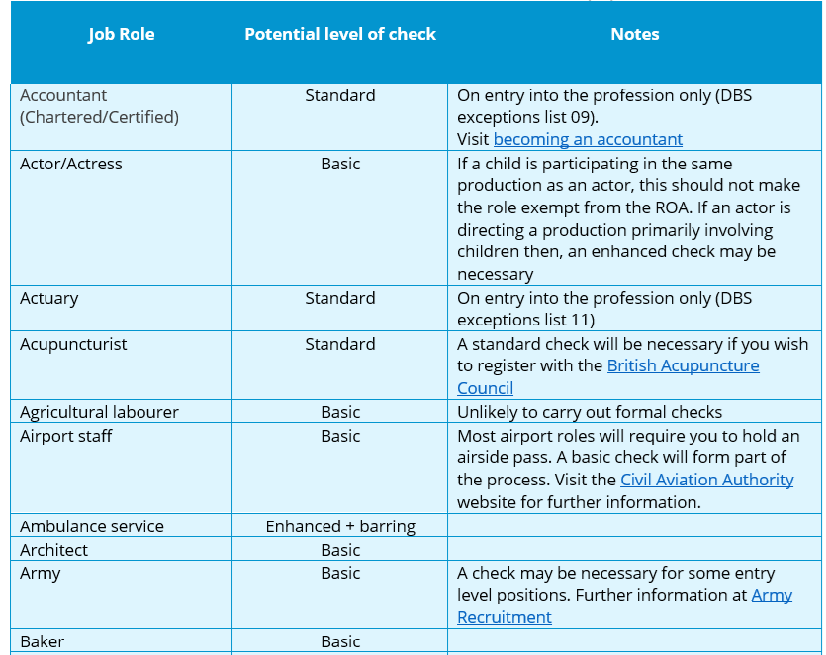
This information sets out the likely levels of disclosure required for different job roles.
Why is this important?
For anybody with a criminal record, the most important part of the recruitment process can often be the disclosure of their convictions. Many employers do not make it clear that they will be undertaking criminal record checks or what type they will be doing. This can make it difficult to know what you will need to disclose if asked.
We’ve put together a list of job roles and their likely level of check (this is based on a previous guide published by Robin Pencavel, ‘I can’t do that, can I? A survey of occupations and the relevance of criminal convictions’). This may help you to:
Understand what you may need to disclose to an employer if you are asked, and:
Determine whether an employer is conducting the correct level of check.
Potential level of criminal record check
The job roles we have considered have been categorised under the following levels of checks:
A number of roles in the public sector and for contractors working within the public sector may require security vetting. This will often be in addition to the above checks. It is difficult to establish exactly which roles require vetting higher than a Baseline Personnel Security Standard (which normally involves a basic check) but the employer should made this clear in each individual situation. Where they do, you should use our guidance on security vetting.
Using the table
The table sets out the levels of criminal record check that may be undertaken for various jobs and roles. Where available, there are links to further guidance on that job role. Not all job roles will involve a criminal record check. The aim with this information is to understand the potential level of check.
For some of the job roles listed, it is difficult to find out the precise criminal record check that an employer will do. For example, it may be necessary for an employer to do an enhanced check for what, on the face of it, looks to be the same job for which they are doing a basic check. This will usually be due to the client group an individual would be working with.
For standard and enhanced checks, where we have referred to the DBS exceptions list, visit the DBS guide to eligibility.
If you believe that an employer is requesting the wrong level of check, visit our information section on ineligible checks for guidance on how to deal with this.
A-Z of job roles
Useful links
Below you will find links to useful websites relating to this page. More specific details (including addresses and telephone numbers) of the organisations listed below can befound here.
This page was last fully reviewed and updated in August 2025. If you’ve spotted something that needs updating, please let us know by emailing the details to advice@unlock.org.uk.
This page sets out the types of criminal record checks that can be conducted by employers, the type of information that can be disclosed on each check and what convictions can be disclosed.
When you are applying for a job it’s important to know as much information as possible about the type of criminal record check that an employer may do. You can then make an informed decision as to whether you need to disclose your conviction or not.
By understanding the types of checks that are available to employers and what information is disclosed, you are less likely to either under or over disclose your criminal record.
The main types of criminal record checks for employers
There are four types of criminal record check for employment purposes, basic, standard, enhancedand enhanced with barred list.
What criminal record checks disclose
For each conviction/caution disclosed, the certificate will state the court/police area, date of conviction/caution, offence and sentence/disposal. It will only disclose factual information, it does not give a description or account of the circumstances surrounding the conviction.
Information for all checks are taken from the Police National Computer (PNC). The only exceptions to this applies to some information on enhanced checks. “Police Intelligence”, comes from local police records and “barring list” information, comes from the Disclosure and Barring Service (DBS).
How many checks are carried out each year?
Overall, approximately 5.8 million criminal record checks are carried out each year (see further explanation below). Of these, roughly:
28% are basic checks
5% are standard checks
67% are enhanced checks
What proportion of checks disclose criminal records?
The proportion of checks which disclose some type of information relating to cautions/convictions is roughly:
1.67% of basic checks disclose unspent convictions
5.62% of standard and enhanced checks disclose convictions/cautions
For anybody with a criminal record, a criminal record check can be the most terrifying part of the recruitment process. If you know that your conviction is spent and believe that the job you are applying for is eligible for a basic check, then you would be extremely concerned to subsequently learn that an employer would be doing a standard or enhanced check.
This information will assist you in challenging through the Disclosure and Barring Service (DBS), an employer who you believe is carrying out an incorrect criminal record check.
Why is this important?
If an employer were to carry out an ineligible check, this could result in them becoming aware of a conviction which, legally, they are not allowed to know about. You may find that once they are aware of it, they decide to withdraw the job offer.
Having a good understanding of the process of challenging an ineligible check will hopefully give you the confidence to do so.
Introduction
Through the DBS, employers are able to conduct standard and enhanced checks for certain roles, which will disclose both spent and unspent convictions. Sometimes employers request DBS checks for roles that only require a basic check. Therefore, the wrong check is being applied for. This could result in the disclosure of a spent conviction which should not be disclosed. The DBS has a system which allows you to query these ineligible checks, to ensure that the correct checks are done for the correct roles, so you only disclose what you legally have to.
Step 1 – Is the role eligible for a DBS check?
Many employers can legally conduct a standard or enhanced check on the roles they are advertising and they will make this clear during their recruitment process.
If you believe the role is eligible for a DBS check, then disclose all cautions/convictions that are not filterable.
If you have good reason to believe that an ineligible check is being requested, then you may not want to disclose your spent cautions/convictions until you have had a chance to query this through the DBS.
Step 2 – Consent to the check
Where you believe that a check is ineligible, at this stage it is best to consent to the check. If you do not consent, then this may raise warning signs with the employer that you do have convictions. You should tick “no”, to the question about cautions and convictions. You do not want to disclose any spent convictions, as the DBS may subsequently find that the check is ineligible.
Step 3 – Immediately raise this with the DBS
Once the employer has submitted the application, you can then challenge it through the DBS. You will have to provide sufficient information to the DBS so that they can locate the check.
In the subject line of the email, enter “APPLICATION ELIGIBILITY QUERY – URGENT”.
In the email, you should include as much information as possible, including your full name, your current address, your date of birth, the position applied for, the organisation name, the Registered Body number and the DBS form reference (11 digits on the top right).
You should also include details of why you think the application is not eligible.
State clearly that you would like the DBS to put the check on hold pending an outcome to their assessment of eligibility.
Examples of email templates challenging an ineligible check
Person one – Sarah
Sarah has applied for a job as an administrator working for a company who has contracts with some NHS trusts, Employer A. As part of the recruitment process, Sarah’s employers have applied for a standard DBS check which would disclose her spent conviction for fraud for which she received a 12 month custodial sentence. Sarah believes that her role is only eligible for a basic DBS check.
Dear Sir/Madam
RE: APPLICATION ELIGIBILITY QUERY – URGENT
I wish to raise an eligibility query with the DBS in relation to a recently submitted application for a standard DBS check, the details of which are as follows:
[Full name, address, date of birth, position applied for, name of organisation or registered body and DBS reference number]
I have recently been offered the role of administrator for Employer A who work on IT contracts for a range of companies. Employer A has recently applied for a standard DBS check on the basis that they carry out some contracts for the NHS. From my job description (see attached) and knowledge of the role, I believe that this position would only be eligible for a basic DBS check. I set out below my reasons for querying eligibility:
From the research I have carried out, my position is not included in the Rehabilitation of Offenders Act (ROA) 1974 (Exceptions) Order 1975 which would make it eligible for a standard DBS check.
Although I work on NHS contracts, I am based in an office on a business park not in a hospital or healthcare setting. During the course of my work, I would have no contact with patients or their medical records.
I have used the online DBS eligibility tool checker which states that my role would only be eligible for a basic DBS check.
Based on the above information I believe that my role of administrator with Employer A would only be eligible for a basic DBS check.
I would like the DBS to undertake an investigation as to the eligibility of this check and, until such time as an outcome has been determined, I would like the application for a standard DBS check to be put on hold.
Yours faithfully
Sarah Smith
The DBS investigated eligibility and agreed that Sarah’s job as administrator for Employer A would only be eligible for a basic DBS check.
Person two – Hassan
Hassan has applied for a job as a bus driver working for a large bus company, Employer B. As part of the recruitment process, his employers have applied for an enhanced DBS check on the basis that children may get on Hassan’s bus. Hassan is concerned that an enhanced check would disclose his spent conviction for GBH. As he would only be working on general town runs (with no specific school runs), Hassan believes that his role would only be eligible for a basic DBS check.
Dear Sir/Madam
RE: APPLICATION ELIGIBILITY QUERY – URGENT
I wish to raise an eligibility query with the DBS in relation to a recently submitted application for an enhanced DBS check, the details of which are as follows:
[Full name, address, date of birth, position applied for, name of organisation or registered body and DBS reference number]
I have recently been offered the position of bus driver for Employer B and a request for an enhanced DBS check has been submitted by ABC Registered Body. Based on the job description I have been given (see attached) I believe that my role would only be eligible for a basic DBS check for the following reasons:
Employer B has stated that I will be working as a bus driver in the ‘Adult and Children Workforce’. However my position is not included in the Rehabilitation of Offenders Act 1974 (Exceptions) Order 1975 nor the Police Act (Criminal Records), the legislation which makes it eligible for an enhanced check.
Although Employer B have a contract with the local council to provide buses for various school runs, this will not form part of my role, as can be seen from the enclosed job description.
I will not be carrying out any regulated activity with children or adults and I will not be managing or supervising anybody that does carry out regulated activity.
Based on the above information I believe that my role of bus driver with Employer B would only be eligible for a basic DBS check.
I would like the DBS to undertake an investigation as to the eligibility of this check and, until such time as an outcome has been determined, I would like the application for the enhanced DBS check to be put on hold.
If you require any further information please feel free to get in touch with me.
Yours faithfully
Hassan Yacoub
The DBS investigated eligibility and agreed with Hassan that as he was not contracted to work on a designated school route, then his job would only be eligible for a basic DBS check.
Person three – Peter
Peter has applied for a job as an accountant working for a large housing association, Employer C. As part of the recruitment process, his employers have applied for an enhanced DBS check. Although Peter doesn’t have any cautions or convictions, an allegation of sexual assault was made against him whilst he was at university and even though the police decided to take no further action, this allegation could potentially be disclosed in the police intelligence part (sometimes referred to as approved information) of an enhanced check. Peter believes that his role is only eligible for a standard DBS check.
Dear Sir/Madam
RE: APPLICATION ELIGIBILITY QUERY – URGENT
I wish to raise an eligibility query with the DBS in relation to a recently submitted application for an enhanced DBS check, the details of which are as follows:
[Full name, address, date of birth, position applied for, name of organisation or registered body and DBS reference number]
I have recently been offered the position of accountant for a large housing association, Employer C, and a request for an enhanced DBS check has been submitted. Based on the job description I have been given (please see attached) I believe that my role would only be eligible for a standard check for the following reasons:
Employer C have stated that I will be working as an accountant in the ‘Adult Workforce’. Although my position is included in the Rehabilitation of Offenders Act 1974 (Exceptions) Order 1975 which would make it eligible for a standard check, it is not included in the Police Act 1997 which makes it eligible for an enhanced check.
Employer C provide housing and maintenance services to residents living in the Leeds area. They also offer support services to their residents, some of whom may be considered vulnerable. However, my role is an office based one, dealing with the corporate affairs of the organisation and, during the course of my work I will have no contact with any of Employer C’s clients.
Since qualifying as an accountant 10 years ago, I have been employed by three companies. Two of these requested basic checks and one a standard. It’s not normal practice for an accountant to have an enhanced DBS check, for the reasons set out above.
Based on the above information I believe that my role of accountant for Employer C would only be eligible for a standard DBS check.
I would like the DBS to undertake an investigation as to the eligibility of this check and, until such time as an outcome has been determined, I would like the application for the enhanced DBS to be put on hold.
Yours faithfully
Peter Jones
Peter’s enhanced check has been put on hold by the DBS and he is awaiting the result of their investigation into eligibility.
What the DBS will do
Once the DBS has received your eligibility query, they will place the application on hold. They will contact the employer to gain more information, but they will not disclose that it is you that has queried the check. At some point the DBS will:
Contact you to establish your details and get your consent to contact the employer.
Contact the employer (normally by letter), to establish eligibility.
If eligibility remains in doubt after first contact, correspond with the employer and liaise with DBS policy officials when assessing the organisation’s responses.
If the DBS decide the check is ineligible, the application will be stopped and the employer informed. The employer will still have the option of conducting a basic check on you if they feel it is appropriate.
If the DBS decide the check is eligible, the application will continue and the DBS will inform you of this. At this point you will have to decide if you wish to continue with your job application or withdraw it. If you continue then you should make sure you disclose any conviction to the employer that will be disclosed on the check. It is best to do this as soon as possible, face to face, so you can discuss any mitigating circumstances and answer any questions they may have in connection with the conviction.
Sometimes the DBS are unable to advise whether the role is eligible for the level of check being applied for. In this case, you will either need to raise your concerns with your employer or seek legal advice.
The results so far
In a Freedom of Information request, we asked the DBS how many times they had written to employers under their Ineligible Applications Process. Between March 2012 and February 2013, they had written to 3,311 employers. Of those, the results was that 1,385 applications were not completed, which works out at 42% of the ones that the DBS had looked into.
So the message we want to give is, if you think a job is carrying out an ineligible check, then challenge it.
Taking further action
If the DBS stops the application (or even if they don’t), you may decide to take further action. If an organisation submits an application for a position that they know is not eligible, they may have committed a criminal offence, as per the following: –
Section 123 of the Police Act 1997 states: “a person commits an offence if he knowingly makes a false statement for the purpose of obtaining, or enabling another person to obtain, a certificate under this Part.”
The DBS Code of Practice sets out employers’ obligations in respect of the use of information obtained through standard and enhanced check. A failure to comply with these provisions and performing ineligible checks beyond the scope of the Exceptions Order could lead to a breach of the Data Protection Act 1998.
The DBS Code of Practice requires that Registered Bodies must: “use all reasonable endeavours to ensure that they only submit Disclosure applications in accordance with the Disclosure eligibility criteria for relevant positions or employment.”
The DBS would first seek to stop the problem happening again by educating the organisation. If that was unsuccessful, the DBS would consider suspension. If the organisation persistently and knowingly submitted ineligible applications then they would be deregistered. However, this action is incredibly rare.
If you believe that the DBS has failed you in some way, you may want to take the matter further by making a complaint.
Via the ICO
The ICO expects the DBS to have preventative measures in place to prevent unauthorised checks. This is because they are defined as a ‘data controller’ under the Data Protection Act 1998.
If you believe that an ineligible check has been made by an organisation for your information you can call the Information Commissioners Helpline on 0303 123 1113 to discuss your complaint.
The ICO can only act once the organisation has obtained the information (as per Section 55 of the Data Protection Act). They normally require you (the complainant), to have some form of written evidence.
If you make a complaint, the ICO will decide whether the organisation has complied with the relevant legislation. The organisation will be informed of their decision, where they need to improve and how they need to rectify the situation with you. If an organisation does not show progress after a number of complaints on the same issue, the ICO’s enforcement team will take over and decide on further action.
Via the Ministry of Justice
Despite having policy responsibility for the ROA and its exceptions, the Ministry of Justice does not have a casework or investigative function. They cannot offer legal advice or investigate breaches of the ROA.
Via the Police
If you suspect that somebody has committed an offence under section 123(1) of the Police Act 1997 (see above), you can report it to the police. However, don’t be surprised if the police don’t make your case a priority. Despite the number of potential breaches, no Registered Body has yet been prosecuted under this section.
On the 28 October 2023, changes were made to the Rehabilitation of Offenders Act 1974. This information reflects the situation after these changes.
Why is this important?
Once your conviction is spent, you don’t need to disclose t it when applying for jobs requiring a basic DBS check and insurance. This means you can generally answer “no” to the question about convictions. Being aware of how the law works will ensure you are able to work out if your convictions are spent or not.
What is the Rehabilitation of Offenders Act?
The Rehabilitation of Offenders Act 1974 gives people with spent convictions and cautions the right not to disclose them when applying for most jobs, and buying insurance.
What are the benefits of it?
The main benefits of the Act relate to applying for work and insurance. Generally, once spent, you can legally ‘lie’ about your past convictions by answering ‘no’ to a question about convictions.
Applying for work
Once your convictions are spent, the Act gives you the right not to disclose them when applying for jobs, unless the role is exempt from the Act. Most employers with jobs covered by the Act will only ask for ‘unspent’ convictions. If they ask about all convictions, you should check what level of disclosure they’re entitled to, and if it’s only a basic DBS disclosure, then this may be an ineligible check and you can legally withhold any spent convictions.
Applying for insurance
Once your convictions are spent, the Act gives you the right not to disclose them when applying for insurance. For example, spent motoring convictions do not need to be disclosed when applying for car insurance. This applies no matter what question an insurance company asks. Most will only ask for unspent convictions, although some might ask for ‘any convictions in the last 5 years’. If it’s spent, you do not need to disclose it under any circumstances when applying for insurance.
What doesn’t it cover?
It only applies in England and Wales. If you’re applying for work in another country you’ll need to check the disclosure laws that apply in that country.
You may have to disclose spent convictions when applying for jobs that are exempt from the Act. These will normally involve astandard or enhancedDBScriminal record check.
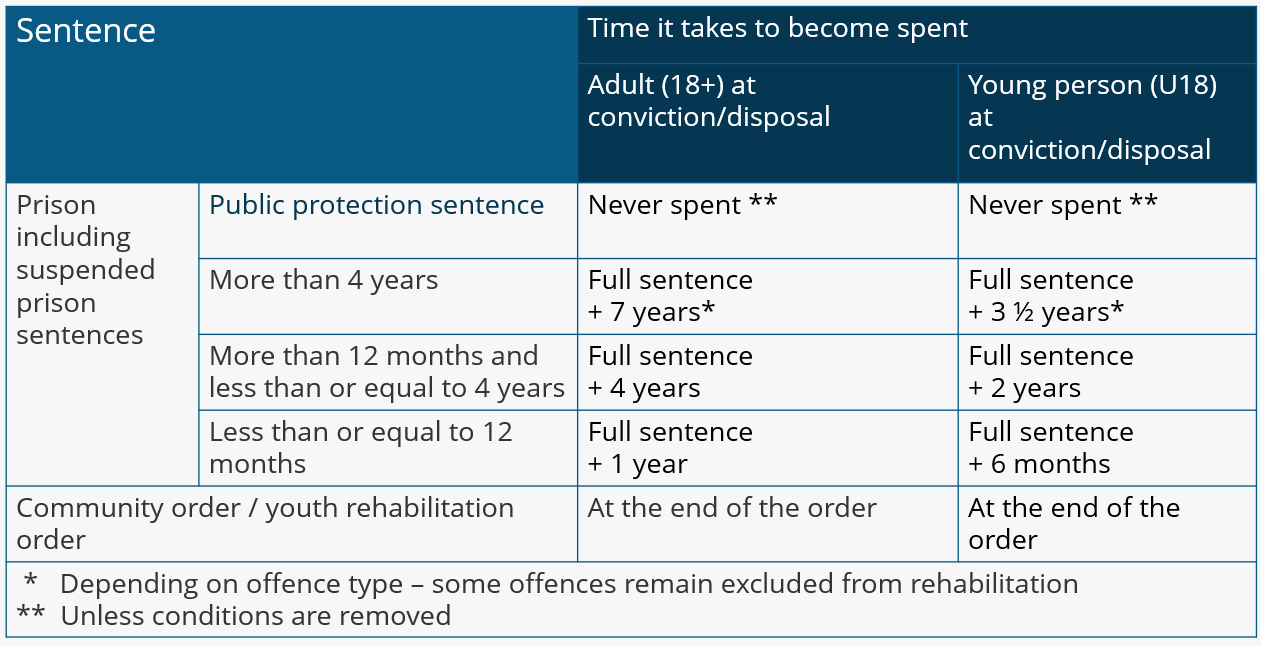
Rehabilitation periods for specific sentences
Prison sentences and community orders
A community order which has no specified end date will have a default rehabilitation period of 2 years. The rehabilitation period won’t be halved if you were convicted when you were under the age of 18.
Prison sentences of over 4 years
A prison sentence of over 4 years can be spent after 7 years providing the offence you were convicted of is not listed in Schedule 18 of the Sentencing Act 2020 or is a Public Protection Sentence.
The types of offence which would be excluded from rehabilitation are:
Other community sentences
What about further convictions?
If you already have an unspent conviction and you get a further conviction before the earlier one becomes spent, then neither conviction will become spent until the longest of them does. If the further conviction results in a prison sentence of more than 4 years, then potentially neither the second nor the first conviction will ever become spent.
How do I work out if my convictions are spent?
If you only have one conviction, it should be relatively straight-forward to establish whether your conviction is spent by using the tables in this guide. If you have got a number of convictions, it might be more difficult. You can use our online disclosure calculator which will help you to work it out.
Can I get a copy of my unspent convictions?
Yes. You can obtain a list of your unspent convictions by applying for a basic DBS disclosure from the Disclosure and Barring Service. The current cost is £18. An employer may also carry out a basic DBS disclosure as part of their recruitment process (but they’d need your permission to do this).
When can spent convictions be taken into account?
There are many jobs or roles where you might need to disclose your spent convictions particularly when applying for certain jobs or volunteer work. Examples include:
Working with children and other vulnerable groups (jobs such as teachers, social workers, doctors, dentists, chemists and nurses).
Working in professions associated with the justice system (such as solicitors, police, court clerks, probation officers, prison officers and traffic wardens).
These jobs will usually involve a standard or enhanced DBS criminal record check. It is important to realise that these types of checks will show both spent and unspent convictions and cautions. The only exception to this is where your caution or conviction is eligible to be filtered.
Only an employer can apply for a standard or enhanced DBS disclosure, you are not able to apply for your own. However, it’s really important that you find out exactly what your criminal record is so that you know what you do and don’t have to disclose. You can apply for a Subject Access Request (SAR), from your local police force. This is a copy of your criminal record and is free of charge. It provides information that is held on the Police National Computer (PNC), about you. This is for your information only and shouldn’t be given to an employer. If an employer forces you to give them a copy of your SAR, this is now a criminal offence and employers can be prosecuted for this. There are other times when spent convictions might be taken into account, including:
If asked by an employer, you have to disclose them, and they can legally refuse you or discriminate against you.
They will be disclosed on all types of criminal record disclosure (basic, standard and enhanced).
If asked, you will have to disclose them when applying for financial products and services, such as insurance, a mortgage or renting a house.
You could be prosecuted if you fail to disclose them when asked.
For most jobs, you do not need to disclose them to an employer, even if they ask about convictions.
They will not be disclosed on a basic DBS criminal record check.
For some jobs (those exempt from the ROA), you may need to disclose them if asked – these jobs will usually involve a standard or enhanced DBS criminal record check. If your conviction is filtered, then you do not have to disclose, however, if it is not filtered an employer can legally refuse you or discriminate against you.
You do not need to disclose them to insurers when purchasing insurance.
You might need to disclose them when travelling or working outside of England and Wales.
They will remain on your record for life – they will not be deleted
More information
For practical self-help information – More information is avaliable on our:
Discuss your views and experiences with others on our online forum
Share your personal story by contributing to our Community
This page was last fully reviewed and updated in October 2023. If you’ve spotted something that needs updating, please let us know by emailing the details to advice@unlock.org.uk.
The aim of this information is to assist you in applying for jobs when you have a criminal record. It should help you become more confident about when and how to disclose your convictions, ensuring that you only disclose what you need to.
It’s important that you’re aware of what you legally need to disclose to an employer. If you don’t disclose something that you should, this may result in a job offer being revoked or, worse still, being sacked once you’ve started the job. If you disclose too much however, your application may not be progressed through the recruitment process. Understanding when and how to disclose your criminal record should give you more confidence and hopefully increase your chances of gaining suitable employment.
Before you start disclosing
Before looking at when and how to disclose, there are a few other things to consider:
It’s important that you understand your criminal record. Although convictions and cautions stay on the Police National Computer until you reach 100 years old (they are not deleted before then), they don’t always have to be disclosed. Many people don’t know the details of their record and it’s important to get this right before disclosing to employers. Usually, this means applying for a copy of your police record (it costs £10 and is known as a Subject Access Request).
For most jobs you don’t need to disclose your criminal record once it’s ‘spent’. This is because of the Rehabilitation of Offenders Act 1974. Most convictions will become spent at some point. We have a tool that can help work this out, our disclosurecalculator or visit Rehabilitation of Offenders Act 1974. Some jobs involve standard or enhanced DBS checks. For these, you’ll normally need to disclose spent convictions and cautions as well, unless they are now filtered by the DBS. Visit filtering of spent cautions/convictions .
You only have to disclose your record to an employer if they ask you. Many employers ask at some point and if your convictions are unspent, you legally need to disclose them. If they ask you and you don’t disclose, they could later revoke the job offer or you could be dismissed. You could even face a further conviction. Visit disclosing to employers.
There are 3 main levels of criminal record check and which one is done by the employer depends on the job role. Make sure you know what level of check an employer is doing and only disclose what you legally need to. Spent convictions are not disclosed on basic checks. Filtered cautions/convictions are not disclosed on standard or enhanced checks. Visit criminal record checks for employment .
When to disclose?
Work with the employer’s process – “Disclose when asked”
Different employers recruit in different ways, so the point that you get asked about your criminal record may not be the same for every job that you apply for. Your first step should be to understand the employer’s process as best as you can, so you can make an informed decision. Check their application form or recruitment policy – does it say anything about if or when they ask about criminal records?
Generally, it’s best to disclose at the earliest stage required (i.e. when you get asked), because that’s when they’ve asked (so that’s when they’re expecting to be told), and you won’t feel like you’re ‘hiding’ something. However, there are some exceptions to this. For example;
If an employer indicates that they’ll be carrying out a formal criminal record check, they should ask you to disclose before they do the check, but not all do. In this situation, we’d always advise that you disclose before the formal disclosure is carried out.
Many employers have a ‘tick-box’ on their application form. We encourage employers to ‘ban the box’ but many still ask in this way. Some people prefer to ‘tick no’ and disclose at a later stage when they believe they’ll get a chance to explain. This has the downside of effectively ‘lying’ to the employer on the application form. It’s also unlikely to be a sensible step for people on licence, on probation or who are barred.
CV’s and covering letters
Many jobs ask for a CV and a covering letter. A CV is designed for you to sell yourself as the best person for the job – you shouldn’t normally include any information about your criminal record on your CV. If you have gaps due to time in prison, you could say that you were ‘unavailable for work’, or if you completed qualifications inside, list these instead. However, you must be prepared to honestly explain what you mean by ‘unavailable for work’ if you get asked.
Choosing whether to disclose in writing or in person
Often, how you disclose will come from how the employer asks. If possible, tell the employer in the way that you feel most comfortable with. This will depend on how you feel about talking and/or writing about your criminal record. It might also depend on the nature of your convictions and the type of job you’re applying for. Usually, the employer’s policy will lean you towards a certain way. Either way, we recommend that you provide the employer with the brief factual details of your criminal record in writing at some point during the recruitment process, so that you have evidence of what you’ve disclosed – keep a copy of this for your own records too.
If an employer wants to know about criminal records, they will normally ask you to disclose in a certain way; this might be at interview or after they’ve made a conditional offer. Some employers ask on their application form. Where possible, we suggest that you disclose your record face-to-face; this tends to be most effective. Prepare a self-disclosure statement; this should help. Address any concerns you think they may have but stay positive and don’t concentrate solely on the negatives of a conviction.
Think like an employer – Prepare for questions
However you choose to disclose, you should be ready for extra questions that the employer might have. The questions below are ones that employers often ask, so think about how you’d answer them;
Can you tell me about your criminal record?
Why did you commit the offences?
Was there anything happening in your life at the time?
How can I be sure you’re not a risk?
What steps have you taken to change your ways?
How is your life different now?
Write a self-disclosure statement
Before applying for jobs, we advise that you write down the details of your criminal record. We refer to this as a ‘self-disclosure statement’. This might be sent with your application if they ask a question about convictions, or you might use it when disclosing in person. However, it can be hard to communicate feelings and emotions in writing. Generally, you should:
It should be no more than one side of A4.
It needs to be tailored to the specific vacancy. Your criminal record may be more relevant to some jobs than it is to others. Don’t copy ‘templates’. The best and most effective disclosures are those that are written by you personally and are genuine. Visit self-disclosure statement/letters for some examples of self-disclosure statements.
Write it so that people with no experience of criminal records can understand it.
This will depend on what you think works best for you, but generally:
a) Start with something positive, like why you’re applying for the job and what skills and experience you bring to the role
b) Next, explain your convictions (see below)
c) Finally, finish with a strong and positive closing statement. You should offer the names and contact details of people who can vouch for you and your suitability.
If you struggle, get help. Probation staff, employment advisor’s and family members can help. Get somebody you trust to check it over, but make sure you write it in your own words.
Explaining your convictions
The most important part of a self-disclosure statement is explaining your convictions. Make sure that you relate it to the job that you’re applying for. You need to try and put yourself in the employer’s shoes – they’ll be making a judgement based on the information you provide. So, make sure you explain:
If the offence happened a long time ago (even if the convictions were quite recent) then highlight this.
If the offence was a one-off and out of character, this is important to point out. If you committed a number of offences over a period of time, try to group them. For example; “between 2004 and 2007, I was convicted four times for theft-related offences”.
If the offences are not particularly relevant to the role in question, explain this. Offence categories can include a wide range of behaviour which can make it difficult for employers to judge whether the offence is relevant to the job. For example, “theft” could be stealing a 50p chocolate bar, or £20,000 from a bank. Tackle any issues with your record which you think might be relevant to the role. For example, if your offence was violence-related and you’re applying to work with children, refer to any recent experience you have.
Some offences sound more serious than the circumstances were. This is usually shown in the sentence that was received, so if this is the case, highlight that.
If there were specific circumstances which led to your offending, explain these. For example, you may have been homeless at the time that you stole from a supermarket. This kind of information can help the employer to better understand.
When explaining the circumstances, be careful not to let these reasons come across as excuses. Employers generally look for people who are taking responsibility. If you took responsibility for the offence – for example, by admitting it to the police when they arrested you – then you should make this clear to the employer.
Whatever the reasons that led to your offences, you should explain how you’ve addressed these, to reassure the employer that you won’t be repeating them again in the future.
The employer may have concerns, or think they are taking a risk. You need to explain yourself and reassure the employer.
How to disclose
Disclosing on an application form
The ‘ban the box’ campaign encourages employers not to ask about criminal records on application forms but instead leave it until later in the process. See who’s signed up by visiting theBan the Box website. However, many employers still have a section about criminal records.
Even if you’re asked at this stage, you might choose to be careful what you disclose. Some will just have a ‘tick-box’, whereas others might have space to explain. The question will also often vary. Generally, we advise against disclosing specific details on application forms. Instead, you could:
State on the application form that you’re sending a self-disclosure statement.
Write on the application form “Yes – happy to discuss if selected for interview”. Withholding details until interview might give you the chance to explain face to face, although if it’s clearly minor or irrelevant, you could state this; e.g. “Motoring fine 30 years ago”.
Not disclose and wait until interview – see ‘when to disclose’ above for more details.
Disclosing in writing
If you’re asked to provide details at application, you might choose to send a copy of your self-disclosure statement alongside your application. We wouldn’t normally advise this, but if you do, make sure that you:
Send it to the right person – If you’re not sure who this is, then ask. Send it in a sealed envelope marked ‘confidential’.
Keep a copy – This is useful as evidence of what you’ve disclosed.
Offer to meet with them – You should offer to have a face-to-face discussion to discuss any concerns that the employer might have.
Disclosing in person (at interview or after job offer)
You need to be prepared to talk about your criminal record at interview;
If you’ve not been asked as part of the initial application process, you might be asked at interview.
If you mentioned your criminal record in your application, you might be asked for more details at interview.
If the application form did ask but you chose not to disclose it through fear of being automatically rejected, you’ll need to make sure that you proactively raise this at interview (and you’ll need to explain why you didn’t disclose it on the application form).
Some employers don’t ask about criminal records at interview. Some employers wait until after the job offer to ask. This is something that we recommend as good practice. If this applies, they will hopefully make this clear in their recruitment policy.
Disclosing in person – Top 10 tips
Many people feel most comfortable disclosing face-to-face. In our experience, this is what works best for individuals to explain and employers to understand. Whether at interview or a later stage:
This will help you to reduce the chances of being caught off-guard by a question about your criminal record, or gaps in your employment history for when you were in prison. Make sure you know the details of your criminal record inside out. Hesitation or vagueness may make you look dishonest. Take your self-disclosure statement with you so that you have the facts written down. You might want to have a simple summary of factual information that you can offer to leave with the employer. Think like an employer – prepare for questions that they might ask.
Do some role-plays or a trial-run beforehand with someone you trust.
If you were asked at application, we suggest you proactively mention at interview what you put in your application. This shows initiative and helps to avoid problems later down the line. For example, you might say: “As you saw on my application form, I have a criminal record. If you have any questions for me, I would be happy to discuss them, as I’m keen to address any questions or concerns that you may have”. Even if it doesn’t come up at interview and you weren’t asked at application, you might choose to bring it up if you think it’s your best chance to explain.
Make sure you keep your explanation simple and focused – don’t babble. Watch the interviewers’ body language to judge the right level of detail. There’s always a risk that you let your criminal record dominate the interview.
It’s difficult to be relaxed in any interview. Try not to come across as being defensive.
Almost one in four people of working age have a criminal record. Employers are likely to have experienced criminal record disclosures before.
Answer questions directly and honestly. Make sure you disclose all that you need to.
Try not to focus entirely on the negative results of your record. Talk about what you’ve learnt and how you have become a better person as a result. Show that you have the right skills and experience for the role.
If you’re able to, back up things that you say with details from others. For example, you can often get confirmation that you’ve completed your community service, a letter from your probation officer and sometimes get copies of pre-sentence reports and sentencing remarks. We normally advise against providing a copy of your formal criminal record – if the employer needs one, they will usually apply for it (with your consent) after they’ve offered you the job.
Provide the employer with a written record of what you’ve disclosed. This can be your self-disclosure statement or it might just be brief factual records. It might not necessarily be the people interviewing you that will make the ultimate decision, so having something in writing to hand over might come in useful.
More information
For practical self-help information – More information is available on the following:
Some jobs and courses are ‘exempt’ (i.e. not covered) by the Rehabilitation of Offenders Act, which means that instead of being able to do a basic criminal record check, organisations are able to carry out a standard or enhanced check, depending on the role.
This information sets out what roles require a standard or enhanced check, what’s included on the certificates and how you apply for them.
It’s important to know the types of roles which require a standard or enhanced check, as this should assist you in establishing which type of check a job you are applying for, is eligible for.
If you know what will be included on a standard or enhanced check, you can ensure that you only disclose what you are legally obliged to disclose and that you don’t over disclose.
Introduction
If a role is exempt from the Rehabilitation of Offenders Act, then an employer will be eligible to apply for a standard or enhanced check. These are provided by the Disclosure and Barring Service (DBS) using information from the Police National Computer (PNC). More information can be found on this in our Disclosure and Barring Servicesection.
Types of roles that commonly require standard and enhanced checks
Some examples of the types of roles eligible for standard and enhanced checks are:-
Standard checks
Security industry licence
Solicitor or Barrister
Accountant
Veterinary surgeon
FCA ‘approved person’ role
Football stewards
Traffic warden
Member of the Master Locksmiths Association
Enhanced checks
Working with children and vulnerable adults
Teacher
Social worker
NHS professional
Carer
Taxi driving licences
What standard and enhanced checks disclose
Standard and enhanced checks will disclose all convictions and cautions held on the PNC and previously ‘stepped down’ cautions/convictions, unless they are now filtered. The certificates will not distinguish between convictions which are spent and those which are unspent.
Enhanced checks may also disclose police intelligence(if the police deem it relevant).
Cautions and convictions that are filtered by the DBS will not be disclosed on standard or enhanced checks.
How standard and enhanced checks are applied for
An employer can only apply for a standard or enhanced check where the role applied for is eligible. If you believe that a role you are applying for is not eligible for this level of check, you can challenge it through the Disclosure and Barring Service (DBS).
Employers need your consent before they can apply for a standard or enhanced check. The certificate will usually be sent to you, unless you have signed a waiver, requesting it be sent to your employer.
It is not possible to apply for a standard or enhanced check on yourself.
We use cookies where necessary to allow us to understand how people interact with our website and content, so that we can continue to improve our service.
We only ever receive anonymous information, and cannot track you across other websites. Find out more
More Options
Can you pay it forward?
If you found this page helpful, could you donate just £1 to help someone else access our information and support?