The YRO is the young person’s equivalent of a community sentence, issued by the courts. You can contact the relevant court directly but it might be better to talk to your Youth Offending Team.
Does it involve guilt?
Yes – the sentence is decided after a guilty verdict.
Is it recorded on the Police National Computer (PNC)?
Yes.
Is it classed as a conviction?
Yes.
How long will it be on my record?
It will remain on the PNC indefinitely and will be referred to in any future criminal proceedings. There are no restrictions on the number of times you can be sentenced to a YRO. In some cases custody is an option for breach of YRO, if the original offence is imprisonable or there is ‘wilful non-compliance’ during the order (see Ministry of Justice information).
When does it become spent?
At the end of the order.
When do I have to declare it?
YROs fall under the protection of the Rehabilitation of Offenders Act so after it is spent you don’t have to disclose unless it is for an occupation which is an exception to the Act, like working with children.
Is it disclosed on DBS checks?
Yes, it is disclosed on both standard and enhanced checks, unless it is eligible for filtering. Once spent, it will not be disclosed on a basic check.
Do I have the right to appeal and what is the process?
GOV.UK information on appealing a court decision can be found here.
What are the implications for life in the community?
The sentence can last up to three years. You might have to be at home by a certain time each day (a ‘curfew’), stay away from specific places (‘exclusion’), be tested for drugs regularly or get treatment for a drug addiction.
“When do I need to tell employers about my criminal record” – ‘Easy Read’ guide on the ROA
As part of our range of information on the Rehabilitation of Offenders Act 1974, we have worked in partnership with KeyRing (with special thanks to Neisha Betts) to produce an Easy Read version of information on this subject. This is available to download by clicking the image below.
What is EasyRead?
‘Easy Read’ documents present information using simple words and pictures that make information easier to understand. The use of Easy Read is common-place in health and social care organizations, as well as other areas. It can help anyone with reading or comprehension difficulties, including those with learning disabilities, learning difficulties and also people for whom English is not their first language. Easy Read is classed as a ‘reasonable adjustment’ (The Equalities Act, 2010) as it helps to ensure people have access to the same information as others.
This page explains the Disclosure & Barring Service’s (DBS) update service, as well as the “one certificate” change in 2013.
Why is this important?
The update service is a subscription service that lets you keep your DBS certificate up-to-date so you can take it with you when you move jobs or roles. The employer can then carry out free, online, instant checks to see if any new information has come to light since the certificate’s issue – this is called a ‘status check’.
To coincide with launching the update service in 2013, the DBS changed to only issuing one certificate, usually to the applicant. They no longer send a copy to the registered body. This change is being referred to “one certificate”. Employers will now need to ask you to see your DBS check.
There are both pros and cons of these services and it’s important to have an understanding of how the systems work and what information will be available to your employer.
Introduction
This information looks at specific areas that will be of interest to people with convictions. To keep it brief, we haven’t repeated the detailed information that the DBS has published on these changes. They have gone into the processes in some detail in their guidance. More generally, the DBS has lots of information online about their process for customers and stakeholders as well as latest news and corporate/policy information
Update service
The DBS update service lets you keep your DBS certificates up to date online and allows employers to check online to see whether there are any changes to the certificate that you have shown them. The service costs £16 (free for volunteers). This means you will be able to take your DBS certificate with you from role to role, within the same workforce, where the same type and level of check is required.
Who can carry out a status check?
An employer doesn’t have to join the update service, or pay a fee, to check a DBS of someone who’s check is part of the update service. You will be able to check who has carried out a status check on you.
What does an employer need to do to carry out a status check?
Have your consent either verbally or in writing
See the original disclosure to check it is the same type and level as they are legally entitled to, make sure that the right checks have been carried out and see what, if any, information was disclosed about you
Check your identity.
Check your name on the DBS check matches this identity.
Note the DBS check reference number, your name and date of birth.
Can I stop an organisation checking the status of my DBS?
Yes. You will need to contact them and withdraw your consent for any future checks. If they fail to stop they would be breaking the law by accessing data they were not entitled to see. If they persist you could remove the check from your account but this would also mean other organisations would not be able to carry out a status check on it. If they persist, you should contact the Information Commissioner’s Office.
This means that, broadly, you should be careful who you give your consent to. If you were to withdraw your consent, if you think they would continue to check (even though it would be against the law) you’d have to remove the check from your account. Given you cannot then add it back onto the account again, you would have to apply for a new check.
Will filtering change the status of my certificate?
The filtering of a caution or conviction would not cause a status change through the update service. A status change is only prompted when there is new information to be added, or an offence needs to be changed or amended, or because you have become barred, whereas an offence being filtered out would mean a removal of information from your Certificate.
If you wish to have a new DBS check which does not show the offence that has been filtered out, you will need to apply for a new DBS check.
Given that, once something is filtered, you no longer need to disclose it, if you have a DBS check with something on it that has since been filtered, it would be sensible to apply for a new certificate.
My employer has requested an early confirmation check; what is this?
As a subscriber to the update service, with your permission your employer is entitled to carry out status checks to see if the information on your DBS check has changed.
An early confirmation check is where they have been informed that there has been a change, and have requested an early confirmation check to see if the change came as a result of you being placed on either of the DBS barred lists.
The “one certificate” change
To coincide with the launch of the update service 2013, the DBS no longer automatically issues a copy of your check to the registered body. Employers will need to ask you for sight of your DBS check
Does the disclosure still get sent to the employer?
No, not normally. However, registered bodies will be entitled to ask the DBS for a copy of your DBS certificate if you don’t provide them with an updated certificate as a result of a change reported through the update service. For this to happen, all of the following conditions must apply:
You must be subscribed to the update service
The employer carried out a status check which revealed a change to the DBS check, and as a result;
You have applied for a new DBS check; and
The DBS issued the new DBS check to you more than 28 days ago; and
You have not shown the employer your new DBS check
If you raise a dispute on the new check, the DBS will not issue a copy to the registered body until 28 days after the dispute is resolved.
Can I apply for a check without a particular job or role secured?
Technically, no. However, once you’ve applied for a DBS certificate for a particular role, so long as you subscribe to the update service at application stage, or within 14 days of getting it, you’ll be able to use this for future roles (assuming the same level of check is required)
Can any employer ask me to show them my DBS check?
Technically, no. An employer is only entitled to ask for a certificate that is of the level that the job or position relates to.
This means that any employer is entitled to ask to see a basic disclosure. Only roles or positions that meet certain eligibility are entitled to see a standard or enhanced level check.
However, in practice, given the update service and one certificate change, people will increasingly ‘own’ their DBS check, and so there is a risk that it becomes commonplace for employers to ask to see a DBS check, even if the role/position that it relates to is not entitled to it.
Will the employer know if I’ve got a criminal record?
Possibly. Umbrella bodies don’t get to see your disclosure, but they’re told by the DBS if there is any information on it, i.e. a caution or conviction. They might then tell the organisation that is ultimately requesting the check. The idea behind this is that, for individuals with ‘clear’ disclosures, the employer will get notified of this by the umbrella body, and therefore don’t have to wait for the individual to provide them with a copy. For individuals with a caution or conviction on the disclosure, the organisation will get told to wait to see the certificate that the individual has been sent.
This might mean that, if something gets disclosed on your DBS disclosure, the organisation might know that something has been disclosed on there (although they won’t know the details) and it’s likely that they’ll be keen for you to show it to them.
Benefits
Ensures that you know what you need to disclose to an employer, giving you the opportunity to disclose this information in the way you think is best for you.
Minimises the risk of inaccurate information being disclosed to a third-party, as you are responsible for providing the certificate to the employer, and so you can take steps to challenge any inaccurate or disproportionate disclosure before you show it to them.
Clarifies what, if any, information the police decide to disclose as ‘other relevant information’, allowing you to know this and explain this to the employer.
Prevents ‘over-disclosure’, as the check does not disclose filtered information, or information no longer stored on the PNC.
Downsides
The responsibility for covering the cost of the Update Service is more clearly placed with the individual, rather than the employer.
It still isn’t possible to get a DBS check before you apply for a particular job.
It makes it easier for employers to ask for the DBS checks of applicants, even if they’re not eligible for one.
The responsibility for the disclosure of criminal conviction information shifts from the DBS to the individual – whilst in terms of inaccurate information, this is an advantage, it may result in criminal conviction information becoming integrated more and more as part of the ordinary recruitment process.
There is the potential for the point at which a DBS disclosure is requested to move to being made much earlier in the recruitment process. Currently, as employers usually cover the cost of the check, they only do it after selection, whereas this may move towards using it as a pre-selection tool.
There is also an issue regarding how the disclosure of non-conviction information operates, given that the DBS is sector-based (i.e. applying to working with either children or vulnerable adults, or both) rather than specific to a particular position, and so could potentially lead to much more non-conviction information being disclosed (as information could be more readily seen as being relevant).
Discuss this with others
Read and share your experiences on our online forum
Useful links
Below you will find links to useful websites relating to this page. More specific details (including addresses and telephone numbers) of some of the organisations listed below can be found here.
Discuss your views and experiences with others on our online forum
This page is for information only. We are unable to provide advice on this. Comments below have been disabled and will not be published
This page was last fully reviewed and updated in December 2024. If you’ve spotted something that needs updating, please let us know by emailing the details to feedback@unlock.org.uk
Criminal convictions and data protection
Summary
The Data Protection Act 1998 (DPA) regulates the collection and use of personal information and is intended to prevent unnecessary data collection and processing. The DPA applies to computerised and non-computerised information on individuals.
The DPA is a very useful piece of legislation when it comes to how organisations should process, handle and store details of criminal records.
In detail
According to the Data Protection Act 1998, personal information is any data that relates to a living individual who can be identified from that data. Information is also ‘personal’ if a ‘data controller’ either already has, or is likely to secure information that can be merged to identify an individual. For example, just having someone’s name often cannot identify a specific individual, but once it is possible to match a specific name with a postcode, telephone number or National Insurance number, the information would become ‘personal’.
Personal information also includes any expression of opinion about an individual and any indication of the intentions of an organisation holding data, or any other person, in respect of that individual. In other words, what a professional thinks about a service user and what they recommend in respect of that individual service user is personal data once it is recorded.
Sensitive information is defined in the 1998 DPA in the following terms:
racial or ethnic origin;
political opinions;
religious beliefs or other beliefs of a similar nature;
membership of a trade union (within the meaning of the M1 Trade Union and Labour Relations (Consolidation) Act 1992);
physical or mental health or conditions;
sexual life;
commission or alleged commission of any offence; or
any proceedings for any offence committed or alleged to have been committed by the data subject, the disposal of such proceedings or the sentence of any court in such proceedings.
The DPA’s principles apply equally to all sharing of data that is individually identifiable personal data, but it can have differing standards of privacy and acceptability (see below). The DPA covers the sharing of both formal case record data and, on a practical basis, to the sharing of working knowledge, because that working knowledge will include some information and opinion, about an identifiable individual that has been recorded in accessible records. Information is not subject to the DPA if it is anonymised.
The sharing of information about an individual between two or more organisations for whom that individual is a current common case, i.e. when for an example an offender manager makes a referral to an ETE or housing provider, and makes a necessary disclosure of information about an an individual, that sharing of information is subject to the DPA.
The DPA covers all sharing of individually identifiable information about individuals between organisations. There is no ‘list’ of which information about people with criminal convictions can or cannot be shared between organisations within the legislation; the legislation always applies.
While the DPA applies in all cases it does not prohibit sharing of information about criminal records between organisations. The widely held myth that the DPA is a simply an inflexible barrier has arisen for two understandable reasons. First, the legislation is complex. Second, there are some respects in which it is opaque, because the operational detail of various arrangements for sharing information have not been tested in the courts.
Criminal convictions and data protection
Employers (and others) must ensure that they remain within the framework of the data protection legislation when using vetting, especially as the Information Commissioner’s Office (“ICO”) is now empowered to issue fines of up to £500,000 where there are serious breaches.
Any information about criminal charges or convictions will be sensitive personal data which enjoys enhanced legal protection and therefore an employer will generally need to gain the individual’s explicit consent before processing it.
The ICO’s Employment Practices Code and Supplementary Guidance provides useful advice and although this is not mandatory, these may be used by employers in defence to any complaint made to the ICO by an individual.
The following good practice suggestions from the ICO to employers are relevant to pre-employment vetting:
It should only be used where there are particular and significant risks involved to the employer, clients, customers e.g. where a government worker has regular access to highly classified information.
Do not use vetting as a means of general intelligence gathering. Ensure that the extent and nature of information sought is justified and that it is clearly focused on data that will have a significant bearing on the employment decision.
Consider whether pre-employment vetting is justified for each of the jobs for which it is currently used and whether the information required could be obtained in a less intrusive way
Where practical, obtain relevant information directly from the applicant and, if necessary, verify it rather than undertake pre-employment vetting.
Tell applicants early in the recruitment process that vetting will take place and how it will be conducted but carry out pre-employment vetting as late as possible in the recruitment process. Ideally, only the people selected for the job should be submitted to comprehensive pre-employment vetting.
If information received will lead to the applicant not being appointed, make sure the applicant is told this. Put in place a mechanism for providing this feedback allowing the applicant to respond and then take this response into account when making the recruitment decision.
Where substantial personal information has been collected about an applicant and is to be retained, ensure there is a process in place to inform them of this and of how the information will be used.
Consider carefully which information contained on an application form is to be transferred to the worker’s employment record. Do not retain information that has no bearing on the on-going employment relationship.
Ensure that personal data received during the recruitment process are securely stored or are destroyed. For example, manual records should be kept securely in a locked filing cabinet and electronic files should be password protected.
Establish and adhere to retention periods for recruitment records that are based on a clear business need. For example, that no recruitment record is held beyond the statutory period in which a claim arising from the recruitment process may be brought unless there is a clear business reason for exceeding this period.
Insurance and data protection
Whilst the Rehabilitation of Offenders Act 1974 sets out that spent convictions cannot be used to disadvantage an individual (such as increasing the premium or refusing to cover), it does not oblige insurers to remove details of convictions from their records that are spent.
However, the Data Protection Act 1998 requires that personal data isn’t held longer than is necessary for the purpose that it was collected.
In terms of spent convictions, the important question is whether, if insurers are in possession of spent convictions (for example because they were unspent when you took out the policy and they have since become spent, or because you mistakenly disclosed them), whether this information can legitimately serve a purpose to the insurance company? It is up to the insurance company to justify why this information is still necessary for their purposes.
They may well argue that it is important to assess future claims. However, this should only extend to convictions that were unspent at the latest renewal, as each renewal is legally regarded as a new contract. For example, if you took out a policy in May 2008, with a conviction that become spent in December 2008, the insurer would be able to justify holding this information until the next renewal, in May 2009. However, as the conviction is now spent, it should not form part of your renewal policy and should not affect your premium in any way. It is difficult to see how an insurer could argue that ongoing retention of spent convictions after this renewal point is justified under the Data Protection Act.
You are entitled to ask an insurance company to remove data regarding spent convictions. This can be done by serving them a note under s.10 of the DPA asking them not to process this data and remove it from their records (this can be done simply in writing to the insurer making reference to s.10 of the DPA). The insurer should respond within 21 days stating either that the information has been removed, or the reasons why they think they have a right to retain it. Although these notices can often have limited affect, if the insurance company refuses to remove spent conviction data, and you disagree with their reasons for not doing so, you can then complain to the Information Commissioners Office.
How to make a complaint regarding data protection
If you believe that the organisation that you are dealing with is not handling your data as they should do, you can make a complaint to the Information Commissioners Office (ICO). However, you should make sure you exhaust internal mechanisms, such as the organisation’s own complaints process, before making a complaint to the ICO.
By email: If all your supporting evidence is available electronically, you can send your form via email by taking the following steps. Visit the ICO website for more information.
By post: If your supporting evidence is in hard copy, you can print out the form from the ICO website and post it to them with your supporting evidence. The address to send it to is Customer Contact, Information Commissioner’s office, Wycliffe House, Water Lane, Wilmslow, SK9 5AF.
By telephone: If you are unsure about what supporting evidence you will need to send to the ICO, are not able to provide the information they need, or are unable to complete a form, you can contact their Helpline on 0303 123 1113.
Child sex offender disclosure scheme – ‘Sarah’s Law’
Introduction
The ‘Child Sex Offender Disclosure Scheme’ is designed for members of the public to ask for disclosure (for a record of child sex offences) on an individual they are concerned about who has contact with children. It has been described in some sections of the media as ‘Sarah’s Law’ but is actually different from the wider public disclosure of information on those with convictions for sexual offences campaigned for by Sara Payne and the News of The World.
The scheme is designed to allow anyone to make an application about a person who has some form of contact with a child or children. Under the Child Sex Offender (CSO) Disclosure Scheme, the disclosure will only be made to a parent, carer or guardian, but outside of the process, disclosure may be made to others. In any event, disclosure may not always be to the original applicant as this person may be estranged from the family and not in a position to protect the child or children and therefore the disclosure may be made to the other parent, carer or guardian who is in a position to protect the child. The presumption to disclose will only exist in cases where the person has convictions for child sexual offences.
The CSO Disclosure Scheme will include routes for managed access to information regarding individuals who are not convicted for child sexual offences but who pose a risk of harm to children. This may include the following:
Persons who are convicted of other offences e.g. serious domestic violence
Persons who are un-convicted but whom police or any other agency holds intelligence on indicating that they pose a risk of harm to children.
There would not be a presumption to disclose such information. The disclosure of information about previous convictions for offences which are not child sex offences is able to continue as it is not the intention of the CSO Disclosure Scheme to make access to information concerning safeguarding children more restricted.
What is new?
The CSO Disclosure Scheme introduced a principle of ‘2-way’ disclosure in that it invites people to ask about the history of a person who has some form of contact or connection to a child or children.
It enhances the previous arrangements whereby disclosure occurred largely in a reactive way when agencies came into contact with information about an individual having contact with a child.
Individual members of the public can now proactively seek information, with an expectation that the agencies will check to see whether relevant information does exist and if it does, that consideration will be given to its disclosure where necessary to protect the child/children.
There does not need to be any form of concern or suspicion to request information.
This scheme does not replace existing arrangements for CRB checks, Subject Access or Freedom of Information and the Vetting and Barring Scheme (managed by the Independent Safeguarding Authority).
Stages to be followed regarding disclosure
Stage 1 – Initial contact with Police/register an interest
This may take the form of:
Individual attending a police station
Street encounter with a police officer/member of police staff
Contact as part of a call to an incident
Telephone call
Online reporting
At this stage the applicant will be advised that:
Disclosure, if appropriate, will only be made to the person who is in the best position to safeguard that particular child or children from harm
Checks will be completed to ascertain that there is no immediate or imminent risk or harm to that particular child or children as soon as possible but in any case will be within 24 hours.
The applicant will be required to undertake a face-to-face meeting within the nect 10 days. They will be required to provide proof of identity, ideally with photographic ID. If they are the parent, carer or guardian then they will also be required to provide proof of their relationship to that particular child or children.
The police will aim to complete the enquiry with 45 days but there may be extenuating circumstances that increase this timescale.
The applicant will be asked if they consider themselves to be at risk of harm from the individual.
Stage 2 – Face-to-face application
The applicant must now be seen in a face-to-face meeting. This is to ensure that the request is genuine and not malicious in any way.
The applicant will be warned that if they wilfully or maliciously provide false information to the police in order to get a disclosure they are not entitled to, that they may risk prosecution.
Stage 3 – Empowerment/education
After the face-to-face meeting, the applicant will be given an information pack on the CSO Disclosure Scheme. This will include what they can do in the interim to better safeguard their children’s welfare.
Stage 4 – Full risk assessment
Staff conducting the full risk assessment will have a list of questions for consideration to help them to make an assessment of the risk and will be trained to have an understanding of child abuse and offending behaviour.
Research and checks on the Police National Computer (PNC), VISOR, force local intelligence systems and Impact Nominal Index should aim to fill any gaps in information, along with information from Probation Service, children’s social care (if applicable) and any other agency than can provide information to inform the risk assessment.
This stage of the process should be reached within 10 days from the initial enquiry.
Stage 5 – Decision route
As a result of the risk assessment and decision making form it will be possible to categorise the application as either ‘concern’ or ‘no concerns’
The criteria for ‘concerns’ are when the individual:
Has convictions for child sexual offences
Has other convictions relevant to the safeguarding children e.g. adult sexual offences, violence, drug or domestic abuse.
Displays concerning behaviour relevant to safeguarding children which is now being displayed by the subject/child that has been disclosed as part of the disclosure application e.g. grooming/unusual behaviour that indicates sexual harm to children might be likely.
The application will be one raising ‘no concerns’ where the individual has no convictions which raise child safeguarding concerns and there is no other intelligence held by the police indicating the same. Also, where the application has not revealed any concerning behaviour relevant to the safeguarding children.
The maximum timescale for completion of a decision route taken at this stage will be no more than 35 days. This is to allow for a MAPPA meeting to take place which could take up to 28 days. The 35 days then allows a further 7 days for disclosure to be completed and closure to take place. This will result in a maximum time scale of 45 days from start to finish for the entire Disclosure Scheme.
Stage 6 – Disclosure and non-disclosure
Non-Disclosure – ‘no concerns’
When the decision route has been taken that there are no concerns in relation to the information provided in the disclosure request then a letter will be forwarded to the applicant/carer if it is deemed appropriate, otherwise the applicant/carer will be visited in person.
The applicant/carer will be told that there is no information to disclose given the information/details provided by the applicant and the result of checks made on these details.
They will also be advised that just because there is no information this does not mean that there is no risk of harm to the child or children and that they should continue to take steps to safeguard them. They will also be given advice on what to do in the event of future disclosures and provide general safeguarding children advice.
Disclosure – ‘concerns’
If there are ‘concerns’ in relation to the information provided in the disclosure request then a record of what the applicant/carer is told is kept on record by the police. The decision then whether to make the disclosure is a multi-agency decision. For those individuals who meet the MAPPA criteria, then this would be discussed at a MAPPA meeting. For those who do not meet the MAPPA criteria, this would be via safeguarding children procedures at a strategy meeting.
MAPPA or another multi-agency body making the decision as to whether to disclose or not may decide that it is appropriate to disclose convictions for other types of offending or intelligence that is held by the police. For instance, where an individual is known for other matters that raise safeguarding children issues. They must ensure that the 3-stage test is satisfied before making a decision to disclose any information.
At this meeting, before disclosure is made either about the individual’s convictions or other offending behaviour or intelligence consideration should also be given to whether it is necessary to inform the individual of the disclosure, and if this is the case, then this must be in person accompanied by information about the scheme and the implications for him/her.
On occasions it may be decided that it would be appropriate to involve the individual in ‘self-disclosure’. This may be by the individual making the disclosure to the applicant/carer in the presence of the police officer/police member of staff. Alternatively it may involve the individual making the disclosure to the applicant/carer themselves and the police officer/police member of staff then confirming the relevant facts have been disclosed with the applicant/carer.
It is thought that by involving the individual in the disclosure that it may facilitate their understanding of the risk they pose in causing harm to a child and allow the individual to be part of their own offender management as well as enabling the individual to object and provide reasons why the information should not be disclosed.
However, there will be cases where informing the individual that disclosure is taking place could increase the potential risk to other e.g. the applicant/carer and in those cases the individual may not always be informed. This issue will have to be considered on a case-by-case basis.
The 3 stage test for disclosure
The police will only be disclosing convictions or indeed intelligence lawfully under the CSO Disclosure Scheme if:
They have the power to disclose the information. They must be able to show that it is reasonable to conclude that such disclosure to the applicant/carer is necessary to protect a child or children from being the victim of crime (most probably, sexual abuse committed by the individual of the request)
There is a pressing need for such disclosure.
Interfering with the rights of the offender (under Article 8 of the European Convention of Human Rights) to have information about his/her previous convictions kept confidential, is necessary and proportionate for the prevention of crime (or in the interests of public safety or for the protection of morals or the rights and freedom of others). This involves considering the consequences for the offender if his/her details are disclosed against the nature and extent of the risks that offender poses to the child or children.
How disclosure is made
If it has been decided that disclosure is to be made then a decision has to be made as to whom it is necessary to disclose the information to. The disclosure must only be made to persons who have a need to know the information to be able to safeguard a child or children from harm. However, MAPPA guidance and supporting legislation under section 327A of Criminal Justice Act 2003 is wider than this and does cater for disclosure to third parties who are not the parent, guardians or carers where necessary to protect a child from risk of serious harm.
The disclosure must be delivered in person with a member of children’s services present, as this helps to provide the applicant/carer with the confidence and relevant contact with other agencies for ongoing support, with the following warning:
The information must only be used for the purpose for which is has been shared i.e. in order to safeguard the child or children.
The person to whom the disclosure has been made will be asked to sign an undertaking that they agree that the information is confidential and that they will not disclose this information further.
That legal proceedings could result if this confidentiality is breached.
Written correspondence with relation to the disclosure of information will never be mailed or left with the applicant/carer.
How a record of the disclosure is maintained
At the closure of every enquiry, whatever the outcome and at any stage in the process, a final intelligence report must then be entered onto the police intelligence system to record the request, outcomes and details of all parties involved. This will allow any patterns where an individual has many disclosure requests against them to be identified to help safeguard children, and any relevant information coming to light as part of this process is to be shared as appropriate with all relevant agencies.
For more information
More information about the Child Sex Offender Disclosure Scheme can be found on the GOV.UK website.
This information sets out the differences between spent and unspent convictions.
Why is this important
It’s really important to know what the differences are between unspent and spent convictions. Specifically, so you are clear about what you legally need to disclose to employers, insurers and housing providers for example.
If asked by an employer, you have to disclose convictions that are unspent. Many employers take on people with unspent convictions, but some might have policies or practices that mean you are refused employment.
If asked, you will have to disclose unspent convictions them when applying for products and services, such as insurance, a mortgage or renting a house.
You could be prosecuted if you fail to disclose them when asked.
Convictions that are spent
Spent convictions and cautions will not come back on a basic criminal record check.
For most jobs, you do not need to disclose spent convictions and cautions to an employer. These would be jobs that are covered by the Rehabilitation of Offenders Act 1974 and would only involve a basic check.
Some jobs and roles might involve astandard or enhanced criminal record check and these checks will normally show spent convictions and cautions so you will need to disclose these if the organisation is doing one of these checks.
Some spent cautions and convictions are removed from standard or enhanced checks if they meet a set of technical rules known as filtering. If your caution or conviction is now filtered, it will not show up on these checks and you do not need to disclose it when applying for any role that involves that level of check.
Most spent convictions and cautions will still appear on standard or enhanced checks, and employers that do these checks can use what comes back on the check and take it into account when making a recruiting decision if they believe it’s relevant to the role.
Spent convictions and cautions do not need to be disclosed when buying home or car insurance.
You might need to disclose spent convictions or caution when travelling or workingoutside of England and Wales
Discuss your views and experiences with others on our online peer forum
Convictions obtained overseas
Introduction
The issue of overseas convictions is a complicated matter. Historically, the sharing of information about convictions obtained overseas has been quite patchy, although it has improved significantly in recent years.
For example, for convictions issued in courts within the EU, there is now a system for sharing this information between Member States; the European Criminal Records Information System (ECRIS). ECRIS, which came into effect in 2012 is an electronic exchange mechanism created in response to EU Framework Decisions providing a legal basis for the exchange of criminal conviction information between EU Member States, some of which have been in effect since 2005.
For convictions issued in courts in non-EU countries, it is possible that these will also be notified to UK Authorities and subsequently recorded on the Police National Computer (PNC). However, unlike exchanges that occur between the 28 EU Member States, there is no single, international agreement which requires all countries of the world to share conviction information albeit such sharing is permitted under INTERPOL exchange protocols.
Do overseas convictions appear on the PNC?
There is no simple answer to this; it depends upon a number of different factors i.e. whether the offence for which the person was convicted is a crime under UK law and if so, whether or not the conviction is for an offence which is deemed to be a recordable offence in the UK.
For UK Nationals, any offence where there is a UK equivalent can be added to the PNC provided that offence is deemed to be a recordable offence. For Non-UK Nationals, the PNC may be updated in certain circumstances as detailed in the EU Framework Decision 2009/315/JHA, or subject to INTERPOL exchange protocols.
Which UK authorities are responsible for ensuring that information about overseas convictions is recorded on the PNC?
Within the ECRIS framework, the ACPO Criminal Records Office (ACRO), is designated as the United Kingdom Central Authority for the Exchange of Criminal Records (UKCA-ECR) and accordingly, ACRO receives notification from EU Member States when a UK national is convicted of an offence in another EU country. Relevant information relating to the convictions will then be entered onto the PNC if an equivalent recordable offence exists in England and Wales. Details of all non-recordable offences notified to ACRO are stored on a local database.
Information about UK nationals who are in non-EU country is managed by ACRO. The Non-European Union Exchange of Criminal Records team (NEU-ECR) has responsibility for exchanging criminal conviction information with INTERPOL countries and for ensuring that information relating to convictions received by UK nationals in non-EU countries is entered onto the PNC and other UK law enforcement systems. The NEU-ECR also manages updates to the PNC with foreign conviction data provided by the National Offender Management Service (NOMS) and the Foreign & Commonwealth Office (FCO). For further information visit the ACRO site.
Why are there two different systems relating to overseas convictions?
There are two different systems as within the EU Member States, European legislation provides for conviction exchange using the ECRIS system. However there is currently no global non-EU equivalent in terms of an information sharing protocol i.e. an agreement to which all countries of the world have signed up to.
What is ECRIS?
ECRIS, the European Criminal Records Information System, was created to improve the exchange of information relating to criminal conviction information throughout the EU. It does this by electronically connecting all Central Authorities within EU Member States to allow for messages relating to convictions to be exchanged quickly and easily using a secure electronic transfer.
Any EU country convicting a national of another EU country will be required to send information on their conviction as soon as possible to that person’s country of nationality. This requirement applies only to new convictions. However, UKCA-ECR does also seek information regarding any previous convictions from other EU states if requested to do so by UK police officers and law enforcement agencies.
What information is shared?
Under ECRIS, the EU country sharing information about a person’s conviction is required to provide a code which corresponds to the particular offence the conviction relates to (ECRIS Offence and sanction codes 2009/316/JHA). This system is designed to account for differences in domestic criminal codes across the EU countries whilst providing a general idea of the nature of offence committed. In addition, Member States provide conviction details in their native language which are automatically translated through the ECRIS coding.
When transferring this information, countries can also provide information relating to the level of participation in the offence or information highlighting any exemption from criminal responsibility which may apply under domestic criminal law in that country.
Information relating to the sentence given is also transferred at this time, using appropriate codes. Countries are able to provide further information about how this sentence or penalty was completed. This information, both the particular offence and sentence or penalty given, along with further details provided, can potentially be entered onto the PNC provided the reported convictions amounts to a recordable offence in the UK.
Responses from Non-EU countries are not received in a standard format and may include conviction history in varying levels of detail. Where sufficient information regarding the offence and sentence is received, and a UK equivalent offence can be found, this may be added to the PNC.
Plans for future developments or expansion?
The European Commission, when announcing the creation of ECRIS on its website, also indicated that the creation of a European index of convicted third-country (non-EU) nationals is also being considered, to supplement ECRIS and allow for information relating to convictions of non-EU nationals to be shared between all EU countries. This is currently being evaluated by Member States and the European Commission and a proposal will be developed.
Are overseas convictions treated differently to those received in the UK?
What is the position under the Rehabilitation of Offenders Act?
Convictions handed down in a foreign country, whether an EU Member State or a country outside of the EU are treated in the same way as those received before a British court. Section 1(4)(a) ROA 1974 indicates that the ROA applies to those convictions passed by or before a court overseas, and so overseas convictions will be treated in the same manner as convictions before British courts. Section 5(7)(f) states that any sentence imposed by an overseas court will be treated in the same way as the most closely related sentence described in the Act under Section 5.
Are all overseas convictions recorded in the same way as those received in the UK?
Not all sentences received abroad are recorded in the same manner as those received in the UK. In some countries, such as Belgium and Germany, records of convictions resulting in prison sentences of less than six months or fines of less than 500 Euros are destroyed after three years, whilst other EU countries have laws which prohibit potential employers from finding out about spent or minor convictions, with other countries not treating minor crimes punished by fines of less than 100 Euros as criminal convictions for the purposes of criminal record reports.
Whilst this information may not be recorded on the PNC, it is important to be aware of this practice if your overseas conviction was received some years ago and prospective employers or UKCA-ECR are seeking information about any convictions received overseas. For instance, if you have come to police notice in the interim, the information about the convictions you received in a foreign country, including your country of birth may have been returned in any request made by ACRO to that foreign country for your conviction information.
For further information on whether minor convictions received in a particular country will be disclosed under DBS-type checks in that country, or whether they are routinely destroyed after a set time period, it is advisable to contact the foreign embassy of that country. A list of foreign embassies in the UK is available here.
You can also find a helpful summary of the processes of retention and disclosure in the Appendix D of a report published by Sunita Mason in March 2010, which is available to download here.
For further information relating to the disclosure of convictions received in one of over fifty countries look at the ‘Related Documents’ section (on the right of this webpage) published by the Centre for the Protection of National Infrastructure.
Is it possible for an employer to discover information relating to foreign convictions which do not appear on the PNC?
A foreign conviction may not necessarily appear on the PNC. However, if you have spent a number of years in a foreign country or countries, any future employer may wish to seek further information regarding any convictions received during the time spent in this country.
There are means available to employers, or other official parties, which would allow them to obtain information relating to convictions directly from the country of origin. Some countries, such as Albania, require that any request for this information is made inside their territory, with consulates in the UK being unable to accept any such request.
How can I find out what is on the PNC?
To find out what information is held about you on the PNC, you will need to submit a police subject access request, which will disclose all information that is held about you on the PNC subject to any exemptions that may be applied under the Data Protection Act 1998. For further information see here.
We are grateful to Matthew Bown for his support in the original production of this information.
Retention and deletion of police cautions and convictions
This page sets out details of the current practice for retaining details of criminal records and the process involved in requesting the deletion of a caution or conviction.
Note – this page is about retention and deletion, not disclosure. Advice on disclosure is covered elsewhere on this site, particularly around when criminal records become spent (so not disclosed on basic checks) or filtered (so not disclosed on standard/enhanced checks)
Why is this important?
Many people are unaware that details of all recordable offences remain on the Police National Computer (PNC) until they reach the age of 100.
Cautions and convictions can only be removed from the PNC in exceptional cases and it’s important to know what those circumstances may be and how you would go about applying for them to be removed.
There is no national or formal process in place for individuals to request the deletion of a court conviction. Where a police force receives a request from an individual to delete a conviction, our understanding is that the majority of police forces would refuse.
Introduction
On this page, when we refer to a “criminal record” we mean convictions, cautions, final warnings and reprimands.
Fixed Penalty Notices (FPN’s), Penalty Notices for Disorder (PND’s), findings of innocence, acquittals and other police intelligence (including allegations) is covered in the local police information section.
Retention
The current practice is for the police to store details of all recordable offences, and other specific offences, and for these to be held until the individual reaches 100 years old. What’s recorded on the PNC?
Historically, the process of retention has varied.
Prior to early 2006, the police were able to delete records from the PNC after a certain period, depending on the nature of the offence. This was possible under the old ‘weeding’ guidelines. However, the police do not appear to have deleted records on a systematic basis, and many records that were eligible for deletion were never actually deleted. If you have a CRB check (as they were known then) that you did prior to 2006 that came back clear, your offences have either been deleted or were not recorded in the first place.
In 2006, the police stopped deleting records and introduced a new policy, the ‘Exceptional Case Procedure’, which stated that all records would be held until an individual reached 100 years of age. The ‘Exceptional Case Procedure’ enabled individuals to request their records be deleted from the PNC if they felt that there were exceptional circumstances, for example if an arrest was unlawful or where it was established beyond doubt that no offence existed. At the same time, they introduced ‘step-down’, which enabled individuals to apply to have their records ‘stepped-down’ if they met the step-down criteria. This meant that they wouldn’t be disclosed on standard or enhanced DBS checks.
This step-down procedure was stopped in October 2009, following a Court of Appeal decision, meaning that information which had previously been stepped-down was reinstated back onto the PNC. If you applied for, and had your records stepped down, it is likely that they will reappear on your standard or enhanced criminal record check and your best course of action would be to discuss this with whoever is requesting the check.
Since October 2009, the police have only deleted cautions under either the old Exceptional Case Procedure (ECP) or the Record Deletion Process which was introduced in May 2015.
If you are not sure what records the police still hold, you can access your own record by doing a subject access request.
What if my conviction doesn’t show up on my police record?
Check local records
It is possible that you have only received details from the PNC. You need to see a copy of the local police records from wherever you received the conviction. It may be recorded there. This wouldn’t automatically be disclosed on a DBS certificate, but may be disclosed on an enhanced certificate.
Police recording practices
The PNC does not include every single conviction.
The police currently store details of all recordable offences (indictable, triable-either-way and some summary offences) and they keep this data until you reach 100 years old. However, in the past, the process of recording has varied which means that you may have been convicted in the past but it may not be recorded on the PNC.
Weeding
In the past, the process of keeping records has also varied. Until early 2006, weeding guidelines, allowed the Police to delete records after a certain period depending on the offence. They only normally deleted records if requested, so many records that could have been deleted were not.
Step-down
In 2006, the police introduced a process for filtering out information before it appeared on a criminal records check. A person could apply to the police to have information ‘stepped down’ from their standard or enhanced check. This was typically in relation to offences that were very old and very minor. The decision was at the discretion of the chief constable of each local force.
Step-down was stopped in October 2009 after a Court of Appeal decision. If you previously had information stepped down, it will now reappear on a criminal record check.
Can convictions be removed from the PNC?
The Police National Computer (PNC) currently retains all information until an individuals 100th birth date. The police are obliged, under Part V of the Police Act 1997, to provide the DBS with access to all convictions held on the PNC. There was previously a system known as ‘step-down’, but this was ended into October 2009.
You retain the right under the Data Protection Act 2018 to contact the police directly about information which is held on the PNC about you; this is often referred to as Subject Access. You can make a request to have a record deleted from the PNC together with associated fingerprints and DNA through the ‘Record Deletion Process’ which is outlined in guidance from the National Police Chiefs’ Council (NPCC) – ‘Deletion of Records from National Police Systems‘.
It is very rare for convictions to be removed under this procedure. The deletion of records from the National Police Systems is usually reserved for cases involving non-conviction information (such as unproven allegations, or findings of innocence), or where it can be proved that the arrest was unlawful or where it is established beyond doubt that no offence existed.
The only other option would be to legally appeal against the conviction (for example “I didn’t do it”). This can normally only be done within a short time period following the conviction. To do this, you should seek legal advice. Also note that, if you pleaded guilty at court, that makes appealing your conviction even more difficult.
Who owns the information?
Under the Data Protection Act, the police are the Data Owners and Data Controllers of the information on the Police National Computer (PNC). They own and maintain the information.
The DBS uses the information from the PNC to produce the criminal record certificate but cannot amend or delete information. The filtering of certain cautions and convictions from standard and enhanced certificates is determined by the DBS based on government legislation.
Deletion of records from National Police Systems
You have the right to ask the police to remove information under the Data Protection Act 2018 and GDPR’s Right to Erasure. The Deletion of records from National Police Systemsguidance sets out the process for making a request.
The Record Deletion Process provides individuals with an opportunity to have their records reviewed by the police. However, submitting an application does not automatically mean that the record will be deleted.
Where a conviction is recorded accurately, we are unaware of a case where the police have agreed to remove it under this procedure
Can cautions be removed from the PNC?
It is only in exceptional circumstances that the police will remove a caution. What is defined as ‘exceptional circumstances’ can be found in Annex A of the National Police Chief’s Guidance.
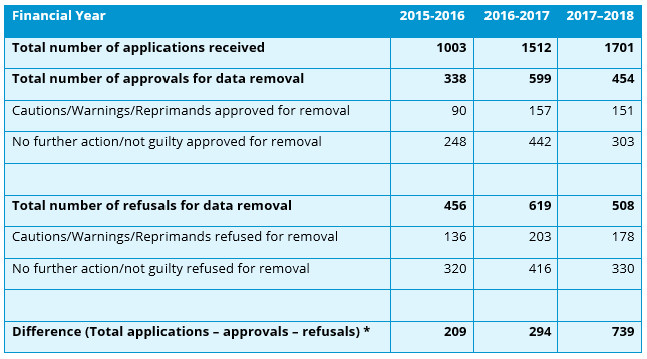
Information provided by ACRO Criminal Records Office and set out in the table below shows that in 2017-2018, only 9% of requests to remove cautions/warnings/reprimands were approved with 18% of non-conviction information being removed.
The above figures relate to applications where a decision has been made to either approve or refuse the removal of data. The remaining numbers fall into one of the following categories:
Outstanding, awaiting a decision from the relevant police force
Outstanding, awaiting further information from the applicant
Rejected by ACRO as ineligible *
* Ineligible applications can include:
Individuals with no PNC records
Individuals who are subject to ongoing investigations
Individuals seeking the deletion of a court conviction.
You may be able to have your caution ‘expunged’ from your criminal record by applying to the police, via the ACRO Records Deletion Unit. You can do this yourself by setting out a well-argued and comprehensive reason as to why the police should consider ‘expunging’ your caution. Alternatively, you could seek legal advice.
If the police agree to ‘expunge’ your caution then the PNC will show ‘no further action’ instead of the caution. If they agree to delete the caution in its entirety then the arrest event will no longer be recorded on the PNC. It will no longer be disclosed on a standard orenhanced Disclosure and Barring Service (DBS) check. There is no standard time period to have a caution removed, and different police forces take differing periods of time to remove cautions (for example, the Metropolitan Police Force give a time estimate of around 12-18 months for a removal application to be processed).
You should be aware that even if your caution is ‘expunged’, the information held by the police force could still be disclosed under the ‘other relevant information’ section of an enhanced check, if the police feel that it is relevant and ought to be disclosed. You can challenge this decision.
Appealing a decision if the police refuse to delete a caution
There is no formal appeals process to challenge a decision made in relation to the deletion of police cautions.
If you don’t agree with the decision you should, in the first instance, make representation to the relevant police force. This should usually be done no later than 3 months from the date you received the original decision. Your representation will need to provide information or ‘evidence’ which was not provided in your previous application.
If you believe that the police are holding information that is inaccurate, incomplete or has been retained for longer than is necessary and your request to have it deleted has been refused, then you could consider making a complaint to the Information Commissioners Office.
If, having followed the process set out above, you remain dissatisfied, then you do have the right to challenge the decision by way of judicial review.
Removing information from local police records
The Record Deletion Process only extends to records held on the Police National Computer, National DNA Database and fingerprint database. Locally held records, including custody photographs, are not covered by this process and instead, are managed by chief officers in accordance with the Authorised Professional Practice (APP) – Information Management.
Personal experiences
The personal story below has been posted on theRecord, our online magazine.
The phrase ‘recordable offence’ is used a lot when it comes to police records.
What is a recordable offence?
Generally, an offence that could result in imprisonment is classed as a recordable offence (i.e. an indictable or triable-either-way offence). There are also some more minor summary offences that are designated as recordable. This additional set of specified offences has grown over time and is now substantial.
For example, the National Police Records (Recordable Offences) Regulations 2000 sets out that convictions, cautions, reprimands and warnings are regarded as ‘recordable offences’ if the offence could be punishable with imprisonment. It also sets out a list of specific offences that are also deemed recordable.
Where a conviction is recordable, any other conviction obtained in the same proceedings will also be recorded.
Non-recordable offences are generally held on local police records although, depending on local arrangements, some non-recordable offences may also be uploaded to the PNC, particularly when dealt with at the same time as a recordable offence. An example could be when someone is convicted of driving without insurance (a non-recordable offence) at the same time as being convicted of drink driving (a recordable offence).
The Ministry of Justice used to publish a full list of indictable and trail either way offences on their website, although this is not currently available. A list of summary offences which are regarded as recordable can be found in this document, provided to Unlock by the Ministry of Justice.
Examples of specified recordable offences (non-imprisonable)
Making a false statement in connection with an application for a sex establishment licence (paragraph 21 of Schedule 3 to the Local Government (Miscellaneous Provisions) Act 1982)
Failure to co-operate with a preliminary (roadside) test (section 6 of the Road Traffic Act 1988)
Taking a pedal cycle without consent (section 12 of the Theft Act 1968)
Falsely claiming a professional qualification (section 44 of the Nursing and Midwifery Order 2001)
Examples of non-recordable offences
Non-payment of TV licence (section 363 of the Communications Act 2003)
Careless driving (section 3 of the Road Traffic Act 1988)
Driving without insurance (section 143 of the Road Traffic Act 1988)
Reproducing British currency notes (section 18 of the Forgery and Counterfeiting Act 1981)
Between 40-45% of all criminal offence convictions each year are for non-recordable offences.
How do I know if my offence was for a recordable offence?
The rules around what is and isn’t recordable are quite complicated, and have changed over the years.
If you are not sure whether your offence is classed as recordable or not, and so are unclear whether it’s held on the PNC, the best thing to do is to apply to your local police force for a police subject access request.
Does it matter?
The police are not able to take or retain your DNA or fingerprints if the only reason you’re arrested is for an offence which is not recordable.
Any conviction that results from an non-recordable offence is unlikely to be recorded on the PNC, unless it is alongside a recordable offence.
We want to make sure that our website is as helpful as possible.
Letting us know if you easily found what you were looking for or not enables us to continue to improve our service for you and others.
Was it easy to find what you were looking for?
Thank you for your feedback.
12.5 million people have criminal records in the UK. We need your help to help them.
We use cookies where necessary to allow us to understand how people interact with our website and content, so that we can continue to improve our service.
We only ever receive anonymous information, and cannot track you across other websites. Find out more
More Options
Can you pay it forward?
If you found this page helpful, could you donate just £1 to help someone else access our information and support?