
Category: Latest

Looking back at 2019 – A month-by-month review of our work and criminal record developments

With the Christmas break almost upon us and 2019 coming to an end, it’s a good time to reflect on the last 12 months at Unlock and the developments relating to criminal records.

Once again it’s been an incredibly busy year for us, with lots of positive news and progress to report in terms of the charity itself:

  1. We’ve continued to expand the information, advice and support we provide to help people overcome the stigma of their convictions. We have some amazing case studies, including Brinley (“I successfully challenged an ineligible DBS check and kept my job”) and Davina (“I was accepted onto a nursing course despite my conviction”)
  2. We have yet again seen large numbers of people accessing our helpline and websites. Our helpline will have yet again dealt with around 8,000 enquiries this year – a phenomenal number given the size of the helpline team. We also piloted the use of web-chat, which we’re planning to make more use of in 2020.
  3. Our information site for people with criminal records has, with all the updates across the year, yet again had over 1 million visitors and our disclosure calculator has helped around 50,000 people work out when their convictions become spent.
  4. Our website for employers, Recruit!, has continued to be a vital source of guidance and resources for employers and organisations in helping them to deal with criminal records fairly.
  5. We advertised for new trustees to join our board and we’re looking forward to announcing the details of the new appointments early next year.

As you can see in the month-by-month highlights below, there’s also been some significant positive policy developments that we’ve played a part in.

Most notably, the Supreme Court ruled, in a case that we intervened in, that two aspects of the criminal records disclosure scheme are disproportionate and in breach of Article 8 of the European Convention on Human Rights. This was the first time in Unlock’s history that we’d intervened in a legal case, and we are incredibly grateful to all those who donated to help us cover our legal costs. We’re still awaiting a government response to the judgment and we are continuing to prioritise this as an area of work for us in 2020. We also saw a number of universities lead the way by signing the ‘Fair Chance for Students with Convictions’ pledge.

But it’s not all been positive. There continues to be new and extended policies and practices that treat people with convictions unfairly and punish people long after they’ve served their sentence. The number of criminal record checks is increasing, and we’ve been looking specifically at the issue of ineligible checks (which you’ll hear more about very soon).

All of this explains why we’ve just published our priorities for government in 2020, where we are calling on the government to commit to five priorities to bring about a fresh start for law-abiding people with criminal records.

And the London Bridge attack at the end of November brought into sharp focus the importance of the work that we do. Enabling people who have offended the chance to change and to move on positively is socially, economically and morally right. The aim of terrorism is to destroy our values and beliefs. We won’t allow these events to destroy our belief in the power of all people to do better.

This all means that, now more than ever, it’s vital that we continue to work hard to provide support and a voice for people with criminal records. So we look forward to yet another strong year in 2020, and we are grateful to those of you that continue to support our vital work.

On a practical note, our helpline will be closed for the Christmas holidays from 4pm on Friday 20th  December and will reopen at 10am on Thursday 2nd January 2019. Our information site has details on what to do if you have questions over the festive period.

In the meantime, on behalf of all the staff and the board of trustees, I would like to wish the people we help, our volunteers, supporters and funders a very merry Christmas and a happy and safe New Year.

Some key moments, month-by-month

January – We responded to the judgment of the Supreme Court on the criminal records disclosure regime. The charity provided an intervention to the court to highlight the unjust consequences of the current regime and the alternative, fairer systems available. We also published a personal response to the Supreme Court ruling

February – We were pleased to be able to share a short video that explains a little bit about Unlock, the work that we do and why it is so important in helping the millions of people in this country who have a criminal record.

March – Bob Neill MP, Chair of the Justice Select Committee, introduced a Westminster Hall debate on the disclosure of youth criminal records and he thanked Unlock and the Standing Committee for Youth Justice for the evidence we provided. As part of the inquiry, we had arranged a seminar for Committee members and people with convictions to meet and discuss the impact of disclosing criminal records from childhood. The debate was well informed and MPs highlighted the effects of disclosure on employment, education, housing, travel and insurance.

April – Following UCAS’ decision to remove the question about criminal convictions for all applicants, universities had to consider if, when and how to collect this information. UCAS still ask applicants to regulated programmes – for example medicine or teaching – to declare criminal records. Having worked with UCAS and universities for some time, we felt it was important to support universities to develop fair admissions policies for applicants with previous criminal records. We published a blog – University admissions: what’s changed? – detailing the work we had been doing in the last year or so, what we had learned so far and our plans for future work in this area.

MayBloomsbury Institute broke new ground with ban the box for staff and students, and we published a blog – Appointing a trustee with a criminal record: reflections of a successful applicant and charity – which was the lived experience of a charity working within the criminal justice system that was successful in getting a waiver from the Charity Commission for a trustee applicant that was “disqualified” because of their criminal record.

June – A report backed tax breaks to employers that recruit people with convictions. We also made some updates to the most popular page on our information site – travelling to the USA – by publishing some new information which help to work out whether they need a Visa.

July – We commented on the Ministry of Justice’s plans on criminal record reform and we published a report highlighting the ‘double discrimination’ faced by black, Asian and minority ethnic people with a criminal record. We also worked with NHS Employers on their new guidance on recruiting people with criminal records, which resulted in some important changes to the process which we set out here.

August – The Association of British Insurers (ABI) published updated guidance on how insurers should treat people with convictions. The guide, first published in 2011 and revised in 2014, was updated to reflect recommendations made by Unlock. We also worked with The Key (an organisation that provides tools and services to education leaders) on their new guidance on asking about criminal records. Many schools ask about criminal records on application forms and ask candidates to bring a written disclosure which may be discussed at interview. The Key received legal advice that this is likely to be considered excessive data collection, as successful candidates will be required to undergo DBS checks. Their advice now is that school recruiters should NOT ask applicants to disclose at any stage before an offer is made. In essence, schools should follow Ban the Box principles. Following an offer, the preferred candidate should complete the relevant level of DBS check and any disclosure should form the basis of a discussion before a final decision is made. In collaboration with Unlock, The Key have published detailed guidance on how to go about discussing a disclosure with a candidate.

September – We published a policy briefing which sets out the concerns that Unlock has about the EU Settlement Scheme (EUSS) in relation to those EU nationals in the UK that have a criminal record. Our aim is to help secure the rights of EU nationals who are eligible for settled status in the UK by ensuring that a criminal record does not unfairly exclude them. The briefing aims to inform the ongoing work that the Home Office and other key stakeholders are doing on the process to better understand the policy and to improve practice.

October – As part of our Unlocking students with conviction project, we announced that ten UK universities lead the way in helping people with convictions access higher education by signing the ‘Fair Chance for Students with Convictions’ pledge. Universities that have signed the pledge include University of Nottingham, University of Liverpool, Birkbeck, University of London, University of Essex, University of Kent, University of Lincoln, University of the West of England, Bristol, London Metropolitan University, Bloomsbury Institute and University of Southampton. To ensure applicants are aware of the commitment, signatories will be asked to include a link to the pledge in their admissions policy going forward. A toolkit to help universities make admissions fair was also published.

November –We were delighted that one of Unlock’s long-standing helpline volunteers, Simon, was shortlisted for the Helpline Partnership’s ‘Helpline Volunteer of the Year’ award. On hearing the news, Simon said: “I’m delighted to have been shortlisted for the Helpline Partnership ‘Volunteer of the year’ award. As much as this is recognition that the work I do for Unlock is truly appreciated, what I have given to Unlock is a moot point in comparison to what they have done for me.”

December – As a charity set up by people with criminal records, Unlock is committed to fair recruitment and the inclusion of people with lived experience of the criminal justice system. Our recruitment policy has helped us do that but we believe every organisation should regularly review their policies and practices to make sure they’re as effective as they can be, so we reviewed our policy and made some improvements. We also put out a statement on the London Bridge attack. Enabling people who have offended the chance to change and to move on positively is socially, economically and morally right. The aim of terrorism is to destroy our values and beliefs. We won’t allow these events to destroy our belief in the power of all people to do better. And following the general election, we published our priorities for government in 2020, where we are calling on the government to commit to five priorities to bring about a fresh start for law-abiding people with criminal records.


Unlock statement on the London Bridge attack

Below is a statement from Christopher Stacey, co-director of Unlock, following the tragic events of Friday 30th November at London Bridge.

“Last Friday, the work of our friends and colleagues at Learning Together was thrust into the spotlight in the very worst way. Our thoughts are with them and their families.

“The transformational power of education has been demonstrated, time and again. The actions of one person should not overshadow the life-changing impact on so many others – as evidenced by the brave and selfless actions of others at the event.

“We will continue to support and promote rehabilitative opportunities for people with criminal records, including the small proportion who have spent time in prison. We will do this because doing so is to all our benefit. Enabling people who have offended the chance to change and to move on positively is socially, economically and morally right.

“The aim of terrorism is to destroy our values and beliefs. We won’t allow these events to destroy our belief in the power of all people to do better.”

Unlock Annual Report 2018-19

We are delighted to publish our Annual Report and Accounts for the year 1 April 2018 to 31 March 2019. Reviewing a whole year of activity can be a demanding process. Our activities are always taking us forwards, driving us on to the next challenge, so to take a step away, look back and reflect, can sometimes seem like a distraction. In fact, it is extremely important to take that time. The Annual Report gives us an archive of what Unlock has done in the course of a year and, crucially, provides an overview of how that activity cumulates to make a significant, positive impact on the lives of people with convictions. It’s also an opportunity to say a huge thank you to all the wonderful people who make our work possible – our Trustees, staff, volunteers, Patrons, contributors to our web resources, partners, donors and funders.

At the beginning of this financial year, we were preparing for the appeal by the Government at the Supreme Court of a complex case challenging the current criminal records system. It was the first time in Unlock’s 18-year history that we had intervened in a legal case, but we were committed because of the potential to achieve a better a system from one that continues to trap people in their pasts. The work was made possible by the 555 pledges of donations through Crowdfunder, which helped us raise over £17,000 towards our legal and campaign costs. Our evidence demonstrated the breadth and scale of the problem (for example, that in the last 5 years, nearly 1 million youth criminal records disclosed on standard/ enhanced checks were over 30 years old). We also demonstrated that generally, employers do not make deeper assessments of individuals but default to avoiding selecting candidates with any kind of criminal record. The judgement came at the end of January 2019, with a ruling that two aspects of the criminal records disclosure scheme are disproportionate and in breach of Articles of the European Convention on Human Rights. We were pleased that the judgement provides a crucial step towards achieving a fair and proportionate filtering system that takes a more calibrated and targeted approach to disclosing criminal records. When taken together with reviews by the Law Commission, Justice Select Committee, Charlie Taylor and David Lammy MP there is a powerful case for a fundamental review of the wider criminal records disclosure regime.

Since the judgement, we have been working with others to argue for that wider review, and, ultimately, for a fairer, proportionate and flexible filtering system that protects the public without unduly harming the ability of people to move forward positively with their lives.

“I hope you’re successful in helping people move away from their pasts and live their lives without the worry and shame of their past.”  (Crowdfunder donor)

In July 2018, Rachel Tynan joined the staff team, to a newly created role of Policy and Practice Lead. Rachel had previously worked in the Civil Service and higher education and joined us following the completion of her PhD and a stint at Open Book at Goldsmiths. Her role is designed to support our campaigning and policy work. As Rachel says:

“Research consistently shows that re-offending is reduced where people are in sustainable employment or training, and employers and universities providing opportunities are contributing to a safer and more just society.”

Rachel has worked closely with Co-director, Christopher Stacey, on a number of our policy issues. As well as the work pushing for a review of the criminal records system, our work has included, working directly with employers to improve their recruitment processes, working with universities to increase access to higher education, researching the increased impact of having a criminal record on young and BAME people, challenging Google and other search engines to remove spent convictions from their indexing and helping people with convictions to understand the law discouraging people with convictions to become charity trustees or senior leaders. We were delighted to see the government abandon the disproportionate, unfair and ineffective “disqualification by association” rules for schools. We also published a number of consultations, submissions and reports including

  • A report – A life sentence for young people – on the impact of criminal records acquired in childhood and early adulthood (May 2018)
  • A paper – University admissions and criminal records: Lessons learned and next steps (June 2018)
  • A report – A question of fairness – research on employment practice of top national employer (October 2018)

Unlock’s policy work is, of course, based on the experiences of people using our direct information, advice and support services. It is only by listening to personal experience that we can see where problems lie and how things can be improved. Our helpline means we are talking to people and helping them overcome their individual challenges daily and our online resources help people find their own solutions at times and in ways that suit them best. We are delighted that we continue to reach large numbers of people with all our services, and that we continue to get very positive feedback on the help we offer.

“Having access to Unlock really gives me the confidence for the future. It is very important to know the facts when applying for employment. My offences were some 20 years ago, and it been a long interesting journey with life to this point. I don’t want to blow it or let those down who have invested time in me to get to this stage because of ‘misinformation’ or incorrect facts.”

“I wanted to get in touch to firstly thank you for the advice and support I received leading up to my applying for University. Secondly to update you with my conditional offer to study BSc Hons Social Work! Without your organisation’s help I would not have had the confidence or motivation to put myself out there as someone with a criminal record for fear of rejection.”

The enquiries our team responds to cover a huge range of problems, across employment, education, training, housing, financial matters and travel. An example of the complicated way having a criminal record affects people, include a client who had believed her 22-year-old conviction was not only spent but would also be filtered from an enhanced DBS check, only to discover that because there were three ‘counts’ it was not filtered. Our support helped them make the case to keep their teaching job.

We are indebted to our volunteers – all people with convictions and some still serving prison sentences – who train as helpline volunteers, and over the year answered nearly 75% of enquiries. We aim to make volunteering for us as beneficial as possible to the volunteer, providing as much training and support as possible.

This is just an introduction to the full story of our activities which we hope you will enjoy reading in our Annual Report.

We’re happy to give the last word to two of our supporters, who were inspired to make donations to help our work:

“I’m an ex-offender who was fortunate enough to be able to largely support myself through the criminal justice process in the main (thank goodness) but 15 years on, when life dictates, you are still the first port of call for advice. Thank you for everything you did for me and continue to do and fight for others.”

“May I take this opportunity to warmly applaud and thank you for the excellent work you are doing. From my experience of living abroad in several Western European countries I have long thought the UK criminal justice system to be far too heavy handed and punitive. It does not surprise me that a criminal record in the UK has a greater, longer term effect than other EU countries.”

Julie Harmsworth 

Co-director

Unlock volunteer shortlisted for helpline volunteer of the year award

We’re delighted that one of Unlock’s long-standing helpline volunteers, Simon, was shortlisted for the Helpline Partnership’s ‘Helpline Volunteer of the Year’ award.

On hearing the news, Simon said:

“I’m delighted to have been shortlisted for the Helpline Partnership ‘Volunteer of the year’ award. As much as this is recognition that the work I do for Unlock is truly appreciated, what I have given to Unlock is a moot point in comparison to what they have done for me.”

Commenting on the news, Debbie Sadler, Unlock’s advice manager and lead for our volunteer programme, said:

“Simon has volunteered for Unlock as a helpline advisor for over 5 years. His background in education makes him ideally placed to provide high-quality information, advice and support delivered in such a way that callers find it easy to understand and utilise.

“Back in 2014 Simon joined us for 2 days per week but, such is his commitment and passion for the charity that during a particularly busy period recently, he not only manned our helpline but helped us redecorate and move office. This commitment is even more extraordinary because for many years Simon has suffered from an anxiety disorder which means that it’s frequently a struggle for him to leave his own home.

“I can’t thank Simon enough for everything he has done and continues to do for Unlock and him being shortlisted for volunteer of the year goes to show how he’ll continue to be one in a million to us”

We’d like to congratulate the eventual winner of the award, Deborah Gascoyne from Myeloma UK.

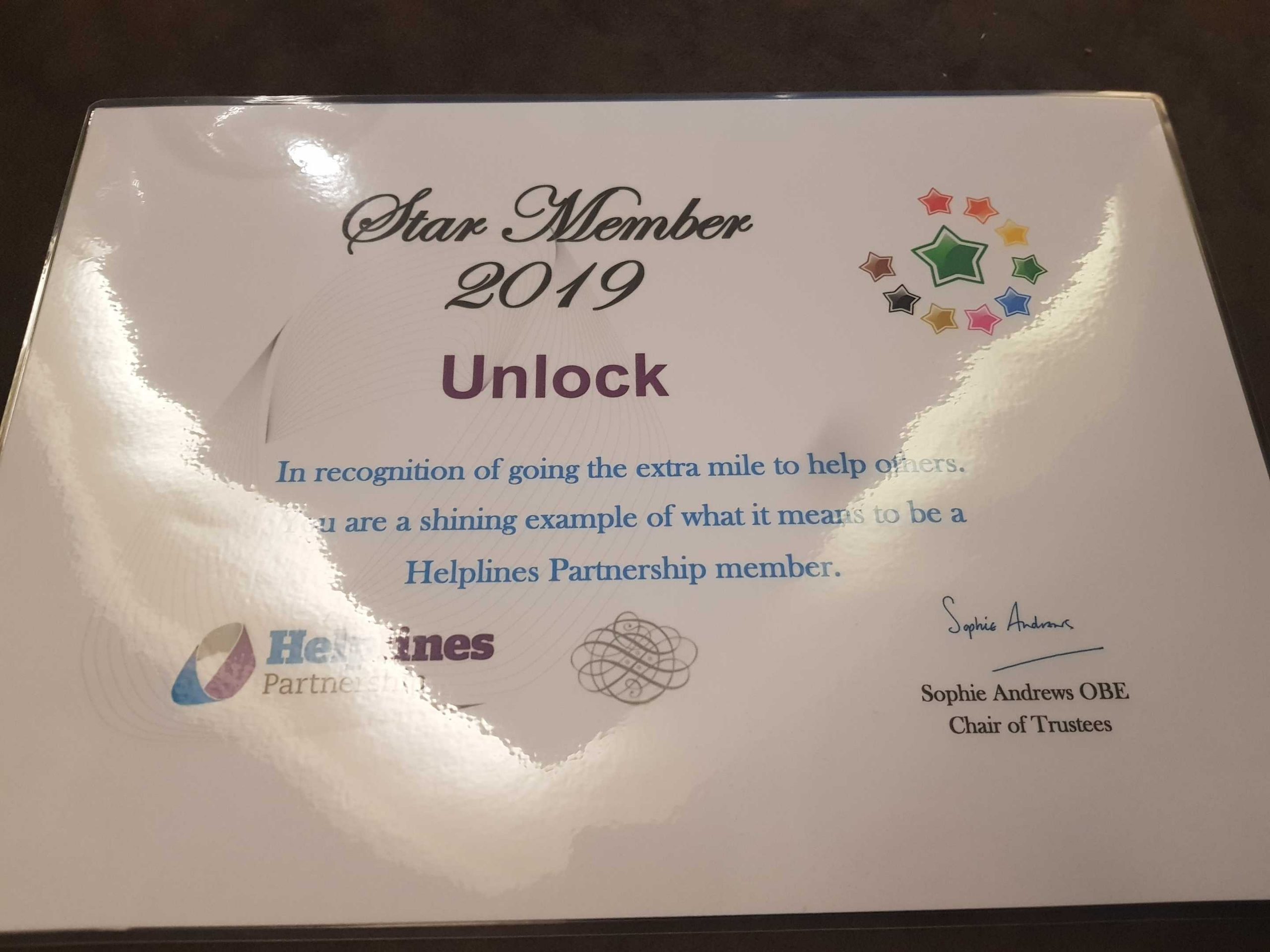
At the same event, Unlock came away with a ‘Star member’ award, in recognition of Unlock “going the extra mile to help others”, saying that we were “a shining example of what it means to be a Helpline Partnership member.”

More information

  1. You can find out more about our volunteer programme.
  2. The winners of the Helpline Awards are on the Helplines Partnership website.

Ten UK universities lead the way by signing the ‘Fair Chance for Students with Convictions’ pledge

Trailblazing UK universities are leading the way in helping people with convictions access higher education by signing the ‘Fair Chance for Students with Convictions’ pledge.

The pledge is the result of a 12-month project conducted by Unlock, a charity for people with convictions, and supported by the UPP Foundation, a charity founded by University Partnerships Programme, the leading provider of on campus student accommodation infrastructure and support services in the UK.

So far, ten UK universities have signed up to this important pledge which sees institutions make a commitment to offering a fair chance to students with a criminal record. The pledge also signals an institution’s support to giving individuals a second chance at life by opening doors to higher education, giving them the best chance of new employment prospects and opportunities.

The project, designed to support fair admissions and improve access and participation for universities has three key objectives. These include putting policies in place at each university; a toolkit for other universities to use to develop their admissions policies and a pledge for universities to sign up to. The pledge will be launched at a roundtable event with admissions leaders taking place in central London later today.

Universities that have signed the pledge include University of Nottingham, University of Liverpool, Birkbeck, University of London, University of Essex, University of Kent, University of Lincoln, University of the West of England, Bristol, London Metropolitan University, Bloomsbury Institute and University of Southampton. To ensure applicants are aware of the commitment, signatories will be asked to include a link to the pledge in their admissions policy going forward.

Richard Brabner, Director of The UPP Foundation said:

“We are proud to be working alongside Unlock to help universities remove the barriers to higher education that are currently facing people with convictions. We recognise that this is a relatively new area for universities and are delighted to see a number of universities signing the pledge and boldly taking steps towards a fairer admission policy.

“Access and participation is more important than ever. Removing barriers for students with convictions and improving access to universities benefits both students, the tax payer and higher education institutions.”

Christopher Stacey, Co-director at Unlock said:

“Education creates opportunities, opens doors, and changes people’s lives. We are delighted to be working alongside the UPP Foundation and higher education institutions to help people with convictions access the life changing opportunities that higher education can offer.

“People with convictions often face stigma and obstacles because of their criminal records, even long after they have served their sentence. There are over 11 million people in the UK with a criminal record. These people have the potential to make positive and meaningful contributions to our society but are often denied this opportunity because of their past. We are delighted to see universities leading the way in removing the systemic barriers that face people with convictions and look forward to more universities signing the pledge and committing to fairer admission policies in the coming months.”

Notes

  1. For press/media enquiries,
  2. Unlock is an independent, award-winning national charity that provides a voice and support for people with convictions who are facing stigma and obstacles because of their criminal record, often long after they have served their sentence. Unlock’s website is unlock.devchd.com.
  3. The UPP Foundation is a registered charity that offers grants to universities, charities and other higher education bodies. In recent years, as higher education has expanded, the burden of paying for a degree has shifted towards the individual. This naturally presents difficulties in terms of maintaining the ‘University for the Public Good’, as well as ensuring there is greater equity in terms of going to, succeeding at and benefiting from the university experience. We believe the UPP Foundation can make a small but significant contribution in helping universities and the wider higher education sector overcome these challenges. The UPP Foundation was created in 2016 by University Partnerships Programme (UPP), the leading provider of on campus student accommodation infrastructure and support services in the UK. UPP is the sole funder of the UPP Foundation. The UPP Foundation is an autonomous charity and all of its grants are reviewed and authorised by its Board of Trustees. The Foundation is supported by an Advisory Board. More information is available at the UPP Foundation website: www.upp-foundation.org.
  4. The ‘Fair Chance for Students with Convictions’ pledge is below. More details are available here.
  5. A toolkit to help universities make admissions fair has also been published. That is available here.
  6. Details about the Unlocking students with conviction project are available here.
  7. For more information about the project, email university@unlock.org.uk.

The Fair Chance for Students with Convictions pledge

We believe everyone with the potential and ambition to go to university should have the opportunity to do so, regardless of background. People with criminal convictions face obstacles and barriers to accessing university, yet higher education has the power to transform their lives by helping them move forward and make a positive contribution to society. Therefore, as the leaders of our institutions we pledge to give applicants with a criminal record a fair chance by…  

  • Asking applicants about criminal records only if – and when – it is necessary
  • Asking targeted and proportionate questions during the admissions process
  • Making our policy transparent and accessible to all applicants
  • If necessary, offering applicants a chance to discuss their case in person before a decision is made
  • Considering flexible adjustments and alternatives for applicants
  • Ensuring staff are trained to make fair and impartial judgements about applicants
  • Supporting students with criminal records to help them achieve academic success
  • Communicating positively about the benefits of a fair admissions process

Blog – How can people with criminal records access higher education?

Evidence shows that some groups are disproportionately criminalised: care leavers, people from low income households and some ethnic groups.

Despite education being widely recognised as a key factor in successful rehabilitation, admissions policies to date have presented psychological and practical challenges to access. When UCAS removed the criminal convictions tick box for applicants to non-regulated courses, universities had the perfect opportunity to re-evaluate their approach.

Now the Universities of Liverpool, Southampton and Nottingham have joined others in pledging to offer a fair chance to students with a criminal record. These universities have recognised that widening participation means looking at the range of barriers under-represented students face – including a criminal record.

Unlocking talent

Over the last 12 months Unlock, supported by the UPP Foundation, have worked with partner universities on their approach to applicants with criminal records. The project had three objectives: to get policies in place at each of the partner universities; a toolkit for other universities to use to develop their admissions policies; and a pledge for universities to sign up to.

The project was designed to focus on admissions, whilst recognising that this is only the first stage of the student journey. Accommodation, visa compliance and voluntary placements might require asking about criminal records but for admission to non-regulated courses this is almost always unnecessary. Admissions decisions should focus on an applicant’s ability to fulfil their potential. A fair chance means looking at ways to include rather than exclude those people who are trying to move on positively with their lives.  People like Connor.

Connor applied for a post-graduate degree, disclosing his unspent conviction at that time. The university decided that as his offence was ‘serious’ his application could not be accepted. Determined not give up, Connor submitted information about his conviction and letters of support from previous tutors and others people in his life. Eventually, the university overturned its decision.

Concerns about safeguarding or capacity to complete the course could be managed by engaging with the applicant themself. Offering applicants the opportunity to disclose conditions or restrictions that could affect their ability to succeed on their programme means universities can advise on adjustments or alternatives, addressing their concerns. Applicants can feel confident to ask for support at the earliest stage and throughout their course.

Primarily this is a widening participation issue. Admissions decisions for students with convictions can and should be in line with the principles of fair admissions, as set out in the Schwartz review.

It’s also an issue of legal compliance; any organisation that processes criminal record data must have a lawful basis under Article 6 and a condition under Article 10 of the General Data Protection Regulation (GDPR). It’s difficult for a university to identify an article 10 condition for non-regulated courses. Where a DBS check is needed for a placement based programme, universities have a legal obligation to check criminal records. For non-regulated courses, this doesn’t apply. Asking a voluntary question about restrictions or conditions means universities can rely on consent when processing criminal records data.

What have we learned?

Three key themes have emerged from the project and we encourage any university looking at this issue to bear these in mind.

First, focus on inclusion: ask ‘how can we safely include’ rather than ‘how can we legitimately exclude’. Applicants with criminal records are a diverse group and fit into traditional widening participation groups. Excluding people because of their past is likely to result in exclusion of under-represented groups

Second, take a ‘whole institution approach’: Identify what information is necessary – or not – at different stages in the student lifecycle; bringing decision makers together, as well as looking at support for students

Third, words matter: Policies of all kinds reflect the values and culture of the university. An inclusive culture begins with inclusive language. If a university is committed to widening participation and including all under-represented groups, the language used to address them is the starting point.

Students with convictions have usually overcome significant barriers already. They are determined and hardworking and, while they may need support to succeed, their inclusion ultimately benefits us all. Recidivism already costs the economy £18bn a year. Education, employment and opportunity are strongly associated with a reduction in reoffending. Can we really afford to ignore those who are working hard to get their lives on track?

What’s next?

Pledging to offer a Fair Chance to Students with Convictions means:

  • Asking applicants about criminal records only if – and when – it is necessary
  • Asking targeted and proportionate questions during the admissions process
  • Making the policy transparent and accessible to all applicants
  • Offering applicants a chance to discuss their case in person before a decision is made
  • Considering flexible adjustments and alternatives for applicants
  • Ensuring staff are trained to make fair and impartial judgements about applicants
  • Supporting students with criminal records to help them achieve academic success
  • Communicating positively about the benefits of a fair admissions process

Signatories include Universities of Nottingham, Lincoln, Kent, Southampton, Essex and Liverpool, UWE; Birkbeck, University of London; London Metropolitan University and the Bloomsbury Institute. We look forward to more universities signing the pledge in the coming months and working with them to make improvements to their practices.

Our toolkit for higher education providers provides a blueprint for universities to make sure their admissions processes are fair and inclusive. We worked with the Office for students on their effective practice guide to working with students with convictions.

Our longer term focus is on the retention and success of students with convictions – how universities can support them to achieve their potential, and to successfully transition into employment. This includes academic and pastoral support and links with employers. Education can be transformative, and universities have an opportunity to help transform the lives of individuals with convictions and their communities.

This blog was written by Rachel Tynan and originally published by Wonkhe

Blog – Government publishes summary of responses to call for evidence on the employment of people with convictions

Last week, more than a year since the consultation closed, the Cabinet Office published a summary of responses to their Call for Evidence (CfE) on employing people with convictions. But what does this summary of responses mean for the future? This blog looks at some of the promising signs, some areas for improvement, and questions the lack of any recommendations from government.

The report draws together responses from 76 organisations – a small sample for a national consultation, but that in itself tells us how much work there is to do. The report indicates that the public sector could do more to increase employment of people with convictions but highlights some pockets of good practice in the voluntary sector.

Firstly, the evidence is promising

The responses are promising – 76 organisations from the voluntary (46%), private (32%), and public (14%) sectors responded to the Call for Evidence. Overall, 73% of the organisations that responded said they hire people with a criminal conviction, either directly or through intermediary companies, suppliers or contractors. Over half (56%) of them ask about convictions in a later stage of the recruitment process (i.e. during interview, at the offer stage, etc.) – with 33% asking at the job offer stage. Public sector respondents were particularly poor at this – 71% ask at the initial stage. The chart below shows that the voluntary sector tends to ask the question about convictions at a later stage compared to the private and public sectors – although there is clearly much more work to do with all sectors.

Of those that ask about convictions, when in the recruitment process do they ask?

In summarising the response, the report states: “The Call for Evidence has provided very useful insights for the Civil Service and organisations in general on how to engage in activities that support people with a conviction in finding employment. Furthermore, the Call for Evidence has helped to identify barriers and challenges, both within and outside organisations, when employing people with convictions, and highlights the need for a communication strategy on the benefits of this practice.”

The key messages from the analysis are at the end of this blog, and the report concludes by saying the results highlight how having specific recruitment practices and employability initiatives that reduce the barriers to employment for people with criminal records could have positive impact on the individuals involved, the organisations they are part of, and wider society as a whole in the long term.”

However, 76 responses is a very low number of employers and the proportion of private and public sectors is much lower than it should be. Most respondents were already actively engaged in recruiting from this population. It feels like this call for evidence was a missed opportunity to engage with a much wider range of employers across all sectors. How might the lessons from this call for evidence be used to engage with employers in the future?

There are positives in the analysis

  • Languageour response to the call for evidence explained why we use person-first language – people with convictions, not ex-offenders. We’re not taking credit for this, but the response refers to people with convictions, using the term ex-offenders only when referring to the questions asked and the initial title of the call for evidence. This alone is a really big step forward, and we hope it reflects an active decision by the Cabinet Office to use person-first language – and that it will be adopted by colleagues across Whitehall.
  • Highlights the variety of excellent work being done – predominantly by the third sector – in supporting people with convictions into, and during, employment.
  • Underlines the value to employers of recruiting people with convictions. In our experience, hearing from employers who already do this cuts through and shows other employers what can be achieved. For example, one respondent said “These staff tend to work extremely well, are productive and eager to learn. They are committed, have a good understanding and knowledge of themselves making for a supportive team member”

There are some areas for improvement

  • The majority of respondents ask at application stage. Even if the employer takes a proactive approach to people with convictions, there’s rarely a need to ask all applicants at this stage and the Cabinet Office should take this as an action to look at wider promotion of Ban the Box, including considering placing it on a statutory footing
  • The issue of enhanced checks and security vetting. This paragraph in the analysis raises some concerns –In relation to the security clearance level needed for the role, out of the 76 organisations, only 64% responded. Of these, the large majority need to conduct a Disclosure and Barring Service (DBS) check, or an enhanced DBS. A few others indicated they required a full security clearance, vetting checks, or Criminal Records Bureau (CRB) check.” Respondents might have used DBS check/enhanced DBS check interchangeably but it’s worth thinking about the implications of this. It could be a function of the large number of voluntary organisations who proactively recruit from this population – lived experience/peer roles etc. It’s interesting that a significant majority of employers require enhanced checks, security clearance and vetting – if employers in sensitive fields can recruit people with convictions, surely mainstream employers can do more too? It’s a shame this wasn’t analysed further. It could also be a misunderstanding of the ‘need’ to conduct a basic check. And I’d be interested to see how many say they need ‘CRB checks’ – it makes you wonder how out of date their processes are (the CRB was replaced by the DBS over 6 years ago!)

No clear recommendations from government

Although publishing a summary of responses and carrying out some analysis of them is helpful, a “summary of responses” is very different to a “government response”. There are no concrete recommendations or actions that the government is taking in response to this consultation – and it’s unclear why not. In the “conclusions and next steps” section, the report states “The value of this Call for Evidence does not merely derive from the immediate actions taken as a result of it, but from inspiring further Civil Service and Government reforms in this field. The Civil Service looks forward to working with its stakeholders to be more inclusive, and promoting a culture that supports people with convictions on their path to employment.”

Yet the report makes no mention of these “immediate actions”. And what are the “further Civil Service and Government reforms”? Given the time it’s taken the publish this summary, and the lack of any further clear commitments, one wonders whether this reflects a deprioritisation of this work for the Cabinet Office?

There has been some progress since we made our own submission back in August last year, and below as an addition to this blog we’ve set out how things have progressed against the areas that we called for government action on. Given the importance of this work, the Cabinet Office had a real opportunity to set the scene by producing a detailed response to this call for evidence and making a number of commitments. Given what ended up being published, we’ll be raising this with both the Cabinet Office and the Ministry of Justice, who jointly published the initial consultation, to understand what their future plans are.

Promising signs from the civil service pilot

One thing that the summary of responses does highlight is the progress that has been made on the Civil Service pilot scheme, ‘Going Forward into Employment’ (GFiE), where people in prison and near to release have been matched to fixed-term office-based and field-based jobs in participating government departments, via a two-year recruitment exception route. We know that there has been an evaluation done of this pilot, and it seems that this Call for Evidence was initiated (at least in part) to support that project. It’s positive that the pilot is now continuing as a mainstream programme which looks at a range of other groups as well, including veterans, and I hope that the programme will be able to offer more opportunities to those people with convictions who are serving sentences in the community, as well as those near to release from prison who were the focus of the initial pilot. We hope that the evaluation of the pilot is published so that there is a better understanding of how it works and what lessons have been learnt.

Written by Christopher Stacey, Co-director at Unlock

Progress since we made our submission

Written by Rachel Tynan, Policy and practice lead at Unlock

Unlock’s submission to the consultation last year emphasised the need for fair recruitment practices, the range of issues to consider when developing employability initiatives, and evidence on what works and what needs to change so that law abiding people with convictions can secure employment. We called on the government to: 

  1. Develop a cross-government strategy on employment of people with convictions 
  2. Pilot financial incentives for employers who pro-actively recruit people with convictions 
  3. Put Ban the Box on a legislative footing 
  4. Fix the broken DBS filtering system 
  5. Develop a legal framework to ensure individuals’ right to be forgotten where convictions are spent  
  6. Support the Private Members’ Bill on amending the Rehabilitation of Offenders Act 1974  

Looking at the areas we called on the government to look at, below we’ve set out how things have progressed since:

Cross government strategy

Since the CfE the government has launched the New Futures Network and a new ROTL framework. The Ministry of Justice and Department for Work and Pensions have launched a three year programme, working in partnership. By committing resources to the recruitment of people with convictions the government has signalled its intent – but as the report shows, there is a lot of work to do.

Ban the Box

Our submission stressed how putting Ban the Box on a legislative footing – or even finding ways to incentivise business to sign up –  would signal government’s commitment to ensuring people with convictions have a fair chance of employment. Disappointingly, only around 30% of organisations responding to the CfE knew about Ban the Box suggesting much more needs to be to increase awareness and encourage take-up. There are 140 employers now signed up to Ban the Box but clearly a long way to go. Based on this evidence, we think the government should be more strident in its approach to employers.

Filtering

Since the CfE the Supreme Court ruled that the current filtering rules are unlawful and must be changed in two key respects – the multiple conviction rule was found to be disproportionate, and reprimands and warnings (followed by youth cautions) should not be disclosed. We have written to the government calling on them to implement changes in line with the ruling, but also to commit to carrying out a fundamental review of the wider regime. The government is yet to formally respond to the Supreme Court ruling.

Reform of the Rehabilitation of Offenders Act 1974

Looking at the range of recruitment practices reported to the CfE, most employers still ask about criminal records at application stage – echoing Unlock’s research last year which found that three-quarters of national employers do just that.

We know that this is hugely off putting to people with criminal records –  over half of people with a criminal record say they would not apply for a job where they needed to disclose their criminal record. 75% of employers discriminate against an applicant with a conviction.

Not only is asking at application stage off-putting, it’s also unnecessary – and very likely a breach of the GDPR. In the absence of clear guidance or enforcement action from the Information Commissioner’s Office, employers are unlikely to change these practices, and again we call on government to take legislative steps to ensure Ban the Box becomes the norm.

This also highlights the discrimination people with convictions face. Most convictions will eventually become spent, but people can find themselves out of work, or only able to secure temporary or unskilled work in the meantime. The economic impact hits the individual, their family and wider society – can we afford that? That’s why we have and continue to call on government to reform the Rehabilitation of Offenders Act. In July the Ministry of Justice announced plans to reform the criminal records regime to improve employment prospects and we look forward to working with the new Secretary of State on this.

Key messages from the analysis

The summary of responses includes a set of “key messages from the analysis”. These were:

a. There are some indications (from the respondents to this Call for Evidence) that variations exist across the different sectors in relation to employing people with criminal records and at which stage of the recruitment this information is taken into account. Asking about criminal records should not constitute a barrier or a filtering criteria for offering employment;

b. Organisations that employ people with convictions across different roles – and responsibilities – reported having positive experiences, and affirmed that this part of the workforce constitutes an important asset thanks to their skills, commitment and experiences;

c. Attitudinal barriers across stakeholders, including customers, colleagues, and even people with criminal records themselves, are reported to be the main challenges to offering employment to someone with a conviction; consequentially cultural change is likely needed;

d. It is important to have activities that support and prepare people with convictions to be in the job market; examples are CV surgeries, mock interviews, mentoring schemes;

e. There is the need to produce and collect more robust evidence – in addition to case studies – that prove the positive impact of hiring people with convictions.

Update on research – The right to a fair future: understanding the influence of an early life criminal record on adult life courses

Nicola Collett, a PhD student at Keele University, is currently researching the potential influence of a criminal record acquired between the ages of 10-25, later on in adulthood. Following a request for participants in February of this year, Nicola writes here about how her research is progressing.

I would first like to thank everyone who has contacted me wanting to take part in my research. I have received such a positive response to my call for participants and it has been a great source of encouragement highlighting just how important this topic is. Following my call for participants in February, I am excited to share with you an update on my PhD research exploring the potential influence of an early life criminal record later on in adulthood.

What have I done?

I have been travelling around the Midlands and North West conducting interviews with adult men and women living in the UK with a criminal record attained when aged twenty-five or under. Overall, I have met with fourteen people twice, in order to hear about their experiences with the criminal justice system, and how they feel their criminal record has influenced them later on in life. Of these fourteen, eight identified as female and six as male. Four had served custodial sentences and most had at least two non-custodial convictions. There was an age range from twenty-five to sixty-six.

Whilst often the conversations have been of a difficult nature, the interviews have been incredibly informative with people being able to reflect on both the positive and negative influences their experiences have had. People have discussed the barriers they have faced with regards to travel and visa applications, and access to employment and volunteering opportunities. More personally, people have shared the difficulties they have had establishing a new life and identity whilst having a criminal record ‘pulling them back to the past’. Disclosure can be incredibly disruptive and people have discussed anxiety and stress over people ‘finding out’ and how this might change people’s opinions of them. Some of the more positive reflections people have made include being able to understand and empathise with those in difficult circumstances and having the ability to help them either via a professional role or through being a positive role model

I would like to thank everyone who has taken part and shared their personal experiences with me.

What’s next?

In September I am travelling to Ghent to present some preliminary findings and reflections at the European Society of Criminology conference. At this event I will be putting forward the experiences of those who I have spoken to highlighting the current state of things in the UK. By doing so, I will be making people aware of the difficulties faced and putting forwards the voices of those who have taken part.  This will help to inform the research of a new European research working group looking to challenge some of the so-called ‘collateral consequences’ arising from criminal records.

I am currently working through all the interview material I have collected to identify the main themes and arguments I wish to make in my thesis. Writing has already begun and I aim to be near-completion by September 2020. After this, I will be developing a summary report to be shared with Unlock highlighting the key findings of the research.

I look forward to providing another update in the New Year.


Written by Nicola Collett

New policy briefing – EU nationals, settled status and criminal records

This new briefing sets out the concerns that Unlock has about the EU Settlement Scheme (EUSS) in relation to those EU nationals in the UK that have a criminal record.

Our aim is to help secure the rights of EU nationals who are eligible for settled status in the UK by ensuring that a criminal record does not unfairly exclude them.

The briefing aims to inform the ongoing work that the Home Office and other key stakeholders are doing on the process to better understand the policy and to improve practice.

Download the briefing.

We want to make sure that our website is as helpful as possible.

Letting us know if you easily found what you were looking for or not enables us to continue to improve our service for you and others.

Was it easy to find what you were looking for?

Thank you for your feedback.

12.5 million people have criminal records in the UK. We need your help to help them.

Help support us now