
Author: Debbie Sadler

Moving on: Applying for settled status if you’re an EU citizen and travelling to Europe

This month we’ve written a further article for Insidetime ‘Through the Gate’ section which highlights the impact of a criminal record when making a settled status application and travelling to the EU with a criminal record after Brexit.

After agreeing a trade deal with the EU, on 1st January 2021 the UK left the single market and customs union. Since then, our helpline has started to receive calls from people with a criminal record worried that leaving the EU will stop them from visiting Europe for a holiday.

The majority of people leaving prison will be on licence, which can make travelling abroad difficult – a standard licence condition is … ‘not to travel outside the UK without obtaining the prior permission of your supervising officer.’ But will a trip to Europe be possible once your licence ends?

The European Commission has previously stated that after Brexit, UK passport holders will need to apply for a European Travel Information and Authorisation System (ETIAS) visa waiver; similar to an American ESTA. This is likely to cost around £6 and will be valid for several years. However it has recently been reported that the introduction of the System is likely to be postponed until late 2022/early 2023.

The ETIAS visa waiver will require applicants to answer basic questions about their past criminal convictions, namely: ‘Have you been convicted of any criminal offence over the previous 10 years and in the case of terrorist offences, over the previous 20 years?’

The answers you give will be checked against the European Criminal Records Information System (ECRIS) and Interpol.

The decision on whether or not to grant you an ETIAS visa waiver will depend on the specifics of your case. If you’ve been convicted of terrorism related offences or sex-trafficking, human trafficking, sexual exploitation of children, murder or rape, you’re likely to be denied entry into Europe.

If your offence falls outside the scope of the question (for example, if you were convicted of theft 12 years ago), then you can answer ‘No’ and your criminal record shouldn’t be a barrier.

If you’re on the Sex Offenders Register

Since 1st January 2021, access to the Schengen Information System (SIS), the information sharing system for security and border management in Europe, has been removed. This means that the police will no longer be able to use SIS to log travel details of anybody travelling to the EU who is on the Sex Offenders Register (SOR).

Although there is no direct replacement for SIS, we’ve been told that the police will continue to use Europol and other relevant data systems if they feel it necessary to share information with the EU. They can also make use of Interpol Notices to monitor the travel of individuals on the SOR across international borders.

Applying for settled status if you’re an EU citizen and have a criminal record

The deadline for applying for settled status is 30th June 2021, but it’s important that you don’t leave it until the last minute to apply. To be granted settled status, you will usually need to have been living in the UK continuously for five years – referred to as ‘continuous residence’.

If you’re currently in prison, you will need at least five years’ continuous residence from the day you are released to be considered for settled status, unless you already had five years’ continuous residence before you were sent to prison. (For example, if you have lived in the UK for less than 5 years, went to prison before 31st December 2020, and are due to be released after 1st January 2021 your application for settled status is likely to be refused. This is because your continuous qualifying residence could not begin until after 31st December 2020).

If you’re considering applying whilst in prison, then you’ll probably need to use a paper form given the difficulties you may have in accessing either your identity documents or the online application form. To request a paper form you should contact the Settlement Resolution Centre (telephone number 0300 123 7379). Once you’ve completed the form, you’ll need to request the relevant identity documents from the prison (we’ve been told that prison governors will make these accessible) before you send it.

As part of the application process, you will be asked for details of your convictions. The Home Office will then check your application against relevant criminal record databases, including the Police National Computer. Your application may be referred to the Immigration Enforcement team for further assessment if:

  • In the last five years you have received a conviction which resulted in a prison sentence;
  • You have ever received a conviction which resulted in a prison sentence of 12 months or more for a single offence;
  • In the last three years, you have received three or more convictions (including non-custodial sentences) unless you have lived in the UK for five years or more;
  • You are currently in prison and your case is awaiting deportation consideration.

If your application is refused you will usually be given the opportunity to appeal to the Home Office against the decision. We would always recommend seeking specialist advice prior to making an appeal and the prison library or resettlement department should be able to provide you with details of organisation that can assist you with this.

Monthly update – January 2021

We’ve just published our update for January 2021.

This months update includes:

  1. An advice post on changes to immigration rules and travel to Europe from 1 January 2021.
  2. personal story from an individual who has benefitted from changes to the filtering rules which came into effect in November 2020 and now has a clean DBS certificate. 
  3. link to a discussion on theForum from an individual looking for advice on disclosing his conviction for a role involving an enhanced DBS check.
  4. A link to Unlocks Annual Report 2019-20.
  5. Details of a new vacancy at Unlock for the role of Chief Executive Officer.

The full update provides a summary of:

  1. the latest updates to our self-help information site for people with convictions
  2. recent posts to our online magazine, theRecord
  3. discussions on our online forum
  4. other news and developments that might be of interest to individuals with a criminal record.

Read the January 2021 update in full.

Best wishes,

Unlock

Notes

Changes to immigration rules and travel to Europe from 1 January 2021

What you’ll find in this post:

Changes to the immigration rules for non-UK citizens

On 22 October 2020, the Home Office announced further details of their new Immigration Bill, which created many ‘rules’ to come into effect on 1 December 2020.

The new points-based system, sets out a specific set of requirements for which all applicants will score points.

The Government’s points-based system aims to create a ‘high wage, high skill, high productivity economy’ which is likely to make it harder for workers from certain sectors to come to the UK, for example those working in social care. The new Bill also sets out the grounds upon which an application must (mandatory) or may (discretionary) be refused due to an applicant having a criminal record.

Mandatory grounds

Immigration rules state that permission must be refused where the applicant:

  • Has been convicted of a criminal offence in the UK or overseas for which they have received a prison sentence of 12 months or more; or
  • Is a persistent offender who shows a particular disregard for the law; or
  • Has committed a criminal offence, or offences, which has caused serious harm.

Discretionary grounds

Immigration rules state that permission may be refused where the applicant has been convicted of a criminal offence in the UK or overseas for which they received:

  • A prison sentence of less than 12 months.
  • A non-custodial sentence, or received an out-of-court disposal that is recorded on their criminal record.

There are no timescales to these discretionary grounds unless you are applying as a visitor, or wish to enter the UK for less than 6 months. In these cases, permission will not be refused providing more than 12 months have passed since the end of your sentence (or date of conviction in the case of a non-custodial sentence).

It’s important that you disclose all criminal convictions when making your immigration application as the Home Office are likely to view your non-disclosure as dishonesty (even if you’ve made a genuine mistake); dishonesty is another ground for refusal.

Further information can be found in the Home Office guidance, Grounds for refusal – Criminality.

If you are a non-UK student wishing to study in the UK, you can apply for a student visa six months prior to the start of your course. You will have to prove that you:

  • Have an offer from an approved educational institution.
  • Can speak English.
  • Are able to support yourself during your studies.

Travelling to Europe from 1 January 2021

Following the government’s announcement of a trade deal with the EU, the UK left the single market and customs union on 1 Jan 2021. Travellers to the EU are likely to notice some changes when they travel to the EU in future.

Travelling to the EU with a criminal record

The European Commission has previously stated that, after Brexit, UK passport holders will need to apply for an ETIAS (European Travel Information and Authorisation System) visa waiver. This is similar to an American ESTA, will probably cost around £6 and will be valid for several years. It was recently announced that the introduction of the system would be postponed until 2023.

The ETIAS visa waiver will require you to answer basic questions about any past criminal convictions you may have. Your answers will then be checked against the European Criminal Records Information System (ECRIS) and Interpol.

If the ECRIS does not find any record of you in the database, you will automatically receive the approved document via email.

In the event that ECRIS does find a record of you, your application will need to be assessed manually. The decision as to whether or not to grant you the ETIAS visa waiver will depend on the specifics of your case. Any person suspected of being involved in terrorism-related offences or crimes such as sex trafficking, human trafficking, sexual exploitation of children, murder or rape are likely to be denied entry into Europe.

If your offences are minor, then you will generally be allowed entry into Europe.

Travelling to Europe if you’re on the Sex Offenders Register

As of 1 January 2021, the UK has no access to the Schengen Information System (SIS), the information sharing system for security and border management in Europe. This means that the police will no longer be able to use SIS to log details of any travel plans.

We understand that although there is no direct replacement for SIS, Visor (PPU) officers can still use the Interpol Criminal Information System. Where they believe “a person to be a possible threat to public safety”, the police may decide to issue a Green Notice.     

Monthly summary – January 2021

Welcome to our monthly summary for January 2021.

This provides a summary of:

  1. the latest updates to our self-help information site for people with convictions
  2. recent posts to our online magazine, theRecord
  3. discussions on our online forum
  4. other news and developments that might be of interest to people with a criminal record.

Have you stumbled across this? You can receive updates to your inbox every month for free by signing up to our mailing list (make sure you choose to receive ‘news for people with convictions’).

Updates to our information site

Here’s a summary of the updates we’ve made to the information hub. There are links within each update to where you can find more information.

Travelling abroad

  • Changes to immigration rules and travel to Europe from 1 January 2021 – We’ve published an advice post setting out changes to the immigration rules, travelling to Europe using the ETIAS visa waiver process and the implications of travelling to the EU whilst on the Sex Offenders Register.

theRecord posts

Below are links to recent posts to our online magazine, theRecord. These are often linked to the practical information that we have, to help give some personal experiences

Success – Could 2021 be the year you become your own boss? – “With over 800,000 jobs being lost since the start of the Covid pandemic and UK unemployment likely to reach 2.6 million by the middle of 2021, the outlook for job seekers looks pretty bleak. But, could this be the time to consider starting your own business? …..” 

Struggles and stigma – Employers, if you’ve got a blanket ban on recruiting people with unspent convictions, just tell us – “I met my ex-girlfriend when we were studying for our ‘A’ levels and we were together until the start of my second year at university. By then, I knew that once I’d finished my degree I would be moving to London to pursue a career in management consultancy and I was totally driven in my desire to secure a graduate position with a global management consultancy firm …..” 

Success – A chance at last – changes to filtering rules will give me a clean DBS at last – “I was born into a violent, chaotic, impoverished and broken home and it was probably due to my dysfunctional family life that I was constantly in trouble with the police, mainly for theft or vandalism …..”

Discussions on our online forum

Below are links to recent posts on our online forum. If you’d like to join the discussion but are not currently a forum member, find out how you can join here

Enhanced DBS – EJ has applied for a role which requires an enhanced DBS check. He did not disclose details of his conviction at application stage, preferring to state “will discuss at interview”. He has now been offered the job but his conviction has not been discussed. What should he do? 

Finding work whilst on the SO Register and with a SHPO – The restrictions caused by a SOPO/SHPO can make it difficult to secure paid employment. Can you offer any advice to somebody in this position?  

Other news and developments

Below are links to other news and developments that might be of interest to people with a criminal record. For more news, check out the news and media section of our main website.

Unlock Annual Report 2019-20 

We’ve published our 2019-20 Annual Report which sets out details of our work and achievements during the year. 

Could you be our new CEO? 

Following the announcement that Unlock’s co-director, Christopher Stacey would be leaving the charity to take up the role of Director of Support and Development at Clinks, we’ve started looking for our new Chief Executive Officer

Some examples of people we’ve helped

Looking back over the last couple of months, we’ve written up a few examples of the people we’ve helped.

We hope they give a good idea of how we help people.

However, more importantly than our role, we think that these examples show how people with convictions are able to overcome some of the barriers that have been put in their way due to their criminal record.

We’ve posted the examples below as case studies in the support section of our website:


Grace – Having a better understanding of criminal record check eligibility gave me the confidence to challenge an ineligible check

Noah – Getting the right information and advice from Unlock meant that I could continue with my university course

TerryOpening a bank account has finally made me feel ‘normal’ again


The helpline will be closed over Christmas

Our helpline will be closed for the Christmas holidays from 4pm on Friday 18th December 2020 and will reopen at 10am on Monday 4th January 2021.

Whilst we’re closed, you can drop us an email, text or WhatsApp message or write to us. You can find our contact details here. We’ll respond to every enquiry we receive as soon as possible following our return to the office in January.

If you’ve got questions that you need answers to, you may find what you’re looking for on this self-help information site. In particular, check our top 10 things to know about criminal records which has links to the key things people with convictions may need to know about their criminal record. Alternatively, you may find the answer on our online forum.

The Christmas holidays can be a difficult time for some. If you’re feeling desperate and need to speak to someone while our helpline is closed, you can contact the Samaritans for free on 116 123, or email them at jo@samaritans.org. Details of other crisis services offering urgent support can be found here.

On behalf of everybody at Unlock, we’d like to take this opportunity to wish you a very merry Christmas and a happy and safe New Year.

Monthly summary – November 2020

Welcome to our monthly summary for November 2020.

This provides a summary of:

  1. the latest updates to our self-help information site for people with convictions
  2. recent posts to our online magazine, theRecord
  3. discussions on our online forum
  4. other news and developments that might be of interest to people with a criminal record.

Have you stumbled across this? You can receive updates to your inbox every month for free by signing up to our mailing list (make sure you choose to receive ‘news for people with convictions’).

Updates to our information site

Here’s a summary of the updates we’ve made to the information hub. There are links within each update to where you can find more information.

About criminal records

  • Criminal records that don’t show (stay) on standard and enhanced DBS checks (filtering and protected cautions and convictions) – Following the long awaited changes to what is disclosed on (and removed from) standard and enhanced criminal record checks, we’ve published updated guidance which explains the new rules.

Insurance

theRecord posts

Below are links to recent posts to our online magazine, theRecord. These are often linked to the practical information that we have, to help give some personal experiences.

SuccessKeep calm and volunteer“As many of us know, getting a job with a criminal record can be hard and that was the position I found myself in several years ago. Getting those letters thanking me for my interest but telling me that my application wouldn’t be progressed was heart-breaking but even worse, were the employers that never even acknowledged them …..”

Struggles and stigmaMistakes made by probation should be a cause of concern to all“Several years ago, along with an accomplice, I “earned” approximately £2000 by claiming refunds for items I owned which I declared were faulty when in fact they were not – this is legally defined as fraud by false representation. I claimed for 6 items in total over a 2-week period before realising how stupid I had been …..”

Discussions on our online forum

Below are links to recent posts on our online forum. If you’d like to join the discussion but are not currently a forum member, find out how you can join here.

EU settlement scheme pre-settled status – Davy has recently received a caution for harassment without violence and wants to know whether this will affect his application for settled status. Can anybody help him?

Banned by the FA – Following a conviction earlier this year, 13TG has been banned by the Football Association from all football including coaching and playing. Have you had any similar experiences?

Other news and developments

Below are links to other news and developments that might be of interest to people with a criminal record. For more news, check out the news and media section of our main website.

Government announces date when planned changes to the criminal record disclosure rules will take effect

On 19 November the government confirmed that changes to the rules on filtering would come into effect on 28 November following the Supreme Court ruling in January 2019.

Unlock wins ‘outstanding national organisation’ at CJA Awards

At the end of what has been a big year at Unlock, we won the award for ‘Outstanding National Organisation’ at the Criminal Justice Alliance Awards.

A momentous day for tens of thousands of people with old and minor criminal records

On the day that changes to the law meant that tens of thousands of people would no longer have their old and minor criminal records show on standard and enhanced DBS checks, read Christopher Stacey’s blog on the changes to the rules and why there still remains a need for further reform.

Monthly update – November 2020

We’ve just published our update for November 2020.

This months update includes:

  1. New guidance explaining the rules on what is disclosed on (and removed from) standard and enhanced criminal record checks following changes to the filtering rules which came into effect on 28 November 2020.
  2. A personal story from Roger describing his experience of volunteering at Unlock.
  3. A link to a discussion on theForum from an individual wanting to find out whether his recent caution will affect his application for settled status.
  4. Details of the award given to Unlock by the Criminal Justice Alliance for ‘Outstanding National Organisation’.


The full update provides a summary of:

  1. the latest updates to our self-help information site for people with convictions
  2. recent posts to our online magazine, theRecord
  3. discussions on our online forum
  4. other news and developments that might be of interest to individuals with a criminal record.

Read the November 2020 update in full.

Best wishes,

Unlock

Notes

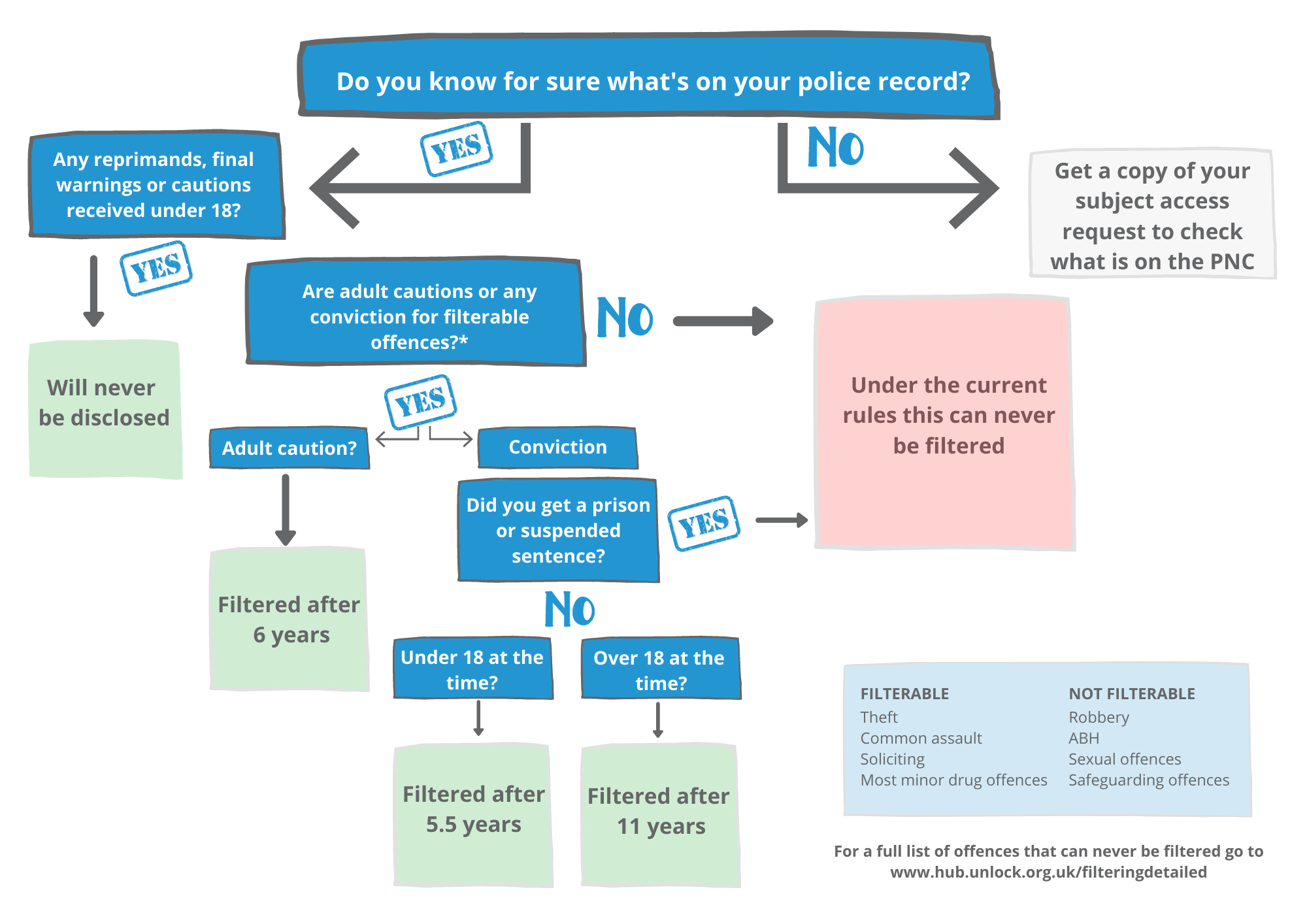
Do you know whether your cautions and/or convictions will be removed from your standard or enhanced DBS? Changes from 28 November

Today (28 November 2020) the long awaited changes to the rules on what is disclosed on (and removed from) standard and enhanced criminal record checks come into effect. This is something Unlock has campaigned for over seven years.

Today we’ve published updated guidance which explains the new rules. You can:

If you’re applying for a job that involves a standard or enhanced Disclosure and Barring Service check, cautions or convictions that would be removed (filtered) won’t be included on your standard or enhanced certificate.

It’s thought that these changes will mean around 45,000 people a year will now have a clear standard or enhanced DBS check, although we know many more people have been put off applying in the past, so we think the number that benefit from these changes will be much higher, so it’s worth finding out whether you’ll be one of them.

More information

Government announces date when planned changes to criminal record disclosure rules will take effect

The government has today confirmed that planned changes to the rules on filtering will come into effect on Saturday 28 November. After years of campaigning for change, and after many months of holding the government to account on the implementation of the changes, the news was confirmed in a letter to Unlock from the Home Office yesterday.

The changes are simple; for jobs and voluntary roles that involve a standard or enhanced criminal record check issued by the Disclosure and Barring Service, childhood cautions will no longer be disclosed, and a rule that meant someone with more than one conviction had all their convictions disclosed, regardless of offence or length of time, has been abolished. For people who have been held back from employment and volunteering to help others because of mistakes they made years ago, the impact will be life changing.

These changes came as a result of a Supreme Court ruling in January 2019 which Unlock intervened in and, according to Home Office data, these changes will mean around 45,000 people a year will now have a clear standard or enhanced DBS check. One in five people who under the old rules would have their criminal records disclosed, will now have a clear certificate.

Some practical points

It’s important to remember that certificates applied for prior to 28 November 2020 will be produced in accordance with the current disclosure rules. Therefore, if you need to apply for a standard or enhanced DBS and you know that you will benefit from the changes being made, we would recommend delaying your application to the DBS until after 28 November.

If you subscribe to the DBS Update Service any cautions or convictions removed from your standard or enhanced certificate after 28 November would not result in a status change. Status changes are only prompted when new information is added, or an offence is changed or amended, whereas an offence which is filtered would result in information being removed. If you wish to have a new DBS certificate which does not disclose your newly removed cautions/convictions, you will need to apply for a new DBS check.

It is important that individuals with a criminal record understand the impact of these changes and we will be publishing updated guidance prior to the changes coming into effect.

We want to make sure that our website is as helpful as possible.

Letting us know if you easily found what you were looking for or not enables us to continue to improve our service for you and others.

Was it easy to find what you were looking for?

Thank you for your feedback.

12.5 million people have criminal records in the UK. We need your help to help them.

Help support us now