
Tag: Sexual offences

For the first time in my adult life, I’m on the way to getting my life back

Michael – Getting accurate information, advice and support enabled me to apply to have my court order discharged

Sexual offence convictions: what you need to know

Aim of this page

Being arrested by the police on suspicion of committing a sexual offence will, for most people, be an extremely stressful and upsetting experience. You are likely to be concerned that rumours and speculation in a case of this type will quickly and irreparably damage your reputation, and about the impact on you and your family.

This information is designed to raise awareness of the things you might need to know, depending on what stage you’re at: whether it’s an allegation, investigation or you have been convicted.

Introduction

Understandably, you will have lots of questions and concerns and the majority of people that contact our helpline after being arrested will ask, “what’s going to happen?”

There are many misconceptions about convictions for sexual offences and how they work in terms of disclosing to employers and others.

It’s important to know:

  • When your conviction becomes spent under the Rehabilitation of Offenders Act and what you’re legally required to disclose to employers if they ask
  • The impact of the sex offenders’ register and any civil order/s on rehabilitation periods

This information aims to cover some of the issues which may arise during the various stages of the criminal justice system and what we believe it’s important to know.

What is a sexual offence?

One of the biggest misconceptions relates to the definition of a sexual offence. Sexual offences cover a wide range of illegal behaviour, including rape and sexual assault, child sexual abuse, prostitution and some forms of pornography:

  • Sexual assault involves touching a person sexually without their consent, or coercing them to engage in sexual behaviour against their will.
  • Child sexual abuse involves forcing or inciting a person under the age of 18 to take part in sexual activity. This can involve physical contact, including non-penetrative acts such as kissing and touching outside of clothing. It can also involve non-contact activities, such as encouraging children to look at sexual images, or grooming a child in preparation for abuse.
  • It is an offence to take, make, possess or distribute indecent images of children. Images can include photographs or video footage, but also drawings, tracings and digitally created images.
  • It is illegal for children under the age of 18 to create or share sexual images of themselves, and for other children to have in their possession an explicit image of a child. Therefore, two 17 year olds in a relationship can be committing a crime by sharing explicit photographs of themselves with each other.
  • There are numerous offences related to prostitution. It is illegal to persistently solicit in public or offer or pay for sexual services; manage a brothel; or incite another person to become a prostitute for gain.
  • Pornographic images that are deemed to be obscene, for example due to including extreme violence, are illegal. It is an offence to disclose private sexual images of another person without their consent (so-called ‘revenge porn’).

Further examples of sexual offences and how the Crown Prosecution Service deal with them can be found here.

Being arrested for a sexual offence

Whenever an allegation of a sexual offence is reported to the police (or they become aware that a sexual offence may have occurred), it will be taken extremely seriously and thoroughly investigated.

Once a crime has been reported the police may invite you to attend a voluntary interview, which would usually take place at a police station. Alternatively, you may be arrested and taken to a local police station for questioning about an alleged offence. Your photograph, fingerprints and DNA will often be taken at this stage.

Whether or not you are guilty of the offence for which you are being questioned the first thing you need to do is to immediately seek legal advice. The police will ask you whether you’d like a duty solicitor to be called but you can ask them to contact a specific solicitor if you have one. An experienced solicitor will support you throughout the investigation and, should the police decide to charge you, they will be able to prepare for and represent you in court.

At the time of your arrest, the police may decide to remove property which they believe may be of interest to their investigation. This will usually include computers, laptops, telephone etc which you own and/or have access to (for example those belonging to your partner). The police will keep your property until their investigation is completed and you will be advised when it can be returned to you.

The police will usually ask about your occupation and any voluntary activities that you are involved in. If your work or voluntary role involves children and/or vulnerable adults or you’ve been arrested, investigated or charged with a ‘relevant offence’ then the police may decide to inform your employer and/or regulatory or licensing body.

Being investigated and charged with a sexual offence

If, following questioning, the police don’t have enough evidence to charge you but they believe they may be able to obtain this evidence over time, you will be released ‘on bail’. You will be asked to return to the police station on a specified date for further questioning at which time you could be charged, freed or re-bailed.

If the police decide to charge you then, depending on the seriousness of the offence, you will either be freed on ‘conditional bail’ or remanded in custody in prison. Bail conditions could include living at a certain address, surrendering your passport to the police or regularly reporting to a designated police station. Contact between you and any co-defendant or the alleged victim of the crime will usually be restricted.

Telling your employer that you’ve been charged

Depending on your occupation or voluntary role, the police may take the decision to inform your employers of your arrest/charge.

If they don’t, then generally there is no obligation on you to tell your employer about a pending conviction unless you are specifically asked to do so; this may be a condition in your contract of employment. However, there may be reasons why you would need to, for example:

  • The removal of devices by the police might make it difficult for you to work, especially if your phone/laptop are the property of your employer.
  • You’re worried that your employer may become aware of it from a third party (for example the police).

There is nothing in law which states that an employer has to dismiss anyone charged with a criminal offence. If you do disclose to your employer, then they will need to consider the nature of the offence, the nature of your job and the extent to which it involves contact with other employees or members of the public. Where a lack of equipment or bail conditions prevent you from doing your job, an employer might consider redeploying you in another part of the business.

Alternatively, they may decide to suspend you until the police investigation is concluded and, in some cases, they may feel that the only option is to disassociate themselves from you especially if they are worried about any potential damage to the reputation of the company or brand.

At a recent Appeal Tribunal [Governing Body of Tubbenden Primary School v Sylvester] a school argued that the reason for dismissing a teacher, who continued her friendship with another teacher arrested for possessing indecent images of children, was the potential damage to the school’s reputation. The Tribunal accepted that the reason for the dismissal was potentially fair.

Being convicted of a sexual offence

Sentence or disposal

If you are found guilty of a sexual offence, various factors will be taken into consideration when determining the sentence or disposal you will receive. Your solicitor will usually be able to give you an indication of what this is likely to be.

However, it’s important to be aware that in addition to a prison sentence or community order, the court may choose to issue you with an additional order relating specifically to sexual offences, for example a Sexual Harm Prevention Order (SHPO). These preventative orders (often referred to as a ‘relevant order’) enable the court to impose prohibitions on those convicted of an offence listed in Schedule 3 or Schedule 5 of the Sexual Offences Act 2003 either in the UK or overseas.

Prohibitions could include:

  • Working with any person under the age of 18 in any capacity.
  • Visiting or residing in any location where a child aged 16 or under is present unless their parent or guardian has knowledge of the offending history.
  • Accessing the internet on a device that does not have approved monitoring software installed.

These orders can potentially have a significant impact on your life, not only because of the prohibitions that they impose but because, as long as they are in force, your conviction cannot be spent under the Rehabilitation of Offenders Act 1974. If you breach any of the prohibitions set out in the order this could result in a return to prison or a further conviction.

Sex offence notification requirements (the Sex Offenders’ Register)

Individuals convicted of a sexual offence will usually be made subject to notification requirements: the Sex Offenders’ Register (SOR). Whilst on the register you must notify the police within three days if you change your name, address or bank account or plan to travel abroad. You must also notify the police if you start regularly staying at another address and if you begin living with a child. The time you spend on the register will be determined by the sentence or disposal you receive. If you receive a prison sentence of 30 months or more, you will be on the register indefinitely although you can ask for this to be reviewed after 15 years has elapsed. Some individuals convicted of sexual offences may also be required to undergo polygraph examinations.

Since 2001 people on the register have been subject to management through the Multi-Agency Public Protection Arrangements, commonly referred to as ‘MAPPA’, This involves the police, probation service and prisons working together, sometimes with other agencies such as social services, to monitor and manage the risk of harm presented by those convicted of sexual and/or violent offences.

Children’s and adults barred list

If you have been working in ‘regulated activity’ and are cautioned or convicted for a relevant offence the DBS may consider adding you to the children and/or adult barred list. If you are on a barred list you will be breaking the law if you apply for or work in regulated activity with a group that you are barred from working or volunteering with.

Having an unspent conviction

It is often at this point that the reality of having a conviction starts to kick in. Up until now, you will have been concentrating on the police investigation and its outcome, the court hearing and then dealing with a prison sentence or the requirements of any community order. Once these are out of the way, the impact of a criminal record and the changes it brings to your life may become clearer.

Depending on your occupation, returning to your previous career may prove problematic. If you’ve always worked with children or vulnerable adults then returning to this type of work with an unspent conviction may be difficult; employers in this sector can be particularly risk averse. Although the thought of working in a new field can be daunting, it doesn’t have to be; you could think of it as an opportunity to start a new career or even your own business.

Convictions for sexual offences can become spent under the Rehabilitation of Offenders Act in the same way as any other conviction. The time it takes to become spent will depend on the sentence or disposal you received. Until the rehabilitation period has elapsed, your conviction will be considered unspent, and you will have to disclose it if asked by a potential employer (or when applying for insurance, or to rent a property or take out a mortgage).

Employment

While your conviction is unspent, you do not have the legal protection of the Rehabilitation of Offenders Act and you will have to disclose your conviction when asked to do so. Since most employers ask at application stage, people with unspent convictions are at immediate risk of discrimination. Many employers carry out Disclosure and Barring Service (DBS) checks and an unspent conviction will be disclosed on all levels of check.

In addition to asking you about your criminal record and carrying out DBS checks there are other ways an employer can find out about your conviction:

  • MAPPA can require you to disclose your conviction to a prospective employer even when the employer does not ask.
  • Employers can do internet searches to find out more about a candidate and this will often reveal details of convictions through online news reports.

We know that people with convictions are at greater risk of employment discrimination than those from other marginalised groups. People with convictions are not offered the legal safeguards of the Equality Act 2010, and prejudice towards them is generally considered acceptable. In 2016, a survey commissioned by the Department of Work and Pensions found that out of 1,849 employers, 50% would not consider employing ‘offenders and ex-offenders’. Unfortunately it appears that employers are particularly averse to hiring people convicted of sexual offences, believing them to be incapable of change and at high risk of reoffending (despite evidence showing that people convicted of sexual offences tend to be less likely to reoffend than those with other types of convictions).

A campaign launched in 2013 by organisations including Unlock, Business in the Community and others, encouraged employers to ‘ban the box’ from application forms, asking instead about criminal convictions at a later stage of the recruitment process. Over 150 employers have now signed up to ban the box. Unlock’s list of friendly employers has identified a number of employers who, either as a result of their recruitment process or company ethics, have a positive attitude towards people with convictions.

Education

If you’re considering applying for a course at university you will usually be asked to disclose ‘relevant’ unspent convictions. Many sexual offences are considered a ‘relevant’ offence and you may be asked to provide additional information relating to your conviction to the university to assist in their decision making process.

If the university believe you pose an unacceptable risk or you would be unable to meet the particular professional or statutory requirement that exists for some courses you may be refused entry or offered an alternative course.

If you are looking to live on campus, the university/police may raise concerns around the safety and impact on you and other students (for example receiving regular visits from the police may highlight the fact that you have a criminal record). Some universities have addressed this issue by offering students the choice of single sex and self-contained accommodation.

Insurance

While your conviction is unspent you will need to disclose it to an insurer if asked. It can be harder to get insurance if you’ve been convicted of a sexual offence and it is likely to be a lot more expensive. However, if you don’t disclose and the insurer were to find out about your conviction they will usually cancel your policy. If you need to make a claim, an insurer can carry out a basic DBS check to establish whether you had an unspent conviction at the time you took out your policy.

Details of motor insurers and insurance brokers who offer policies to individuals with unspent convictions can be found here.

Having a spent conviction

As stated above sexual offences can become spent under the Rehabilitation of Offenders Act (ROA) in the same way as any other conviction.

It’s important to note that the length of time it takes for a conviction to become spent can be different to how long you will be subject to the notification requirements. As a result, it is possible for a conviction  to be ‘spent’ under the ROA but you will still be subject to the notification requirements.

Employment

Once your conviction is spent, you don’t need to disclose it for any job covered by the ROA (even if you are still on the register). Until your notification requirements end, there is always a chance that the police will want a potential employer to know that you are on the register, especially if the job involves working with vulnerable groups.

You will now be able to apply for most jobs safe in the knowledge that if an employer were to carry out a basic DBS check nothing would be disclosed. However, if an employer were to undertake an ineligible check (for example a standard or enhanced DBS instead of a basic) then this could result in them becoming aware of a conviction which, legally, they are not entitled to know about. You may find that once they know about it, they decide to withdraw the job offer. It’s important therefore to be sure that an employer is doing the correct level of check. Our A-Z of job roles and their eligibility for basic, standard and enhanced DBS checks sets out the levels of DBS checks which may be undertaken for various jobs and roles.

You now have some protection under the ROA and employers cannot legally refuse you a job on the basis of a spent conviction. However, in our experience many will give another reason as to why your application has been unsuccessful.

Some employers carry out Google searches as a way of informally checking someone’s criminal record. If there are stories on the internet which relate to your conviction, an employer may be able to find details of your spent conviction which they may not legally be entitled to know about. In May 2014, Google (and other search engines) launched a system whereby individuals can request information about them be removed from search engine results. Google state that they are more likely to consider de-listing results relating to relatively minor offences that happened a long time ago rather than results relating to recent convictions for more serious offences. As the online application form is relatively quick and easy to complete, it may be something worth considering.

If you’re applying for a job which is exempt from the ROA and which requires a standard or enhanced check then spent convictions will be disclosed unless they are eligible for filtering. Although the filtering system was introduced to prevent the disclosure of old and minor cautions and convictions on standard and enhanced DBS certificates, in practice very few sexual offences are eligible for filtering.

Education

As universities usually only ask applicants to disclose unspent convictions when applying for courses, a spent conviction will allow you to apply for a lot more courses without having to disclose your conviction. If you’re considering applying for a course which would involve working with children or vulnerable adults and where an enhanced DBS check would be required (for example a nurse or a teacher) then you would need to disclose your conviction.

The ongoing effects of a sexual offence conviction

Travel

Being on the SOR means that you have to notify the police of all foreign travel. You will need to provide the police with the following information at least seven days prior to your departure:

  • The date of departure from the UK
  • The destination country (or, if there is more than one, the first) and the point of arrival in that country
  • The point(s) of arrival in any countries that will be visited in addition to the initial destination country
  • The carrier(s) you intend to use to leave and return to the UK or to any other point(s) of arrival while you are outside the UK
  • Details of accommodation arrangements for the first night outside the UK
  • The date of re-entry to the UK and point of arrival.

Once you have informed the police, your travel arrangements will be risk assessed and any appropriate action taken – this may include sharing the information with other agencies and countries. Where the police believe ‘a person to be a possible threat to public safety’, they may decide to issue a Green Notice through the Interpol Criminal Information System relating to your criminal record.

If a Green Notice has been issued then customs/immigration will be aware of it when your passport is scanned. This can sometimes result in you being taken to one side (or to an office within the airport) and asked further questions about your visit. Immigration will then decide whether to admit you or deny you entry.

Partners and family

Being convicted of a sexual offence can impact on other family members, especially if they work with or have children of their own.

If your partner’s occupation involves working with children and/or vulnerable adults then the police may feel it necessary to inform their employers of your conviction. If they need an enhanced DBS check then the police may choose to disclose your conviction as police intelligence (sometimes referred to as additional information) if they believe it is necessary. Although this rarely happens, in our experience it can cause partners a huge amount of worry and anxiety as they wait to receive their DBS certificate.

If you have children of your own then depending on the offence you were convicted of, there is a chance that there will be some involvement with children’s services, even if the offence was nothing to do with your own child. A risk assessment may be needed before you will be allowed any unsupervised contact, overnight stays or a return to the family home.

For further information visit our page on relationships, children and dealing with social services.

Employers’ attitudes towards hiring people convicted of sexual offences

In 2020 we worked with the Prison Reform Trust to explore employer’s attitudes towards hiring people convicted of sexual offences. The report “Thinking Differently – Employers’ views on hiring people convicted of sexual offences” can be found here.

The report identified several barriers to employment for people with sexual offence convictions. The majority of employers who responded to our survey were concerned about other employees’ reactions (65%), customer safety (62%) and workplace safety (54%).

The survey identified a range of factors that would make employers more willing to consider hiring people with sexual convictions, with half stating they would feel more confident if they had access to management advice (58%), believed that the applicant wouldn’t reoffend (55%) or knew that the person would be under strict probation supervision (49%). Around a third would be reassured by believing that other workers would accept them (39%) and by knowing that the offence was not ‘too serious’ (30%).

Our findings tentatively suggest that providing employers with some basic information might make them less concerned, in some ways, about hiring people with sexual convictions.

Personal experiences

The personal stories below have been posted on theRecord, our online magazine:

Discuss this with others

Read and share your experiences on our online forum.

Key sections include:

More information

  1. For practical information – Find more information on sexual offences
  2. To read personal stories – You can read stories about this posted on theRecord, our online magazine
  3. To discuss this issue with others – Read and share your experiences on our online forum
  4. Questions – If you have any questions about this, you can contact our helpline.


Applying to a court to end a court order

Aim of this page

This page explains what it means to be given a court order, especially one that doesn’t have an end date (known as an indefinite order). It also outlines how you can apply to change (vary) or cancel (discharge) an order, and what steps you can take to improve your chances of success.

While the focus is on Sexual Offences Prevention Orders and Sexual Harm Prevention Orders, much of the advice here also applies to other types of court orders.

It is part of our information on understanding your criminal record and sexual offences.

Why is this important?

Court orders can seriously affect your private and family life. This isn’t just because of the restrictions they place on you, but also because, while the order is active, your conviction cannot be considered “spent” under the Rehabilitation of Offenders Act 1974.  As a result, you would have to disclose your conviction if asked – for example, when applying for a job or financial services.

If you think the conditions of your order are too strict, or if you’d like the end date changed, you may want to apply to have the order varied or cancelled.

What do we mean by a court order?

A court order is an official decision by a court that tells someone what they must or must not do. These are often called ancillary orders and are usually given alongside other punishments.

Some orders, like compensation orders, are meant to repair the harm caused. Others, such as restraining orders, aim to stop future crimes or protect victims.

In some cases, a judge must issue an ancillary order – for example, someone guilty of causing death by dangerous driving must be disqualified from driving. In other cases, the judge decides whether to give an order, depending on how serious the crime is. In those situations, the prosecution usually asks the judge to make the order.

There are a number of different ancillary orders including:

  • Criminal Behaviour Orders
  • Compensation Orders
  • Confiscation Orders
  • Disqualification from driving
  • Football Banning Orders
  • Forfeiture Orders
  • Restraining Orders
  • Sexual Harm Prevention Orders

What are the implications of having a court order?

Under the Rehabilitation of Offenders Act, court orders can affect when a conviction becomes spent (i.e. no longer needs to be disclosed).

  • A compensation order is only spent once it’s been paid in full.
  • If an order has a set time limit (e.g. 2 years), it becomes spent after that time.
  • If there’s no time given, the default period is 2 years.
  • If the order is indefinite (it has no end date), it will never be spent unless you go back to court to change or cancel it.
  • An indefinite order also means that any other sentence given at the same time will also never be spent.

For example: In court, Robert was convicted of stalking. He was given a fine which would usually mean his conviction would be spent after one year. However, in addition to the fine, he was given an indefinite restraining order meaning his conviction would never be spent until such time as the order was changed or cancelled.

Changing or ending a court order

Anyone named in a court order – including you, the prosecution, or someone protected by the order – can ask the court to change or cancel it. This is allowed by law.

How to apply

To ask for a change (called a “variation”) or to cancel (called a “discharge”) the order:

  • Write to the court that issued the order. Explain that you want to change or cancel it, describe how your situation has changed since the order was made, and why you think the order should be changed or ended.
  • If needed, the court might ask for a Victim Personal Statement to understand what has happened since the order was put in place.
  • You’ll usually get a chance to speak at the court hearing.

Sexual Offences Prevention Order (SOPO) and Sexual Harm Prevention Orders (SHPO)

You can apply to change or cancel a SOPO or SHPO at any time. However, within the first 5 years after it’s made, the court can only fully cancel the order if the local Chief Constable or Police Commissioner agrees. During those 5 years, the court can still change or shorten the order without police permission. After 5 years, the court can cancel the order completely without needing police approval.

If you want to change or cancel and order, it’s best to talk to your Public Protection Unit police officer first. Sometimes changes can be agreed on together before going to court.

What information will I need to include in an application?

When deciding what restrictions to include in an order, the court should make sure that it:

  • Minimises the risk of harm to the public or specific people
  • Is proportionate and necessary
  • Can be enforced effectively

If you think any condition on your order is unfair, unnecessary, or impossible to enforce, you should explain why. For example, if you are trying to find a job, a ban on using the internet would be a big problem.

If you want to change this condition, you should explain the kind of job you want and show examples of useful job websites.

If you’re receiving Jobseekers Allowance or Universal Credit, provide proof of your Job Seekers Agreement and explain how hard it is to apply for jobs without internet access.

If you want to cancel the order completely, you can improve your chances by:

  • Showing that you have sought help for any problems that led to your offending.
  • Explain positive changes you’ve made like moving away from bad influences, getting a job or improving relationship.
  • Proving you have followed all rules of the Sex Offenders Register and the requirements of your SOPO/SHPO.
  • Asking your supervising officer for a ‘clean bill of health’ from police inspections of your devices after any unannounced inspection visits.

Will I need to use a solicitor?

Changing or cancelling a court order is done through a civil court, not a criminal one. This means you can often represent yourself, and court staff can help guide you through the process.

Sometimes, solicitors can represent you using the same legal aid certificate from the original court hearing.

Details of organisations that offer legal advice can be found here.

Discuss this with others

Read and share your experiences on our online forum.

Below you will find links to useful websites relating to this page. More specific details (including addresses and telephone numbers) of some of the organisations listed below can be found here.

  • Ministry of Justice – Government department who have responsibility for the Rehabilitation of Offenders Act

For information

  1. For practical information – More information can be found on our sections on sexual offences and understanding your criminal record
  2. To discuss this issue with others – Read and share your experiences on our online forum
  3. Questions – If you have any questions about this, you can contact our helpline.
This page was last updated in June 2025.


Sexual offences

Sexual offences in brief

There are many misconceptions about sexual offence convictions and how they work in terms of disclosing to employers. It’s important therefore be to clear about:

  • When your conviction becomes spent under the Rehabilitation of Offenders Act and what you’re legally required to disclose to employers, insurers etc.
  • The impact that any civil order (for example a Sexual Harm Prevention Order) will have on the rehabilitation period of your caution or conviction.
  • If you have an indefinite notification or indefinite Sexual Offences Prevention Order (SOPO) or Sexual Harm Prevention order (SHPO), it’s generally worth applying to have them amended or discharged at the appropriate time.
  • Wherever possible, try to develop a good working relationship with your probation officer or supervising police officer. They are likely to be less intrusive or restrictive if you are open and upfront with them.

What is the definition of a sexual offence?

One of the biggest misconceptions relates to the definition of a sexual offence. Sexual offences cover a wide range of illegal behaviour, including rape and sexual assault, child sexual abuse, prostitution and some forms of pornography:

  • Sexual assault involves touching a person sexually without their consent, or coercing them to engage in sexual behaviour against their will.
  • Child sexual abuse involves forcing or inciting a person under the age of 18 to take part in sexual activity. This can involve physical contact, including non-penetrative acts such as kissing and touching outside of clothing. It can also involve non-contact activities, such as encouraging children to look at sexual images, or grooming a child in preparation for abuse.
  • It is an offence to take, make, possess or distribute indecent images of children. Images can include photographs or video footage, but also drawings, tracings and digitally created images.
  • It is illegal for children under the age of 18 to create or share sexual images of themselves, and for other children to have in their possession an explicit image of a child. Therefore, two 17 year olds in a relationship can be committing a crime by sharing explicit photographs of themselves with each other.
  • There are numerous offences related to prostitution. It is illegal to persistently solicit in public or offer to pay for sexual services; manage a brothel; or incite another person to become a prostitute for gain.
  • Pornographic images that are deemed to be obscene, for example due to including extreme violence, are illegal. It is an offence to disclose private sexual images of another person without their consent (so called ‘revenge porn’).

Further examples of sexual offences and how the Crown Prosecution Service deal with them can be found here.

Have you been convicted of a sexual offence?

If you have been convicted of a sexual offence and worried about how this will affect you and your family, you’ll find general information at:

Relevant orders

If you’ve been convicted of a sexual offence, various factors will have been taken into consideration when determining the sentence or disposal you received. It’s important to be aware however that in addition to a prison sentence or community order, the court may choose to issue you with an additional order relating specifically to sexual offences, for example a Sexual Harm Prevention Order (SHPO). These preventative orders (often referred to as a ‘relevant order’) enable the court to impose prohibitions on those convicted of an offence listed in Schedule 3 or 5 of the Sexual Offences Act 2003.

You can find further information at:

Sex offence notification requirements (Sex Offenders’ Register)

In addition to your sentence or disposal, you will usually be made subject to notification requirements: the Sex Offenders’ Register (SOR).

The time you spend on the register will be determined by the sentence or disposal you receive. If you receive a prison sentence of 30 months or more, you will be on the register indefinitely although you can ask for this to be reviewed after 15 years have elapsed.

If you have been convicted of a sexual offence overseas, you could still be made subject to the notification requirements if you return to live in England or Wales. You can find further information at:

Since 2001 people on the SOR have been subject to management through the Multi-Agency Public Protection Arrangements, commonly referred to as ‘MAPPA’.

Children’s and adults barred list

If you have previously worked in ‘regulated activity’ and have been cautioned or convicted for a relevant offence, the DBS may consider adding you to the children and/or adult barred list. If you are on a barred list you will be breaking the law if you apply for or work in regulated activity with a group that you are barred from working or volunteering with.

The ongoing effects of a sexual offence?

Travel

Being on the SOR means that you will have to notify the police of all foreign travel.

Once you have informed the police, your travel arrangements will be risk assessed and any appropriate action taken – this may include sharing the information with other agencies and countries. Where the police believe ‘a person to be a possible threat to public safety’, they may decide to issue a Green Notice through the Interpol Criminal Information System.

If a Green Notice has been issued then customs/immigration will be aware of it when your passport is scanned. Immigration will then decide whether to admit you or deny you entry.

Partners and family

Being convicted of a sexual offence can impact on other family members, especially if they work with or have children of their own.

If your partner’s occupation involves working with children and/or vulnerable adults then the police may feel it necessary to inform their employers of your convictions and it may be disclosed on their enhanced DBS certificate.

If you have children of your own then depending on the offence you were convicted of, there is a chance that there will be some involvement with children’s services, even if the offence was nothing to do with your own child.

Frequently asked questions

No, you can apply to the police force in your local area to vary the registration time under the Sexual Offences Act 2003 (Remedial) Order 2012. They would take a number of factors into consideration in determining a response to your request. See our sex offence notification requirements section.

If you’re travelling abroad, the police may put a notification ‘flag’ on your passport. This can sometimes cause problems if you are using the automated passport control gates at the airport. The gates won’t let you through and an immigration officer will come to speak to you. Some people might find this embarrassing. Therefore, whenever possible, it’s advisable to use a manned gate.

Under the Rehabilitation of Offenders Act, the rehabilitation period is based on the sentence or out of court disposal handed down to you, not the offence that you have been convicted of.

In certain situations, it may be possible to go back to court to get it amended. More details are available here.

The time spent on the SOR would be determined by the custodial element of your sentence, not the suspended part. Therefore, in this case, the time spent on the SOR would be 7 years.

If you’re subject to an extended sentence, the notification period is calculated using the whole term of the sentence. For instance, if you were sentenced to 4 months plus a four month extended supervision period, the whole term would be eight months. The notification period would be 10 years. So in this example, if the total period was over 30 months, you will be on the register for life (but can appeal to come off in the future)

Technically it’s not him that is doing it. One of Facebook’s terms and conditions is “You will not use Facebook if you are a convicted sex offender”.

Notification requirements came into force on 1 September 1997 in the Sex Offenders Act 1997. The Sexual Offences Act 2003 repealed the 1997 Act and made considerable changes to the notification requirements.

The Sexual Offences Act 2003 also reformed and clarified the majority of sexual offences, and those offences/sentences that would mean an individual is placed on the register are listed in Schedule 3 of the Act. The notification requirements apply to anyone convicted or cautioned from 1997 onwards for a Schedule 3 offence and also includes offences committed before that date.

Here you’ll find links to useful organisations and websites related to sexual offences that we refer to in our information and advice. Contact details for the organisations listed below can be found here.

  • Circles UK – A national organisation working to reduce sex offending
  • Lucy Faithfull Foundation – A child protection charity working with people who have convictions for sexual offences
  • Family Rights Group – A charity working with parents in England and Wales who have children in need, at risk or are in the care system. They also advise family members and friends of their rights and options
  • Ministry of Justice  – A Government body who have responsibility for the Rehabilitation of Offenders Act
  • Police.UK – Provides a list of police forces in the UK

Read personal stories

The personal stories below are from people with convictions writing about their experiences of living as a law abiding person with a criminal record.


Information: Relationships, children and dealing with social services

Aim of this page

This information is designed to set out what you may need to consider if you have been convicted of a sexual offence and are looking to start a new relationship. It also looks at how social services may become involved in any new or existing relationship.

Why is this important?

If you have been convicted of a sexual offence, then you will naturally be concerned about disclosing this to a new partner, especially if your partner has children.

Many people with sexual or violent offences will be managed by the police, probation, prison and other professionals in order to protect the public from harm. These arrangements are referred to as MAPPA. As a result of this, the police or probation may chose to share details of your conviction with some of the following organisations:

  • Local authorities
  • Social services
  • Housing providers
  • Children’s services
  • Employers
  • Health services

If the police/probation choose to make a disclosure, then this could potentially have an impact on a new or existing partner, for example if they are working with children or have children of their own.

Its important to recognise that the police/probation may insist that you disclose your conviction to a new partner (or threaten to do it for you). This may also result in social services and/or other organisations becoming involved. Having an awareness of this will hopefully prepare you for dealing with them if, and when, they occur.

Starting a new relationship

For many people, getting a job, somewhere to live and starting a new relationship can all be seen as positive ways of moving on with life following a conviction. However, for anybody who has been convicted of a sexual offence, meeting somebody new can provide additional difficulties.

If you are on licence, you may find that additional conditions are added to it if you are convicted of a sexual offence. For example:

  • To tell your supervising officer if you start a new relationship.
  • To tell your supervising officer if you start a new relationship where the person resides in a house with someone under the age of 18.

If you are subject to notification requirements, you will also need to:

  • Notify the police where you are living in a household with a child under the age of 18. You will also be required to notify when residing or staying in a relevant household for a period of at least 12 hours with a child who is under the age of 18.

If you have any of the above restrictions, or if the police/probation believe that your new partner could be in any way vulnerable, then they will insist that you disclose your conviction to your new partner.

A good probation/public protection officer will give you an opportunity to do this for yourself. However, the time period they give is likely be to weeks rather than months. There is every chance that either the police or your probation officer will require clarification from your new partner that you have disclosed and what you’ve disclosed. It’s therefore in your best interest to be as up front and honest as you can.

Disclosing your conviction to a new partner

Telling somebody about your past can be hard. You may be worried that your new partner will judge you, lose respect for you or put an end to the relationship. Many people who have been convicted of a sexual offence will have no option but to disclose this to a partner, for fear of them finding out some other way. How you disclose will depend on the type of person you are. However there are some things that you may want to consider beforehand.

Tell the story to yourself first. Think about the who, what, where, when, how and why it happened.

Think about the circumstances at the time of the offence. Explain any events that led up to the incident and, more importantly, explain what you’ve done since.

Think about why you are telling your partner now and what impact it might have on them. For example, the possible involvement of social services if they have children.

Don’t immediately leap to the worst case scenario. Imagine step by step what might happen and how you could respond to anything that comes up.

Practice telling your story from beginning to end but don’t be tempted to write a script. You can’t assume how your partner will react so you have to keep the lines of communication open. It might be an idea to practice with somebody who knows the situation.

Meet at a time and place where you can focus entirely on each other. It’s always a good idea to tell your partner when they have time to digest the information, for example a Friday evening when they have the weekend to think about what you’ve told them.

This will certainly be the case if you feel you may have misled your partner in some way by not telling them earlier.

If you feel remorse, show it.

Be prepared for a bad reaction. You partner may shout, cry or be silent. It will probably come as a shock to them. People don’t always mean what they say in situations like this.

Questions from your partner may bring back unpleasant memories but try to answer as best you can. If you find it difficult to talk about, explain this.

Disclosing that you have a criminal record won’t necessarily be the end of the relationship. However, have realistic expectations and give your partner time and space to come to terms with what you’ve told them.

Starting a new relationship if your partner has children

When it becomes known that a person subject to the sex offence notification requirements (on the sex offenders’ register) is sharing the household or, has significant contact with children, then there is every likelihood that children’s services will become involved.

If this is the case, then children’s services will usually wish to carry out a risk assessment under Section 47 of the Children’s Act 1989. The child’s parent/carer will be told of the concerns held and, if it is appropriate, a child protection conference and/or legal proceedings may result.

What would a risk assessment involve?

Risk assessments are undertaken to evaluate:

  • The frequency and extent of your past offending behaviour
  • The level of danger that professional agencies have attributed to you in the past
  • The likely risk to current, future and potential victims
  • Your motivation to change or control your offending behaviour
  • Details of any intervention programmes that you have undertaken.

In addition, an assessment will be made of:

  • Your partner’s willingness and capacity to protect their children
  • Any risk posed to other members of the household or the extended family
  • Any risk posed to members of the wider community.

It is possible that any findings will be shared with other agencies (for example health care professionals, schools etc).

The process can be extremely intrusive and difficult and we have heard of situations where children’s services have threatened to take children into care if a man/woman refuses to break off their relationship with somebody who is on the sex offenders’ register.

Returning to your own family following a conviction for a sexual offence

If you are already a parent at the time you receive a conviction for a sexual offence, then there is a chance that there will be some involvement with children’s services, even if the offence was nothing to do with your own child. A risk assessment may be needed before you will be allowed any unsupervised contact, overnight stays or a return to the family home.

Social workers will be keen to speak to all members of the family together and also separately to ensure that:

  • You want to reintegrate with your family
  • Your family are happy for you to return to the family home and are not being coerced into agreeing to it
  • Key issues surrounding your offending behaviour have been addressed

Having a family of your own

All the time you are on the sex offenders’ register, you stand a good chance of there being some involvement with children’s services if you choose to start a family of your own. Once you come off the register, you should be treated no differently to any other couple looking to start their own family.

Child protection procedures

If children’s services believe that a child may be at risk of harm, they will try to establish what kind of assessment (if any) needs to be carried out and whether they should start a child protection enquiry. The aim of a child protection enquiry is to gather information about a child’s circumstances and decide whether any action is needed to keep them safe and well cared for.

If an enquiry demonstrates that there is no risk of harm to a child, then no further action will be taken. If children’s services feel that the family may benefit from additional support, then they may put some monitoring measures in place. This could be for example, ensuring that a child is never left unsupervised with the person who has a conviction for a sexual offence.

If it is believed that a child is, or is likely to be, suffering significant harm, then an initial child protection case conference will be arranged.

Challenging decisions and making a complaint

Parents, people caring for children, family members who are involved with a child and sometimes children themselves can make a complaint about a decision made by children’s services.

Complaints can be made about:

  • Any of the decisions of or services provided by a social worker or children’s services and
  • Not getting the services or help you or your child needs.

How do you make a complaint?

You can make a complaint by:

  • Arranging a face to face meeting with your designated social worker and discussing your complaint with them. Always follow up what you’ve discussed in writing so that you have a record of it
  • Completing the local authorities online complaints form
  • Writing to or emailing the children’s services complaints department.

In any complaint you should:

  • Put all your issues in one letter rather than writing lots of separate letters as this may come across as you being an habitual complainer
  • Keep your complaint as clear and brief as possible
  • Make sure you explain clearly what you believe children’s services has done wrong, how it has affected your child and what you would ideally like them to do to put things right
  • Keep a copy of the complaint and other relevant information relating to it.

Personal experiences

Discuss this with others

Read and share your experiences on our online forum.

Key sections include:

Below you will find links to useful websites relating to this page. More specific details (including addresses and telephone numbers) of some of the organisations listed below can be found here.

  • Lucy Faithfull Foundation – A child protection charity working with people with convictions for sexual offences
  • Family Rights Group – A charity working with parents in England and Wales who have children in need, at risk or are in the care system

More information

  1. For practical information – More information on sexual offences
  2. To read personal stories – You can read stories about this posted on theRecord, our online magazine, under the tag sexual offences
  3. To discuss this issue with others – Read and share your experiences on our online forum
  4. Questions – If you have any questions about this, you can contact our helpline.
Get involved

Help us to add value to this information. You can:

  1. Comment on this page (below)
  2. Send your feedback directly to us
  3. Discuss your views and experiences with others on our online forum
  4. Share your personal story by contributing to our online magazine, theRecord.

This page was last fully reviewed in June 2025. If you’ve spotted something that needs updating please let us know by emailing advice@unlock.org.uk

Sex offenders notification requirements (The Register)

Aim of this page

This information is designed to provide specific information around convictions for sexual offences. In particular, details of notification requirements, more commonly referred to as the sex offenders’ register.

Why is this important?

There are many misunderstandings about what it means to be subject to notification requirements following a sexual offence conviction. One common assumption is that being on the register means you’ll always need to disclose your conviction, even if it’s spent. This isn’t always the case.

It’s important to understand what your specific notification requirements involve and how they might affect your day-to-day life. However, it’s equally important to know that simply being on the register does not automatically mean you’ll need to disclose your conviction every time someone asks.

Also, if you’ve been convicted of a sexual offence outside the UK, you may still be required to follow notification requirements in England and Wales.

Introduction

The requirement for individuals convicted or cautioned for sexual offences to notify the police of specific personal details (commonly known as the ‘sex offenders’ register’) were first introduced across the UK in the Sex Offenders Act 1997.

This system, which also applied to some past offences, was later updated by Part 2 of the Sexual Offences Act 2003. Under this updated legislation, individuals who meet the criteria must notify certain personal details to the police in their area.

What are the notification requirements?

When the notification requirements were introduced they included:

  • Name and any aliases;
  • Date of birth;
  • National Insurance number;
  • Main address and any addresses at which you may reside for more than 7 days in 12 months;
  • Any changes to the above details.

However, under the Sexual Offences Act 2003 (Notification Requirements) (England & Wales) Regulations 2012, since August 2012 those subject to notification requirements are also required to:

  • Notify the police of all foreign travel;
  • Notify weekly where you are not registered as regularly residing or staying at one place (i.e. where a registered sex offender has no sole or main residence and instead must notify the police of the place where he can regularly be found);
  • Notify where you are living in a household with a child under the age of 18. Under the changes, those subject to the notification requirements will be required to notify when residing or staying in a relevant household for a period of at least 12 hours with a child who is under the age of 18;
  • Notify bank account and credit card details (changes must be notified within 3 days). This has been explained by the Home Office as being necessary to tackle internet child pornography. Whilst the legislation requires notification of bank accounts, credit and debit cards held by the offender or jointly, it does not require details of accounts, credit or debit cards held independently by family members to be provided;
  • Notify information about your passports or other identity documents at each notification. This provision has been put in place purportedly to stop individuals from seeking to avoid being on the register when they change their name.

The above information must be provided in person at a nominated police station within 3 days of your conviction and must be updated on an annual basis. For a list of the police stations which can accept notifications, click here.

As part of the notification process, individuals are also routinely photographed when making a notification.

Bank account information is securely stored by the police. They do not have the right to access or examine your account transactions without obtaining a court order.

It’s important to note that failure to comply with the notification requirement is a criminal offence and may result in a prison sentence of up to five years.

Further information can be found in updated guidance published by the Home Office.

Pay it forward

If you found this page helpful, could you donate £1 to help someone else access our advice and support?

Donate £1 now

How long do the requirements last for?

The length of time someone needs to follow the notification requirements depends on the sentence or disposal received. If the person was under 18 at the time of their conviction or caution, this period is halved.

Notification requirements for extended sentences

If you are given an extended sentence, please note that the notification period is worked out using the full length of the sentence, not just the time spent in prison.

For example:

  • If your sentence is 4 months in prison plus 4 months of extended supervision, the total term is 8 months.
  • This means the notification period will be 10 years, rather than 7 years (which would apply if the sentence was only 4 months in prison).

For further explanation from the Home Office, click here.

Indefinite notification

In April 2010, the UK Supreme Court decided that requiring people to stay on the register indefinitely was unfair. This was because there was no way for individuals to have their situation reviewed. This was incompatible with Article 8 of the European Convention on Human Rights (Right to respect for private and family life).

The ruling meant that people who were placed on the register for life should have the chance to appeal. During this appear, they can show that their risk has reduced to the point where it is no longer necessary for them to remain under these requirements.

In response, the law was updated through the Sexual Offences Act 2003 (Remedial) Order 2012 which came into effect on 30 July 2012. This change gives people on indefinite notification requirements the right to apply to the police for a review after a fixed period of time has passed. Currently, the review periods are:

  • 15 years for adults
  • 8 years for young people (under 18 at the time they were cautioned or convicted).

The time starts from the date the individual makes their first notification to the police.

Breaching notification requirements

Breaching your notification requirements could potentially lead to a fine or a prison sentence. Things that might constitute a breach include:

  • Failing to provide information – not providing the police with details of your passport or bank account.
  • Failing to update information – not notifying the police of a change in circumstances, for example a new address.
  • Lying to the police.
  • Failing to allow your photograph or fingerprints to be taken.
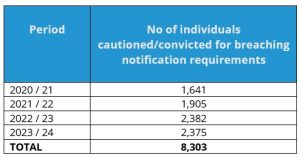
Cautions/convictions for notification breaches since 2020

Appealing an indefinite notification

Any request to review notification requirements will be considered by the police. They will look at a range of factors including information provided from the Responsible Authority and other partner agencies who work together under the Multi-Agency Public Protection Arrangements (MAPPA) framework (under section 325 of the Criminal Justice Act 2003).

The Home Office has published detailed guidance for police forces which you can download here.

If the police decide not to approve your application, you will remain under the current indefinite notification requirements. However, you will have the opportunity to ask for another review once a minimum of 8 years has passed.

When determining your appeal the police will take into consideration matters in section 91d of the 2003 Act, namely:

  • Any information documented and provided to them by the police, probation and the prison service;
  • The risk of sexual harm posed by you and the effect of a continuation of the indefinite notification requirements;
  • The seriousness of the offence(s) that led to you being made subject to notification requirements
  • The period of time that has passed since the offence was committed;
  • Whether you have previously failed to comply with your notification requirements;
  • Your age, both at the time of the application and at the time the offence was committed;
  • Any submission or evidence from the victim; and
  • Any convictions or cautions you have received other than for sexual offences listed in Schedule 3 of the Act.

What you should include in an appeal

In any application you make, you will need to demonstrate:

  • How the circumstances now, compared to those at the time of your offence, have changed meaning that you no longer pose any risk of re-offending.
  • The way you behave now, compared to your behaviour at the time of your offence means that you no longer need to be subject to the notification requirements to manage any risk you pose.

You may also want to consider including some of the following:

  • Details of positive relationships you’ve had with both adults and children.
  • How you fill your time – if you’re employed, how long you’ve been in the same job and what other hobbies and interests you have.
  • Details of any treatment programmes that you’ve attended which are relevant to your offence.
  • Your attitude to your offence and how you make sure that you will not offend again.
  • Any other information that you consider demonstrates that you no longer pose a risk.

What can you do if your appeal is unsuccessful?

If your appeal is not successful and you would like to challenge the police’s decision further, you can take your case to the magistrates court. You will need to do this within 21 days. Please be aware that while your case is ongoing, the indefinite notification requirements will still apply.

It’s also important to know that you may need to pay court fees and, if your appeal is not successful, you might be asked to cover some additional costs. Because of this, we strongly recommend getting independent legal advice before making a decision about going to the magistrates court.

Visits from the police and risk assessments

If you are subject to notification requirements, you are not legally required to let the police into your home when they visit. However, refusing entry may raise concerns and can make it harder for the police to carry out a full risk assessment.

Under Section 58 of the 2006 Violent Crime Reduction Act (which updated the 2003 Sexual Offences Act), the police can apply for a warrant to enter and search your home if they have already tried at least twice to gain entry without success. This means that if entry is refused during a risk assessment under MAPPA, officers may seek a warrant from a magistrate.

To make the process smoother, it is recommended that you cooperate with these visits. They are also a chance for you to ask questions or get advice from your designated Public Protection Unit (PPU) officer on any matters that affect you.

The frequency of visits depends on the assessed level of risk:

  • Lower-risk individuals are usually visited once a year.
  • Higher-risk individuals may be visited more often, up to monthly in the most serious cases.

Violent and sex offenders’ register (ViSOR)

ViSOR is a secure database used to help keep communities safe. It contains records about:

  • People who must follow the rules set out in the Sexual Offences Act 2003.
  • People who have been given a prison sentence of more than 12 months for violent crime.
  • People who may be considered at risk of committing serious offences, even if they have not been convicted.

The database can only be accessed by the police, probation and prison services. Staff from private companies who manage prisons are also granted secure access.

Travelling abroad whilst under notification requirements

If you live in England or Wales you will need to notify the police of all foreign travel. You will need to attend the police station at least 7 days prior to departure and provide the following information:

  • The date of departure from the UK;
  • The destination country (or, if there is more than one, the first) and the point of arrival in that country;
  • The point(s) of arrival in any countries that will be visited in addition to the initial destination country;
  • The carrier(s) you intend to use to leave and return to the UK or to any other point(s) of arrival while you are outside the UK (but not internal flights);
  • Details of accommodation arrangements for the first night outside the UK;
  • The date of re-entry to the UK and point of arrival.

Keeping your details up to date – If any of your travel details change, you must let the police know at least 24 hours before leaving the UK.

If you don’t yet know your return date – If you can’t provide the date you’ll come back to the UK or the point of arrival prior to departure, you must share this information within 3 days of returning to the UK.

If you are on licence – You must ask your probation officer for permission to travel.

Your travel plans – Your travel arrangements will be risk assessed. In some cases, the information may be shared with other agencies or countries. The police will look at whether there are risks of further offences being committed abroad, which may put children or adults in danger, and effect the ‘reputation of UK law enforcement agencies’.

Remember, it’s a criminal offence not to notify the police of your travel plans. This could result in a prison sentence of up to five years.

Interpol notices

Interpol introduced it’s International Notice System in 1946 to help countries share important information across borders.

A Green Notice is one type of Interpol notice. It is usually shared to alert countries about someone whose past activities suggest they might pose a risk to others’ safety. These notices help law enforcement exchange key information worldwide and support efforts to keep communities safe.

Interpol can publish a notice on its own or at the request of its member countries. Notices should only be issued when there is reliable information that a person has committed, is committing or plans to commit a serious offence.

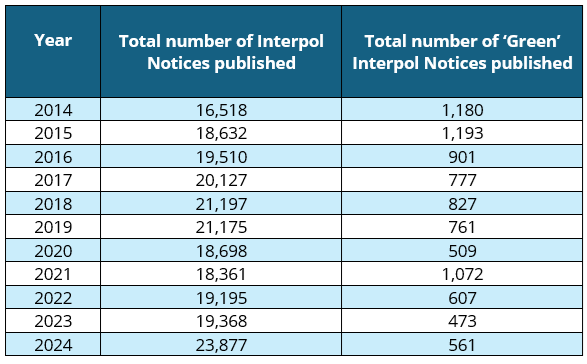
Green notices issued since 2014

Notification requirements for sexual offences committed overseas

In the UK, people who have been convicted of a sexual offence are automatically required to follow certain notification rules.

These rules can also apply to British citizens and foreign nationals who have been convicted of a similar offence outside the UK. In these cases, the police in England and Wales may issue a notice that requires the individual to provide the same information as if the conviction had happened in the UK.

A police officer with the rank of inspector of higher can issue such a notice when specific conditions are met. Local police may do so if the person lives in their area, is currently there, or is believed to be planning a visit.

According to Home Office guidance, the decision to issue a notice will usually be based on intelligence that the person is in, or is planning to come to, the UK and is likely to stay.

This power to issue notices in England and Wales was introduced by the Police, Crime, Sentencing and Courts Act 2022. Before this, the police could only apply to the magistrates court to request an order be put in place.

The conditions

Three conditions must be met before the police can serve a notice.

  1. Under the law in force outside the UK, the individual has been convicted of a “relevant offence” (whether or not they have been punished for it).
  2. The individuals received the conviction:
    • on or after 1 September 1997
    • before the 1 September 1997 and had yet to be dealt with in respect of the offence, or
    • before the 1 September 1997 but was on that date, in respect of the offence or finding, subject to imprisonment, a community sentence supervision, detention in hospital under the law of the country in question.
  3. The equivalent notification period that would have applied had the offence been committed in the UK would not have expired.

The notification period

An individual who is served a notice must make an initial notification within 3 days of the notice being served.

The length of the notification will depend on the type of sentence or disposal an individual would have received if a UK court had convicted them.

The notification period is counted from the date of the caution or conviction, even if the notification order is made years later.

Appeals

An individual can apply to the magistrates court to appeal against the decision to give them a notice.

Discuss with others

Read and share your experiences on our online forum.

Key sections include:

Below you will find links to useful websites relating to this page. More specific details (including addresses and telephone numbers) of some of the organisations listed below can be found here.

  • Circles UK – A national organisation working to reduce sex offending
  • Lucy Faithfull Foundation – A child protection charity working with people with convictions for sexual offences

More information

  1. For practical information – More information on sexual offences
  2. To discuss this issue with others – Read and share your experiences on our online forum
  3. Questions – If you have any questions about this you can contact our helpline.


Information: General information about sexual offences

Aim of this page

This information is designed to provide specific information around convictions for sexual offences, in particular civil orders which may run alongside a caution or a conviction. We have specific information on notification requirements.

Why is this important?

There are many misconceptions about convictions for sexual offences and how they work in terms of disclosing to employers. You should make sure that you are clear about:

  • When your conviction becomes spent under the Rehabilitation of Offenders Act and what you’re legally requested to disclose to employers, insurers etc.
  • The impact of the sex offenders’ register and any civil order on rehabilitation periods.

Introduction

This information gives an overview of the relevant legislation relating to those with convictions for sexual offences. We have separate information on notification requirements and barring.

The Rehabilitation of Offenders Act 1974

Sexual offences can become spent under the Rehabilitation of Offenders Act in the same way as any other conviction. It depends on the sentence that was received.

The ROA and notification requirements

It’s important to note that the length of time it takes for a conviction to become spent is usually different to how long you may be subject to the notification requirements. As a result, it is possible for a conviction to be ‘spent’ under the ROA, but you will still be subject to the notification requirements.

The ROA and Sexual Offences Prevention Orders (SOPO’s) or Sexual Harm Prevention Orders (SHPO’s)

The view of the Ministry of Justice is that SOPO’s and SHPO’s fall within the definition of an “order that imposes prohibition”, so the rehabilitation period ends on the date when the prohibition ceases to have effect (if it’s the longest one). This will depend on the length of the SOPO/SHPO. This means that a conviction cannot become spent until the SOPO/SHPO that relates to that conviction ends.

It follows that if a SOPO/SHPO is imposed for an indefinite period, then it will be subject to disclosure indefinitely, until the SOPO/SHPO is ended in some way (for example going back to court to get the end date amended).

On licence for a sexual offence

If you have been released on licence it means that you will serve the rest of your sentence in the community.

Your licence gives specific instructions on what you must do and the conditions that you must follow. You may be taken back to prison if you do not follow the rules. This may be because you have offended again or broken some other conditions; this is called a breach of licence.

For more information and advice about being on licence for a sex offence, the Prison Reform Trust have published a useful leaflet.

Civil orders – SOPO’s, SHPO’s and SRO’s

On the 8th May 2015, the Sexual Offences Act 2003 was amended, making changes to the provisions dealing with behaviour orders to be imposed following complaint or conviction for a sexual offence. The following orders were repealed at that time:

  • Sexual Offences Prevention Orders
  • Risk of Harm Orders
  • Foreign Travel Orders

They were replaced with:

  • Sexual Harm Prevention Orders
  • Sexual Risk Orders

Sexual Offences Prevention Orders (SOPO’s)

Until March 2015, a Sexual Offences Prevention Order (SOPO) was a civil order created by the Sexual Offences Act 2003 to replace Restraining Orders and Sex Offender Orders available through the Sex Offenders Act 1997.

Read more about SOPO’s.

Sexual Harm Prevention Orders (SHPO’s)

A Sexual Harm Prevention Order (SHPO) is a preventative order enabling a court to impose prohibitions on an individual who has been:

‘Convicted, found not guilty by reason of insanity or found to be under a disability and to have done the act charged, or cautioned etc for an offence listed in Schedule 3 or Schedule 5 of the Sexual Offences Act 2003 either in the UK or overseas’

They replaced SOPO’s in March 2015.

Sexual Risk Order (SRO)

A Sexual Risk Order (SRO) is a civil order which can be sought by the police against an individual who has not been convicted, cautioned etc of a Schedule 3 or Schedule 5 offence but who is nevertheless thought to pose a risk of harm.

Foreign travel restrictions

SHPO’s and SRO’s may contain foreign travel prohibitions, where this is necessary for the purpose of protecting children or vulnerable adults abroad. Restrictions can include:

  • A prohibition on travelling to any country outside the UK named or described in the order
  • A prohibition on travelling to any country outside the UK, other than a country named or described in the order, or
  • A prohibition on travelling to any country outside the UK.

An individual subject to a SHPO or SRO prohibiting them from travelling to all countries outside the UK will be required to surrender their passport at a police station specified in the order. It is an offence for the individual to fail to surrender their passport as required by the order.

It is important to note that the activity which would constitute causing harm to the child or vulnerable adult does not have to be illegal in the foreign country where it is intended to take place. For example, a SHPO or SRO can prevent an individual from travelling to a foreign country to engage in sexual activity with a child aged 14 even if sexual activity with a child aged 14 is not an offence in the country concerned.

Notification orders

Notification orders (not to be confused with the notification requirements) require those convicted of sexual offences overseas to register with the UK police, in the same manner as those convicted in the UK.

The police may apply to the court for the order in relation to individuals already in or intending to enter the UK. These orders will not apply to the majority of people convicted of sexual offences already resident in the UK as they will already have been subject to the notification requirements from the point of conviction. The number of applications for notification orders is therefore relatively low compared to the use of Sexual Offences Prevention Orders.

Personal experiences

The personal stories below have been posted on theRecord, our online magazine.

Read Alex’s story about living day to day with a sexual offence order – Functioning on a daily basis with a sexual offences order

Duncan writes about the ongoing discrimination of a sexual offence – Food for thought at the food bank – An old sexual offence getting in the way of collecting food

Discuss with others

Read and share your experiences on our online forum

Key sections include:

Below you will find links to useful websites relating to this page. More specific details (including addresses and telephone numbers) of some of the organisations listed below can be found here.

  • Circles UK – A national organisation working to reduce sex offending
  • Lucy Faithfull Foundation – A child protection charity working with people with convictions for sexual offences

More information

  1. For practical information – More information on sexual offences
  2. To read personal stories – You can read stories about this posted on theRecord, our online magazine, under the tag sexual offences
  3. To discuss this issue with others – Read and share your experiences on our online forum
  4. Questions – If you have any questions about this, you can contact our helpline.

Get involved

Help us to add value to this information. You can:

  1. Comment on this page (below)
  2. Send your feedback directly to us
  3. Discuss your views and experiences with others on our online forum
  4. Share your personal stories by contributing to our online magazine, theRecord


We want to make sure that our website is as helpful as possible.

Letting us know if you easily found what you were looking for or not enables us to continue to improve our service for you and others.

Was it easy to find what you were looking for?

Thank you for your feedback.

12.5 million people have criminal records in the UK. We need your help to help them.

Help support us now