Type: Advice Update

Is it worth applying to your local council for a taxi licence if you have a criminal record?

As anybody with a criminal record knows, finding paid work can be difficult and so, for many, self-employment can be very attractive. If you enjoy driving, then becoming a taxi driver could be one option for you to consider.

You will need an operator’s licence which you can apply for through your local council or from Transport for London (TfL) if you want to work in the capital. You will also usually need:

  • To have held a full UK or EEA driving licence for at least 12 months (3 years in London)
  • An enhanced Disclosure and Barring Service check
  • To be over 18 (21 in some areas)
  • Pass a geographical test
  • Complete a driving skills assessment

For further information visit driving licences for taxi’s and private hire vehicles.

The need for an enhanced criminal record check will often deter people from applying for these types of licences with many individuals assuming they will automatically be refused. But, is this right?

A Freedom of Information request undertaken recently by a Welsh newspaper looked at the number of taxi licences applied for through Cardiff Council. The results showed that they had received over 1,000 applications between January 2012 and September 2016 with 176 of these listing some type of conviction which were considered by the Council’s Public Protection Sub-committee. Of these 176, over 50% of applications were granted a licence.

A spokesperson for the Council said:

Each application is determined on its own merits and consideration is given to the seriousness of the offence, the sentence imposed, whether there is a pattern of offending and any other facts that may be relevant’

Although the FOI report in this instance related to Cardiff Council, our experience from calls to our helpline has shown that significant numbers of people applying for taxi licences who have a criminal record are successful.

There are usually taxi and private hire driving opportunities in every part of the country. Some companies will expect you to own your own car but many will give you the opportunity to rent a car from them. The job allows you to work flexible hours and, with drivers in many towns earning approximately £20K per year for a 40 hour week – this may be just the job for you.

So, if you’re interested in getting a taxi licence, a DBS check shouldn’t be the thing that stops you from applying.

For more information

  1. For practical self-help information – More information is available on our criminal record checks for employment (including DBS) section and A-Z of job roles and their eligibility for basic, standard and enhanced criminal record checks
  2. Questions – If you have any questions about this, you can contact theHelpline.


Trustee or senior manager of a charity and have convictions? Are you affected by the Charities Act 2016?

People with convictions play an important role in many charities, particularly those working in the criminal justice sector. Becoming a trustee or leading a charity as part of the senior management team are important roles that people with convictions should be encouraged to take on, and we know it can provide people with a positive pro-social identity.

That’s why for the last few years, we’ve taken an active interest in the extensions to the rules that have become law through the Charities (Protection and Social Investment) Act 2016. I’ve just published a blog on our main website to cover some of the background to where we are now, and help you to understand whether you’re affected.

Monthly summary – October 2016

Welcome to our monthly summary for October 2016.

This provides a summary of:

  1. the latest updates to our self-help information site for people with convictions
  2. recent posts to our online magazine, theRecord
  3. other news and developments that might be of interest to people with a criminal record

Have you just stumbled across this? You can receive these updates direct to your inbox every month for free by signing up to our mailing list (make sure you choose to receive ‘news for people with convictions’)


Updates to our information site

Here’s a summary of the updates that we’ve made recently to the theInformationHub. There are links within each update to where you can find more information about the update. There are also links next to many of the updates, which link to threads on our online forum where you can discuss these with other people with convictions. 

Work and volunteering

  • Spent and unspent convictions and employment law – We’ve updated our information on spent and unspent convictions and employment law which aims to set out the legal actions open to you if you come across any type of discrimination when applying for work.

Information on the internet, online and through search engines like Google

  • Are you affected by the online publication of your spent convictions? Possible legal remedies – We’re currently working with a law firm specialising in media law, Carter-Ruck, who are willing to advise people affected by having their spent convictions published online on a ‘no win no fee’ basis. Find out further information here.

Specific types of offences

  • Is there anything stopping you applying to come off the Sex Offenders Register if you’ve got an indefinite registration requirement – As a result of a Freedom of Information request carried out by BBC News, we’ve used this to produce some information highlighting the number of applications received for removal from the Sex Offenders Register which have been approved across a range of police forces in the UK.

Travel

  • Travelling to Australia – Following information received from the Migration Institute of Australia, we’ve updated our information on travelling to Australia.

theRecord posts

Below are links to recent posts to our online magazine, theRecord. These are often linked to from the practical information that we have, to help give some personal experiences.

Success – Harnessing my anger to help myself and others – Becoming a teacher with a criminal record  – ‘Having grown up with an alcoholic and abusive father, I struggled to behave like a normal teenager. On reflection, I now appreciate how angry I was that nobody was trying to help me out of the dreadful situation I was in and my unwillingness to be ‘normal’ was undoubtedly my way of rebelling …..’

Struggles and stigma – Food for thought at the food bank – An old sexual offence getting in the way of collecting food‘I’ve just been released from prison having completed two years of a four year sentence. The offence I was convicted of happened when I was 14 years old. I’m now 31. During the past 17 years I’ve never been in trouble with the police. I’m married to a wonderful lady, we have a son and I’ve worked hard to provide for both of them. However, due to my conviction being for a sexual offence, I’m on the sex offenders register for life and can’t apply to come off it for 15 years …..’

News A big thank you to Maureen – The power of peer support ‘It was the anniversary of my release from prison yesterday and these words came to mind “It’s time to build a bridge and walk over it”. This was my first introduction to solution focused thinking …..’

Other news and developments

Below are links to other news and developments that might be of interest to people with a criminal record. For more news, check out the news and media section of our main website.

New dates announced for our popular Advising with Conviction workshops

We’ve just released some dates for our Advising with Conviction workshops taking place in 2017. These one day workshops are endorsed by the Probation Institute and The Institute of Employability Professionals.

Some examples of people we’ve helped

We’ve written up some examples of how people with convictions are able to overcome some of the barriers they have faced as a result of their criminal records. Read Evan, Jeremy and Kevin’s stories here.

Autumn 2016 Activities Newsletter

Our Autumn 2016 Activities Newsletter provides a update of what’s been happening at Unlock over the past three months. Visit here to download the newsletter.

Trial for November – the helpline will open until 7pm each Wednesday.

We’ll be running a trial throughout November, extending our helpline opening hours until 7pm. More information about the trial can be found here.

Can employment law help you if you’re refused a job or been badly treated by your employer as a result of your criminal record?

Anybody with a criminal record will, at one time or another, have come across some form of negativity or discrimination when applying for work.

Many employers simply don’t know enough about criminal record disclosure legislation and have little understanding of what they can and can’t do.

If your conviction is spent, then you will have some rights under the Rehabilitation of Offenders Act (ROA). If however it is unspent or, you are applying for jobs which are exempt from the ROA, then you will have very little legal protection.

If you have been refused a job or been treated badly in the workplace as a result of your criminal record then it’s important that you are clear about what, if any, legal remedies are available to you.

We have updated our information on spent and unspent convictions and employment law which aims to set out the legal options open to you if you find yourself in one of the situations described above.

For more information

Trial for November – the helpline will be open until 7pm each Wednesday

Our helpline is the forefront of the direct support that we provide, and since we launched it in 2008 it’s only ever been open during normal office working hours.

As part of providing information, advice and support for people with convictions, we’re always looking at ways to improve and make it more accessible.

We have decided to run a trial of extending the opening hours of the helpline.

So for November, we’re going to keep the helpline open until 7pm each Wednesday. Given the way the days fall in November, it means for  5 weeks we’ll be open on Wednesday until 7pm. The dates in November this will apply to are the 2nd, 9th, 16th, 23rd and 30th.

As a team, we’re going to split the extra working hours between us and crucially, we’ll keep a track on the number of calls we receive and try and find out why people have called us at that time. That should give us a good sense of whether there’s any demand in the future and what benefits it bring to those that call during those times.

Help us raise awareness

It’s now important for us to raise awareness of this trial so that people know they can call us on these dates after our normal 4pm closing time. That’s why we’ve written this post, and we’ll be tweeting using the hashtag #unlockhelpline – help us spread awareness as best as you can.

After the trial, we’ll reflect and post an update on here to let you know how it went and what we plan to do next.

Is there anything stopping you applying to come off the Sex Offenders Register if you’ve got an indefinite registration requirement?

A Freedom of Information (FOI) request undertaken by BBC News earlier this year, showed that around 50% of applications allowed under a review process (introduced in 2010 to allow people to apply to be removed from the sex offenders register) were successful. The same FOI request stated that approximately 700 people on the register had successfully applied to be removed from it over the past 4 years.

We thought this was interesting because, although there are many reasons why people are not successful, this was the first time we had seen figures that show the number that had been successful in their application to be removed from the register.

The Sexual Offences Act 2003 made anybody sentenced to more than 30 months in prison subject to indefinite notification requirements, without any opportunities for review.

However, in 2010, the Supreme Court ruled that under human rights laws, individuals should have the opportunity to prove that they are reformed and changes were made to allow individuals to seek a review after 15 years.

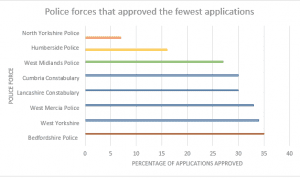
When the review process first came in, the Home Office issued guidance to all police forces  which highlighted that before considering removing somebody from the register, officers should conduct a ‘robust review’ and be ‘satisfied that it is not necessary, for the purpose of protecting the public from the risk of sexual harm’ for a sex offender to continue to be on the register. However, one of the more surprising things to come out of the FOI was to show how police forces interpret the guidance very differently. For example, in North Wales 90% of requests to be removed from the register were successful whilst Dyfed-Powys did not approve any requests.

forces-that-approve-the-most-requests

forces-that-approve-the-least

Dyfed-Powys and the City of London Police did not approve any requests

As the charts above show, although there appears to be a certain amount of disparity in how requests are dealt with, our advice to anybody with an indefinite notification requirement would be to request a review as soon as you are able to.

In you application, you will need to demonstrate:

  • How the circumstances now, compared to those at the time of your offence, have changed meaning that you no longer pose any risk of reoffending.
  • The way you behave now, compared to your behaviour at the time of your offence means that you no longer need to be subject to the notification requirements to manage any risk you pose.

You may also want to consider including some of the following:

  • Details of positive relationships you’ve had with both adults and children.
  • How you fill your time – if you’re employed, how long you’ve been in the same job and what other hobbies and interests you have.
  • Details of any treatment programmes that you’ve attended which are relevant to your offence.
  • Your attitude to your offence and how you make sure that you will not offend again.
  • Any other information that you consider demonstrates that you no longer pose a risk.

If the police determine that your application should be refused, then you will continue to remain subject to indefinite notification requirements. You will be able to seek a further review after a minimum of 8 years has elapsed.

For more information

Applying for work through recruitment agencies

With so many employers advertising temporary and permanent jobs through recruitment agencies, we’ve published some new information, applying for work through a recruitment agency.

As agencies only get paid once they’ve placed a successful applicant with an employer, some agencies may be tempted to weed out anybody who has disclosed a criminal record to them. It’s important to understand therefore how and when you should disclose.

Our new information also lists some recruitment agencies who deal specifically with helping people with convictions back into work. In addition to the usual range of services offered by an agency, they can often assist you in putting a CV together, preparing you for interviews and offering advice around disclosing your criminal record. Some, like Working Chance, also seek to change the attitudes of employers towards people with a criminal record.

However, don’t limit yourself to only signing up with these specialists. Most agencies will have exclusive access to jobs which you would not be able to find through online searches. You might only be looking for an introduction to these companies, and securing a job will be down to how well you can sell yourself to the employer.


For more information

  1. For practical self-help information – More information is available on our disclosing to employers and looking for (and keeping) work sections
  2. To read personal stories – You can read stories about this posted on theRecord, our online magazine
  3. To discuss this issue with others – Read and share your experiences on our online forum
  4. Questions – If you have any questions about this, you can contact our helpline.

Monthly summary – September 2016

Welcome to our monthly summary for September 2016.

This provides a summary of:

  1. the latest updates to our self-help information site for people with convictions
  2. recent posts to our online magazine, theRecord
  3. other news and developments that might be of interest to people with a criminal record

Have you just stumbled across this? You can receive these updates direct to your inbox every month for free by signing up to our mailing list (make sure you choose to receive ‘news for people with convictions’)


Updates to our information site

Here’s a summary of the updates that we’ve made recently to the theInformationHub. There are links within each update to where you can find more information about the update. There are also links next to many of the updates, which link to threads on our online forum where you can discuss these with other people with convictions. 

Work and volunteering

  • Applying for work through a recruitment agency – Many individuals with a criminal record will look to use the services of a recruitment agency to get into work. However, some agencies may be tempted to weed out people who disclose a conviction. We’ve produced some new information setting out how and when to disclose details of your criminal record along with details of agencies who specifically help people with convictions.

Rehabilitation of Offenders Act

  • Long list of sentences/disposals and how long it takes for them to become spent under the ROA – We’ve updated this page to make it easier to navigate and included links to other relevant parts of the site.

Travel

  • Travelling to Japan – We’ve put together some information which sets out the entry requirements for travelling to Japan and highlights when you may be asked to disclose details of your criminal record.

Insurance

  • List of motor insurers for people with non-motoring convictions – We’ve recently discovered that as part of their online service, Admiral now ask a question about criminal, as well as motoring convictions. We’ve updated our list of motor insurers and removed Admiral from it.

theRecord posts

Below are links to recent posts to our online magazine, theRecord. These are often linked to from the practical information that we have, to help give some personal experiences.

Struggles and stigma – ‘Let me put that in writing to you’ – Why you should always confirm your criminal record in writing what you’ve said verbally  – ‘Back in 2011, I was arrested and charged. As a result of this, I lost my job and fell into deep despair. Anxiety issues followed and ultimately depression took hold. I was lucky that I still had my close friends and family for support but I struggled with guilt and couldn’t really cope …..’

SuccessKnitting stopped me unravelling! And now it’s a business ‘I’m 68 years of age and happily married. I’m well educated and achieved academic success. Oh, just one more thing. In March 2012, I was given a four year prison sentence for attempted fraud …..’

SuccessFor better or worse – my relationship with a sex offender ‘Two years ago my life changed when I met a new man. He was kind, gentle, easy to talk to and made me laugh. The day after out first ‘date’ I received a text message from him that read “I need to tell you something but it needs to be in person …..’

Other news and developments

Below are links to other news and developments that might be of interest to people with a criminal record. For more news, check out the news and media section of our main website.

Unlock launches its website to help employers recruit people with convictions

Our new website, Recruit, was launched this month. The new site is targeted at employers and aims to encourage and support them to recruit people with criminal records. Read our full press release.

Official launch of updated online forum to support people with convictions

Today Unlock officially launches its updated online forum to support people in overcoming the stigma of their criminal record.

Christopher Stacey, Co-director of Unlock said:

“Although there’s over 10.5 million people in the UK with a criminal record, it can often feel like a lonely place when you’re struggling with the stigma and discrimination that can come with a criminal record. Problems can unexpectedly come up many years after, including practical issues like disclosing your record to employers, finding insurance and going on holiday. The sense of isolation and lack of confidence can compound this problem. That’s why we’re delighted to launch our updated forum, as we know it’s a great way for people to share their experiences, motivate others, highlight examples of bad practice and help push for changes”.

The forum, which was originally set up over seven years ago, has over 2,600 members who, between them, have made 22,384 posts.

Commenting on the re-design, Debbie Sadler, Advice Manager at Unlock and project lead for the recent update, said:

“The forum provides a fantastic community for people with convictions to get information, advice and support from others who have been in similar situations. After 7 years, the forum needed a bit of a face lift and some restructuring to make it better able to meet the needs of people with a criminal record. The new forum is certainly more user-friendly and will hopefully help us to reach and involve more people with convictions, as well as being a big hit with our existing members”.

theForum offers people with convictions the chance to:

  • Engage in a positive, peer-to-peer community
  • Provide and receive information, advice and support in overcoming the stigma of a criminal record
  • Share positive experiences and inspirational stories

Jamie, a person with a criminal record who used Unlock’s previous forum said:

“I joined the forum when it first started 7 yeas ago. I saw it as a way of talking with and listening to other people with convictions who had between them a vast amount of experience and were prepared to share their advice with others who were trying to find that all important break and re-build their lives. The forum provides a form of support which, over the years, has been invaluable. The more people with convictions that know about this, the better.

For more information

  1. You can visit the forum or find out further information
  2. A poster that promotes theForum can be found here
  3. There is further information about the recent changes to the forum.

New website for employers

Yesterday we launched a unique website to encourage and support companies to recruit people with criminal records.

Over 10.5 million people in the UK have a criminal record and many face stigma and discrimination when applying for work, despite having put the past behind them. Unlock’s work with employers over many years has highlighted the significant business benefits of employing people with convictions. Yet recruiters often struggle to understand complex criminal record disclosure legislation and don’t know what they can and can’t do, with policies and processes that often discourage applicants. Although nine out of ten employers have said that they’re open to the idea of recruiting people with convictions, in practice less than 20% say they have knowingly done so.

The new website aims to deal with this by:

  1. Supporting employers in recruiting people with convictions
  2. Helping companies to deal with criminal records fairly
  3. Sharing good practice (such as Ban the Box)
  4. Providing free guidance and tools
  5. Showing what other employers are doing

Read our full press release.

We want to make sure that our website is as helpful as possible.

Letting us know if you easily found what you were looking for or not enables us to continue to improve our service for you and others.

Was it easy to find what you were looking for?

Thank you for your feedback.

12.5 million people have criminal records in the UK. We need your help to help them.

Help support us now