This page explains which organisations can access the Police National Computer (PNC) and how they use the information from it. It also sets out how the PNC is regulated and monitored. It forms part of our sharing of criminal records and criminal record databases sections.
Why is this important?
It is important to know which organisations can access information about your criminal record other than the police. This can be relevant for a range of situations, for example applying for a job or getting a travel visa.
It is also useful to understand what measures are in place to ensure that your information is stored safely and appropriately.
The Police National Computer (PNC)
The PNC is the computer system for England and Wales governed by section 27(4) of the Police and Criminal Evidence Act 1984. It is used to record convictions, cautions, reprimands and warnings for any offence punishable by imprisonment and any other offence that is specified within the regulations.
As the PNC has developed and grown, the number of users have grown with it. In 1992, the DVLA and HM Customs and Excise were the only organisations with direct access to the PNC for ‘read only’ purposes. Today, as well as servicing the needs of the 43 police forces in England and Wales and 8 forces in Scotland and Northern Ireland, other smaller police forces and specialist units also have access to the PNC as do a number of non-police agencies.
Requests for access to the PNC are decided upon by the PNC Information Access Panel (PIAP) which is made up of a cross section of expertise from different forces who meet to consider each application for access to the PNC. Any organisation given access will be asked to sign a “Supply Agreement” and a “Code of Connection”.
Organisations with full access to the PNC
Having full access to the PNC allows an organisation to read and update records. However the PNC Administrator in each organisation will set up access levels specific to an individual’s role within the organisation.
This includes:
All territorial police forces in England and Wales
Other police organisations, including the Police Service of Northern Ireland, Police Scotland, Isle of Man Constabulary, States of Guernsey Police Agency and States of Jersey Police
National Police Chiefs Council
British Transport Police
Civil Nuclear Constabulary
Defence Intelligence Staff
GCHQ
National Identification Service
National Crime Agency
Ministry of Defence Police
The Security Service (MI5)
The Secret Intelligence Service (MI6)
Non-police organisations which have restricted access to the PNC
Most non-police organisations will only have ‘read only’ access to the PNC. This is the part which holds information about criminal records. They will not be able to amend or remove any information, but are granted access in order to perform specific tasks. Some only have access to one database such as the DVLA with its access to vehicle information and some only have access to names of people with a criminal record rather than the full record.
A customs officer, for example, has described how they use the PNC:
‘We’re able to use the PNC to gain background information … what we want to know is if someone we suspect – say of drugs smuggling – has a criminal record or if a vehicle has any markers against it. So we have limited access to the PNC database for vehicles and names’.
In prisons, use of the PNC mean that staff are able to assess and categorise newly arrived prisoners.
Other non-police organisations with restricted access to the PNC include:
Access Northern Ireland
Charity Commission for England and Wales
Children and Family Court Advisory and Support Service
Community Rehabilitation Companies (CRC’s)
Criminal Cases Review Commission
Defence Vetting Agency
Department for Business, Energy and Industrial Strategy
Department for Environment, Food and Rural Affairs
Department for Transport
Department for Work and Pensions
Disclosure and Barring Service
Disclosure Scotland
Driver and Vehicle Licensing Agency
Environment Agency
Financial Conduct Authority
Foreign and Commonwealth Office
Gangmasters and Labour Abuse Authority
G4S
Health and Safety Executive
Highways Agency
HM Courts & Tribunals Service
Her Majesty’s Prison Service
Her Majesty’s Revenue and Customs
Home Office
Independent Police Complaints Commission
States of Jersey Customs and Immigration Service
Mersey Tunnels Police
Ministry of Justice
National Air Traffic Service
National Health Service
National Probation Service
Office for Civil Nuclear Security
Office of Fair Trading
Royal Mail
Royal Air Force Police
Royal Marines Police
Royal Military Police
Royal Navy Police
United Kingdom Border Agency
Vehicle and Operator Services Agency
How is use of the PNC regulated?
Strict rules and regulations are imposed on the use of the PNC due to the confidential and often sensitive nature of its contents.
If an organisation wants to apply for access, it must submit a detailed proposal outlining its requirements to the PNC Information Access Panel (PIAP). Users must complete a series of e-learning modules and take at least a five-day training course on how to view data and conduct basic queries. Further training is required in order to gain greater levels of access and carry out more sophisticated queries.
There are rules on how information obtained through the PNC can be shared. For example, it cannot be distributed by email.
Has a level of access appropriate to its needs and function
Uses the database in a way that complies with strict procedures
Makes efficient and effective use of the PNC
How is abuse and misuse of the PNC dealt with?
Since 2011, HMIC has carried out inspections into non-police force usage of the PNC. Resulting reports have revealed occasional instances of misuse and illegal access. For example, some organisations have continued to access the computer after their initial contract has expired.
Unauthorised use or misuse can result in dismissal and a court appearance.
Discuss this with others
Read and share your experiences on our online forum.
Below you will find links to useful websites relating to this page. More specific details (including addresses and telephone numbers) of some of the organisations listed below can be found here.
This information is designed to set out what you may need to consider if you have been convicted of a sexual offence and are looking to start a new relationship. It also looks at how social services may become involved in any new or existing relationship.
Why is this important?
If you have been convicted of a sexual offence, then you will naturally be concerned about disclosing this to a new partner, especially if your partner has children.
Many people with sexual or violent offences will be managed by the police, probation, prison and other professionals in order to protect the public from harm. These arrangements are referred to as MAPPA. As a result of this, the police or probation may chose to share details of your conviction with some of the following organisations:
Local authorities
Social services
Housing providers
Children’s services
Employers
Health services
If the police/probation choose to make a disclosure, then this could potentially have an impact on a new or existing partner, for example if they are working with children or have children of their own.
Its important to recognise that the police/probation may insist that you disclose your conviction to a new partner (or threaten to do it for you). This may also result in social services and/or other organisations becoming involved. Having an awareness of this will hopefully prepare you for dealing with them if, and when, they occur.
Starting a new relationship
For many people, getting a job, somewhere to live and starting a new relationship can all be seen as positive ways of moving on with life following a conviction. However, for anybody who has been convicted of a sexual offence, meeting somebody new can provide additional difficulties.
If you are on licence, you may find that additional conditions are added to it if you are convicted of a sexual offence. For example:
To tell your supervising officer if you start a new relationship.
To tell your supervising officer if you start a new relationship where the person resides in a house with someone under the age of 18.
If you are subject to notification requirements, you will also need to:
Notify the police where you are living in a household with a child under the age of 18. You will also be required to notify when residing or staying in a relevant household for a period of at least 12 hours with a child who is under the age of 18.
If you have any of the above restrictions, or if the police/probation believe that your new partner could be in any way vulnerable, then they will insist that you disclose your conviction to your new partner.
A good probation/public protection officer will give you an opportunity to do this for yourself. However, the time period they give is likely be to weeks rather than months. There is every chance that either the police or your probation officer will require clarification from your new partner that you have disclosed and what you’ve disclosed. It’s therefore in your best interest to be as up front and honest as you can.
Disclosing your conviction to a new partner
Telling somebody about your past can be hard. You may be worried that your new partner will judge you, lose respect for you or put an end to the relationship. Many people who have been convicted of a sexual offence will have no option but to disclose this to a partner, for fear of them finding out some other way. How you disclose will depend on the type of person you are. However there are some things that you may want to consider beforehand.
Tell the story to yourself first. Think about the who, what, where, when, how and why it happened.
Think about the circumstances at the time of the offence. Explain any events that led up to the incident and, more importantly, explain what you’ve done since.
Think about why you are telling your partner now and what impact it might have on them. For example, the possible involvement of social services if they have children.
Don’t immediately leap to the worst case scenario. Imagine step by step what might happen and how you could respond to anything that comes up.
Practice telling your story from beginning to end but don’t be tempted to write a script. You can’t assume how your partner will react so you have to keep the lines of communication open. It might be an idea to practice with somebody who knows the situation.
Meet at a time and place where you can focus entirely on each other. It’s always a good idea to tell your partner when they have time to digest the information, for example a Friday evening when they have the weekend to think about what you’ve told them.
This will certainly be the case if you feel you may have misled your partner in some way by not telling them earlier.
If you feel remorse, show it.
Be prepared for a bad reaction. You partner may shout, cry or be silent. It will probably come as a shock to them. People don’t always mean what they say in situations like this.
Questions from your partner may bring back unpleasant memories but try to answer as best you can. If you find it difficult to talk about, explain this.
Disclosing that you have a criminal record won’t necessarily be the end of the relationship. However, have realistic expectations and give your partner time and space to come to terms with what you’ve told them.
Starting a new relationship if your partner has children
When it becomes known that a person subject to the sex offence notification requirements (on the sex offenders’ register) is sharing the household or, has significant contact with children, then there is every likelihood that children’s services will become involved.
If this is the case, then children’s services will usually wish to carry out a risk assessment under Section 47 of the Children’s Act 1989. The child’s parent/carer will be told of the concerns held and, if it is appropriate, a child protection conference and/or legal proceedings may result.
What would a risk assessment involve?
Risk assessments are undertaken to evaluate:
The frequency and extent of your past offending behaviour
The level of danger that professional agencies have attributed to you in the past
The likely risk to current, future and potential victims
Your motivation to change or control your offending behaviour
Details of any intervention programmes that you have undertaken.
In addition, an assessment will be made of:
Your partner’s willingness and capacity to protect their children
Any risk posed to other members of the household or the extended family
Any risk posed to members of the wider community.
It is possible that any findings will be shared with other agencies (for example health care professionals, schools etc).
The process can be extremely intrusive and difficult and we have heard of situations where children’s services have threatened to take children into care if a man/woman refuses to break off their relationship with somebody who is on the sex offenders’ register.
Returning to your own family following a conviction for a sexual offence
If you are already a parent at the time you receive a conviction for a sexual offence, then there is a chance that there will be some involvement with children’s services, even if the offence was nothing to do with your own child. A risk assessment may be needed before you will be allowed any unsupervised contact, overnight stays or a return to the family home.
Social workers will be keen to speak to all members of the family together and also separately to ensure that:
You want to reintegrate with your family
Your family are happy for you to return to the family home and are not being coerced into agreeing to it
Key issues surrounding your offending behaviour have been addressed
Having a family of your own
All the time you are on the sex offenders’ register, you stand a good chance of there being some involvement with children’s services if you choose to start a family of your own. Once you come off the register, you should be treated no differently to any other couple looking to start their own family.
Child protection procedures
If children’s services believe that a child may be at risk of harm, they will try to establish what kind of assessment (if any) needs to be carried out and whether they should start a child protection enquiry. The aim of a child protection enquiry is to gather information about a child’s circumstances and decide whether any action is needed to keep them safe and well cared for.
If an enquiry demonstrates that there is no risk of harm to a child, then no further action will be taken. If children’s services feel that the family may benefit from additional support, then they may put some monitoring measures in place. This could be for example, ensuring that a child is never left unsupervised with the person who has a conviction for a sexual offence.
If it is believed that a child is, or is likely to be, suffering significant harm, then an initial child protection case conference will be arranged.
Challenging decisions and making a complaint
Parents, people caring for children, family members who are involved with a child and sometimes children themselves can make a complaint about a decision made by children’s services.
Complaints can be made about:
Any of the decisions of or services provided by a social worker or children’s services and
Not getting the services or help you or your child needs.
How do you make a complaint?
You can make a complaint by:
Arranging a face to face meeting with your designated social worker and discussing your complaint with them. Always follow up what you’ve discussed in writing so that you have a record of it
Completing the local authorities online complaints form
Writing to or emailing the children’s services complaints department.
In any complaint you should:
Put all your issues in one letter rather than writing lots of separate letters as this may come across as you being an habitual complainer
Keep your complaint as clear and brief as possible
Make sure you explain clearly what you believe children’s services has done wrong, how it has affected your child and what you would ideally like them to do to put things right
Keep a copy of the complaint and other relevant information relating to it.
Below you will find links to useful websites relating to this page. More specific details (including addresses and telephone numbers) of some of the organisations listed below can be found here.
Lucy Faithfull Foundation– A child protection charity working with people with convictions for sexual offences
Family Rights Group– A charity working with parents in England and Wales who have children in need, at risk or are in the care system
More information
For practical information – More information on sexual offences
To read personal stories – You can read stories about this posted on theRecord, our online magazine, under the tag sexual offences
To discuss this issue with others – Read and share your experiences on our online forum
Despite relaxing the recruitment rules to allow for a more inclusive and diverse police force, the police still have very strict entry requirements.
It’s important to be aware of the criteria that the police use to make their recruitment decisions and whether you are likely to meet them. Some convictions/cautions will result in an outright rejection whilst others will be considered on a case by case basis.
Entry routes for police constables
There are currently four main routes into the police service.
Apprenticeship – You can join as a constable and follow an apprenticeship in professional policing practice. This route will usually take three years and will involve both on and off-the-job learning.
Degree-holder entry – If you already have a degree (it doesn’t matter which subject) you can join and follow a work-based programme, supported by off-the-job learning. This route will usually take two years.
Pre-join degree – If you’d prefer to study first, you can do a three year degree in professional policing (at your own expense) and then apply to a police force and follow a shorter on-the job training programme.
‘Traditional’ Initial Police Learning Development Programme (IPLDP) – This is the original route into the police force and is gradually being replaced with the three new entry routes set out above. You will need to apply directly to the force and then undertake a two year programme.
What is the eligibility criteria for the role of a police officer?
The College of Policing has produced guidance for the recruitment of police officers which can be found here.
There are various criteria you must meet in relation to age, financial situation and tattoos/body piercings but our information will concentrate on criminal records.
Criminal records
The checks they carry out
Police force’s will carry out thorough checks on you, your spouse or partner, close relatives such as parents, in-laws, children or others residing or associated with you. They will check the Police National Computer (PNC), Criminal History System (CHS), Criminal Information System (CIS), local intelligence and other relevant non-conviction databases. Where appropriate they will also check military and police professional standards databases as well.
Depending on the role that you may be carrying out when you join the police force, a Counter Terrorism Check (CTC) may be carried out.
If you are applying to a police force outside the area where you live, your residing force may be asked to conduct checks on you using their systems and local intelligence databases.
The Rehabilitation of Offenders Act 1974 does not apply to the police. Therefore, you will need to disclose all spent and unspent convictions, including those that are filtered. The police will conduct a search of the PNC, so they will be aware of all cautions/convictions (even those which would be eligible for filtering).
A case heard at the Court of Appeal in October 2020 ruled that all would-be police officers must disclose all convictions and cautions including those received as a child. The judges stated that disclosure is “necessary in a democratic society” to prevent crime.
Police forces will use the guidance provided to assess each application on an individual basis and eligibility will depend on the nature and circumstances of the offence.
In May 2019, the College of Policing produced a guide to APP Vetting which provides information on the vetting procedures which are applied to police forces in England and Wales.
The Rehabilitation of Offenders Act 1974 (Exceptions) Order 1975 does not apply to police officers. Police forces are therefore entitled to ask applicants to reveal spent convictions during the recruitment or vetting process.”
For vetting purposes, a check will be made of the Police National Computer, the Police National Database and other intelligence databases. Any cautions or convictions which are ‘protected’ (eligible for filtering off standard and enhanced DBS checks) would also need to be disclosed.
How are convictions/cautions dealt with?
On 12 October 2017 the new Police Vetting Code of Practice was published, replacing the previous 2012 policy. The Code applies to all police forces in England and Wales.
It emphasises the importance of maintaining high ethical and professional standards and of police officers acting with the utmost integrity, for which purpose a thorough vetting regime is essential. It sets out a number of principles, including Principle 12 which states:
Public confidence may be affected if an officer has a previous conviction or caution, therefore there is a rebuttable presumption that a person will not be suitable for appointment as a police officer or special constable if they have a previous conviction or caution for a criminal offence, especially if it relates to dishonest or corrupt practices, or violence. Factors that may weigh against this presumption being applied in individual cases include the nature and severity of the offence, the person’s age at the time they committed the offence, and the length of time since the offence was committed. Each case must be considered on its own merits including both the individual’s role in the offence and the nature of the conviction or caution. This presumption applies to police staff roles with designated powers or roles where there is a likelihood of being in the evidential chain.”
The Code adds that an application for a position as a police officer, or as a member of police staff where the person may be in the evidential chain, are to be rejected in all cases where an offence, whether committed as an adult or child, resulted in a custodial sentence (including a suspended sentence) or where the applicant is a registered sex offender or subject to a registration requirement.
Undisclosed convictions
Where the police suspect that you have failed to declare a conviction or caution, enquiries will be made to ascertain whether the conviction or caution is attributable to you. Enquiries will be made to the relevant court to ensure that the conviction has not been overturned on appeal. Where it is established that you have deliberately failed to disclose a conviction or caution, then your application will probably by rejected.
If you disclose an outstanding charge or summons, your application will probably be put on hold until the outcome is known, at which point it will be considered in accordance with the guidance above.
HM Forces convictions
If you are a serving member of the armed forces and have been convicted of any criminal offence by a military tribunal, this will be recorded on the PNC. This will include any aspect of a conditional discharge. Any convictions obtained whilst in the armed forces will be considered in accordance with the guidance.
Relatives and associates with criminal convictions or cautions
Where your relatives or associates are found to have unspent convictions or cautions for recordable offences, the following will be considered:
The likelihood that your performance and discharge of duty will be adversely affected e.g. through adverse pressure or a conflict of interests.
The nature, number and seriousness of the offences or involvement in criminal activity and the time over which these took place.
Whether the circumstances are likely to bring discredit to or embarrass the Police Service or Police Force.
Vetting for candidates who have been living or are resident abroad
The police will carry out recruitment vetting procedures on all applicants to determine your suitability to have access to sensitive and classified information. This applies to all applicants (including United Kingdom nationals who have been living abroad, Commonwealth and foreign applicants).
If you are living or have recently lived abroad then the police will make checks looking for at least a 3 year checkable history.
If you cannot be vetted then your application will not be successful.
Vetting for non-police personnel
The police will carry out recruitment vetting procedures on all “persons employed for the purposes of, or to assist the constables of, a police force established under any enactment”. You can be asked about both unspent and spent cautions and convictions and they can be considered in the vetting process. However, you shouldn’t be asked to disclose protected (filtered) cautions and convictions and they shouldn’t be considered in the vetting process.
Discuss this with others
Read and share your experiences on our online forum.
Below you will find links to useful websites relating to this page. More specific details (including addresses and telephone numbers) of some of the organisations listed below can be found here.
This page was last fully reviewed and updated in November 2016. If you’ve spotted something that needs updating, please let us know by emailing the details to advice@unlock.org.uk
Sex offenders notification requirements (The Register)
This information is designed to provide specific information around convictions for sexual offences. In particular, details of notification requirements, more commonly referred to as the sex offenders’ register.
Why is this important?
There are many misunderstandings about what it means to be subject to notification requirements following a sexual offence conviction. One common assumption is that being on the register means you’ll always need to disclose your conviction, even if it’s spent. This isn’t always the case.
It’s important to understand what your specific notification requirements involve and how they might affect your day-to-day life. However, it’s equally important to know that simply being on the register does not automatically mean you’ll need to disclose your conviction every time someone asks.
Also, if you’ve been convicted of a sexual offence outside the UK, you may still be required to follow notification requirements in England and Wales.
Introduction
The requirement for individuals convicted or cautioned for sexual offences to notify the police of specific personal details (commonly known as the ‘sex offenders’ register’) were first introduced across the UK in the Sex Offenders Act 1997.
This system, which also applied to some past offences, was later updated by Part 2 of the Sexual Offences Act 2003. Under this updated legislation, individuals who meet the criteria must notify certain personal details to the police in their area.
What are the notification requirements?
When the notification requirements were introduced they included:
Name and any aliases;
Date of birth;
National Insurance number;
Main address and any addresses at which you may reside for more than 7 days in 12 months;
Notify weekly where you are not registered as regularly residing or staying at one place (i.e. where a registered sex offender has no sole or main residence and instead must notify the police of the place where he can regularly be found);
Notify where you are living in a household with a child under the age of 18. Under the changes, those subject to the notification requirements will be required to notify when residing or staying in a relevant household for a period of at least 12 hours with a child who is under the age of 18;
Notify bank account and credit card details (changes must be notified within 3 days). This has been explained by the Home Office as being necessary to tackle internet child pornography. Whilst the legislation requires notification of bank accounts, credit and debit cards held by the offender or jointly, it does not require details of accounts, credit or debit cards held independently by family members to be provided;
Notify information about your passports or other identity documents at each notification. This provision has been put in place purportedly to stop individuals from seeking to avoid being on the register when they change their name.
The above information must be provided in person at a nominated police station within 3 days of your conviction and must be updated on an annual basis. For a list of the police stations which can accept notifications, click here.
As part of the notification process, individuals are also routinely photographed when making a notification.
Bank account information is securely stored by the police. They do not have the right to access or examine your account transactions without obtaining a court order.
It’s important to note that failure to comply with the notification requirement is a criminal offence and may result in a prison sentence of up to five years.
Further information can be found in updated guidance published by the Home Office.
Pay it forward
If you found this page helpful, could you donate £1 to help someone else access our advice and support?
The length of time someone needs to follow the notification requirements depends on the sentence or disposal received. If the person was under 18 at the time of their conviction or caution, this period is halved.
Notification requirements for extended sentences
If you are given an extended sentence, please note that the notification period is worked out using the full length of the sentence, not just the time spent in prison.
For example:
If your sentence is 4 months in prison plus 4 months of extended supervision, the total term is 8 months.
This means the notification period will be 10 years, rather than 7 years (which would apply if the sentence was only 4 months in prison).
For further explanation from the Home Office, click here.
Indefinite notification
In April 2010, the UK Supreme Court decided that requiring people to stay on the register indefinitely was unfair. This was because there was no way for individuals to have their situation reviewed. This was incompatible with Article 8 of the European Convention on Human Rights (Right to respect for private and family life).
The ruling meant that people who were placed on the register for life should have the chance to appeal. During this appear, they can show that their risk has reduced to the point where it is no longer necessary for them to remain under these requirements.
In response, the law was updated through the Sexual Offences Act 2003 (Remedial) Order 2012 which came into effect on 30 July 2012. This change gives people on indefinite notification requirements the right to apply to the police for a review after a fixed period of time has passed. Currently, the review periods are:
15 years for adults
8 years for young people (under 18 at the time they were cautioned or convicted).
The time starts from the date the individual makes their first notification to the police.
Breaching notification requirements
Breaching your notification requirements could potentially lead to a fine or a prison sentence. Things that might constitute a breach include:
Failing to provide information – not providing the police with details of your passport or bank account.
Failing to update information – not notifying the police of a change in circumstances, for example a new address.
Lying to the police.
Failing to allow your photograph or fingerprints to be taken.
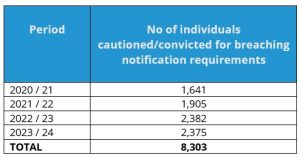
Cautions/convictions for notification breaches since 2020
Appealing an indefinite notification
Any request to review notification requirements will be considered by the police. They will look at a range of factors including information provided from the Responsible Authority and other partner agencies who work together under the Multi-Agency Public Protection Arrangements (MAPPA) framework (under section 325 of the Criminal Justice Act 2003).
The Home Office has published detailed guidance for police forces which you can download here.
If the police decide not to approve your application, you will remain under the current indefinite notification requirements. However, you will have the opportunity to ask for another review once a minimum of 8 years has passed.
When determining your appeal the police will take into consideration matters in section 91d of the 2003 Act, namely:
Any information documented and provided to them by the police, probation and the prison service;
The risk of sexual harm posed by you and the effect of a continuation of the indefinite notification requirements;
The seriousness of the offence(s) that led to you being made subject to notification requirements
The period of time that has passed since the offence was committed;
Whether you have previously failed to comply with your notification requirements;
Your age, both at the time of the application and at the time the offence was committed;
Any submission or evidence from the victim; and
Any convictions or cautions you have received other than for sexual offences listed in Schedule 3 of the Act.
What you should include in an appeal
In any application you make, you will need to demonstrate:
How the circumstances now, compared to those at the time of your offence, have changed meaning that you no longer pose any risk of re-offending.
The way you behave now, compared to your behaviour at the time of your offence means that you no longer need to be subject to the notification requirements to manage any risk you pose.
You may also want to consider including some of the following:
Details of positive relationships you’ve had with both adults and children.
How you fill your time – if you’re employed, how long you’ve been in the same job and what other hobbies and interests you have.
Details of any treatment programmes that you’ve attended which are relevant to your offence.
Your attitude to your offence and how you make sure that you will not offend again.
Any other information that you consider demonstrates that you no longer pose a risk.
What can you do if your appeal is unsuccessful?
If your appeal is not successful and you would like to challenge the police’s decision further, you can take your case to the magistrates court. You will need to do this within 21 days. Please be aware that while your case is ongoing, the indefinite notification requirements will still apply.
It’s also important to know that you may need to pay court fees and, if your appeal is not successful, you might be asked to cover some additional costs. Because of this, we strongly recommend getting independent legal advice before making a decision about going to the magistrates court.
Visits from the police and risk assessments
If you are subject to notification requirements, you are not legally required to let the police into your home when they visit. However, refusing entry may raise concerns and can make it harder for the police to carry out a full risk assessment.
Under Section 58 of the 2006 Violent Crime Reduction Act (which updated the 2003 Sexual Offences Act), the police can apply for a warrant to enter and search your home if they have already tried at least twice to gain entry without success. This means that if entry is refused during a risk assessment under MAPPA, officers may seek a warrant from a magistrate.
To make the process smoother, it is recommended that you cooperate with these visits. They are also a chance for you to ask questions or get advice from your designated Public Protection Unit (PPU) officer on any matters that affect you.
The frequency of visits depends on the assessed level of risk:
Lower-risk individuals are usually visited once a year.
Higher-risk individuals may be visited more often, up to monthly in the most serious cases.
Violent and sex offenders’ register (ViSOR)
ViSOR is a secure database used to help keep communities safe. It contains records about:
People who must follow the rules set out in the Sexual Offences Act 2003.
People who have been given a prison sentence of more than 12 months for violent crime.
People who may be considered at risk of committing serious offences, even if they have not been convicted.
The database can only be accessed by the police, probation and prison services. Staff from private companies who manage prisons are also granted secure access.
Travelling abroad whilst under notification requirements
If you live in England or Wales you will need to notify the police of all foreign travel. You will need to attend the police station at least 7 days prior to departure and provide the following information:
The date of departure from the UK;
The destination country (or, if there is more than one, the first) and the point of arrival in that country;
The point(s) of arrival in any countries that will be visited in addition to the initial destination country;
The carrier(s) you intend to use to leave and return to the UK or to any other point(s) of arrival while you are outside the UK (but not internal flights);
Details of accommodation arrangements for the first night outside the UK;
The date of re-entry to the UK and point of arrival.
Keeping your details up to date – If any of your travel details change, you must let the police know at least 24 hours before leaving the UK.
If you don’t yet know your return date – If you can’t provide the date you’ll come back to the UK or the point of arrival prior to departure, you must share this information within 3 days of returning to the UK.
If you are on licence – You must ask your probation officer for permission to travel.
Your travel plans – Your travel arrangements will be risk assessed. In some cases, the information may be shared with other agencies or countries. The police will look at whether there are risks of further offences being committed abroad, which may put children or adults in danger, and effect the ‘reputation of UK law enforcement agencies’.
Remember, it’s a criminal offence not to notify the police of your travel plans. This could result in a prison sentence of up to five years.
Interpol notices
Interpol introduced it’s International Notice System in 1946 to help countries share important information across borders.
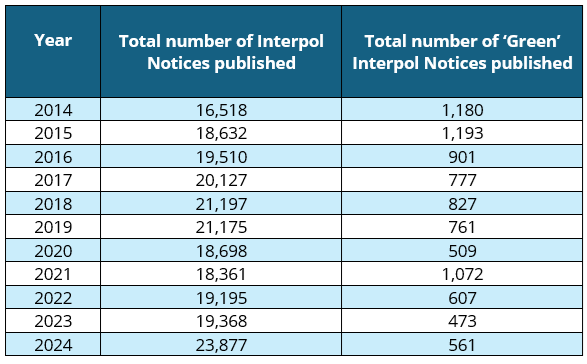
A Green Notice is one type of Interpol notice. It is usually shared to alert countries about someone whose past activities suggest they might pose a risk to others’ safety. These notices help law enforcement exchange key information worldwide and support efforts to keep communities safe.
Interpol can publish a notice on its own or at the request of its member countries. Notices should only be issued when there is reliable information that a person has committed, is committing or plans to commit a serious offence.
Green notices issued since 2014
Notification requirements for sexual offences committed overseas
In the UK, people who have been convicted of a sexual offence are automatically required to follow certain notification rules.
These rules can also apply to British citizens and foreign nationals who have been convicted of a similar offence outside the UK. In these cases, the police in England and Wales may issue a notice that requires the individual to provide the same information as if the conviction had happened in the UK.
A police officer with the rank of inspector of higher can issue such a notice when specific conditions are met. Local police may do so if the person lives in their area, is currently there, or is believed to be planning a visit.
According to Home Office guidance, the decision to issue a notice will usually be based on intelligence that the person is in, or is planning to come to, the UK and is likely to stay.
This power to issue notices in England and Wales was introduced by the Police, Crime, Sentencing and Courts Act 2022. Before this, the police could only apply to the magistrates court to request an order be put in place.
The conditions
Three conditions must be met before the police can serve a notice.
Under the law in force outside the UK, the individual has been convicted of a “relevant offence” (whether or not they have been punished for it).
The individuals received the conviction:
on or after 1 September 1997
before the 1 September 1997 and had yet to be dealt with in respect of the offence, or
before the 1 September 1997 but was on that date, in respect of the offence or finding, subject to imprisonment, a community sentence supervision, detention in hospital under the law of the country in question.
The equivalent notification period that would have applied had the offence been committed in the UK would not have expired.
The notification period
An individual who is served a notice must make an initial notification within 3 days of the notice being served.
The length of the notification will depend on the type of sentence or disposal an individual would have received if a UK court had convicted them.
The notification period is counted from the date of the caution or conviction, even if the notification order is made years later.
Appeals
An individual can apply to the magistrates court to appeal against the decision to give them a notice.
Discuss with others
Read and share your experiences on our online forum.
Below you will find links to useful websites relating to this page. More specific details (including addresses and telephone numbers) of some of the organisations listed below can be found here.
Circles UK– A national organisation working to reduce sex offending
Lucy Faithfull Foundation– A child protection charity working with people with convictions for sexual offences
More information
For practical information – More information on sexual offences
To discuss this issue with others – Read and share your experiences on our online forum
This information is designed to provide specific information around convictions for sexual offences, in particular civil orders which may run alongside a caution or a conviction. We have specific information on notification requirements.
Why is this important?
There are many misconceptions about convictions for sexual offences and how they work in terms of disclosing to employers. You should make sure that you are clear about:
When your conviction becomes spent under the Rehabilitation of Offenders Act and what you’re legally requested to disclose to employers, insurers etc.
The impact of the sex offenders’ register and any civil order on rehabilitation periods.
Introduction
This information gives an overview of the relevant legislation relating to those with convictions for sexual offences. We have separate information on notification requirements and barring.
The Rehabilitation of Offenders Act 1974
Sexual offences can become spent under the Rehabilitation of Offenders Act in the same way as any other conviction. It depends on the sentence that was received.
The ROA and notification requirements
It’s important to note that the length of time it takes for a conviction to become spent is usually different to how long you may be subject to the notification requirements. As a result, it is possible for a conviction to be ‘spent’ under the ROA, but you will still be subject to the notification requirements.
The ROA and Sexual Offences Prevention Orders (SOPO’s) or Sexual Harm Prevention Orders (SHPO’s)
The view of the Ministry of Justice is that SOPO’s and SHPO’s fall within the definition of an “order that imposes prohibition”, so the rehabilitation period ends on the date when the prohibition ceases to have effect (if it’s the longest one). This will depend on the length of the SOPO/SHPO. This means that a conviction cannot become spent until the SOPO/SHPO that relates to that conviction ends.
It follows that if a SOPO/SHPO is imposed for an indefinite period, then it will be subject to disclosure indefinitely, until the SOPO/SHPO is ended in some way (for example going back to court to get the end date amended).
On licence for a sexual offence
If you have been released on licence it means that you will serve the rest of your sentence in the community.
Your licence gives specific instructions on what you must do and the conditions that you must follow. You may be taken back to prison if you do not follow the rules. This may be because you have offended again or broken some other conditions; this is called a breach of licence.
For more information and advice about being on licence for a sex offence, the Prison Reform Trust have published a useful leaflet.
Civil orders – SOPO’s, SHPO’s and SRO’s
On the 8th May 2015, the Sexual Offences Act 2003 was amended, making changes to the provisions dealing with behaviour orders to be imposed following complaint or conviction for a sexual offence. The following orders were repealed at that time:
Sexual Offences Prevention Orders
Risk of Harm Orders
Foreign Travel Orders
They were replaced with:
Sexual Harm Prevention Orders
Sexual Risk Orders
Sexual Offences Prevention Orders (SOPO’s)
Until March 2015, a Sexual Offences Prevention Order (SOPO) was a civil order created by the Sexual Offences Act 2003 to replace Restraining Orders and Sex Offender Orders available through the Sex Offenders Act 1997.
‘Convicted, found not guilty by reason of insanity or found to be under a disability and to have done the act charged, or cautioned etc for an offence listed in Schedule 3 or Schedule 5 of the Sexual Offences Act 2003 either in the UK or overseas’
They replaced SOPO’s in March 2015.
Sexual Risk Order (SRO)
A Sexual Risk Order (SRO) is a civil order which can be sought by the police against an individual who has not been convicted, cautioned etc of a Schedule 3 or Schedule 5 offence but who is nevertheless thought to pose a risk of harm.
Foreign travel restrictions
SHPO’s and SRO’s may contain foreign travel prohibitions, where this is necessary for the purpose of protecting children or vulnerable adults abroad. Restrictions can include:
A prohibition on travelling to any country outside the UK named or described in the order
A prohibition on travelling to any country outside the UK, other than a country named or described in the order, or
A prohibition on travelling to any country outside the UK.
An individual subject to a SHPO or SRO prohibiting them from travelling to all countries outside the UK will be required to surrender their passport at a police station specified in the order. It is an offence for the individual to fail to surrender their passport as required by the order.
It is important to note that the activity which would constitute causing harm to the child or vulnerable adult does not have to be illegal in the foreign country where it is intended to take place. For example, a SHPO or SRO can prevent an individual from travelling to a foreign country to engage in sexual activity with a child aged 14 even if sexual activity with a child aged 14 is not an offence in the country concerned.
Notification orders
Notification orders (not to be confused with the notification requirements) require those convicted of sexual offences overseas to register with the UK police, in the same manner as those convicted in the UK.
The police may apply to the court for the order in relation to individuals already in or intending to enter the UK. These orders will not apply to the majority of people convicted of sexual offences already resident in the UK as they will already have been subject to the notification requirements from the point of conviction. The number of applications for notification orders is therefore relatively low compared to the use of Sexual Offences Prevention Orders.
Personal experiences
The personal stories below have been posted on theRecord, our online magazine.
Below you will find links to useful websites relating to this page. More specific details (including addresses and telephone numbers) of some of the organisations listed below can be found here.
Circles UK – A national organisation working to reduce sex offending
Lucy Faithfull Foundation– A child protection charity working with people with convictions for sexual offences
More information
For practical information – More information on sexual offences
To read personal stories – You can read stories about this posted on theRecord, our online magazine, under the tag sexual offences
To discuss this issue with others – Read and share your experiences on our online forum
The aim of this page is to give you an overview of how your criminal record can affect your employment, and what remedies are available should something go wrong.
The information contained here is intended to be very basic; if it doesn’t answer your questions, or you have any doubts about whether or not you should raise an issue with your employer or commence legal proceedings, we would recommend that you seek legal advice.
There are some instances where it may be appropriate (or necessary) for Unlock to take on your case and provide you with individual help and support.
Employers can be influenced by a great deal of prejudice when dealing with someone who has a criminal record.
Despite the fact that 1 in 3 of the adult male population has a criminal record, not all employers are entirely clued up on what their obligations are when dealing with those who have a criminal record.
If you have an unspent conviction, you have very little legal protection when applying for work.
However, it is unlawful for an employer to subject you to any ‘prejudice’ because of a conviction if it is now spent, for jobs where the Rehabilitation of Offenders Act (ROA) 1974 applies. In practice, this should not arise very often, as it would be difficult for an employer to discover a spent conviction without a standard or enhanced Disclosure and Barring Service check(which should only be done for roles exempt from the ROA), or through your own admission.
It is possible that an employer could learn of your conviction inadvertently (e.g. through others), so it’s important to know what legal rights you have.
Seeking employment with a spent conviction
The general rule
The Rehabilitation of Offenders Act 1974 (ROA) allows most convictions to be considered spent after a set period of time. Unless you receive a prison sentence of over 4 years or have any type of indefinite order, your conviction will become spent at some point.
Once your conviction is spent, this entitles you (for jobs where it applies to), in basic terms, to portray yourself as somebody who has never been convicted, i.e. it allows you ‘to legally lie’ (subject to the exceptions listed below).
Spent convictions should not be used as evidence in employment tribunals, without the consent of the person concerned and questions should not be asked that would elicit or hint at such information.
If your contract of employment asks you to disclose your convictions, you would not be required to disclose any that are spent (see section 4(3) of the ROA). As a general rule, you would not be breaching any employment contract if you failed to disclose a spent conviction and, if you were dismissed for failing to disclose a spent conviction, then you may have legitimate grounds to bring a case of unfair dismissal.
The exceptions
Certain jobs do require you to disclose spent convictions, as these jobs are exempt from the ROA.
However, you should only disclose when you are sure that you are applying for a position that requires you to do so. The vast majority of jobs and professions are not covered by these exemptions and a request to disclose spent convictions can be ignored unless the position is exempt.
Below is a brief list of the types of jobs that might require you to disclose spent convictions:
Doctors, dentists, midwives and nurses
Solicitors
Accountants
School based jobs
Jobs with social services providers
Jobs that involve the supervision or training of people under the age of 18
If you have to undergo a standard or an enhanced criminal record check as part of any recruitment process, then this will result in an employer discovering your spent convictions and cautions unless they are eligible for filtering from these checks.
Applying for jobs covered by the ROA with a spent conviction
Making your application
If you’re asked about whether you have a criminal record, either on an application form or during a job interview, then legally you can answer ‘no’ if it is spent.
However, this does not prevent you from discussing or revealing your conviction if you chose to, although this is unnecessary and in most cases unlikely to be your best option. If you have any gaps in your employment record which you would find difficult to explain without disclosing your conviction or, you believe that an employer may find out in some other way, then you may decide to disclose. It’s important to remember that you are under no obligation to disclose and you should consider your position carefully before you do so, as although employers should not use a spent conviction to penalise you, in practice, it is difficult to stop them if they do.
Being refused a job
The ROA makes it unlawful for an individual to be excluded from any job (other than those not covered by the ROA) on the basis of them having a spent conviction. Therefore, if you’ve been denied a job purely because you have a spent conviction, then you may be able to bring litigation based on a ‘breach of statutory duty’.
To the best of our knowledge however, this has never been tried before, so we would recommend that you seek legal advice before you consider commencing proceedings. In addition, you would have to be able to prove that the decision not to offer you the position was based wholly or mainly on the existence of a spent conviction, which, without clear documentary evidence is likely to be very difficult to prove.
Treatment whilst in employment, including dismissal
If your employer/colleagues become aware of your conviction and you find yourself being bullied, harassed or otherwise mistreated because of it, then you should raise this informally with your line manager. If your manager is the cause of the bullying etc then you can either arrange to talk to them and try to rectify the issue or seek out their immediate superior. Hopefully you’ll be able to sort out the problem at this point.
If not, then you will need to consider whether to make a formal complaint, via your company’s grievance procedure. If your employer has an HR department, they should be able to provide you with a copy of this. Your trade union (if you are a member) will also usually be able to provide you with advice . You may also want to have a look at the ACAS guide to grievance procedures.
The most obvious and serious form of mistreatment resulting from a knowledge of your spent conviction is dismissal. Any dismissals which are based on a failure to disclose a spent conviction will be deemed unfair (and will guarantee a finding of unfair dismissal at an employment tribunal). If you are dismissed, then it is possible that your former employer will claim a different reason for their decision at a tribunal, so you should gather as much evidence as you can to support your claim that it was your conviction that was the main motivating factor behind the decision. This can include:
Communication between yourself and the employer
Information about other employees
Internal communications within the organisation
It should always be your aim when going through disciplinary proceedings to avoid dismissal. You could try to enlighten the company about it’s legal obligations, by pointing out to them that they cannot legally dismiss you solely because you have a spent conviction. You might want to refer them to the ROA and the case of Property Guards Ltd v Taylor and Kershaw [1982] IRLR 175. This case contains an explicit reference to the relevant part of the ROA 1974 (S.4 (3)(b)) and clearly states that a decision to dismiss for not revealing a spent conviction is legally unfair. It may be that your employer is unaware of this and that this information leads them to change their position.
We would recommend that you seek legal advice as soon as you are notified of any disciplinary proceedings so that you are able to mount the best possible defence and have the greatest possible chance of avoiding dismissal.
Applying for jobs exempt from the ROA with a spent conviction
Making your application
If the job you are applying for is exempt from the ROA you will legally have to disclose all cautions and convictions unless they are eligible for filtering.
Being refused a job
The potential for legal action if you are refused employment because of a spent conviction is, as mentioned above, somewhat uncertain. However, if you are applying for a job which is exempt from the ROA, then the position is much clearer; there is very little that you can do.
If a job is exempt from ROA then generally, it is also exempt from the legislative protective elements as well.
Treatment whilst in employment, including dismissal
The initial position is the same as above. The exemption strips you of the ROA’s protection and you will not be able to use it to defend yourself in concealing a conviction.
However, this does not deny your right to file a grievance if you are unfairly treated or a claim with an employment tribunal if you are dismissed. Being dishonest about a spent conviction does not automatically entitle an employer to dismiss you or subject you to negative treatment, although it may make your actions seem more reasonable to a tribunal than might otherwise be the case.
Seeking employment with an unspent conviction
Applying for a job
If your conviction is unspent, then you do not have the legal protection of the ROA and cannot answer ‘no’ when asked if you have a criminal record.
This is a question that you will need to be prepared for, as most application forms will contain it in some form. The lack of ROA protection means that there is nothing to prevent a potential employer from asking you the details of these convictions if you admit to having a criminal record. Many companies have a ‘Recruitment of Offenders’ policy and you should check if your potential employer has one and what it says so that you know what to expect.
The ROA is not designed to enforce disclosure of unspent convictions; it is a protective law, not one aimed at making life difficult for those who do not benefit from it’s protection. This means that if information about your criminal record is not sought by an employer, then there is no legal need for you to disclose your unspent convictions and nor should you be penalised if these are later discovered.
If you are dismissed for such a reason, it may be worth considering an unfair dismissal claim and raising this point during any internal appeal. Whether or not the dismissal was lawful would depend on what you were asked and what factors you put forward in the interview as qualifying yourself for the job. For example, if you described yourself as trustworthy, but had dishonesty convictions, then this could count against you, even if you were not asked about such convictions.
In practice however, it is more than likely that the question will be asked. If it does not come up on the application form or the interview, then you should still be prepared for it to form part of your contract of employment that you disclose any convictions. This is a standard term in a lot of employment contracts and perhaps explains why it is important to ensure that you read and understand the terms of your contract before you accept a job offer.
If you disclose your conviction, it is important to be as honest as you can be. A failure to do so is likely to lead to dismissal in the event that any lie is discovered and could also, potentially, lead to civil litigation (for breach of contract) and even further criminal charges. Both of these would cause serious problems for a person seeking to turn their life around and could prove costly both financially and personally.
Being refused a job
Unfortunately, this is one of those situations where there is very little you can do.
Although the intention of the ROA was to attempt to make life easier for people with certain types of criminal record, it did not include any provisions regarding the appropriate treatment of all the others. In the intervening years, little or nothing has been done to alter this situation. There is no legal concept of ‘discrimination on the basis of having a criminal record’, as there is for discrimination on the grounds of age or disability.
Your treatment, therefore, will only create a legal claim if it would do so for someone without a criminal record. Where you are refused a job because of your race, sex, religion, nationality, age or some other characteristic protected by the Equality Act 2010, then you can bring an action at an employment tribunal.
Otherwise, the law as it stands, permits an employer to recruit whom he wants; it will not question his reasons or his motives. Refusing to employ someone for having a conviction cannot be the cause of a legal claim, in the same way that an employer cannot be sued for refusing to employ someone because they like watching Eastenders; there is no obligation to engage in reasonable or rational decision-making when choosing employees.
Treatment whilst in employment, including dismissal
The position here is essentially the same as in the sections above on treatment based on a spent conviction and recruitment. Having an unspent conviction is not a characteristic afforded legal protection; how to proceed will therefore depend on factors other than your conviction.
Dismissal for non-disclosure of an unspent conviction
If you fail to disclose an unspent conviction when you are asked, this could result in your being dismissed should the conviction be discovered later. An employer would usually be able to justify the dismissal on the basis that you breached your contract and that your dishonesty was a breach of the term of mutual trust and confidence implied in your employment contract. An employer should still take the time to investigate the reason for the non-disclosure fully and come to a reasonable conclusion – he can’t simply take the decision without consideration. It is usually difficult to convince an employment tribunal that dismissals of this kind are unfair.
Another issue is that you would almost certainly have a credibility problem as you’re starting out with an open admission that you acted dishonestly by lying about your criminal record in order to obtain employment. If you are merely questioning the legal fairness of the employer’s decision, this may not do you too much harm. However, if you are questioning the employer’s account of events (for example by claiming that he is using the lie as a pretext for an unlawful dismissal), then a lack of credibility could prove fatal to your case. You would need some very strong independent evidence or be a very convincing witness in order to win in such circumstances.
Don’t be discouraged from bringing a claim but think carefully about how you would address the obstacles highlighted above. If your conviction were for a minor offence or had no relevance to your suitability for the job then it might be possible to argue that the decision to dismiss you was unreasonable, notwithstanding the deception.
Dismissal for a known conviction
It is possible that even when you are honest about your conviction, your employer could later decide to dismiss you because of its existence. If this happens, then any employment tribunal case would proceed in the same way as any other unfair dismissal case. Your employer will need to demonstrate that the decision they made was fair.
If you received the conviction prior to being recruited and the employer was aware of it at the time they hired you then, it is likely that a dismissal made purely on the basis that you had such a conviction would be unfair.
This does not mean that all cases where you are dismissed for openly known about convictions will result in findings of unfairness. It may be, for example, that the nature of your employment has changed to such an extent that your conviction now relates more directly in your day-to-day work or your suitability for the role. Examples of such situations would be where:
You have a dishonesty conviction and your job changed to put you in greater unsupervised contact with money or valuable property.
You have a conviction related to children and your role now brings you into closer or more contact with them.
Your conviction is related to driving and your role is being changed to include driving duties.
However, none of these examples alone would necessarily make your dismissal fair. The circumstances that led to the dismissal and the exact relationship between your conviction and the change in duties would often still be open to argument and an employer would, at the very least be required to consider (but not necessarily provide) alternative employment within the company.
It is also possible that a conviction could lead to it being more likely that a tribunal would find it reasonable for an employer to draw conclusions in misconduct cases; for example, where you are accused of violence, dishonesty or drug use and have a conviction that proves past incidents that are of a similar nature. This does not mean however, that a conviction will automatically induce an employer to find you guilty in such circumstances and a tribunal would expect a proper investigation of the allegations.
Dismissal in cases of resignation
If your conviction leads to your being mistreated by your manager/colleagues then you may decide that you have no other option but to resign. Before things get to this stage, try to raise it through the company’s grievance procedure. This can often nip the situation in the bud. If you do make the decision to resign however, you may be able to claim unfair dismissal, referred to in cases such as this, as constructive dismissal.
A constructive dismissal case is one in which the dismissal is a result of your resignation, rather than the employer’s decision to dismiss you. If you are seeking to claim that such a dismissal is unfair, then you will likely be relying on the fact that the employer, through his actions, breached the term of ‘mutual trust and confidence’ that is implied into all employment contracts. Technically, you may be relying on the employer’s breach of any employment term, but the term of ‘mutual trust and confidence’ is the most commonly used in such circumstances. Proving this has been breached is no easy task and will require significant negative action from the employer or his staff. Simply hurting your feelings is unlikely to justify a claim that there has been such a breach.
In cases of a single action or comment, the humiliation or upset that it causes would have to be severe, and your response to it would have to be reasonable. Resigning because someone made a single joke about your conviction would be unlikely to meet this standard, but a single unjustified and baseless accusation of misconduct or criminal actions could, in certain circumstances, be serious enough to justify resignation.
The other scenario is where a string of incidents lead to a ‘final straw’ event that means that you feel you have no choice but to leave your employment. An example of this could be where constant negative references or ‘jokes’ are made about your conviction, to the extent that you are constantly being humiliated. Another example could be where you are consistently blocked from opportunities for advancement, training or other benefits open to your colleagues. In the ‘final straw’ scenario, the bar for the significant trigger incident is set lower, provided you can set out that it was the last in a string of incidents that would, taken as a whole, justify a loss of trust and confidence in your employer. Going through the grievance procedure is helpful, but where this is ineffective, it is important to highlight to the tribunal why this was the case.
What comes after your resignation? Well you have to convince the tribunal that you were unfairly dismissed. There are three basic components to this:
That your employer committed a serious breach of the contract (as described above)
That you resigned because of the breach. It must be the main reason for your dismissal, rather than merely a minor motivating factor. For example, if you have had another job offer and had already decided to leave then the breach would likely not have caused your resignation. Similarly, if you had decided you wanted to stop working in retail and move into sales, the breach is also unlikely to have caused your resignation.
That you did not ‘waive’ the breach, by unduly delaying your resignation. In constructive dismissal cases, there should not be a long break in time between the actions you claim caused the breach and your decision to resign.
It is important to know that constructive dismissal is by no means easy to prove. Resignation should always be the last resort; it can rarely be undone and should never be taken lightly. As we’ve said above, a grievance procedure can often remedy ill treatment and you should never be afraid to go to your HR department informally and make enquiries about how that procedure works in your company. However, if a grievance procedure is ineffective or inappropriate, and you are treated in such a manner that you genuinely feel that you cannot continue to work for your employer, then a resignation should be followed by you seeking immediate legal advice.
Discuss this with others
Read and share your experiences on our online forum.
Below you will find links to useful websites relating to this page. More specific details (including addresses and telephone numbers) of some of the organisations listed below can be found here.
To read personal stories – You can read stories about this posted on theRecord, our online magazine, under the tag looking for (and keeping) employment
To discuss this issue with others – Read and share your experiences on our online forum
The aim of this page is to consider how recruitment agencies might be able to help you in your search for employment, and what you legally need to disclose to an agency about your criminal record. It also provides details of agencies who specifically help people with convictions.
Why is this important?
You only have to look at job search websites such as Indeed.co.uk and Monster.co.uk to see how many companies advertise both permanent and temporary positions via recruitment agencies. For some professions, for example teaching, approximately 90% of vacancies are advertised through recruitment agencies rather than directly by the school.
Recruitment agencies tend to only get paid when they place a successful applicant with an employer and some agencies may be tempted to weed out any CV’s or application forms that disclose a criminal record. It’s important therefore to understand the best time to disclose to increase your chances of successfully securing an interview and hopefully a job.
What are the benefits of applying for work through a recruitment agency?
Recruitment agencies act as an intermediary between a company that is looking to employ someone, either on a temporary or permanent basis, and an individual who is looking for work.
Most agencies have a wide range of jobs on their books and some, which start out on a temporary basis, can often turn into a permanent job. For anybody with a criminal record, this will give you the opportunity to prove yourself through your work and may help to alleviate any fears an employer has about employing somebody with a criminal record.
Some agencies have exclusive access to jobs that would not otherwise be found through online searches or in newspapers etc.
There are some specialist recruitment agencies who concentrate on finding work for people with a criminal record. These agencies work with employers who are more positive towards recruiting people with convictions and the agencies will have an in-depth knowledge of what type of offences will and won’t be acceptable to those employers.
Registering with an agency and disclosing your criminal record
Registering
Some agencies allow you to register your CV online. They will ask you to provide details of the location you wish to work in and the types of jobs that you want to apply for. You will then be emailed with details of any jobs which match your criteria. You will rarely be asked to provide details of your criminal record to these agencies at this stage.
Many agencies will ask you to register face to face at a local branch. The staff will discuss your skills, experiences and your salary/career expectations. You may be asked to undertake basic literacy or numeracy tests or carry out some practical tasks which allow the agency to assess any competencies you will require. You will often be asked to disclose details of your criminal record as part of the registration process especially if the jobs you will be applying for require you to have formal criminal record checks.
Disclosing
If you are registering with an agency for temporary work where the agency will be paying your wages, then legally, you will need to disclose details of your criminal record if you are asked. You should only disclose unspent convictions unless the jobs you are applying for are exempt from the Rehabilitation of Offenders Act. For further information see our disclosing to employers section.
The more information you give to an agency about yourself, the quicker and easier it will be for them to find you a suitable position. This means that the agency won’t put you forward for jobs which you would not be suitable for (for example jobs with organisations who have a blanket ban on recruiting people with an unspent conviction if yours is currently unspent).
As stated above, agencies tend to only get paid once they’ve successfully placed an applicant. If you believe that an agency may be loath to put you forward if you were to disclose your criminal record to them, then you may decide to say nothing and wait to disclose to the employer if you are successful. The benefit of this approach is that having secured an interview (which you may not have done if you’d disclosed to the agency), you will be able to explain the details and circumstances of your conviction to the employer face to face. There is always the chance, however, that an employer may feel as though they have been misled and your application will be rejected on this basis alone.
If you are registering with an agency who specialise in finding work for people with convictions, then it’s likely that you’ll feel a lot more comfortable about disclosing and you should be as open and upfront as possible.
Recruitment agencies and criminal record checks
The majority of agencies who are looking to place people in jobs covered by the Rehabilitation of Offenders Act, will not carry out basic criminal record checks. If they are required, they will usually be undertaken by the employer when you are offered the job.
However, agencies that recruit for care work/teaching jobs etc (especially for temporary work) will apply for Disclosure and Barring Service checks for all applicants. Many agencies will immediately reject anybody who does not have a ‘clean’ DBS certificate, irrespective of whether the offence is relevant or not. Having a criminal record will not, in most cases, stop you from doing this type of work. However, you may have more success by applying to these employers directly.
You may be asked by an agency to provide them with a copy of your DBS certificate, as this is one of their ‘standard registration requirements’. If your conviction is spent and you are not looking to work in a job which is exempt from the ROA, then you are within your rights to inform the agency that you only wish to apply for jobs which are covered by the Rehabilitation of Offenders Act and which, potentially, only require a basic criminal record check.
Specialist recruitment agencies for people with convictions
Looking for work and disclosing a criminal record is never easy and for many people, registering with a recruitment agency that specialises in finding work for people with convictions can alleviate some of this anxiety.
Many specialist agencies will also be able to assist you in putting a CV together, prepare you for interview and advise on disclosure. The employers they work with will be aware that any applicant coming from these specialist agencies will have a criminal record.
We’ve put together a list of some of those that we know about below:.
Overlooked talent – a national organisation offering a wide range of jobs.
Pertemps – has over 100 branches throughout the UK and offers helps with finding permanent and temporary work in both the private and public sector.
Working Chance – an award winning charity specialising in helping women with convictions.
Useful links
Below you will find links to useful websites relating to this page. More specific details (including addresses and telephone numbers) of some of the organisations listed below can be found here.
Discuss your views and experiences with others on our online forum
This page was last fully reviewed and updated in September 2016. If you’ve spotted something that needs updating, please let us know by emailing the details to advice@unlock.org.uk
The aim of this page is to set out the entry requirements for travelling to Japan and when you may be asked to disclose details of your criminal record.
Applying for any type of visa can be expensive and time consuming and so it’s important to know what, if anything, you’ll need to disclose about your criminal record. Also, if you do disclose a conviction, it’s useful to know how this will impact on you being granted permission to enter Japan.
Do I need a visa to travel to Japan?
If you are a British citizen or British national, you will be able to enter Japan as a visitor for up to 90 days without a visa. You will need to provide evidence that you have a return or onward ticket.
With a criminal record, you can still travel without a visa for up to 90 days
If you have a different type of British nationality or you wish to enter Japan for another purpose (for example a longer stay, study, settlement or employment), then you will need to apply for the relevant visa.
What do they ask about criminal convictions on the visa application form?
If you need to apply for a visa, then it’s important to note that Japan has some of the strictest conviction-related bars to entry, covering many offences and having little regard to the length of stay or the purpose of the stay.
An excerpt from the visa application form (as of September 2016) can be found below.
The Japanese Ministry of Justice has interpreted the restrictions imposed by Japan’s Immigration Control and Refugee Recognition Act to bar entry to anybody sentenced to more than a year in prison, and anyone convicted of a drug offence, no matter how old or minor the conviction is. Further information can be found at the Ministry of Foreign Affairs of Japan.
Are there any other occasions when I would need to disclose my criminal record?
If you are visiting Japan as a tourist or visiting family or friends, you will need to complete an Embarkation and Disembarkation (EDcard) before being allowed entry into Japan. There is a question on the form which asks:-
Have you ever been found guilty in a criminal case in Japan or in another country?’
Whether you disclose your conviction on the EDcard is something only you can decide. Japanese Immigration have no links to the Police National Computer and officials would need to seek permission through Interpol to be provided with criminal record information. We have little evidence on what happens if you do tick yes to this question.
Have you travelled to Japan and ticked yes to this question? What happened? Let us know
However, when you present your EDcard, the immigration officer will take your photograph and will scan both your index fingers. This is part of recently introduced anti-terrorism laws but can worry some people who believe that it will flag up their criminal record – they don’t have access to UK police records, so this process is only likely to flag something up if the Japanese authorities hold any information about you.
I have just returned from a trip to Japan and am not the sort of person to lie on a form so did tick “yes” to the question, “Have you ever been found guilty in a criminal case in Japan or in another country?”
In my case my conviction was within what Japan deems acceptable as it was not a prison sentence of more than 1 year and not related to any of their restrictions.
The border guard asked me why I had ticked “yes”, and I gave a brief description of my conviction. I was then taken to a side room and after a short wait another guard handed me a form in English to fill in about my conviction. I filled this in and handed it back with my basic DBS check certificate which I had recently received and had decided to take with me. This disclosed my conviction as it was unspent. They seemed happy that I had bought a certificate disclosing my conviction with me and took the form, my basic DBS check and my passport and went behind a counter for a few minutes. When they came back they had put a normal temporary visitor sticker in my passport and one of the guards showed me across the border.
I would say the whole procedure only took about 10 minutes to complete, so I wasn’t delayed for too long.
From my experience I would say that if your conviction is within what is OK for Japan then don’t be afraid to tick the “yes” box. They did seem happy I took my Basic DBS check with me. I don’t think it’s necessary but it seem to speed things up.
Discuss with others
Read and share your experiences on our online forum.
This page was last fully reviewed and updated in September 2016. If you’ve spotted something that needs updating, please let us know by emailing the details to advice@unlock.org.uk.
Explaining gaps in your CV as a result of a criminal record
The aim of this page is to look at ways of dealing with gaps in your employment history that have come about as a result of your criminal record. This may be by understanding what to put in your CV or how you explain at interview.
Many people with a criminal record have gaps in their CV that came about because of their criminal record. It’s important to know the best ways of addressing the issue and landing yourself a job offer.
Introduction
Having a gap in your CV may seem like a real stumbling block when you’re seeking a new job. However, if approached in the right way, these gaps needn’t be a hindrance and may present you with the opportunity to look at your existing CV and give it a complete overhaul.
Dealing with career gaps in a written application
When preparing your CV or completing an application form, it may be tempting to ignore breaks in your career, in the hope that potential employers won’t notice them. However, recruiters view applications carefully and may disregard your application straight away if your CV is full of unexplained gaps.
If the gap is a result of being in prison or losing your job as a result of a conviction, then the good news is you don’t need to state this explicitly in your application. This is your chance to sell yourself – highlight the positives and leave out the negatives.
How should I set out my CV?
When considering your CV, try to avoid using the standard chronological listings of job dates and previous employers. This format will draw more attention to gaps in your work history or limited work experience. Instead, use a functional CV format which highlights your abilities and skills for the job you’re applying for. Remember not just to focus on what you’ve done in the past but what you’re looking to do in the future. An example of a functional CV is set out below.
Although a functional CV is less common, it’s generally used by applicants who are looking for a career change. Therefore, don’t view it as something that will stand out in a negative way. The National Careers Service website has examples of different CV styles.
How can I explain short gaps?
If the gap in your employment history is short and sandwiched between longer periods of employment, you can often deflect attention by giving the dates of employment in years rather than months. For example 2002-2006, rather than January 2002 – October 2006.
How can I explain bigger gaps?
If there is a bigger gap in your career, maybe as a result of a prison sentence, then don’t try to conceal the gap but instead use it to show how you spent your time constructively and developed new qualities to bring to the workplace. This may not mean saying that you’ve been in prison, but it does mean explaining what you did at the time. Things that you might have done which can boost your CV include training courses you completed, new skills you’ve learnt, volunteering you’ve done or projects of your own that you’ve carried out. These will all demonstrate how you have occupied your time effectively.
You could explain gaps by stating that you were ‘unavailable for work’. It’s important to bear in mind however that an employer will probably ask you to explain what you mean by this if you’re invited to an interview. If you’re going to explain it in this way, you should plan in advance how you would answer this type of question.
If the gap comes from being in prison, but you worked whilst you were there, then include this work on your CV but put down the corporate entity’s name you worked for instead of the prison. For example, put that you worked for DHL instead of at HMP Maidstone. If you acquired new qualifications in prison, then put these on your CV but again, list the awarding body or college rather than the prison.
If you really want to address the gaps in your written application, then do so in a covering letter rather than in your CV. Read our guidance on when and how to disclose for more details.
Explaining career gaps during an interview
If you know that you’re going to discuss the gaps in your CV during an interview, think carefully about the questions an interviewer might ask.
Remember, good interviewers will have been trained to look for gaps in CV’s. They will probably go through your CV or application form and will want to know about the gaps. Resist the temptation to lie as it’s fairly easy for organisations to verify whether the information you’ve given is true.
When you’re providing details of the gaps in your CV, avoid lengthy explanations that will cast you in a bad light. If you’ve had a long gap in your employment history then it’s going to be particularly important that you can explain really well why you’re the best candidate for the job. Fairly or unfairly, employers will worry about hiring anybody coming back to the workplace after a long time off. Technology and processes change quickly and your challenge will be to show that you have been keeping up to date with new developments, this might have been by reading trade journals, doing courses etc.
Also bear in mind that this might be the first time they find out about your criminal record. Prepare your answers so that you can talk about your criminal record in the most positive way possible. We have tips on disclosing your criminal record in person
Dealing with a career gap if your conviction is spent
If your conviction is now spent, then having to explain a gap in your employment history might result in you inadvertently disclosing your spent conviction.
The Rehabilitation of Offenders Act allows you to withhold information which relates to ‘circumstances ancillary to a spent conviction’. You could therefore decide to hold back any information which might lead to your having to disclose your spent conviction but you can’t lie to hide the gaps in your career. You’ll need to think carefully about what you say as many employers will seek to clarify what you tell them. Also, if you think that an employer may find out about the conviction in some other way, you may choose to tell them, even though legally you don’t need to. For further information see here.
Personal experiences
The personal stories below have been posted on theRecord, our online magazine.
Below you will find links to useful websites relating to this page. More specific details (including addresses and telephone numbers) of some of the organisations listed below can be found here.
To read personal stories – You can read stories about this posted on theRecord, our online magazine, under the tag looking for (and keeping) employment
To discuss this issue with others – Read and share your experiences on our online forum
This page was last fully reviewed and updated in August 2016. If you’ve spotted something that needs updating, please let us know by emailing the details to advice@unlock.org.uk
A-Z of job roles and their eligibility for basic, standard and enhanced criminal record checks
This information sets out the likely levels of disclosure required for different job roles.
Why is this important?
For anybody with a criminal record, the most important part of the recruitment process can often be the disclosure of their convictions. Many employers do not make it clear that they will be undertaking criminal record checks or what type they will be doing. This can make it difficult to know what you will need to disclose if asked.
We’ve put together a list of job roles and their likely level of check (this is based on a previous guide published by Robin Pencavel, ‘I can’t do that, can I? A survey of occupations and the relevance of criminal convictions’). This may help you to:
Understand what you may need to disclose to an employer if you are asked, and:
Determine whether an employer is conducting the correct level of check.
Potential level of criminal record check
The job roles we have considered have been categorised under the following levels of checks:
A number of roles in the public sector and for contractors working within the public sector may require security vetting. This will often be in addition to the above checks. It is difficult to establish exactly which roles require vetting higher than a Baseline Personnel Security Standard (which normally involves a basic check) but the employer should made this clear in each individual situation. Where they do, you should use our guidance on security vetting.
Using the table
The table sets out the levels of criminal record check that may be undertaken for various jobs and roles. Where available, there are links to further guidance on that job role. Not all job roles will involve a criminal record check. The aim with this information is to understand the potential level of check.
For some of the job roles listed, it is difficult to find out the precise criminal record check that an employer will do. For example, it may be necessary for an employer to do an enhanced check for what, on the face of it, looks to be the same job for which they are doing a basic check. This will usually be due to the client group an individual would be working with.
For standard and enhanced checks, where we have referred to the DBS exceptions list, visit the DBS guide to eligibility.
If you believe that an employer is requesting the wrong level of check, visit our information section on ineligible checks for guidance on how to deal with this.
A-Z of job roles
Useful links
Below you will find links to useful websites relating to this page. More specific details (including addresses and telephone numbers) of the organisations listed below can befound here.
This page was last fully reviewed and updated in August 2025. If you’ve spotted something that needs updating, please let us know by emailing the details to advice@unlock.org.uk.
We want to make sure that our website is as helpful as possible.
Letting us know if you easily found what you were looking for or not enables us to continue to improve our service for you and others.
Was it easy to find what you were looking for?
Thank you for your feedback.
12.5 million people have criminal records in the UK. We need your help to help them.
We use cookies where necessary to allow us to understand how people interact with our website and content, so that we can continue to improve our service.
We only ever receive anonymous information, and cannot track you across other websites. Find out more
More Options
Can you pay it forward?
If you found this page helpful, could you donate just £1 to help someone else access our information and support?