
Category: News @ Unlock

We’ve updated our recruitment policy for applicants with a criminal record

As a charity set up by people with criminal records, Unlock is committed to fair recruitment and the inclusion of people with lived experience of the criminal justice system.

Our recruitment policy has helped us do that but we believe every organisation should regularly review their policies and practices to make sure they’re as effective as they can be.

We wanted to make sure our approach reflects the advice and guidance we provide to other employers as part of our employment project. That’s why we’ve reviewed our ‘Applicants with a criminal record policy’ and made some improvements, in particular more detail on if, what, when and why we ask about criminal records for different roles.

It is essential that people do not face unfair discrimination in any role within the charity, whether paid or voluntary. For that reason, we do not use criminal records to exclude people. We only ask about criminal records if they are relevant to the role. These include peer delivered roles and those where there is a regulatory requirement to ask.

For peer delivered roles, having a criminal record is a requirement. In this context, we are looking for individuals who have received a conviction or caution for a criminal offence. Where this applies, it will be made clear in the vacancy details, and applicants will be expected to discuss this at interview as it forms part of the ‘experience’ we are looking for as part of the particular role.

Regulatory requirements mean certain senior roles and trustee positions may require disclosure depending on the individual’s circumstances.

We do not have any blanket bans on offence types; the purpose of any disclosure is to support applicants to show they have the relevant experience to be able to deliver the role. We will not look to exclude an applicant because of a criminal record.

We hope that sharing our updated policy will also encourage other organisations working in the criminal justice sector to think about their own approach to actively involving people with criminal records.

Download: Applicants with a criminal record policy

Looking back at 2019 – A month-by-month review of our work and criminal record developments

With the Christmas break almost upon us and 2019 coming to an end, it’s a good time to reflect on the last 12 months at Unlock and the developments relating to criminal records.

Once again it’s been an incredibly busy year for us, with lots of positive news and progress to report in terms of the charity itself:

  1. We’ve continued to expand the information, advice and support we provide to help people overcome the stigma of their convictions. We have some amazing case studies, including Brinley (“I successfully challenged an ineligible DBS check and kept my job”) and Davina (“I was accepted onto a nursing course despite my conviction”)
  2. We have yet again seen large numbers of people accessing our helpline and websites. Our helpline will have yet again dealt with around 8,000 enquiries this year – a phenomenal number given the size of the helpline team. We also piloted the use of web-chat, which we’re planning to make more use of in 2020.
  3. Our information site for people with criminal records has, with all the updates across the year, yet again had over 1 million visitors and our disclosure calculator has helped around 50,000 people work out when their convictions become spent.
  4. Our website for employers, Recruit!, has continued to be a vital source of guidance and resources for employers and organisations in helping them to deal with criminal records fairly.
  5. We advertised for new trustees to join our board and we’re looking forward to announcing the details of the new appointments early next year.

As you can see in the month-by-month highlights below, there’s also been some significant positive policy developments that we’ve played a part in.

Most notably, the Supreme Court ruled, in a case that we intervened in, that two aspects of the criminal records disclosure scheme are disproportionate and in breach of Article 8 of the European Convention on Human Rights. This was the first time in Unlock’s history that we’d intervened in a legal case, and we are incredibly grateful to all those who donated to help us cover our legal costs. We’re still awaiting a government response to the judgment and we are continuing to prioritise this as an area of work for us in 2020. We also saw a number of universities lead the way by signing the ‘Fair Chance for Students with Convictions’ pledge.

But it’s not all been positive. There continues to be new and extended policies and practices that treat people with convictions unfairly and punish people long after they’ve served their sentence. The number of criminal record checks is increasing, and we’ve been looking specifically at the issue of ineligible checks (which you’ll hear more about very soon).

All of this explains why we’ve just published our priorities for government in 2020, where we are calling on the government to commit to five priorities to bring about a fresh start for law-abiding people with criminal records.

And the London Bridge attack at the end of November brought into sharp focus the importance of the work that we do. Enabling people who have offended the chance to change and to move on positively is socially, economically and morally right. The aim of terrorism is to destroy our values and beliefs. We won’t allow these events to destroy our belief in the power of all people to do better.

This all means that, now more than ever, it’s vital that we continue to work hard to provide support and a voice for people with criminal records. So we look forward to yet another strong year in 2020, and we are grateful to those of you that continue to support our vital work.

On a practical note, our helpline will be closed for the Christmas holidays from 4pm on Friday 20th  December and will reopen at 10am on Thursday 2nd January 2019. Our information site has details on what to do if you have questions over the festive period.

In the meantime, on behalf of all the staff and the board of trustees, I would like to wish the people we help, our volunteers, supporters and funders a very merry Christmas and a happy and safe New Year.

Some key moments, month-by-month

January – We responded to the judgment of the Supreme Court on the criminal records disclosure regime. The charity provided an intervention to the court to highlight the unjust consequences of the current regime and the alternative, fairer systems available. We also published a personal response to the Supreme Court ruling

February – We were pleased to be able to share a short video that explains a little bit about Unlock, the work that we do and why it is so important in helping the millions of people in this country who have a criminal record.

March – Bob Neill MP, Chair of the Justice Select Committee, introduced a Westminster Hall debate on the disclosure of youth criminal records and he thanked Unlock and the Standing Committee for Youth Justice for the evidence we provided. As part of the inquiry, we had arranged a seminar for Committee members and people with convictions to meet and discuss the impact of disclosing criminal records from childhood. The debate was well informed and MPs highlighted the effects of disclosure on employment, education, housing, travel and insurance.

April – Following UCAS’ decision to remove the question about criminal convictions for all applicants, universities had to consider if, when and how to collect this information. UCAS still ask applicants to regulated programmes – for example medicine or teaching – to declare criminal records. Having worked with UCAS and universities for some time, we felt it was important to support universities to develop fair admissions policies for applicants with previous criminal records. We published a blog – University admissions: what’s changed? – detailing the work we had been doing in the last year or so, what we had learned so far and our plans for future work in this area.

MayBloomsbury Institute broke new ground with ban the box for staff and students, and we published a blog – Appointing a trustee with a criminal record: reflections of a successful applicant and charity – which was the lived experience of a charity working within the criminal justice system that was successful in getting a waiver from the Charity Commission for a trustee applicant that was “disqualified” because of their criminal record.

June – A report backed tax breaks to employers that recruit people with convictions. We also made some updates to the most popular page on our information site – travelling to the USA – by publishing some new information which help to work out whether they need a Visa.

July – We commented on the Ministry of Justice’s plans on criminal record reform and we published a report highlighting the ‘double discrimination’ faced by black, Asian and minority ethnic people with a criminal record. We also worked with NHS Employers on their new guidance on recruiting people with criminal records, which resulted in some important changes to the process which we set out here.

August – The Association of British Insurers (ABI) published updated guidance on how insurers should treat people with convictions. The guide, first published in 2011 and revised in 2014, was updated to reflect recommendations made by Unlock. We also worked with The Key (an organisation that provides tools and services to education leaders) on their new guidance on asking about criminal records. Many schools ask about criminal records on application forms and ask candidates to bring a written disclosure which may be discussed at interview. The Key received legal advice that this is likely to be considered excessive data collection, as successful candidates will be required to undergo DBS checks. Their advice now is that school recruiters should NOT ask applicants to disclose at any stage before an offer is made. In essence, schools should follow Ban the Box principles. Following an offer, the preferred candidate should complete the relevant level of DBS check and any disclosure should form the basis of a discussion before a final decision is made. In collaboration with Unlock, The Key have published detailed guidance on how to go about discussing a disclosure with a candidate.

September – We published a policy briefing which sets out the concerns that Unlock has about the EU Settlement Scheme (EUSS) in relation to those EU nationals in the UK that have a criminal record. Our aim is to help secure the rights of EU nationals who are eligible for settled status in the UK by ensuring that a criminal record does not unfairly exclude them. The briefing aims to inform the ongoing work that the Home Office and other key stakeholders are doing on the process to better understand the policy and to improve practice.

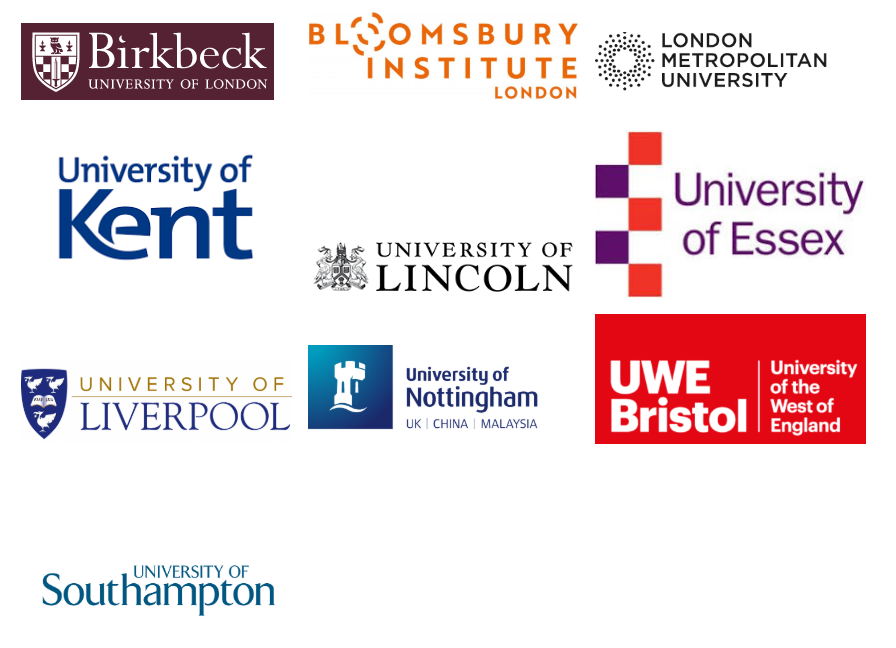
October – As part of our Unlocking students with conviction project, we announced that ten UK universities lead the way in helping people with convictions access higher education by signing the ‘Fair Chance for Students with Convictions’ pledge. Universities that have signed the pledge include University of Nottingham, University of Liverpool, Birkbeck, University of London, University of Essex, University of Kent, University of Lincoln, University of the West of England, Bristol, London Metropolitan University, Bloomsbury Institute and University of Southampton. To ensure applicants are aware of the commitment, signatories will be asked to include a link to the pledge in their admissions policy going forward. A toolkit to help universities make admissions fair was also published.

November –We were delighted that one of Unlock’s long-standing helpline volunteers, Simon, was shortlisted for the Helpline Partnership’s ‘Helpline Volunteer of the Year’ award. On hearing the news, Simon said: “I’m delighted to have been shortlisted for the Helpline Partnership ‘Volunteer of the year’ award. As much as this is recognition that the work I do for Unlock is truly appreciated, what I have given to Unlock is a moot point in comparison to what they have done for me.”

December – As a charity set up by people with criminal records, Unlock is committed to fair recruitment and the inclusion of people with lived experience of the criminal justice system. Our recruitment policy has helped us do that but we believe every organisation should regularly review their policies and practices to make sure they’re as effective as they can be, so we reviewed our policy and made some improvements. We also put out a statement on the London Bridge attack. Enabling people who have offended the chance to change and to move on positively is socially, economically and morally right. The aim of terrorism is to destroy our values and beliefs. We won’t allow these events to destroy our belief in the power of all people to do better. And following the general election, we published our priorities for government in 2020, where we are calling on the government to commit to five priorities to bring about a fresh start for law-abiding people with criminal records.


Monthly update – November 2019

We’ve just published our update for November 2019.

This months update includes:

  1. Examples of templates which can be used to challenge an ineligible check being carried out by the Disclosure and Barring Service.
  2. A link to a survey asking users of our Information Hub for their thoughts and opinions about the site.
  3. A personal story highlighting the challenges of being in a relationship with someone who has been convicted of a sexual offence.
  4. A link to a discussion on theForum from an individual who is finding it difficult getting into work due to his criminal record and gaps in his CV.
  5. Details of Unlock’s Annual Report 2018-19 which provides an overview of what we’ve been doing during the year.

The full update provides a summary of:

  1. the latest updates to our self-help information site for people with convictions
  2. recent posts to our online magazine, theRecord
  3. discussions on our online forum
  4. other news and developments that might be of interest to individuals with a criminal record.

Read the November 2019 update in full.

Best wishes,

Unlock

Notes

Unlock Annual Report 2018-19

We are delighted to publish our Annual Report and Accounts for the year 1 April 2018 to 31 March 2019. Reviewing a whole year of activity can be a demanding process. Our activities are always taking us forwards, driving us on to the next challenge, so to take a step away, look back and reflect, can sometimes seem like a distraction. In fact, it is extremely important to take that time. The Annual Report gives us an archive of what Unlock has done in the course of a year and, crucially, provides an overview of how that activity cumulates to make a significant, positive impact on the lives of people with convictions. It’s also an opportunity to say a huge thank you to all the wonderful people who make our work possible – our Trustees, staff, volunteers, Patrons, contributors to our web resources, partners, donors and funders.

At the beginning of this financial year, we were preparing for the appeal by the Government at the Supreme Court of a complex case challenging the current criminal records system. It was the first time in Unlock’s 18-year history that we had intervened in a legal case, but we were committed because of the potential to achieve a better a system from one that continues to trap people in their pasts. The work was made possible by the 555 pledges of donations through Crowdfunder, which helped us raise over £17,000 towards our legal and campaign costs. Our evidence demonstrated the breadth and scale of the problem (for example, that in the last 5 years, nearly 1 million youth criminal records disclosed on standard/ enhanced checks were over 30 years old). We also demonstrated that generally, employers do not make deeper assessments of individuals but default to avoiding selecting candidates with any kind of criminal record. The judgement came at the end of January 2019, with a ruling that two aspects of the criminal records disclosure scheme are disproportionate and in breach of Articles of the European Convention on Human Rights. We were pleased that the judgement provides a crucial step towards achieving a fair and proportionate filtering system that takes a more calibrated and targeted approach to disclosing criminal records. When taken together with reviews by the Law Commission, Justice Select Committee, Charlie Taylor and David Lammy MP there is a powerful case for a fundamental review of the wider criminal records disclosure regime.

Since the judgement, we have been working with others to argue for that wider review, and, ultimately, for a fairer, proportionate and flexible filtering system that protects the public without unduly harming the ability of people to move forward positively with their lives.

“I hope you’re successful in helping people move away from their pasts and live their lives without the worry and shame of their past.”  (Crowdfunder donor)

In July 2018, Rachel Tynan joined the staff team, to a newly created role of Policy and Practice Lead. Rachel had previously worked in the Civil Service and higher education and joined us following the completion of her PhD and a stint at Open Book at Goldsmiths. Her role is designed to support our campaigning and policy work. As Rachel says:

“Research consistently shows that re-offending is reduced where people are in sustainable employment or training, and employers and universities providing opportunities are contributing to a safer and more just society.”

Rachel has worked closely with Co-director, Christopher Stacey, on a number of our policy issues. As well as the work pushing for a review of the criminal records system, our work has included, working directly with employers to improve their recruitment processes, working with universities to increase access to higher education, researching the increased impact of having a criminal record on young and BAME people, challenging Google and other search engines to remove spent convictions from their indexing and helping people with convictions to understand the law discouraging people with convictions to become charity trustees or senior leaders. We were delighted to see the government abandon the disproportionate, unfair and ineffective “disqualification by association” rules for schools. We also published a number of consultations, submissions and reports including

  • A report – A life sentence for young people – on the impact of criminal records acquired in childhood and early adulthood (May 2018)
  • A paper – University admissions and criminal records: Lessons learned and next steps (June 2018)
  • A report – A question of fairness – research on employment practice of top national employer (October 2018)

Unlock’s policy work is, of course, based on the experiences of people using our direct information, advice and support services. It is only by listening to personal experience that we can see where problems lie and how things can be improved. Our helpline means we are talking to people and helping them overcome their individual challenges daily and our online resources help people find their own solutions at times and in ways that suit them best. We are delighted that we continue to reach large numbers of people with all our services, and that we continue to get very positive feedback on the help we offer.

“Having access to Unlock really gives me the confidence for the future. It is very important to know the facts when applying for employment. My offences were some 20 years ago, and it been a long interesting journey with life to this point. I don’t want to blow it or let those down who have invested time in me to get to this stage because of ‘misinformation’ or incorrect facts.”

“I wanted to get in touch to firstly thank you for the advice and support I received leading up to my applying for University. Secondly to update you with my conditional offer to study BSc Hons Social Work! Without your organisation’s help I would not have had the confidence or motivation to put myself out there as someone with a criminal record for fear of rejection.”

The enquiries our team responds to cover a huge range of problems, across employment, education, training, housing, financial matters and travel. An example of the complicated way having a criminal record affects people, include a client who had believed her 22-year-old conviction was not only spent but would also be filtered from an enhanced DBS check, only to discover that because there were three ‘counts’ it was not filtered. Our support helped them make the case to keep their teaching job.

We are indebted to our volunteers – all people with convictions and some still serving prison sentences – who train as helpline volunteers, and over the year answered nearly 75% of enquiries. We aim to make volunteering for us as beneficial as possible to the volunteer, providing as much training and support as possible.

This is just an introduction to the full story of our activities which we hope you will enjoy reading in our Annual Report.

We’re happy to give the last word to two of our supporters, who were inspired to make donations to help our work:

“I’m an ex-offender who was fortunate enough to be able to largely support myself through the criminal justice process in the main (thank goodness) but 15 years on, when life dictates, you are still the first port of call for advice. Thank you for everything you did for me and continue to do and fight for others.”

“May I take this opportunity to warmly applaud and thank you for the excellent work you are doing. From my experience of living abroad in several Western European countries I have long thought the UK criminal justice system to be far too heavy handed and punitive. It does not surprise me that a criminal record in the UK has a greater, longer term effect than other EU countries.”

Julie Harmsworth 

Co-director

Unlock volunteer shortlisted for helpline volunteer of the year award

We’re delighted that one of Unlock’s long-standing helpline volunteers, Simon, was shortlisted for the Helpline Partnership’s ‘Helpline Volunteer of the Year’ award.

On hearing the news, Simon said:

“I’m delighted to have been shortlisted for the Helpline Partnership ‘Volunteer of the year’ award. As much as this is recognition that the work I do for Unlock is truly appreciated, what I have given to Unlock is a moot point in comparison to what they have done for me.”

Commenting on the news, Debbie Sadler, Unlock’s advice manager and lead for our volunteer programme, said:

“Simon has volunteered for Unlock as a helpline advisor for over 5 years. His background in education makes him ideally placed to provide high-quality information, advice and support delivered in such a way that callers find it easy to understand and utilise.

“Back in 2014 Simon joined us for 2 days per week but, such is his commitment and passion for the charity that during a particularly busy period recently, he not only manned our helpline but helped us redecorate and move office. This commitment is even more extraordinary because for many years Simon has suffered from an anxiety disorder which means that it’s frequently a struggle for him to leave his own home.

“I can’t thank Simon enough for everything he has done and continues to do for Unlock and him being shortlisted for volunteer of the year goes to show how he’ll continue to be one in a million to us”

We’d like to congratulate the eventual winner of the award, Deborah Gascoyne from Myeloma UK.

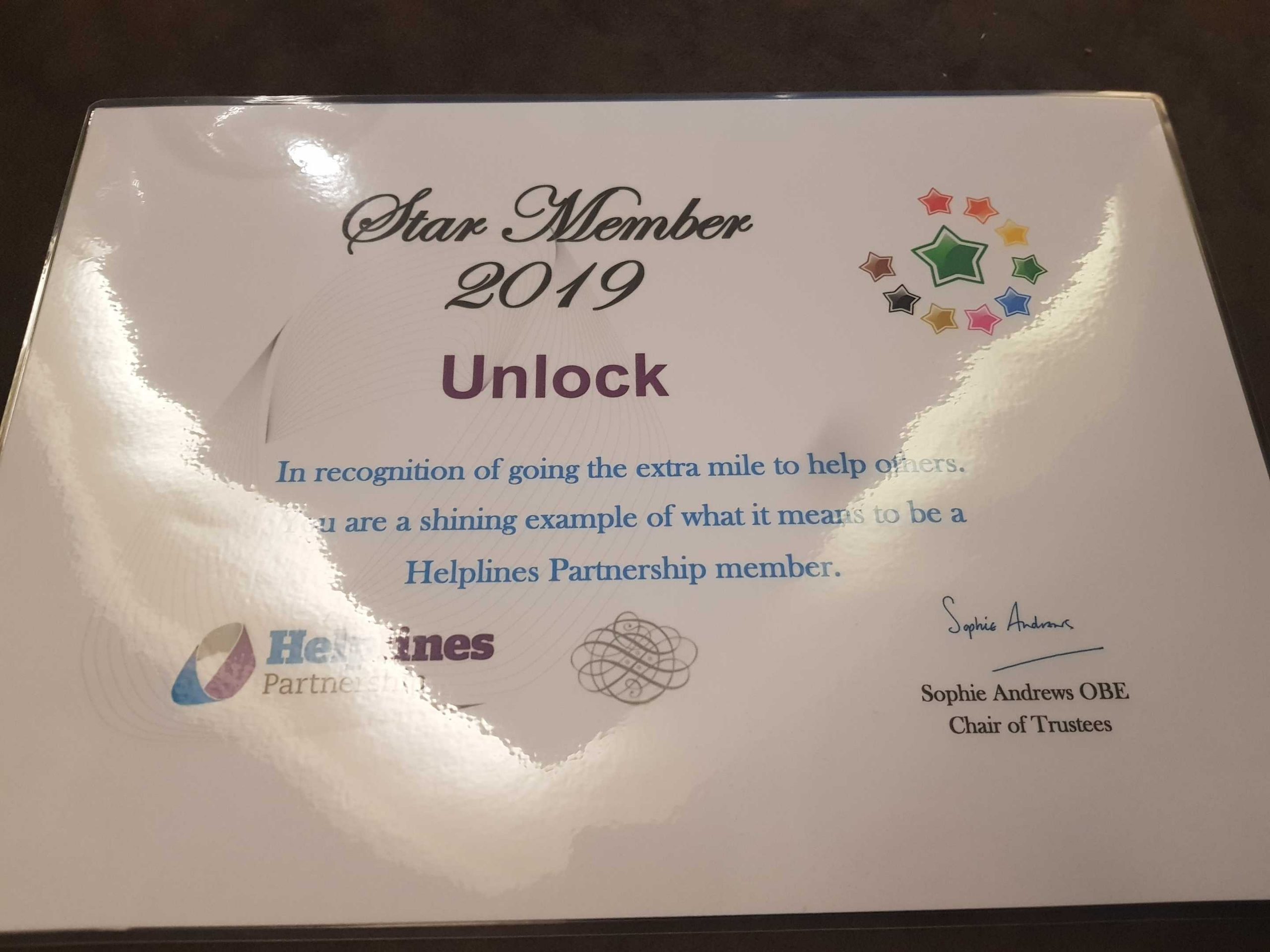
At the same event, Unlock came away with a ‘Star member’ award, in recognition of Unlock “going the extra mile to help others”, saying that we were “a shining example of what it means to be a Helpline Partnership member.”

More information

  1. You can find out more about our volunteer programme.
  2. The winners of the Helpline Awards are on the Helplines Partnership website.

Monthly update – October 2019

We’ve just published our update for October 2019.

This months update includes:

  1. An update on the new costs of all Disclosure and Barring checks.
  2. A personal story highlighting Lucy’s success in getting a newspaper to remove an article relating to her conviction.
  3. A link to a discussion on theForum around a probation officer’s insistence that an individual disclose their conviction to a new employer even though the employer had not asked them to do so.
  4. A blog setting out the governments summary of responses to their call for evidence on the employment of people with convictions
  5. Details of ten universities who have signed up to the ‘Fair Chance for Students with Convictions’ pledge.

The full update provides a summary of:

  1. the latest updates to our self-help information site for people with convictions
  2. recent posts to our online magazine, theRecord
  3. discussions on our online forum
  4. other news and developments that might be of interest to individuals with a criminal record.

Read the October 2019 update in full.

Best wishes,

Unlock

Notes

Ten UK universities lead the way by signing the ‘Fair Chance for Students with Convictions’ pledge

Trailblazing UK universities are leading the way in helping people with convictions access higher education by signing the ‘Fair Chance for Students with Convictions’ pledge.

The pledge is the result of a 12-month project conducted by Unlock, a charity for people with convictions, and supported by the UPP Foundation, a charity founded by University Partnerships Programme, the leading provider of on campus student accommodation infrastructure and support services in the UK.

So far, ten UK universities have signed up to this important pledge which sees institutions make a commitment to offering a fair chance to students with a criminal record. The pledge also signals an institution’s support to giving individuals a second chance at life by opening doors to higher education, giving them the best chance of new employment prospects and opportunities.

The project, designed to support fair admissions and improve access and participation for universities has three key objectives. These include putting policies in place at each university; a toolkit for other universities to use to develop their admissions policies and a pledge for universities to sign up to. The pledge will be launched at a roundtable event with admissions leaders taking place in central London later today.

Universities that have signed the pledge include University of Nottingham, University of Liverpool, Birkbeck, University of London, University of Essex, University of Kent, University of Lincoln, University of the West of England, Bristol, London Metropolitan University, Bloomsbury Institute and University of Southampton. To ensure applicants are aware of the commitment, signatories will be asked to include a link to the pledge in their admissions policy going forward.

Richard Brabner, Director of The UPP Foundation said:

“We are proud to be working alongside Unlock to help universities remove the barriers to higher education that are currently facing people with convictions. We recognise that this is a relatively new area for universities and are delighted to see a number of universities signing the pledge and boldly taking steps towards a fairer admission policy.

“Access and participation is more important than ever. Removing barriers for students with convictions and improving access to universities benefits both students, the tax payer and higher education institutions.”

Christopher Stacey, Co-director at Unlock said:

“Education creates opportunities, opens doors, and changes people’s lives. We are delighted to be working alongside the UPP Foundation and higher education institutions to help people with convictions access the life changing opportunities that higher education can offer.

“People with convictions often face stigma and obstacles because of their criminal records, even long after they have served their sentence. There are over 11 million people in the UK with a criminal record. These people have the potential to make positive and meaningful contributions to our society but are often denied this opportunity because of their past. We are delighted to see universities leading the way in removing the systemic barriers that face people with convictions and look forward to more universities signing the pledge and committing to fairer admission policies in the coming months.”

Notes

  1. For press/media enquiries,
  2. Unlock is an independent, award-winning national charity that provides a voice and support for people with convictions who are facing stigma and obstacles because of their criminal record, often long after they have served their sentence. Unlock’s website is unlock.devchd.com.
  3. The UPP Foundation is a registered charity that offers grants to universities, charities and other higher education bodies. In recent years, as higher education has expanded, the burden of paying for a degree has shifted towards the individual. This naturally presents difficulties in terms of maintaining the ‘University for the Public Good’, as well as ensuring there is greater equity in terms of going to, succeeding at and benefiting from the university experience. We believe the UPP Foundation can make a small but significant contribution in helping universities and the wider higher education sector overcome these challenges. The UPP Foundation was created in 2016 by University Partnerships Programme (UPP), the leading provider of on campus student accommodation infrastructure and support services in the UK. UPP is the sole funder of the UPP Foundation. The UPP Foundation is an autonomous charity and all of its grants are reviewed and authorised by its Board of Trustees. The Foundation is supported by an Advisory Board. More information is available at the UPP Foundation website: www.upp-foundation.org.
  4. The ‘Fair Chance for Students with Convictions’ pledge is below. More details are available here.
  5. A toolkit to help universities make admissions fair has also been published. That is available here.
  6. Details about the Unlocking students with conviction project are available here.
  7. For more information about the project, email university@unlock.org.uk.

The Fair Chance for Students with Convictions pledge

We believe everyone with the potential and ambition to go to university should have the opportunity to do so, regardless of background. People with criminal convictions face obstacles and barriers to accessing university, yet higher education has the power to transform their lives by helping them move forward and make a positive contribution to society. Therefore, as the leaders of our institutions we pledge to give applicants with a criminal record a fair chance by…  

  • Asking applicants about criminal records only if – and when – it is necessary
  • Asking targeted and proportionate questions during the admissions process
  • Making our policy transparent and accessible to all applicants
  • If necessary, offering applicants a chance to discuss their case in person before a decision is made
  • Considering flexible adjustments and alternatives for applicants
  • Ensuring staff are trained to make fair and impartial judgements about applicants
  • Supporting students with criminal records to help them achieve academic success
  • Communicating positively about the benefits of a fair admissions process

Monthly update – September 2019

We’ve just published our update for September 2019.

This months update includes:

  1. New information on Ban the Box employers.
  2. An infographic which sets out details of the people we supported in 2018/19.
  3. A personal story setting out Andi’s views that marginalising people with convictions does not reduce the rates of re-offending.
  4. A link to a discussion on theForum around indefinite restraining orders.
  5. Details of a new briefing policy setting out our concerns around the EU Settlement Scheme in relation to EU nationals that have a criminal record.

The full update provides a summary of:

  1. the latest updates to our self-help information site for people with convictions
  2. recent posts to our online magazine, theRecord
  3. discussions on our online forum
  4. other news and developments that might be of interest to individuals with a criminal record.

Read the September 2019 update in full.

Best wishes,

Unlock

Notes

Monthly update – August 2019

We’ve just published our update for August 2019.

This months update includes:

  1. New information on extended sentences.
  2. An advice post on opening a basic bank account and the alternatives if you’re unable to, possibly due to having a fraud conviction which flags up on the CIFAS database.
  3. A personal story setting out the link between a gambling addiction and a criminal record.
  4. A link to a discussion on theForum on the impact of spent convictions appearing on Google.
  5. Details of updated guidance published by the Association of British Insurers on how insurers should treat people with convictions.

The full update provides a summary of:

  1. the latest updates to our self-help information site for people with convictions
  2. recent posts to our online magazine, theRecord
  3. discussions on our online forum
  4. other news and developments that might be of interest to individuals with a criminal record.

Read the August 2019 update in full.

Best wishes,

Unlock

Notes

We want to make sure that our website is as helpful as possible.

Letting us know if you easily found what you were looking for or not enables us to continue to improve our service for you and others.

Was it easy to find what you were looking for?

Thank you for your feedback.

12.5 million people have criminal records in the UK. We need your help to help them.

Help support us now