
Category: Financial services

‘Impact report’ published by Unlock on access to banking for people in prison

Unlock has now come to the end of a landmark 9-year project in developing access to basic bank accounts for people in prison before release. We are pleased to publish a report on this work. It reflects on the progress that we have made, and sets out a number of recommendations to the National Offender Management Service (NOMS), prisons and the banking industry, so that the progress is sustained and developed even further.

Back in 2005, we first identified the issue of people coming out of prison who had managed to secure employment, but were losing these opportunities because they didn’t have a bank account to get paid their wages into. The personal testimony below demonstrates the importance of this. It seemed like a simple problem to resolve, to open an account before release, but there were a number of complex underlying issues that stood in the way, not least the lack of engagement from many banks, and the lack of awareness of the issue across prisons.

During the 9 years that followed, we worked at various levels; piloting a process in a small number of prisons; rolling this out into further prisons; working with the banking industry to develop a fair and sustainable process; working with specific banks to develop their operating processes; and providing training/support to prisons. The work took much longer than we had expected. What began as a small charitably-funded pilot project ultimately ended up in a national campaign involving significant political and media attention.

And we are immensely proud of the progress we’ve made. In 2013-14 alone, 5,936 basic bank accounts were opened for people in prison, ready for them to use once they were released. In total, we have helped to set up 74 prison/banking programmes, and overall 114 prisons have links with a high-street bank. Ultimately, all prisons that want and need a basic bank account opening programme now have one in place, which was the principal aim of the project.

This work shows the value of being responsive to the issues that people are facing. Unlock’s independence, and “ear to the ground, voice at the top” approach has enabled us to achieve systemic change to a long-standing problem.

Unlock are now handing over day-to-day responsibility to NOMS for sustaining and developing the project. We look forward to seeing this work continue, so that all people near to release are able to apply for a basic bank account which is set up and ready for them to use when they are released so that they are better able to lead law-abiding lives in the future.

For more information about this work, visit the bank accounts policy section.


The importance of this work – A personal testimony

“I was in an open prison a couple of years ago. Having gone into prison with the loss of everything, I had no bank account, no ID, no anything. I was approached by staff one day and told about this wonderful scheme which would allow me to get started again. Very simply, the bank was Barclays and they had the most amazing very straightforward system for getting a bank account open. I would highly praise them, and Unlock for organising it, and for the way that is done. The account is opened, you have the bank card and details a couple of weeks later, and they are kept in your private property until you are released from prison. So you are actually ready to go the day you get out.

But to me the biggest things are the personal things. Self-esteem is a big thing and the bank account helped a great deal with that. Can you imagine what it is like not to have a bank account? Just for a moment. Not so much the practicalities but what it says about you. Why haven’t you got one? People give you funny looks, or you suspect they do. Getting a bank account in prison made me feel a great deal better about myself; that I belonged, and that reintegration was possible. Prison, for all the wrongs you have done to get you there, is a very lonely place, and that’s one of the problems when it comes to reintegrating when you get out. Anything that can be done to improve things there will help people.

Confidentiality is another thing: the way the accounts are set up. When you go to your branch when you get out, the staff don’t know you are an ex-offender. There is nothing on the system to say: this man is a former criminal; this account was set up in prison. That’s a fantastic feeling: to walk in to a branch as a normal citizen. One of the things that really hit me when I came out of prison, when I got onto the Jubilee line to head home, I was absolutely paranoid, that I had ‘prisoner’ stamped across my forehead. I kept looking round the carriage thinking ’they know’. And I’m not normally a paranoid person. A lot of people go through that. But when you walk into a bank branch and know they will treat you as a normal customer, and that rubber stamp on your forehead is no longer there, that is a fantastic feeling.

There are too many things, emotionally, that drag people back into prison. I know it sounds strange but I think bank accounts and having them set up for you, can help reduce re-offending. It’s one thing out of the way. You’ve got your benefits when you come out, you get paid when you find employment, it’s just one less box you have to tick. I think it’s a fantastic scheme and long may it continue, and be rolled out across the estate.”

Person with convictions, released from prison
Former MP Denis MacShane writes about the role of financial services

Denis MacShane, former MP and former prisoner, argues in a feature for this months’ Financial World magazine, that the financial services industry needs to do more to help discharged prisoners reintegrate into society.

Thanks to Financial World, you can download the specific article here.

The two main issues that Denis raises are that of bank accounts and insurance. We were pleased to be able to speak to Denis when he was writing this article, and we’re glad that he’s raised some of the core issues that remain on these fronts.

Criminals get better insurance – but not speeding motorists

The Telegraph’s Money section has published a very interesting article about the changes to the ROA and how these do (or don’t) impact on people with motoring offences.

We spoke with the journalist as she was developing this piece, although we’re not specifically referenced.

This article highlights a number of issues that we’re taking forward as part of our ongoing work around the ROA.

You can read the article here.

Unlock on Radio 4’s Money Box – Obtaining insurance with unspent convictions

Today, we took part in a discussion on Radio 4’s Money Box about obtaining insurance with unspent convictions. You can listen below or click here.


Changes to motor insurance disclosure

Today we took part in a Radio 4 Money Box discussion about changes to motor insurance disclosure, as well as what people need to disclose under the Rehabilitation of Offenders Act 1974.

You can listen to the interview below.

Changes to insurance disclosure

The below is post from our Information Hub

The reason for this update is to let you know of some changes to insurance disclosure, which came into force in April 2013, which should help many people with convictions. We updated the guidance on our website at the time, but to raise awareness of this, we thought we’d send around an e-update as well!

For many years, people with convictions have found themselves in a difficult situation when purchasing insurance. This is because of archaic insurance law dating back to the Marine Insurance Act 1906, which imposed heavy duties on all consumers to disclose all material facts, even if the insurer didn’t ask about them specifically. If you failed to guess what the insurer wanted to know, your claim could be rejected.

In 2008, the Law Commission consulted on whether the law should be changed. Unlock made a submission which highlighted the problems that the law caused for people with convictions. Following this consultation, the Law Commission recommended a change in the law. Unlock, along with a number  of other consumer organisations (including Age UK, Consumer Focus and Which?), worked hard to push  the Government to change the law. This was successful in March 2012, when the Consumer Insurance (Disclosure and Representations) Act 2012 received Royal Assent.

The Consumer Insurance (Disclosure and Representation) Act 2012 came into force on 6th April 2013. It removes the duty on consumers to volunteer ‘material facts’ if not asked. The onus is now on the insurer to ask the right questions. For people with convictions, this will help to clarify the law when companies do not ask about certain convictions (e.g. non-motoring convictions). Previously, you had to disclose all unspent criminal convictions, regardless of whether you were asked about them. This is no longer the case.
The onus now sits squarely with the insurer to ask you the questions that they want to know information about. Instead of a duty to volunteer material facts, now the law requires you to answer the questions that are put to you fully and accurately. You need to “take reasonable care”, and one of the factors that will be taken into account is whether the questions asked by the insurer were clear and specific.

For more information

We’ve published a guide on the changes to insurance disclosure. We’ve also updated our simple and detailed guides, as well as updating our list of insurance brokers and list of motor insurers. As always, all of this can be downloaded from the insurance section of our website.


Can you help us improve our lists?

Since these changes have come in, some insurers have changed the questions they ask. Some mainstream motor insurers, for example, have started asking about non-motoring convictions, meaning we’ve had to take them off our specific list of motor insurers that didn’t ask about non-motoring convictions.

However, there are many other insurers that ask quite specific questions about convictions (e.g. convictions in the last 5 years). For these insurers, even if your conviction is unspent, if it was after this period, you do not need to disclose.

As a result, we’re in the process of reviewing our list of motor insurers, to identify more mainstream companies that do not ask about certain convictions. We’re also looking to produce a similar list of home insurers, providing details of companies that ask quite specific questions. If you come across any specific insurers that you think should be included in either of these, please let us know by emailing the details to advice@unlock.org.uk.

Local credit unions support efforts to reduce re-offending

New report finds credit union accounts improve the prospects of people leaving prison

Research carried out by Unlock and the Research Unit for Financial Inclusion at Liverpool John Moores University has highlighted 13 credit unions working in partnership with 21 local prisons to reduce re-offending. Credit unions are providing savings accounts to people in prison, with some offering a current account on release.

The Unlocking Credit Unions report, launched at Parliament today, shows that membership of a community financial institution can have positive economic, social and psychological effects that support desistance from crime. It also suggests that credit unions may be critical in delivering flagship reforms within the justice system, including the Work Programme and Universal Credit. However, the report also questions how sustainable such partnerships are in the light of budget cuts and argues they must be properly resourced.

With stable housing and work as the key factors in reducing re-offending, local initiatives by credit unions have been welcomed by prison staff involved in resettlement.

“[Access to credit union services] opens up a market with regards to employment and accommodation that would not have normally been available…It is an important aspect of the resettlement process”.
– Prison Officer quoted in the report

The high rate of re-offending immediately after prison has been linked to the £46 ‘discharge grant’, which often has to last several weeks before wages or benefits come through. With average prison wages estimated at below £10 a week, opportunities to save are limited. However, credit unions have inspired some people in prison to save to avoid reliance on state benefits on release.

One person featured in the report is Charles. Before coming into prison he had never had a bank account and managing in cash had caused problems due to his drug problem. In prison, the credit union inspired him to save for a motorbike. In two years he saved £800 which he was able to take with him when on release. He said:

“I only used prison toiletries and never used the phone. I went without to save for the bike…it made me feel brilliant; it was a sense of achievement. It was probably the first time I had saved in my life and it made me feel good. I felt proud and normal” – Charles, a person in prison

The report also highlights how credit unions could help families who send money in to loved-ones in prison. Increasingly hard-pressed families are currently forced to use postal orders, which incur a 15% charge.

Nine further credit unions are working with local probation, charities and housing associations to provide services to people in the criminal justice system and their families.

Chris Bath, Executive Director at Unlock and co-author of the report, said: “Access to basic financial services is a keystone to leaving crime behind and building a positive life; working, paying taxes, spending and saving. Partnerships between credit unions and justice agencies have the potential to help deliver that, but they must be properly resourced to be effective.”

Paul A Jones, Reader in the Social Economy at LJMU and co-author or the report, added: “The unique contribution of credit unions is enabling people to save whilst in prison. Saving builds people’s confidence, self-worth and ability to plan for the future, all of which are important if people are desist from crime and resettle effectively in the community”.

-END-

Media enquiries – click here

Banking before release

We’ve written a letter in this month’s edition of Inside Time, the prison newspaper, updating people on the progress of our Unlocking Banking project.

You can read the letter here.

Money for nothing? Unspent convictions and insurance

We’ve taken part in a Radio 4 discussion about insurance and convictions. The piece can be listened to below. There is also a link to more information about the piece here.

Paying twice for crime – insurance and convictions

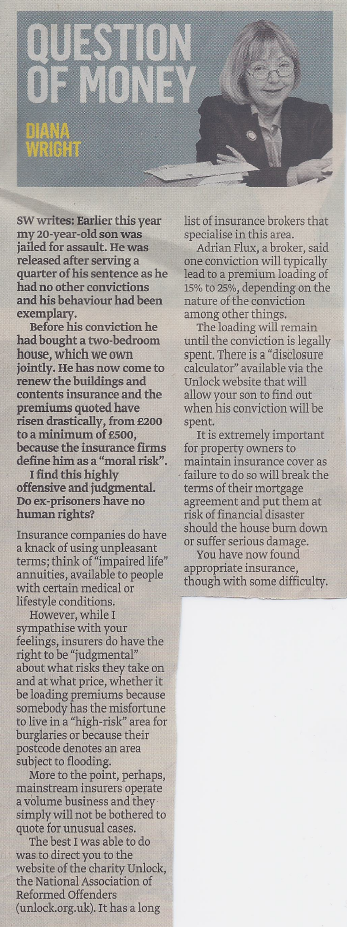
The Sunday Times have featured in their Money section a letter from somebody whose son is experiencing difficulties getting insurance. We spoke with the journalist last week, and provided her with some advice, which led to the person eventually finding some cover, and we’re featured in the published response (see below).

payingtwice

We want to make sure that our website is as helpful as possible.

Letting us know if you easily found what you were looking for or not enables us to continue to improve our service for you and others.

Was it easy to find what you were looking for?

Thank you for your feedback.

12.5 million people have criminal records in the UK. We need your help to help them.

Help support us now