Today we took part in a Radio 4 Money Box discussion about changes to motor insurance disclosure, as well as what people need to disclose under the Rehabilitation of Offenders Act 1974.
You can listen to the interview below.
 For people with criminal records
Today we took part in a Radio 4 Money Box discussion about changes to motor insurance disclosure, as well as what people need to disclose under the Rehabilitation of Offenders Act 1974.
You can listen to the interview below.
The below is post from our Information Hub
The reason for this update is to let you know of some changes to insurance disclosure, which came into force in April 2013, which should help many people with convictions. We updated the guidance on our website at the time, but to raise awareness of this, we thought we’d send around an e-update as well!
For many years, people with convictions have found themselves in a difficult situation when purchasing insurance. This is because of archaic insurance law dating back to the Marine Insurance Act 1906, which imposed heavy duties on all consumers to disclose all material facts, even if the insurer didn’t ask about them specifically. If you failed to guess what the insurer wanted to know, your claim could be rejected.
In 2008, the Law Commission consulted on whether the law should be changed. Unlock made a submission which highlighted the problems that the law caused for people with convictions. Following this consultation, the Law Commission recommended a change in the law. Unlock, along with a number of other consumer organisations (including Age UK, Consumer Focus and Which?), worked hard to push the Government to change the law. This was successful in March 2012, when the Consumer Insurance (Disclosure and Representations) Act 2012 received Royal Assent.
We’ve published a guide on the changes to insurance disclosure. We’ve also updated our simple and detailed guides, as well as updating our list of insurance brokers and list of motor insurers. As always, all of this can be downloaded from the insurance section of our website.
Since these changes have come in, some insurers have changed the questions they ask. Some mainstream motor insurers, for example, have started asking about non-motoring convictions, meaning we’ve had to take them off our specific list of motor insurers that didn’t ask about non-motoring convictions.
However, there are many other insurers that ask quite specific questions about convictions (e.g. convictions in the last 5 years). For these insurers, even if your conviction is unspent, if it was after this period, you do not need to disclose.
As a result, we’re in the process of reviewing our list of motor insurers, to identify more mainstream companies that do not ask about certain convictions. We’re also looking to produce a similar list of home insurers, providing details of companies that ask quite specific questions. If you come across any specific insurers that you think should be included in either of these, please let us know by emailing the details to advice@unlock.org.uk.
We’ve taken part in a Radio 4 discussion about insurance and convictions. The piece can be listened to below. There is also a link to more information about the piece here.
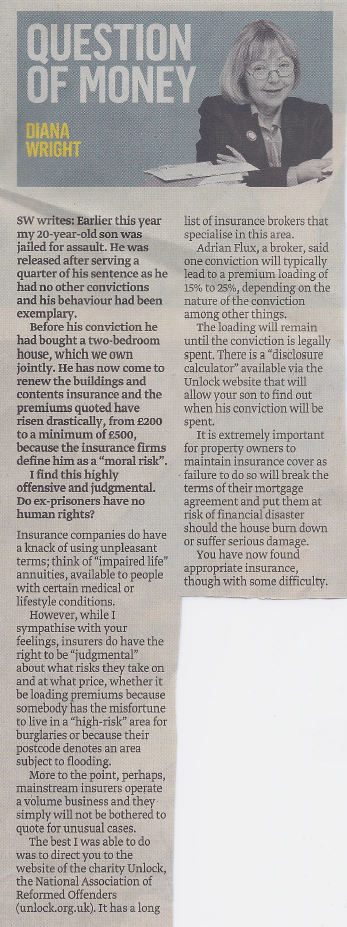
The Sunday Times have featured in their Money section a letter from somebody whose son is experiencing difficulties getting insurance. We spoke with the journalist last week, and provided her with some advice, which led to the person eventually finding some cover, and we’re featured in the published response (see below).
The Observer picked up on our launch of the Disclosure Calculator and featured this as an article, looking at how it will help people when applying for insurance. You can read the article below.

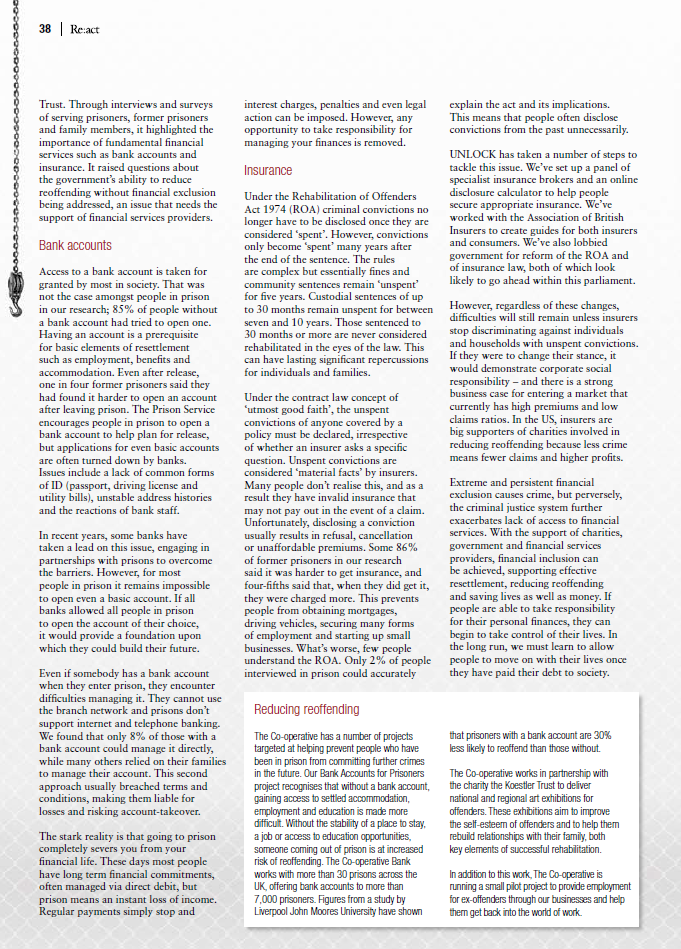
We’ve written an article for the Co-op’s members magazine, Re:Act. It’s only sent out in hard copy, but we’ve taken some copies of the article and these are available below as images.

Linked to the launch of Time is Money, we’ve written a Think Piece for the Chartered Insurance Institute. You can read the article here.
Today we were featured in a Daily Mail article which looked at how minor convictions can have a huge impact on your insurance. You can read the article here.
The article was also featured on the thisismoney.co.uk website.
Today we’ve launched guidance with the ABI (Association of British Insurers), to both insurers and individuals, to try to help people to understand what they do and don’t have to disclose, and what insurers should and shouldn’t ask for.
The guidance is available to download here.
This news was released via the Mail on Sunday (see below) and has been picked up in a number of press outlets, including:
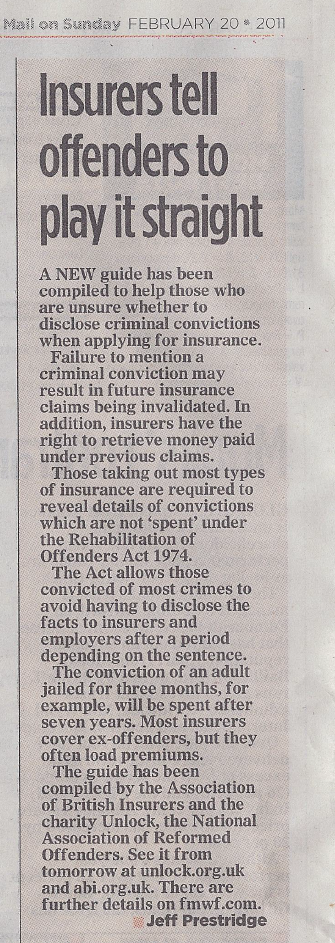
Unlock has joined up with the Association of British Insurers (ABI) to produce guidance for consumers and insurers on the complex issue of criminal convictions and insurance.
According to government figures, more than 8 million people in England and Wales have a criminal conviction and one in three men are convicted by the age of fifty-three.
Consumers are legally required to declare convictions even if insurers do not ask about them, unless they are considered ‘spent’ under the Rehabilitation of Offenders Act 1974. A fine or community order must be declared for five years, while short custodial sentences must be declared for between seven and ten years. People sentenced to more than thirty months must disclose their convictions for the rest of their life.
The laws apply to anyone covered by a policy, including partners and children on home policies and named drivers on motor policies. If a child receives a fine then their parents must disclose the conviction for 30 months as disclosure periods are shorter for people convicted when under the age of eighteen.
Many insurers take unspent convictions into account when assessing risk. If ‘unspent’ convictions are not disclosed insurers are able to avoid any claims made on the policy.
Unlock’s guidance, which has been sponsored by online insurers homeprotect, highlights consumers’ legal obligations and provides advice on how to buy insurance. The ABI’s guidance covers insurers’ legal obligations and industry best practice, such as including clear questions about convictions to make sure consumers get appropriate cover.
Chris Bath, Director of Projects at Unlock said: “Financial services are a crucial foundation for engagement in modern society. If we want people to lead productive lives; working, paying taxes and providing their family with a home, we cannot allow the justice system to sever people from their finances, even less to create lifelong financial exclusion.”
Nick Starling, the ABI’s Director of General Insurance and Health, said: “Access to, and fair treatment by, financial services providers is a key part of financial inclusion. We recognise that some people with criminal convictions and related offences may encounter difficulties when looking for insurance. We have produced guidance for our members to ensure that people with criminal convictions get a fair deal from insurers. Customers can expect insurers following the guidance to provide clear information about how they use criminal convictions, ask clear and concise questions, and help those to whom they may be unable to insure.”
If you have a press/media enquiry, click here.
Letting us know if you easily found what you were looking for or not enables us to continue to improve our service for you and others.
Was it easy to find what you were looking for?We use cookies where necessary to allow us to understand how people interact with our website and content, so that we can continue to improve our service.
We only ever receive anonymous information, and cannot track you across other websites. Find out more