
Author: Debbie Sadler

What’s the best way to approach a panel interview if you have a criminal record?

Panel interviews seem to be increasingly common for some employers looking for more rigorous ways to screen job seekers and spot the best talent.

As the name suggests, a panel job interview is where you’re interviewed by a group of interviewers – a ‘panel’. The panel may consist of a mix of senior or line managers, a representative from HR and, in some cases, a potential colleague.

One idea behind a panel interview is to put an interviewee under more pressure compared with a typical one-to-one interview. The panel will ask you a series of questions and will consider how you cope under such demanding conditions.

What would you do if one of the questions was about your criminal convictions?

Although it may not be good practice to spring a question about convictions on you in a panel interview, we know it happens. Details of your criminal record should officially only be known to relevant personnel, i.e. an HR Manager, Line Manager etc. Therefore, if the panel consists of a potential colleague, considering what and when to disclose may prove to be a bit of a minefield. How you deal with the question will often depend on whether or not you’ve already disclosed details earlier on in the process.

If you’ve not been asked about your record prior to interview

The advice we normally give would be not to disclose until asked. However, if you disclose at a panel interview, are successful and then subsequently find out that one of the panel members will be a work colleague, this could create a potentially awkward situation for you.

This can be a bit of a minefield. You may decide not to disclose your conviction during this type of interview because you are not sure whether all members of the panel should have access to that information. However, if you are successful and then disclose, you need to be aware that an employer may feel as though you have misled them and they could revoke the job offer.

If you can find out who is on the panel, this will help you to decide whether to disclose or not.

If you’ve disclosed prior to the interview, i.e. on an application form

In this situation, it’s likely that the panel will have been given copies of your completed application form and will therefore be aware of what you’ve disclosed. It will be in your best interest therefore to use this opportunity to explain the circumstances surrounding your conviction so that all members have a better understanding of the situation and can make a more informed decision about any risk you are likely to pose.

How can you improve your chances of success?

  • Be prepared – Make sure you’ve researched the company and the job role you are applying for. If possible, try to find out who will be sitting on the interview panel and what their role in the company is. You will then be able to answer and ask questions that are relevant to them as well as the job role.
  • Rehearse your answers with friends and family especially answers to potentially difficult questions, for example gaps in your CV.
  • Engage with the whole panel. When you’re asked a specific question, maintain eye contact with the person asking it, but when you answer, address the whole panel.
  • Each member of the panel will come to the interview with their own agenda. Establish early on who the doubters might be and try to win them over first.

Panel interviews are nothing to dread. If you prepare, are armed with a positive attitude and some success stories, then you should have nothing to worry about. If just one member of the panel is particularly passionate about recruiting somebody with a criminal record, they could easily be in a better position than you to convince the others that you’re the best person for the job.

For more information

For practical self-help information – More information on disclosing to employers and, in particular, information on when and how to disclose.
Monthly summary – May 2016

Welcome to our monthly summary for May 2016.

This provides a summary of:

  1. the latest updates to our self-help information site for people with convictions
  2. recent posts to our online magazine, theRecord
  3. other news and developments that might be of interest to people with a criminal record

Have you just stumbled across this? You can receive these updates direct to your inbox every month for free by signing up to our mailing list (make sure you choose to receive ‘news for people with convictions’)


Updates to our information site

Here’s a summary of the updates that we’ve made recently to the Information Hub. There are links within each update to where you can find more information about the update on our Hub. There are also links next to many of the updates, which link to threads on our online forum where you can discuss these with other members of the forum.

Information on the internet, online and through search engines like Google

  • Having internet search results removed – As a result of the number of enquiries our helpline receives from people seeking assistance in making applications to Google and other search engines, we’ve produced a new search engine removal request template which can be used when making requests to Google to have search results removed.

Work and volunteering

  • Working abroad and the use of Police Certificates – This advice post looks at the way that Police Certificates are used when applying for work abroad and the importance of being clear about the entry/work visa requirements which are needed for the country you wish to move to.

Finance

  • Benefits – We’ve updated our information to include a section on national insurance contributions and contribution based benefits while you’re in prison.

theRecord posts

Below are links to recent posts to our online magazine, theRecord. These are often linked to from the practical information that we have, to help give some personal experiences.

SuccessesMoving on with fire in my belly‘Back in June last year, after almost nine years in prison, I finally made it to open conditions. Wow, at long last, I could start to imagine a life for myself away from prison. Soon after arriving at my new abode, I met with my offender supervisor who told me that In order to complete one final piece of offending behaviour work, I needed to attend a series of meetings with the local Fire Service. She didn’t expand on this and foolishly, I expected it to be a bit like one of those fire talks you get when you’re at school….’

Struggles and StigmaWhy can’t my childhood mistakes be left in the past? ‘Like many teenagers, I suffered at the hands of the school bully and like many teenagers, the day came when I finally decided that enough was enough and retaliated. The result was a fight in the school playground when I was 15 years old ….’

SuccessesUniversity is possibly – but you’ll have to fight for it ‘Access to education and training is essential for those with criminal convictions who want to move on with their lives. However, gaining an academic place on any course when you have unspent criminal convictions – especially ones of a sexual nature – makes it virtually impossible. I found this out the hard way when I applied to do a course and was twice refused a place. I did eventually manage to overturn their decision and here’s what I’ve learnt along the way…..’

Other news and developments

Below are links to other news and developments that might be of interest to people with a criminal record. For more news, check out the news and media section of our main website.

Criminal record disclosure training endorsed by the Probation Institute

Our criminal record disclosure training has now been endorsed by the Probation Institute meaning that we are now a Probation Institute Endorsed Learning Provider. Read Christopher Stacey’s comments on the news here.

Our approach to working with other organisations

We are seeing a rise in the number of enquiries from service-providers to our helpline which, was predominantly set up and funded to provide support for individuals themselves. We’ve recently published a document which clarifies what support we can offer organisations and how it can be accessed.

Unlock in prison!

In February 2016, we were invited to visit Wormwood Scrubs and Pentonville prisons to present workshops on criminal records and disclosure. Read more about our experiences here.

Unlock speaks on Radio Stoke on the issue of old/minor convictions

Unlock’s Christopher Stacey spoke on Radio Stoke about the continuing problem of old/minor convictions showing up on criminal record checks. The programme is available here to download.

Unlock submits evidence to the review of Youth Justice

Unlock were asked to provide a written submission to the review of Youth Justice which is being led by Charlie Taylor. Download a copy of our submission here.

Were the effects of a caution explained to you?

We’re interested in seeing copies of cautions that people have accepted in the last two years. Different police forces give different guidance and we believe that many individuals have accepted cautions without fully understanding the long-term effects. Find out how your can help.

Monthly update – May 2016

We’ve just published our update for May 2016.


This months update includes:

  1. A new page about information on the internet, online and through search engines like Google which includes a search engine removal request
  2. Advice on the importance of understanding how Police Certificates are used when working abroad
  3. A personal view on the experiences of working as a volunteer at Unlock
  4. A link to the details of workshops Unlock has been running on criminal records and disclosure in prisons
  5. Details of information we are seeking from people who have received a caution in the last two years


The full update provides a summary of:

  1. the latest updates to our self-help information site for people with convictions
  2. recent posts to our online magazine, theRecord
  3. other news and developments that might be of interest to individuals with a criminal record


Read the May 2016 update in full


Best wishes,

Unlock


Notes

  • All previous updates can be found in full in the ‘Latest updates‘ section of our Information Hub
  • For more self-help information, please visit unlock.devchd.com/information-and-advice/
  • If you have any questions about this information, please contact our helpline
  • If you’ve been forwarded this email, you can sign up to receive these updates directly by clicking here and selecting to receive ‘News/updates for people with convictions’
  • If you have found this information useful, please leave us your feedback and/or consider making a donation.


Were the effects of accepting a caution explained to you? Send us a copy of what you were given

Our helpline receives enquiries every day from individuals who have accepted cautions without feeling like they understand the effects of it.

The Home Office guidance on cautions states that ‘the significance of the admission of guilt in agreeing to accept a caution must be fully and clearly explained to the individual before they are cautioned.’

However, different police forces give different guidance and have different forms in place.

We’re interested in seeing copies of cautions that people have accepted in the last two years. This will give us a good idea of the type of written information people were given before they signed to accept the caution.

So, if you’ve received a caution from the police in the last two years and have a copy of what you were given at the time, please send us a copy. We don’t need your personal details, so feel free to blank these out. Send the details to casework@unlock.org.uk.

You can attach a copy of your caution (and any other information you were given) as an image or a PDF to the email, or you can send us a copy in the post (please don’t send originals).

There’s no particular deadline to this, but if you could send us copies by Friday 17th June, we’ll review the ones we’ve received at that point.

Thanks for your support.

For more information

For practical self-help information – See our information on simple cautions

What we do with your evidenceFind out more about what we do with your experiences and evidence

Are you looking to have ‘Google’ search results removed?

We have added a new information page, information on the internet, online and through search engines like Google, which brings together our information, advice and other useful resources relating to information that may be available about you on the internet through search engines such as Google.

Following the ‘right to be forgotten’ ruling in May 2014, which enables individuals to request the removal of information from Google search results, our helpline has received many enquiries from people seeking assistance in making applications to Google. We’ve produced a new search engine removal request which you can use as a guide when making your case, and then copy/paste into the online forms that the different search engines have.

For more information

  1. For practical self-help information – For more information go to information on the internet, online and through search engines like Google 
  2. To read personal stories – You can read stories about internet issues posted on theRecord, our online magazine, under the category of the ‘Google effect.
  3. Our policy work – Read about the policy work we’re doing on the ‘Google effect’ and spent convictions.
  4. Questions – If you have any questions about this, you can contact our helpline.

Working abroad and the use of Police Certificates

Many people who have a criminal record consider moving abroad as a way to ‘escape’ their past and improve their chances of employment.

People looking to emigrate to countries such as Australia, Belgium, Canada, the Caymen Islands, New Zealand, South Africa and the USA have always needed to apply to the National Police Chiefs’ Council Criminal Records Office (ACRO) to get a copy of their Police Certificate as part of their visa process.

Police Certificates contain details of all convictions, reprimands, warnings and cautions which have been recorded on the Police National Computer (PNC) although it doesn’t disclose anything that is eligible to be ‘stepped down’. Read more about the step down model here.

If your criminal record has been ‘stepped down’ then your Police Certificate will come back with ‘No Live Trace’ recorded. Anyone who sees this, and understands the phase, can assume that you have a criminal record from the past, even if they can’t see the details.

If this applies to you, then we advise that you contact ACRO to obtain details of the conviction information which was not disclosed on the certificate. The country concerned will probably want you to disclose everything, and they’ll know from your Police Certificate that there’s something on your record. By getting these further details from ACRO, you’ll be clear about what’s been recorded on the PNC and you’ll be able to contact the relevant Embassy and disclose the information.

A recent case

We have recently heard from somebody who has been working successfully in the Middle East for many years without needing to disclose a very old conviction. A couple of months ago, they were offered a well-paid job in Saudi Arabia for a company they’ve worked with in the past. However, as a result of a new work residence visa process, they were asked to provide their employer with a copy of their Police Certificate.

Their conviction was spent under the Rehabilitation of Offenders Act and is eligible for filtering from DBS Certificates. As a result, they wouldn’t have to disclose it to employers in the UK that require basic, standard or enhanced checks. However, because of the statement ‘No Live Trace’ their new employers may be aware that there is something ‘lurking in the background’.

They told us:

After a lot of soul searching and stress, I’ve decided that rather than risk damaging my previous good character and reputation, I would turn down this great job due to “personal reasons”. I count my blessings that this is a fairly new requirement and I’ve been able to work in the Middle East for many years. However, I do wonder whether his really is an acceptable rehabilitation.

Although ACRO state on their website that a Police Certificate should not be used for employment purposes, in the case of a work visa, it does become directly related.

The lesson here is that if you are thinking of living or working abroad, be clear what the entry/work visa requirements are for the country you’ll be moving to. If it’s somewhere that requires a Police Certificate, then it may be in your best interest to be upfront and honest about your criminal record to your potential employer as it’s possible that they’ll become aware of it even if they haven’t asked you during the application process. This could potentially save you money as well as a lot of unnecessary worry.

For more information

  1. For practical self-help information – More information on Police Certificates 
  2. To read personal stories – You can read stories about working abroad and Police Certificates posted on theRecord, our online magazine, under the category/tag of travelling to the USA 
  3. To discuss this issue with others – Read and share your experiences on our online forum
  4. Questions – If you have any questions about this, you can contact our helpline.

Unlock in prison!

In February 2016, we were invited by Plias Resettlement to visit Wormwood Scrubs and Pentonville prisons to present workshops on criminal records and disclosure (they deliver the National Careers Service contract there). The aim was to look at the ongoing effects of a criminal record, how this can affect a person’s ability to reintegrate into society upon release from prison, and how to overcome these.


‘We recommend the workshops that Unlock deliver; they are informative, relevant and provide people with convictions with up to date and accurate information that enables them to move on with their lives.’  PLIAS Resettlement, 2016 


Plias gave us a fairly flexible brief in running a 2-hour workshop. This is where the idea behind our Top 10 things to know about a criminal record came from (which we developed at the same time). We wanted to keep things simple, but wanted to cover some of the key areas of life that people need to be aware of.


Wormwood Scrubs Workshop

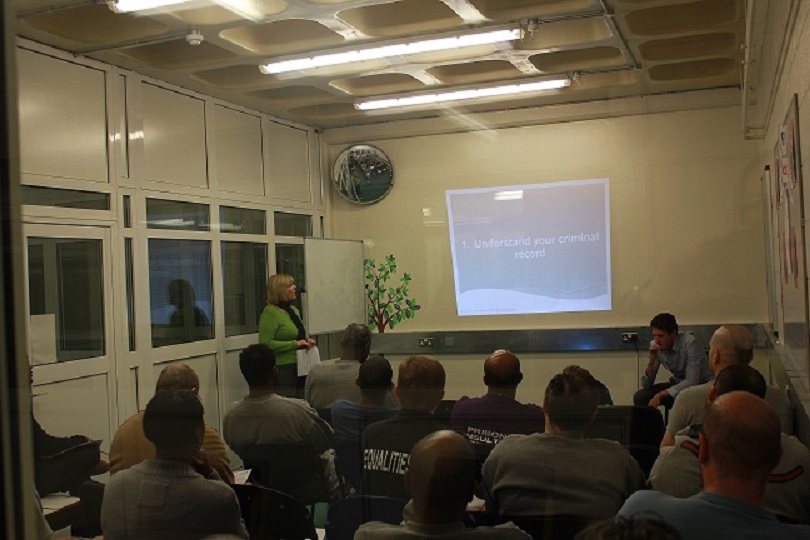
Our 1st workshop at Wormwood Scrubs (photograph courtesy of PLIAS with permission from the prison)


The result was a new ‘Moving on with Conviction’ workshop. The idea being that we would highlight 10 key areas which we think, from experience of running our helpline, are important for anybody with a criminal record to know about, with plenty of opportunity for questions.

We had about 20 men come along to the classroom in the education department at Wormwood Scrubs. With a relatively small number of people, we were able to make the session very interactive with lots of questions and answers and many of the men shared their own personal experiences. Some comments after the event were:-


I think workshops like the one today should take place more often – enlightening


Very positive approach and really well presented


Full of confidence from the first one, we headed off to Pentonville a couple of days later. This one was quite different; it took place in the large prison chapel with around 70 men turning up. The size of the room and the number of people meant that the session had to be far more ‘controlled’ which made it difficult for too much interaction. Initially, this made it quite difficult to engage with the group.

We recognise how hard it is to take any positives out of being in prison and it’s easy to think that a criminal record will prevent you being able to move on successfully in the future. It was clear that many of the men in Pentonville felt this way.

Explaining to the group that there were may employers out there that were willing to give people a second chance and highlighting how 50% of Unlock’s staff and trustees had a criminal record seemed to endorse the positive message we were trying to put across.

From then on, the atmosphere in the room seemed to change, with the session becoming more upbeat. Comments from the men included:-


I understand a lot now about jobs and how to disclose


I felt the event was done very well under pressure


We are grateful to the support of Plias in covering our costs in preparing and delivering these sessions. We’ve come away with some ideas of how we might be able to do more of these in the future, as it’s clear to us that many people in prison are simply not made aware of things they need to be alert to in dealing with the impact of having a criminal record once they’re released.


Written by Debbie Sadler, Advice Manager


More information

You can find out more about our fair access to employment project here or get in touch with us.

Practical self-help information can be found on understanding your criminal record and disclosing to employers.


Monthly summary – April 2016

Welcome to our monthly summary for April 2016.

This provides a summary of:

  1. the latest updates to our self-help information site for people with convictions
  2. recent posts to our online magazine, theRecord
  3. other news and developments that might be of interest to people with a criminal record

Have you just stumbled across this? You can receive these updates direct to your inbox every month for free by signing up to our mailing list (make sure you choose to receive ‘news for people with convictions’)


Updates to our information site

Here’s a summary of the updates that we’ve made recently to the Information Hub. There are links within each update to where you can find more information about the update on our Hub. There are also links next to many of the updates, which link to threads on our online forum where you can discuss these with other members of the forum.

Work and volunteering

  • Receiving a criminal record whilst you’re in employment – We regularly receive enquiries from people who, following receipt of a caution or conviction, want to know how they should go about disclosing this to their current employer. Our latest information sets out not only your legal position, but other factors which you may want to take into consideration.
  • Becoming a Police and Crime Commissioner   With the next Police and Crime Commissioner (PCC), elections taking place on 5th May 2016, we’ve produced some new information which looks at how a criminal record may prevent you from standing as a candidate in the future.
  • Be aware of what type of criminal record check is being done for the job you’re applying for – Once your conviction becomes spent, there is no need to disclose it to employers and it won’t appear on a basic criminal record check. However, if you are applying for a job which requires a standard or enhanced check, your spent conviction will be disclosed unless it’s eligible for filtering. Our latest advice post sets out the importance of understanding what’s on your criminal record and knowing what level of check an employer will be doing.

Insurance

  • List of insurance brokers – We’ve added three more companies to our list of brokers who are able to offer insurance to people with convictions.
  • List of motor insurers – We’ve recently been advised that, on their online quotation system, Elephant have started asking about non-motoring convictions. We’ve updated our list of motor insurers and removed Elephant from it. 

theRecord posts

Below are links to recent posts to our online magazine, theRecord. These are often linked to from the practical information that we have, to help give some personal experiences.

NewsUS Judge expunges criminal record‘This article was originally published in The New York Times and we thought it would be of interest to people with convictions in considering how the US deal with old convictions………..’.

SuccessesLife’s about reinventing yourself, not finding yourself ‘I’ve been reading stories on theRecord for a while now and following my own experiences recently, I’ve felt compelled to write something in the hope that even if I can encourage just one person, then it’s been worthwhile……..’

Struggles and Stigma Is a caution really ‘a slap on the wrist?’ – Not if you need a Police Certificate‘I have on rare occasions, recreationally used small quantities of ‘soft’ drugs, though less so as I’ve got older. I’m a professional, hard-working, and otherwise an entirely law-abiding citizen with not so much as a parking ticket. However, in 2011, I became a criminal and will be deemed as such until my 100th birthday….,’

Other news and developments

Below are links to other news and developments that might be of interest to people with a criminal record. For more news, check out the news and media section of our main website.

Helpline evaluation

A couple of years ago, we embarked on undertaking an independent evaluation of our helpline with the support of Professor Sue Wilkinson from the University of York, an expert in conversational analysis. The results of her analysis and evaluation have now been published in her report Unlocking the helpline.

Examples of people we’ve helped

We’ve published some case studies showing how people with convictions are able to overcome some of the barriers that have been put in their way due to their criminal record. Read the case studies here.

Spring 2016 Activities Newsletter

Download the Spring Newsletter which provides an update of the news at Unlock over the last three months.

New research into the impact of childhood criminal records and launch of campaign

This month, the Standing Committee for Youth Justice published their report which reviews the criminal record system in over a dozen countries and compares this to the system in England and Wales which is considered punitive and holds back children with a criminal record from reaching their full potential. Read the full report and Christopher Stacey’s comments here.

Monthly update – April 2016

We’ve just published our update for April 2016.


This months update includes:

  1. New information on receiving a criminal record whilst you’re in employment
  2. Advice on the importance of understanding what’s on your criminal record and knowing what level of criminal record check an employer will be doing
  3. Updated information on insurance brokers and motor insurers
  4. A personal view on the consequences of a criminal record and working abroad
  5. A link to the results of an analysis and evaluation of our helpline


The full update provides a summary of:

  1. the latest updates to our self-help information site for people with convictions
  2. recent posts to our online magazine, theRecord
  3. other news and developments that might be of interest to individuals with a criminal record


Read the April 2016 update in full here


Best wishes,

Unlock


Notes

  • All previous updates can be found in full in the ‘Latest updates‘ section of our Information Hub
  • For more self-help information, please visit unlock.devchd.com/information-and-advice/
  • If you have any questions about this information, please contact our helpline
  • If you’ve been forwarded this email, you can sign up to receive these updates directly by clicking here and selecting to receive ‘News/updates for people with convictions’
  • If you have found this information useful, please leave us your feedback and/or consider making a donation.


What do you do if you receive a conviction whilst in employment?

Most of our information around disclosing to employers looks at how to disclose details of an existing criminal record when you’re applying for work. However, what happens if you receive a caution or conviction when you’ve already got a job?

We’ve produced some new information on receiving a criminal record whilst you’re in employment, which looks at the consequences of receiving a criminal record whilst you’re working and whether you legally need to disclose it to your employer.

Irrespective of the legal position, it may be that you’ll need to look at other factors which may affect whether you disclose to your employer or not. For example:-

  • If there’s been any publicity about your case, you may need to weigh up the chances of your employer finding out about it.
  • If your conviction led to any restrictions, i.e. you may be prevented from going to certain places or working with certain people.
  • If the disposal you receive affects your ability to do your job, i.e. if you’ve lost your driving licence and your job involves driving.

Have a look at our receiving a criminal record whilst you’re in employment page, which features an interesting personal experience and some recent case law.

We hope you find this helpful. Let us know what you think by completing our feedback form.

For more information

  1. For practical self-help information – More information on convictions and employment law.

We want to make sure that our website is as helpful as possible.

Letting us know if you easily found what you were looking for or not enables us to continue to improve our service for you and others.

Was it easy to find what you were looking for?

Thank you for your feedback.

12.5 million people have criminal records in the UK. We need your help to help them.

Help support us now