Tag: Rehabilitation of Offenders Act 1974

The ‘google effect’, internet search results and the right to be forgotten

Aim of this page

In May 2014, the Court of Justice of the European Union ruled that individuals should be able to request the deletion or removal of personal data published online where there is no compelling reason for it to remain. This right to erasure is often referred to as ‘the right to be forgotten’.

This page sets out how to request the removal of online information and how you can appeal the decision if an online search engine refuses your request.

Why is this important?

Once your conviction is spent under the Rehabilitation of Offenders Act, there is no legal obligation for you to disclose it when applying for the majority of jobs. However, information on the internet can stay around, long after a conviction becomes spent.

We’re aware that some employers will do ‘Google’ searches as a way of informally checking someone’s criminal record. If there are stories on the internet which relate to your conviction, an employer may be able to find out more about you than they are legally entitled to know.

If you’re aware of any links to your name on the internet and your conviction is spent, it’s definitely worth applying to have the links removed. If your application is successful, then you can be confident that any future employer or work colleague who searches for your name on the internet, won’t be able to find any information relating to your criminal record.

Introduction

In May 2014, Google launched a system whereby individuals can request information about them be removed from Google’s search results. This came about because of a ruling on the 13th May by the Court of Justice of the European Union. The case was brought by a Spanish man who complained that an auction notice of his repossessed home on Google’s search results infringed his privacy. The court found in his favour, which has already had wide-reaching consequences for search engines like Google.

The ruling only covers the removing of the search results – the information will still exist on the website that published the original article but Google won’t be able to deliver matches to some enquiries that are entered. Deletion of the original information would still be the responsibility of the website owner, and in our experience, it’s very rare that websites agree to remove details relating to convictions (see more in reporting of criminal records in the media).

Information will only disappear from searches made in Europe. Queries piped through its sites outside the EU will still show the relevant search results.

However, many people are still seeing the ruling as a potential way of dealing with the ‘google effect’ that often haunts people for lots of different reasons, and our Helpline and Forum have already seen this being raised by quite a few people when it comes to past convictions that have been reported online. So the important question for us is whether it will actually help people with convictions?

Does it help people with convictions?

Under the ‘Right to be Forgotten’ anyone in the UK and EU can make a request to Google (and other search engines) to have information about themselves removed. For the first time, this ruling and the Right to Erasure provides individuals with a legal mechanism through which news articles, images, videos and other digital content can be removed.

In 2022, Google delisted approximately 56% of the “right to be forgotten” requests it received. The percentage of successful requests varied depending on the type of information concerned:

  • Criminal record information – 61% of requests were delisted.
  • Professional wrongdoing and other professional information – less than half of requests were delisted.

The Independent Press Standards Organisation (IPSO) in their “Court reporting: What to expect – Information for the public guidance”, have also made reference to the removal of links stating:

“If your convictions have been ‘spent’, you may have legal rights to have links to articles about these convictions to be removed from search engines. If you make a formal request to an internet search engine directly, they may remove these articles from search results.”

Google’s system

Google state that they always comply with their legal requirement to remove pages from Google search results and encourage individuals and authorities to contact them if they believe the continued publication of information violates the law.

Google summarises it’s approach as follows:


“We will balance the privacy rights of the individual concerned with the interest of the general public in having access to the information, as well as the right of others to distribute the information. For example, we may decline to remove certain information about financial scams, professional malpractice, criminal convictions, or public conduct of government officials”.


From our point of view, we strongly believe that once a conviction is spent, this should be removed from the internet (on request). Otherwise, protections that are afforded under the Rehabilitation of Offenders Act are undermined.

It’s highly unlikely that Google will be willing to remove search results that relate to unspent criminal convictions.

The Information Commissioner’s Office view

Back in 2014, the ICO looked at what the ruling meant for people in the UK.  In a blog post, a particular point they made was that;

“It is also important to remember that the exemption for journalism, art and literature under Schedule 2, part 5 (26) of the Data Protection Act 2018 can be applied by media organisations, bloggers and other publishers of information, depending on the circumstances. What this is not, then, is a full or absolute ‘right to be forgotten’.”

This casts doubt over to what extent Google (and others) will remove details such as convictions, where media organisations have claimed a legitimate exemption of the basis of journalism.

The Article 29 Working Party (which the ICO is part of) Guidelines on the implementation of the Courts judgement, gives a good indication as to how the ICO will treat complaints that it deals with. The ICO has also published their search result delisting criteria.

Making an application to Google

As part of Google’s current system, you have to do a couple of things.

Firstly, you have to provide the URL links for each link appearing in a Google search.

Secondly, and perhaps most importantly, you have to explain why the search result is “irrelevant, outdated, or otherwise inappropriate”. At the moment, the clearest argument is that your convictions are spent under the Rehabilitation of Offenders Act 1974, and so in most cases, you can treat it as if it had never happened. You should look to put forward any other reasons why you think it meets the definition of “irrelevant, outdated or inappropriate”. Until we begin to see examples of what’s worked and what hasn’t, it’s difficult to give much more guidance at this stage. The ‘representation box’ only allows you to use 1000 characters so you’ll need to keep your argument short and succinct.

Thirdly, you have to provide proof of your identity. Some people have expressed concern to us about this last point. However, we have no reason to think that this should put people off – ultimately, if your information is already available online, this application process cannot make things worse!

We have devised a search engine removal request template which can be used as a guide to completing the online form.

If you’re interested in making an application to Google, the online form is available here.

Reporting a concern to the Information Commissioner’s Office

Once you have a decision from Google, if they refuse your application, we would advise people to make a complaint to the Information Commissioner’s Office.

What will the ICO do?

If you decide to make a complaint to the ICO regarding Google’s refusal to remove a link then, the ICO will consider your request based on a set of criteria. If they believe that any links should be removed they will contact Google and ask them to de-list the information. Google will either agree with the ICO removing the link or refuse and refer back to the ICO.

If Google inform the ICO that they are refusing to remove a link after a request is made, the ICO will review the matter under their case review process with the involvement of senior colleagues, taking into account all of the circumstances of the case and arguments presented by all parties in order to decide whether the original decision was correct.

Where the ICO agrees with Google and decides that the link does not have to be removed from their search engine, you can still make an application to the court under section 167 of the Data Protection Act 2018, seeking an order that the court is satisfied there has been an infringement of your rights under the data protection legislation. The court would reach its own view as to whether they are satisfied there has been an infringement of your rights under the act. If you pursue this option you may wish to seek independent legal advice.

Having reviewed the overall circumstances of the case, we have concluded that it is appropriate to amend our assessment and we consider the search results likely to comply with the Data Protection Act. Therefore the ICO will not be requiring Google to delist the search results.

Although we recognise that the conviction is now deemed ‘spent’ for the purposes of the Rehabilitation of Offenders Act, and we take this into account, we must also consider the public interest in the availability of information about criminal convictions. Our published criteria explain that we are less likely to require the delisting of information about serious offences, and we consider sex offences involving minors to fall into this category.

While a number of years have passed since the conviction, we consider there to be a significant degree of public interest in the availability of information about convictions of this nature and on balance we consider this to mean the information in the search results remains relevant. In reaching this view, we also take account of the fact that you held a position of trust at the time the offences took place.

We recognise that the availability of the search results may be detrimental to you, but the right to have search results delisted is not absolute and does not necessarily entitle individuals to have negative information about them removed. When reaching decisions we must also take into consideration the relevance of the information to the public interest, which in this case we consider to be significant for the reasons I have explained. We have concluded that the original decision provided to you did not adequately take account of these factors.

Whilst the above refers to a sex offence, this does not mean you cannot apply to have your link removed if you have a spent conviction for a sex offence. You need to be aware that under ‘public interest’ a decision could be made that will result in your application to have your link removed declined.

Other ways of dealing with the Google effect

This problem isn’t new, and regardless of this new system, many people with convictions will continue to experience difficulties because of their convictions being reported online.

One option that some people look at is changing their name. Although this doesn’t get you away from your criminal record (because if an employer does a criminal record check, depending on whether your convictions are spent, and depending on the level of check, it will still come back) it does prevent people from getting access to information that they would otherwise not be allowed to (e.g. spent convictions if the job is covered by the ROA).

Another option that some people look at is trying to flood the internet with alternative, positive, stories about them, to ‘force down’ the reports that relate to their convictions.

Online reputation repair companies

There are many companies offering services to repair your online profile by replacing negative search results with positive coverage. Some of these can be very expensive, often tying you in to long term contracts and only doing what you can do yourself.

Details of a couple of organisations we would recommend can be found in the useful links section below.

Personal experiences

The personal stories below have been posted on our website.

Success with dealing with the ‘google-effect’ – Sam explains how her life has been turned around since Google agreed to remove links to her name

I got the link to my sexual offence conviction removed from a search engine

Discuss this with others

Read and share your experiences on our online forum.

Key sections include:

Below you will find links to useful websites relating to this page. More specific details (including addresses and telephone numbers) of some of the organisations listed below can be found here.

  • Information Commissioners Office – The ICO are an independent authority set up to uphold individuals’ information rights.
  • Mycleanslate – If you have a spent conviction, Mycleanslate may be able to act on your behalf by making a request to search engines such as Google, Yahoo and bing to have links to your name removed. They currently charge a flat fee of £295.
  • Internet Erasure – Offer a free consultation to assess your eligibility for removal and will then outline their predicted timescales and costs.
  • The Internet Law Centre – Law firm specialising in internet and social law.

More information

  1. For practical information – More information on changing your name and counteracting negative ‘Google’ or other internet search information
  2. To discuss this issue with others – Read and share your experiences on our online forum
  3. Questions – If you have any questions about this, you can contact our helpline.

This page was last fully reviewed and updated in October 2024. If you’ve spotted something that needs updating, please let us know by emailing the details to advice@unlock.org.uk

 

Pre 10th March 2014 guide to the Rehabilitation of Offenders Act 1974

Updates to the law

The Rehabilitation of Offenders Act 1974 (ROA) enables some criminal convictions to be not disclosed after a rehabilitation period. Its purpose is that people do not have to disclose a criminal conviction for long periods of time.

The ROA has been reformed as a result of changes in the law in 2012. These came into force on the 10th March 2014.

The changes are ‘retrospective’, which means they apply to convictions received before the 10th March 2014, and in most cases the rehabilitation periods are reduced, so you should start by reading our latest guidance, which is available here.

Why might you need to know what the old law was?

There are some examples where the rehabilitation period has lengthened as a result of the changes. This is particularly the case for:

  1. Further convictions for summary offences – these will now normally drag previously unspent convictions with them
  2. Youth rehabilitation orders (in some cases)
  3. Detention and Training Orders for 12-14 year olds

However, it’s important to realise that anything that was previously spent under the old law cannot now become unspent.

As a result, if you received any of the above sentences before 10th March 2014, you might also want to check the guidance below, as well as use the old version of our Disclosure Calculator (which is also still available).

If, under the old law, your convictions were regarded as spent before 10th March 2014, even if they would now be regarded as unspent under the new law, you’re allowed to treat them as spent convictions.

What is the Rehabilitation of Offenders Act 1974?

The rehabilitation period is automatically determined by the sentence, and starts from the date of the conviction. After this period free of further convictions, the conviction is “spent”, and with certain exceptions you are not obliged to mention a spent conviction in any context, including when applying for a job, or obtaining insurance, or in criminal or civil proceedings.

Certain professions are exempt from the Act so that individuals are not allowed to withhold details of previous convictions in relation to their job. These include :

  • Those working with children and other vulnerable groups, such as teachers and social workers
  • Those working in professions associated with the justice system, such as solicitor, police, court clerk, probation officer, prison officer and traffic warden
  • Doctors, dentists, chemists or nurses
  • Accountants

Positions that are exempt from the Act usually involve a standard or enhanced checks.

Coverage

The ROA only covers England and Wales. No other country is bound by this legislation. There are very similar (but not identical) provisions for Scotland and Northern Ireland, but these are not covered by this information.

Rehabilitation periods

The table below sets out the main sentences, orders and warnings and the ‘rehabilitation period’ attached to each. The period starts from the date of warning or conviction, unless otherwise stated.

The time it takes for a conviction to become ‘spent’ depends on the sentence given, not the offence committed (except for the offence of Loitering and Soliciting under the Policing and Crime Act 2009, where the period is six months).

For custodial sentences, the rehabilitation period is decided by using the sentence imposed at court, rather than the time served in custody.

Before selecting a particular sentence, please sure you look at any notes relating to that sentence underneath.

roacurrent

Notes on rehabilitation periods

  1. This has been replaced by the youth rehabilitation order.
  2. This has been replaced by the community order for adults and the youth rehabilitation order for juveniles
  3. This was abolished in 1983.
  4. Care orders in criminal proceedings were abolished by the Children Act 1989 and effectively replaced by a supervision order with residence requirements.
  5. This was replaced by the community punishment and rehabilitation order, which was itself replaced by the community order for adults and the youth rehabilitation order for juveniles.
  6. This has been replaced by the community order for adults and the youth rehabilitation order for juveniles.
  7. This has been replaced by the community order for adults and the youth rehabilitation order for juveniles.
  8. This has been replaced by the community order for adults and the youth rehabilitation order for juveniles.
  9. This was replaced by the community punishment order, which was itself replaced by the community order for adults and the youth rehabilitation order for juveniles.
  10. This is an ancillary order which is treated as a sentence in its own right.
  11. This has been replaced by the community order for adults and the youth rehabilitation order for juveniles.
  12. This was abolished in 1988.
  13. This was abolished for those under 18 in 2000 and replaced by the detention and training order, but it is still available for those aged 18-20 years.
  14. This was abolished for those under 18 in 2000 and replaced by the detention and training order, but it is still available for those aged 18-20 years.
  15. This is an ancillary order which is treated as a sentence in its own right.
  16. This has been replaced by the community order for adults and the youth rehabilitation order for juveniles.
  17. This is a sentence, but it is not a penalty. It has a rehabilitation period of five years under a general sweep-up provision in the ROA which applies to sentences not otherwise specified.
  18. The rehabilitation period applies even if the offender is subsequently imprisoned for default of a fine.
  19. This is an ancillary order which is treated as a sentence in its own right.
  20. This was replaced by the community rehabilitation order, which was itself replaced by the community order for adults and the youth rehabilitation order for juveniles.
  21. This was replaced by the community rehabilitation order, which was itself replaced by the community order for adults and the youth rehabilitation order for juveniles.
  22. This was abolished in 2000 and replaced by the detention and training order.
  23. This has been replaced by the youth rehabilitation order.
  24. To be piloted in six areas around the country from mid-2010.
  25. This was abolished in 1988.
  26. This was abolished in 1988.
  27. This replaces a number of orders for offences committed after 30 November 2009.

When the rehabilitation period starts

The rehabilitation period runs from the date of conviction. This is set out in s.5(2) of the Act, which states that the rehabilitation period (as defined in subsections (a) and (b)) are “reckoned in either case from the date of the conviction in respect of which the sentence was imposed”.

Where the sentence is not imposed on the date of conviction, there is potentially a period where you will not be aware of what the rehabilitation period for the conviction is until you receive your sentence. However, sentencing decisions, where they are not made on the date of conviction, usually follow relatively swiftly after it. The shortest rehabilitation period which is available where a conviction is imposed in front of a court is an absolute discharge, where the rehabilitation period is 6 months. It is unlikely that an individual would not have been sentenced by this point. The only exception to this is compensation orders, which become spent once paid, however it is highly unlikely that a court would simply sentence an individual to a compensation order alone.

When asked for details of unspent convictions, it is only the conviction that needs to be disclosed, not the rehabilitation period. Therefore, where you await sentence, you will need to disclose that conviction.

When the offence was committed does not influence the rehabilitation period.

For example, if you committed an offence in 2002 and were not convicted until 2010, the ‘rehabilitation period’ would run from 2010.

Disqualifications

The rehabilitation period for a disqualification is the length of the disqualification. If a person is disqualified (e.g. from driving or from being a company director) and at the same time receives another penalty, the longer of the two rehabilitation periods applies.

For example, if you are banned from driving for seven years and also fined, although the fine becomes spent after 5 years, the rehabilitation period for the conviction (including both the disqualification and fine) would be 7 years, not 5 years.

Endorsements and penalty points

Endorsements

Road traffic legislation does not specify how an endorsement is to be treated for the purposes of the ROA. The case of Power v Provincial is, therefore, the established authority that an endorsement is a sentence, not a penalty. The Court of Appeal said that it has a rehabilitation period of five years under a general sweep-up provision in the ROA, which applies to sentences not otherwise specified. How long the endorsement remains on the licence is irrelevant.

For example, if you are fined for drink driving and have your licence endorsed, the rehabilitation period would be five years (the length applicable to the fine) rather than 11 years (the length of time before a driver convicted of drink driving is entitled to a clean driving licence).

Penalty points

Penalty points are considered under section 5(8) of the ROA. Section 29(2) of the Road Traffic Offenders Act 1988 provides for totting up of penalty points where offences are committed within three years of each other.

As a result, penalty points alone have a rehabilitation period of three years. However, penalty points are normally issued by courts in combination with a fine, which would mean that it would be 5 years.

Further convictions

If you are convicted of a minor offence (a ‘summary’ offence), which can be tried only in a magistrates’ court, the rehabilitation period for the further conviction will run separately – therefore, the rehabilitation period for the further offence could end before the rehabilitation period for the first offence. Summary offences include most motoring offences, criminal damage of £5,000 or less, drunkenness and kerb-crawling. More details can be found in the user guide of our Disclosure Calculator.

For example, if you received 100 hours community service (5 year disclosure period) and then one year later was fined for a minor offence (which could only be tried in a magistrates’ court, the community service conviction would become spent before the fine. Therefore, once the first conviction became spent, only the fine would need to be disclosed until it became spent.

If the second conviction is either triable either way (can be tried in either court), or indictable (i.e. can only be tried in the Crown Court), then neither conviction will become spent until the rehabilitation period for both is over. This applies even if the first conviction was for a summary offence. If the further conviction leads to a prison sentence of more than 30 months, neither conviction will ever become spent. Once a conviction becomes spent, it remains spent, even if you are subsequently convicted for further offences.

For example, if you received a fine and then one year later was convicted for a serious offence, both convictions would have to be disclosed until the fine became spent.

If, however, the first conviction leads to a prison sentence of more over 30 months, later convictions with fixed rehabilitation periods will become spent separately.

If the first offence was for loitering or soliciting and you are convicted again for the same offence, the rehabilitation period for the first offence will be extended by the second offence, even if the rehabilitation period for the first had expired. This is the only example where a previously spent conviction can become unspent.

Concurrent and consecutive sentences

If you receive two or more prison sentences in the course of the same proceedings, the rehabilitation period will depend on whether the sentences are ordered to run concurrently or consecutively.

Concurrent – Two sentences of 6 months to take effect concurrently are treated as one sentence of 6 months, and therefore have a disclosure period of 7 years.

Consecutive – Two prison sentences of 6 months ordered to run consecutively are treated as a single terms of 12 months, giving a rehabilitation period of 10 years.

Prison sentences ordered to run consecutively to sentences already being served are not affected by this rule.

Breach of court orders

If you are given a community order or conditional discharge order and are later brought before the courts for a breach of that order, this can affect the rehabilitation period applicable to the original conviction.

If the court imposes a further sentence when it deals with the breach, then the original conviction will run on until both rehabilitation periods have expired.

Sometimes the courts may not deal with the breach until after the rehabilitation period applying to the original conviction has already expired. If the court then imposes a further sentence in dealing with the breach, the original conviction will still not become spent until the new rehabilitation period has expired.

Military convictions

The ROA also applies to convictions in the armed forces, including some service offences (see below). However, if the service offence was of a kind which most people would not consider criminal (such as failing to salute an officer), the ROA only applies if the sentence was three months’ detention or more.

The service offences to which the Act always applies are:

Army and Air Force

Navy

LootingCorresponding with, supplying or serving the enemy
Offences relating to property of members of forcesLoss or waste of public and service property
Miscellaneous offences relating to propertyOffences relating to issues and decorations
Making of false statements on enlistmentFalse statements on entry
Making of false documentsFalsification of documents
Scandalous conduct by an officerCruelty or scandalous conduct by an officer
Disgraceful conductDisgraceful conduct

Other than those list above, the ROA only applies to service offences if the punishment awarded was imprisonment, cashiering, discharge with ignominy or dismissal with disgrace from HM Service; dismissal from HM Service; or detention for a term of three months or more. The rehabilitation periods for the various sentences are set out below.

Military sentence

Rehabilitation period

Cashiering, discharge with ignominy or dismissal with disgrace10 years (halved if under 18 at the time)
A sentence of dismissal7 years (halved if under 18 at the time)
A custodial order of more than 6 months (1)7 years (halved if under 18 at the time)
A sentence of detention in respect of conviction in service disciplinary proceedings5 years (halved if under 18 at the time)
A custodial order of 6 months or less (2)3 years (halved if under 18 at the time)
  1. Under the relevant schedules and sections of the Army Act 1955, the Air Force Act 1955 and the Naval Discipline Act 1957 where the maximum period of detention is more than 6 months
  2. Under the relevant schedules and sections of the Army Act 1955, the Air Force Act 1955 and the Naval Discipline Act 1957 where the maximum period of detention specified is 6 months or less

Convictions obtained overseas

A conviction for the purposes of the ROA includes a conviction issued outside Great Britain (see s1(4) of the 1974 Act) and therefore foreign convictions are eligible to receive the protection of the ROA.

For example, if you received a sentence of 10 months in prison whilst you lived in Australia, you would have to continue disclosing it in this country for 10 years after conviction, irrespective of what the disclosure periods are in Australia.

However, there is some confusion regarding what to do when a sentence given abroad doesn’t match with those in the ROA. We have spoken to the Ministry of Justice about this and have been informed that, where sentences received abroad do not match with those contained in the Act, the only way to approach it is to find a domestic sentence which is the nearest equivalent. This would appear to be something that you have to decide, as neither the Courts nor the Ministry of Justice operate a process for deciding this process on your behalf. If in doubt, contact the Ministry of Justice Policy team responsible for the ROA – email roa@justice.gsi.gov.uk.

More general information about convictions obtained overseas is available here.

Retention of criminal records

Your conviction will remain on record even after it has become spent – it will not be deleted from the Police National Computer.

Previously, there were mechanisms available where records of reportable offences (i.e. offences which can be tried in the Crown Court, whether or not they actually are) were deleted after 20 years, unless there were further convictions or if there is evidence of mental illness, indecency, drug trafficking or homicide. Records of non-reportable offences could be deleted after 10 years.

However, a Court of Appeal decision in October 2009 ruled that the indefinite retention of criminal records on the PNC was lawful. See the retention and deletion of police records for more information.

Cautions

Cautions, reprimands and final warnings are not criminal convictions and, until 2008, were not covered by the Act. This meant that, technically speaking, people with cautions, reprimands or final warnings, when asked whether they had a criminal record, should have disclosed them.

However, in December 2008, legislation was passed which rectified this rather strange anomaly. Part 4 of Schedule 27 of the Criminal Justice and Immigration Act 2008 states that a caution becomes spent immediately. Conditional cautions become spent after 3 months.

Benefits of the ROA

It means that if you are asked on an application form or at an interview whether you have any previous convictions, you can answer no if the convictions are spent and the job applied for is not an exception from the Act. Under the terms of the Act, a spent conviction shall not be proper grounds for not employing or for termination of employment.

However, if you do not disclose unspent convictions when asked to do so, you risk dismissal on the grounds of deceiving the employer and could face prosecution.

Also, the Act does not provide any means of enforcing your right to not be refused employment (or entry into a profession) on the grounds of a spent conviction. If, however, you can prove that you have been dismissed for a spent conviction and you have been in employment for two years or more, you may be able to claim unfair dismissal under employment legislation. Find out more about convictions and employment law.

Applying for insurance

If an insurance proposal form asks whether your have any previous convictions, the answer can be no if your convictions are spent. This is the case even if the insurer believes that the conviction is relevant to the risk which the insurers will underwrite. For example, spent motoring convictions can be omitted from a proposal form for motor insurance.

For more information about insurance, click here.

Civil proceedings

In civil proceedings, no one should be asked questions which might lead to disclosure of spent convictions. If such questions are asked, they need not be answered. However, this rule does not apply: –

  • in civil proceedings relating to children (adoption, guardianship, wardship, marriage, custody, care and control, schooling);
  • when the court is satisfied that justice cannot be done unless evidence of spent convictions is admitted (anyone who has spent convictions can always consent to evidence being given about them);
  • if the proceedings involve a matter excepted from the Act.

The rule on civil proceedings applies not only to ordinary courts, but also to arbitration proceedings, disciplinary proceedings before an administrative tribunal, and to a club committee which has powers to affect anyones rights, privileges, obligations, or liabilities.

Criminal proceedings

Previous convictions can be cited in criminal proceedings, even if they are spent. The Lord Chief Justice and the Home Office have, however, advised the Courts that spent convictions should not be mentioned except in very special circumstances.

Confidential information

The Act makes it an offence for anyone with access to criminal records to disclose spent convictions unless authorised to do so. The Act makes it a more serious offence to obtain such information by means of fraud, dishonesty or bribe. However, as far as we are aware, nobody has been prosecuted for an offence under this section.

It might be possible for a person with spent convictions to sue for libel anyone making an allegation about spent convictions, if it can be proved that the allegation was made with malice.

Exceptions

Under the Rehabilitation of Offenders Act 1974 (Exceptions) Order 1975, as amended, there are many offices, occupations and positions which are exempt from the Act.

In these situations, employers and professional bodes can ask you to disclose both spent and unspent convictions and, in addition, they can carry out a standard or enhanced check with the Disclosure & Barring Service.

More information about the DBS, and eligibility in particular, is available here.

Some of the main positions exempt from the ROA include:

  • any work which is defined as regulated activity relating to children or vulnerable adults within the meaning of the Safeguarding Vulnerable Groups Act 2006
  • certain professions, occupations, offices and employments in areas such as health, pharmacy, finance, the courts and the law
  • licences to drive taxis and to work in the private security industry

Application forms for posts which are exempt from the Act should always make this clear, although some employers claim that posts are exempt when they are not. If in doubt, seek advice.

Going abroad

The Act only covers England and Wales; other countries have their own rules about those to whom they will give visas and work permits. Embassies or overseas employment agencies should be able to provide information about this.

Working out if your record is spent

There are a number of ways in which you can find out when your record is spent. Click here for more information.


“When do I need to tell employers about my criminal record” – ‘Easy Read’ guide on the ROA

As part of our range of information on the Rehabilitation of Offenders Act 1974, we have worked in partnership with KeyRing (with special thanks to Neisha Betts) to produce an Easy Read version of information on this subject. This is available to download by clicking the image below.

easyread

What is EasyRead?

‘Easy Read’ documents present information using simple words and pictures that make information easier to understand. The use of Easy Read is common-place in health and social care organizations, as well as other areas. It can help anyone with reading or comprehension difficulties, including those with learning disabilities, learning difficulties and also people for whom English is not their first language. Easy Read is classed as a ‘reasonable adjustment’ (The Equalities Act, 2010) as it helps to ensure people have access to the same information as others.


Differences between unspent and spent convictions


Aim of this information

This information sets out the differences between spent and unspent convictions.

Why is this important

It’s really important to know what the differences are between unspent and spent convictions. Specifically, so you are clear about what you legally need to disclose to employers, insurers and housing providers for example.

Introduction

Whether a criminal record is unspent or spent depends on the Rehabilitation of Offenders Act 1974.

The first thing you need to do is find out when your record is spent.

This page is also helpful in understanding the results you’ve received from theCalculator.


Convictions that are unspent

  • Unspent convictions will come back on all levels of criminal record check (basic, standard and enhanced).
  • If asked by an employer, you have to disclose convictions that are unspent. Many employers take on people with unspent convictions, but some might have policies or practices that mean you are refused employment.
  • If asked, you will have to disclose unspent convictions them when applying for products and services, such as insurance, a mortgage or renting a house.
  • You could be prosecuted if you fail to disclose them when asked.


Convictions that are spent

  • Spent convictions and cautions will not come back on a basic criminal record check.
  • For most jobs, you do not need to disclose spent convictions and cautions to an employer. These would be jobs that are covered by the Rehabilitation of Offenders Act 1974 and would only involve a basic check.
  • Some jobs and roles might involve a standard or enhanced criminal record check and these checks will normally show spent convictions and cautions so you will need to disclose these if the organisation is doing one of these checks.
  • Some spent cautions and convictions are removed from standard or enhanced checks if they meet a set of technical rules known as filtering. If your caution or conviction is now filtered, it will not show up on these checks and you do not need to disclose it when applying for any role that involves that level of check.
  • Most spent convictions and cautions will still appear on standard or enhanced checks, and employers that do these checks can use what comes back on the check and take it into account when making a recruiting decision if they believe it’s relevant to the role.
  • Spent convictions and cautions do not need to be disclosed when buying home or car insurance.
  • You might need to disclose spent convictions or caution when travelling or working outside of England and Wales
  • Spent convictions and cautions will stay on your police record – they are not deleted.

More information

  1. For practical self-help information – More information regarding this can be found at Rehabilitation of Offenders Act 1974.
  2. To discuss this issue with others – Read and share your experiences on our online forum.
  3. Our policy work – Read about the policy work we’re doing on this issue.

Get involved

Help us to add value on this information. You can:-

  1. Comment on this information (below)
  2. Send your feedback directly to us
  3. Discuss your views and experiences with others on our online peer forum

Basic DBS checks

About Basic DBS checks

Official name

Criminal Conviction Certificate (often known as a ‘Basic DBS disclosure’ or ‘Basic DBS check’)

Issued by

Disclosure and Barring Service or Access NI

Use

It is commonly used for employment positions covered by the ROA. It’s also used in other situations (e.g. insurance claims) where you might need to provide proof of your unspent convictions.

What it contains

Essentially, it contains unspent convictions. For guidance on whether your conviction is unspent, click here.

For checks carried out by the Disclosure and Barring Service the certificate will include all unspent convictions recorded on the Police National Computer, the Scottish Criminal History System and the Criminal Record Viewer (Northern Ireland Conviction System).  For Access NI it is the Police National Computer and the Criminal Record Viewer.

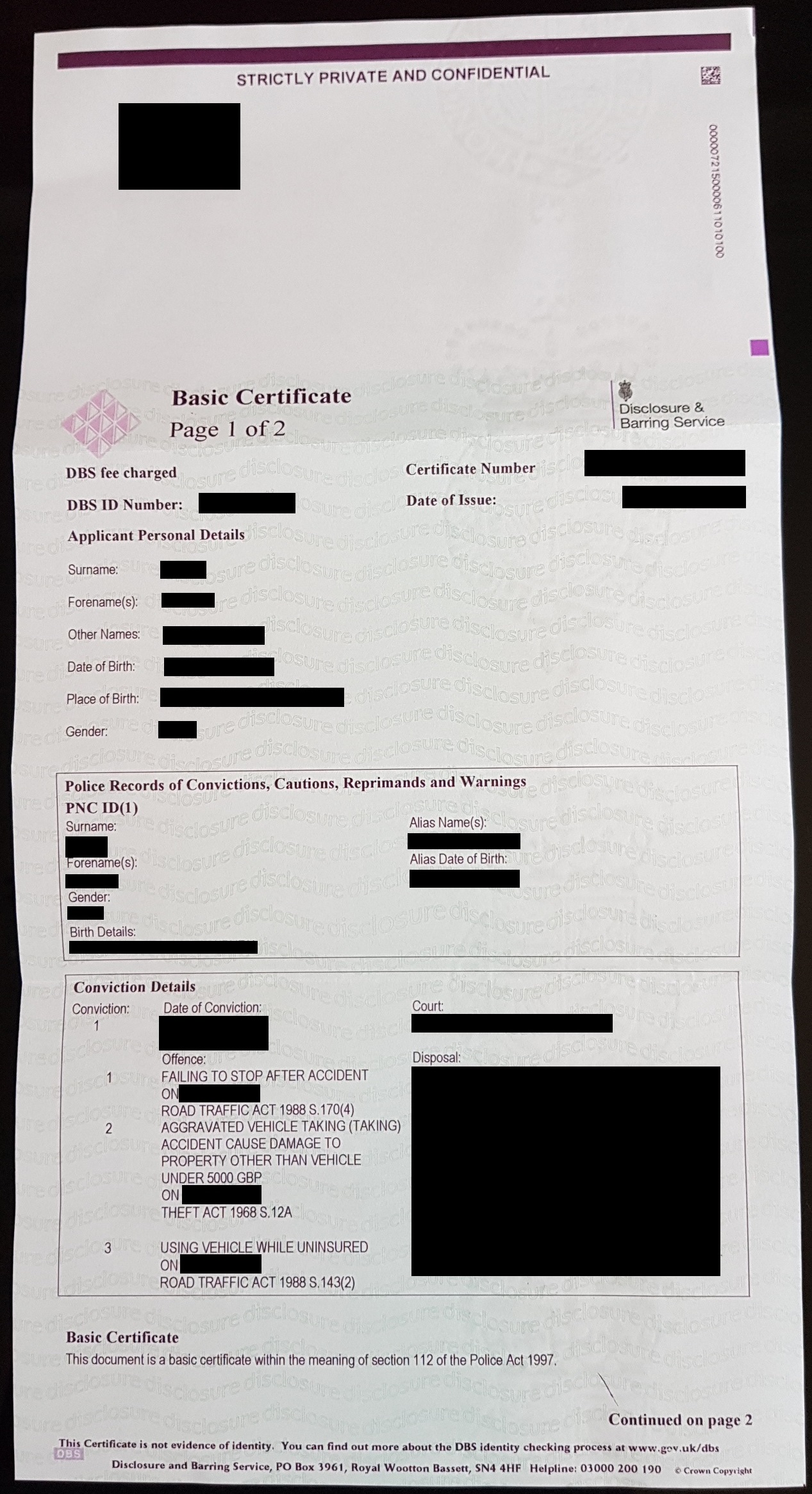
For each conviction it includes the date of conviction, the court, the offence committed, the date of offence and the sentence/disposal.

Note – The details surrounding the sentence/disposal can sometimes come as a surprise, as many people don’t realise exactly what formed part of the ‘sentence’ that they received, such as certain disqualifications, fines or prohibitions.

There is more detail about how certain sentences, disposals and other penalties are treated on basic DBS disclosures further down this page.

The example below shows what a basic DBS disclosure looks like when revealing unspent convictions.

How to apply

There are two ways of applying for a basic DBS check:

You can apply for a basic check by going directly to the DBS via their online self-service channel.

Key points:

  • It costs £21.50.
  • Your identity will be verified either by GOV.UK Verify or by the Post Office.
  • You provide all the information online.
  • It does not have the option to give a 3rd party consent to view the check.
  • It does not provide eResults to any intermediary or employer (as you have applied directly).
  • You can choose to have your paper certificate sent to a 3rd party.

You can apply for a basic check through an organisation that is registered with the DBS. Referred to by the DBS as a “Responsible Organisation (RO), an employer or other intermediary could be registered with the DBS. These are allowed to submit applications for basic checks via a DBS web service. The DBS has guidance on the organisation that can be used.

Key points:

  • The cost will vary – it will cost £21.50 plus whatever extra cost is charged by the intermediary. This might be covered by the employer.
  • An employer will need to be registered with the DBS themselves, or use an intermediary that is registered, to get a basic DBS check through this route.
  • There is a list of these organisations, and the DBS call centre can advise of the latest ones.
  • Only one paper check is issued – if the applicant consents, the paper check can be sent to an alternative address, such as the employer’s address.
  • There will be an eResult sent to the registered organisation.
  • The check will be available online – known as an eCertificate.
  • The registered organisation will:
  1. Be responsible for collecting the information about you and verifying your identity.
  2. Be able to check the status online.
  3. Be able to request an electronic (eResult)

Who can apply for it

You (or somebody on your behalf, with your consent).

Legally it is the individual who applies, although third parties do submit applications on behalf of individuals. Sometimes, employers will ask applicants to put the employer’s address as a ‘care of’ address so that it’s sent straight to whoever is undertaking pre-employment checks and the Disclosure and Barring Service will facilitate this.

Contact details

Find out about the contact details of Disclosure and Barring Service
Find out about the contact details of Access NI

Cost

£21.50 (Disclosure and Barring Service) £16 (Access NI)
The cost is sometimes covered by the organisation requiring it.

Where it is sent

To you, although you can choose for it to be sent to an employer as part of the application process, though in this situation you won’t receive a copy.

If you’re applying for a job at a new company and it involves a basic DBS disclosure, you might want to be aware that a high proportion of basic applications that employers apply for go via the ‘bulk electronic’ process which is likely to mean that although the disclosure will be addressed to you, it will be sent to the employer’s address. This may result in the employer opening it, particularly if you have given your consent for them to do this. Other employers might simply request that you apply for the disclosure, but put their address down as the ‘care of’ address. This makes it even more important that you make sure that you find out about your criminal record before applying for specific roles.

How long it takes

Within 14 calendar days

How certain disposals are treated

This section provides some details on how certain disposals are treated on basic DBS disclosures. This section should be read alongside our detailed guide on working out whether convictions are spent under the Rehabilitation of Offenders Act.

Technically, a compensation order does not become spent under the Rehabilitation of Offenders Act until it is paid in full.

However, in practice the Disclosure and Barring Service (DBS) will consider a compensation order as paid in full if it:

  1. was for an amount of less than £100; or
  2. is over 6 years old

If your compensation is for either of the above, it means that your basic check will be processed without you having to provide proof of payment of the compensation.

If your compensation order was for more than £100 or is less than six years old, then you’ll need to provide the DBS with proof that it has been paid in full.

If you didn’t get this at the time of paying it, you should be able to get something from the court at a later stage. In England and Wales, you can obtain a letter of confirmation from the court when any compensation order has been paid in full. The DBS have also confirmed that they will accept copies of emails sent to you by the court so long as the email relates specifically to the compensation order and confirms that payment has been made in full. There is guidance in the magistrates’ courts’ staff manual as to the wording to be used by courts in a proof of payment letter relating to compensation orders.

A copy of that letter or email should be provided to the Disclosure and Barring Service either with your application or separately in confidence if your application is being submitted via a third party.

To submit proof of payment independently of submitting an application, you can send it:

You should quote your application barcode or reference number, or your name, current address, and date of birth in your communication.

Once you’ve submitted proof once, the Disclosure and Barring Service should keep this on file in case you have to apply for a further disclosure in the future.

It’s important to note that if the DBS see that a compensation order is holding a conviction back from being spent, they should write to you asking whether you have any proof of payment.

If you end up receiving your basic check without providing proof and the compensation order is on there, you’ll probably have to make another application, alongside your proof of payment, to have another one issued.

This is something that we are challenging, as we don’t believe that the system of having to provide proof is workable or fair. It’s not particularly clear when you apply for a basic DBS disclosure that you have to provide this proof, and many people don’t even realise they have a compensation order.

Orders for disqualification from working with children under section 38 of the Criminal Justice and Court Services Act 2000 are not treated as ‘sentences’ as such, and so do not impact on whether the conviction appears on the basic DBS disclosure. It’s the ‘sentence’ that is used. So if you received a 3 year prison sentence, and an indefinite/lifetime disqualification, it would be the 3 year sentence that would be used to work out how long the conviction appeared on the basic DBS disclosure.

If the conviction remains unspent, the Disclosure and Barring Service are currently disclosing the fact that somebody is subject to the notification requirements. The length of time subject to these should not be taken into account when deciding whether the conviction is spent, but if it is unspent, it might be disclosed. This is something that we are challenging.

How to correct inaccurate information

For the Disclosure and Barring Service, email customerservices@dbs.gsi.gov.uk or write to the Disclosure and Barring Service, PO Box 165, Liverpool L69 3JD

For Access NI, you should write to the Department of Justice, Block B, Castle Building, Stormont Estate, Belfast, Northern Ireland, BT4 3SG
You have 90 days from the date of issue of a certificate to raise a dispute.

DBS Subject Access Requests

You’re entitled to know if the DBS holds any information about you and if so, to be provided with a copy of that information. This process is referred to as a Subject Access Request.

Other information


We want to make sure that our website is as helpful as possible.

Letting us know if you easily found what you were looking for or not enables us to continue to improve our service for you and others.

Was it easy to find what you were looking for?

Thank you for your feedback.

12.5 million people have criminal records in the UK. We need your help to help them.

Help support us now