Basic DBS checks can legally be carried out by any employer or voluntary organisation as part of their recruitment process. They may also be required if you need to make an insurance claim.
This information sets out what will be disclosed on a basic DBS check and how you can apply for one. This information forms part of our disclosing to employerssection.
Why is this important?
If you’re applying for jobs which may require a basic DBS check, it’s important that you know what will be included on the certificate. This will ensure that you disclose accurately what you’re legally obliged to disclose, while helping to make sure you don’t over disclose.
Types of roles that commonly require a basic DBS check
Any role that is covered by the Rehabilitation of Offenders Act can request a basic DBS check, for example supermarkets, delivery companies and warehouse roles.
What will be disclosed on a basic DBS check
A basic DBS check will disclose any convictions which are unspent. To find out whether your conviction is currently unspent, you can use our disclosure calculator.
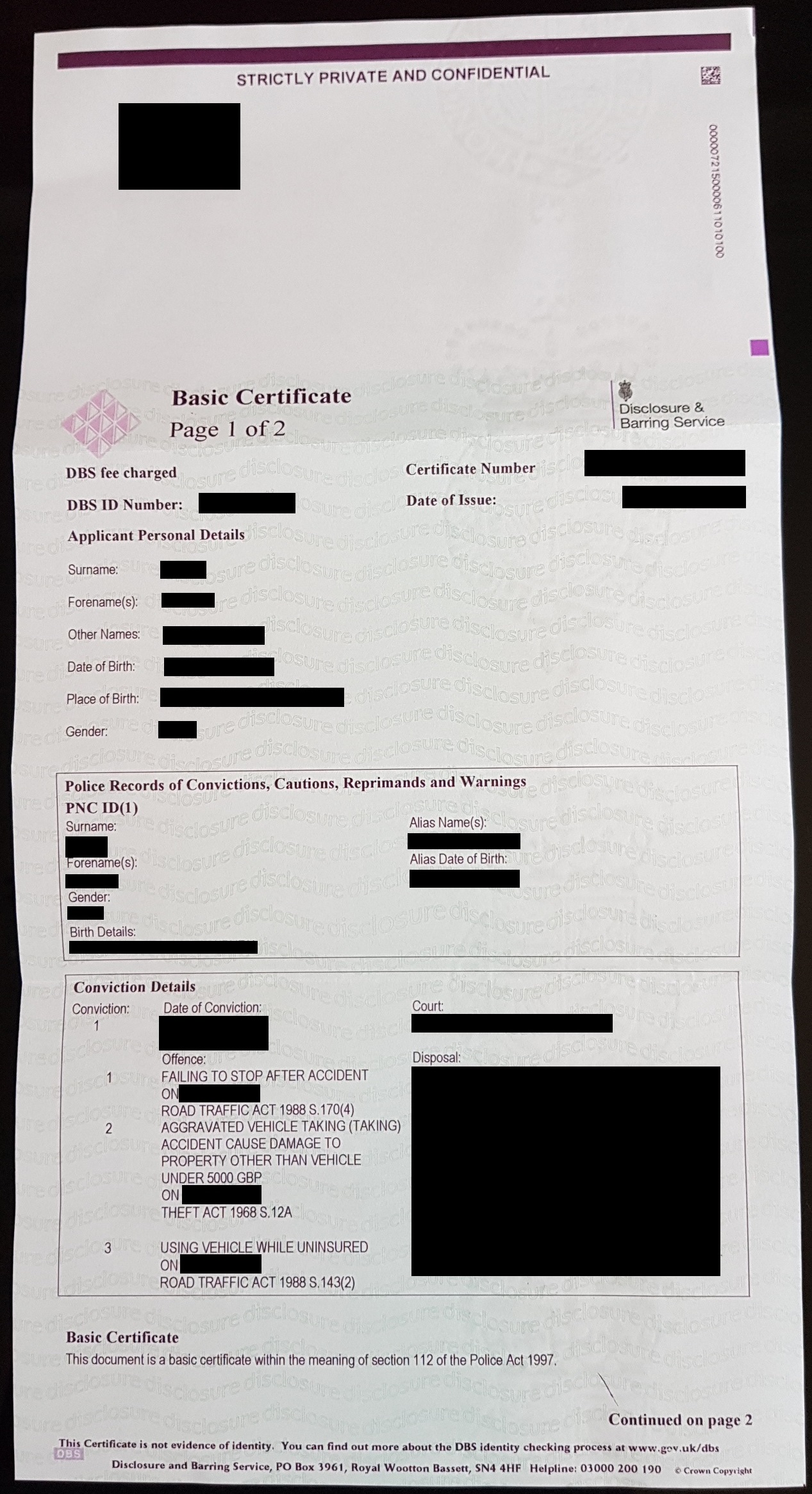
If you do have unspent convictions, the basic DBS check will give details of the date of conviction, the name of the court you appeared in, the offence committed, the date of the offence and the sentence received.
What will not be disclosed on a basic DBS check
Basic DBS checks do not disclose any convictions which are spent, cautions, fixed penalty notices or allegations.
An example of a basic DBS certificate with unspent convictions
How to know whether your convictions are spent
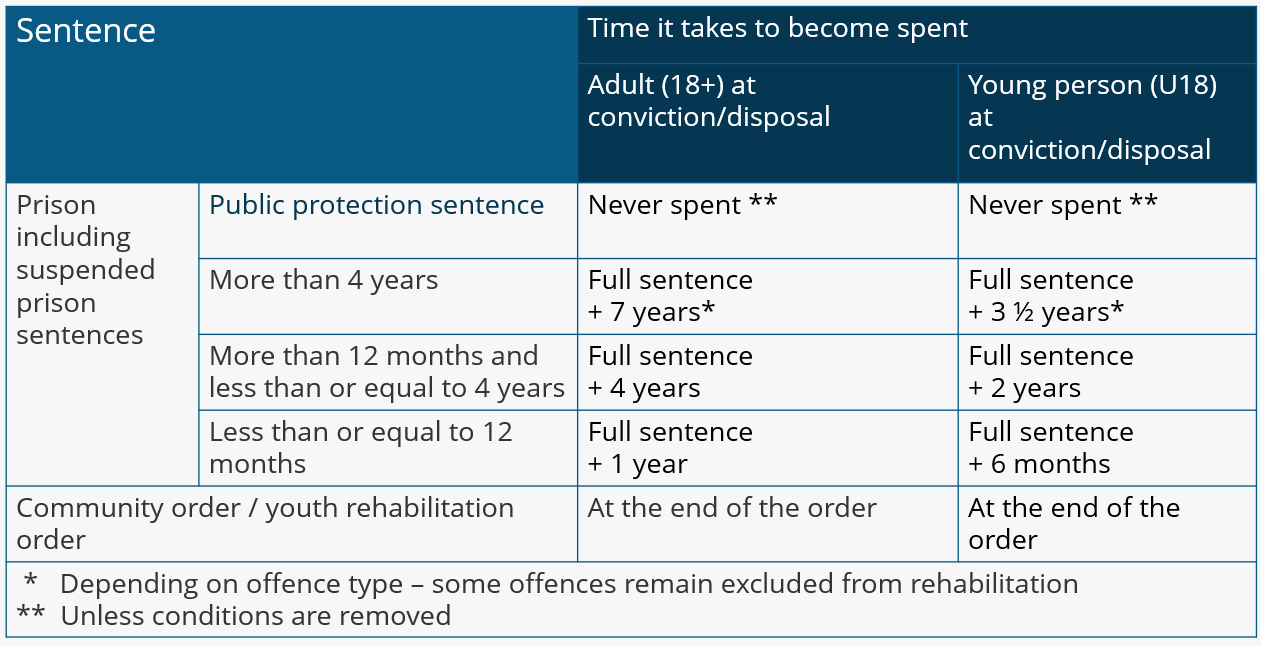
This is worked out by the Rehabilitation of Offenders Act 1974 – see the table below.
You or an employer on your behalf (and with your consent), can apply for a basic DBS check. It costs £21.50 and is issued by the Disclosure and Barring Service who will send it to you, unless you choose for it to be sent to the employer. It normally takes about 14 days to receive the certificate. If all of your convictions are spent, the certificate will come back ‘blank’.
Finding out what’s on your criminal record will assist you when it comes to dealing with employers and other organisations (for example insurance companies). Once you have this information you will be able to work out if your convictions are spent orfiltered, thereby giving you a better understanding of whether or not you need to disclose your convictions.
This information sets out the different ways in which you can find out the details of your criminal record and how to apply for them.
There are millions of people in the UK with a criminal record. You will probably have a criminal record if you have ever accepted an official police caution, pleaded guilty or been found guilty in a criminal court.
Employers, insurers, and others might ask you for details of your criminal record, and if the information you disclose is not accurate, this could cause you problems at a later stage.
It’s important therefore that you find out what’s contained on your criminal record, to enable you to disclose the correct information when asked. This will prevent you from disclosing inaccurate information, disclosing too much information or not disclosing what you are legally obliged to disclose.
Introduction
Before you start thinking about how and when to disclose, you need to know what to disclose. It’s a good idea to know this as soon as possible and before applying for a particular role.
There are various types of criminal record checks. The most common are those which relate to employment and are referred to as basic, standard or enhanced DBS checks. You can apply for your own basic DBS check. However, you cannot apply for your own standard or enhanced DBS check.
Ways of finding out your criminal record
Depending on what type of job you’re applying for, there are two different ways to find out about your criminal record for disclosure purposes:
1. Basic DBS check
If you’re applying for a job that is covered by the Rehabilitation of Offenders Act 1974, the employer may carry out a basic DBS check. You can apply for this yourself through the Disclosure and Barring Service.
It costs £21.50, and will show any unspent criminal convictions.
Click above image for an example of a basic DBS certificate showing unspent convictions
2. ‘Subject access request’ from the police
If you’re applying for a job that is not covered by the Rehabilitation of Offenders Act 1974, the employer may carry out a standard or enhanced criminal record check.
You’re unable to apply for your own standard or enhanced criminal record check in advance.
However, under the Data Protection Act, you’re able to ask the police for a copy of your criminal record. This is known as a ‘subject access request’ (SAR).
The SAR is free, and the police have up to one calendar month to supply it. For more details on how to apply, see our information onpolice records.
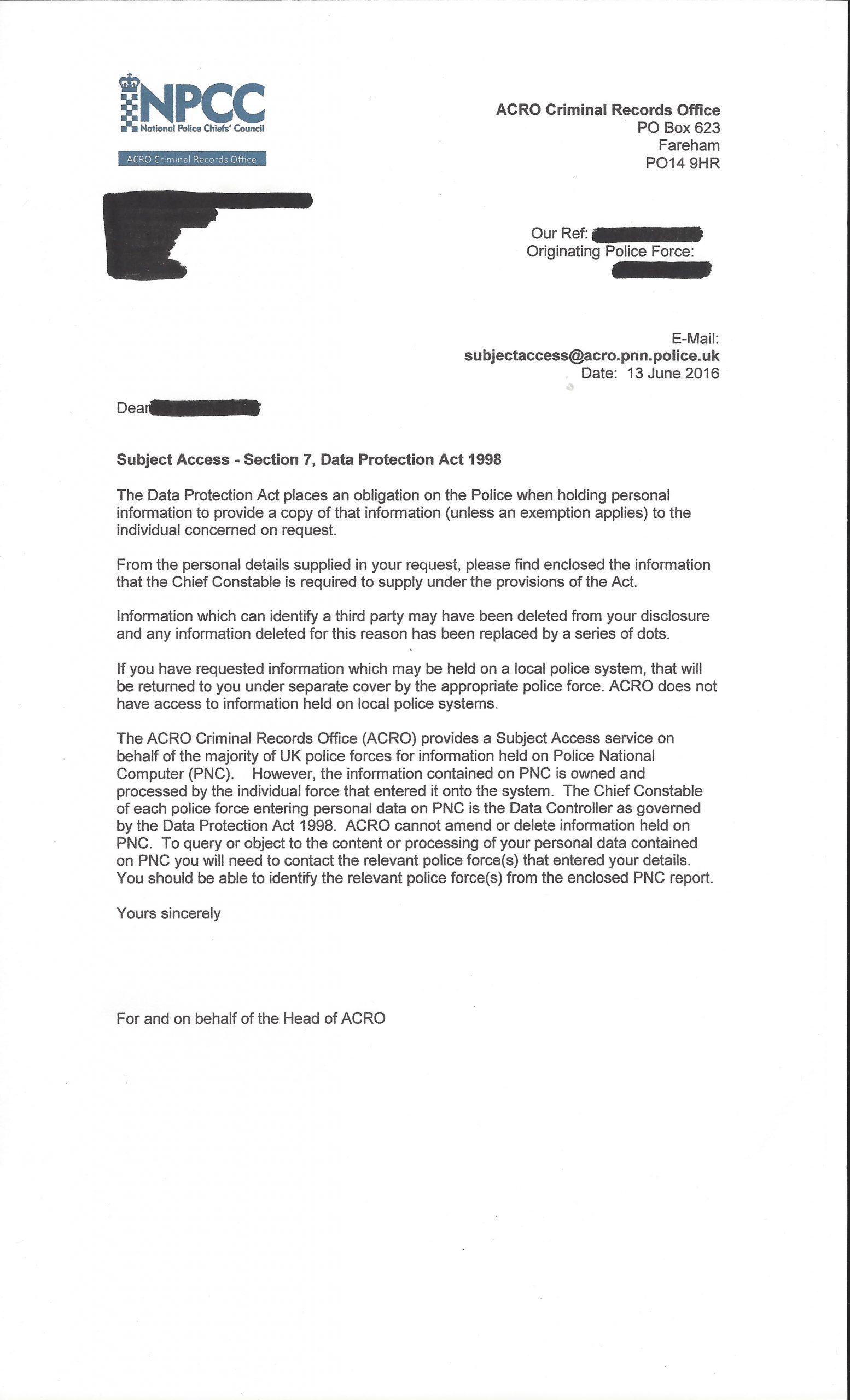
Click above image for an example of a NPCC no trace letter and a four page Police Record SAR
When you apply for your SAR, depending on what you want, you can request to see:
A copy of your national PNC (Police National Computer) record – this will show all convictions and cautions that are held on the PNC. This is useful if the criminal record check you’re planning to do in the future is a standard one.
A copy of your national PNC and local police records if the criminal record check being carried out is an enhanced one. This will show all convictions and cautions that are held on the PNC, as well as any information held locally by the police.
This document should only be used to help you understand your criminal record. If you want to know what will be disclosed on a standard or enhanced check, you’ll need to use the information disclosed to work out if anything will be filtered.
On enhanced checks local police records may also be disclosed, if the police force consider they are relevant to the role being applied for.
You should not be required to provide the SAR report to an employer, insurer or other organisation. This is known as enforced subject accessand is a criminal offence.
There are also other ways of finding out about your criminal record, such as a police certificate (used for travel purposes). For more information, go to our information on understanding your criminal record.
Basic DBS check or SAR?
With SAR’s being free of charge, you might assume that this is the best option available. However, it’s important to remember that what you see on your SAR will be different to what you’ll need to disclose to an employer. An SAR provides details of everything that’s held about you on the Police National Computer (PNC), it doesn’t differentiate between spent and unspent convictions. If you’re not really careful you could easily find yourself disclosing too much to a potential employer.
If you’re applying for jobs in the future that involve basic checks. In particular, if you think your conviction is spent and you’re planning not to disclose it to an employer.
If you’re applying for jobs involving standard/enhanced DBS checks.
If you want to know if something will be filtered and need to work it out.
If you want to find out what information the police hold about you.
Please note: This information is quite new. Let us know what you think of it and how it could be improved. Leave your feedback here. We will be updating it more as time goes by – to be alerted when it gets updated, sign up to our mailing list.
This information aims to set out what legal obligations a previous employer has when providing you with a reference, what employers are most likely to mention in a reference and whether they are entitled to disclose details of any convictions (unspent or spent) which they may be aware of. It also looks at alternative referees if you are unable to get a reference from a previous employer.
Once you have been offered a job, most employers will ask you to supply at least one reference from a previous employer. For most people, this will not present any problems. However, if you’ve not been working for a while (perhaps as a result of a prison sentence), or if you were sacked by your previous employer (linked to the criminal record you now have) then you may be worried about asking them for a reference.
If your previous employer is aware of your criminal record – because you received it during the course of your employment or it was unspent at the time you were taken on by them – then it’s important that you know what they can and can’t disclose in a reference.
Is my previous employer obliged to provide me with a reference?
Your previous employer is under no legal obligation to provide you with a reference. However, there are several exceptions in which you may be entitled to one:
An employer must give you a reference if there was a written agreement to do so.
Where the reference is needed by a regulatory body – this may be somebody like the Financial Conduct Authority to ensure that people employed to give financial advice are qualified to do so.
If your former employer agreed orally to provide you with a reference and is now refusing to, you may still be entitled to one, although this is probably going to be difficult to prove.
If your previous employer’s behaviour led you to believe that you would receive a reference. You may have grounds to claim a reference if, for example, they have always provided references to previous employees.
What if my employer refuses to give me a reference?
If your employer refuses to give you a reference, then this may ring alarm bells with your new company. However, some companies are increasingly refusing to give references because they’re worried about legal action.
You are likely to be asked to provide 1 or 2 work references and possibly, a personal reference – so choose carefully. If the organisation is satisfied with the majority of your references then they may not argue about one being refused.
Can my previous employer write something bad about me just because they do not like me?
No. The law states that any reference must be ‘fair, truthful and accurate’ and your referee should not mislead the employer asking for the reference in any way.
If you believe that you have been given an inaccurate, incorrect or misleading reference then you may be able to sue your previous employer for damages if you were able to prove that the reference prevented you from getting a job or, you suffered some other financial loss as a result of it. In some cases, you may also be able to bring an action against them for defamation.
What is my previous employer most likely to mention in a reference?
An employer can include details about your work abilities and performance together with the reasons why you left the job. However, employers are increasingly reluctant to provide too many details in a reference because they are worried about claims for defamation of character and other types of legal action that former employees can take. Therefore, they tend to provide the bare minimum for references, simply mentioning the job title and the dates when you were employed.
The duty for a referee to provide a true, accurate and fair references means that they will usually avoid:
Failing to respond to specific questions in a reference request without explaining why
Omitting key information that a new employer would expect to be disclosed
Organising the information in a way that would give a reasonable person a wrong inference or impression of you
What do employers tend to ask for from references?
We’ve seen examples of employers asking referees to provide details of criminal record. See an example below.
If your previous employer is aware of your criminal record or any pending prosecutions, then the Data Protection Actstates that they should class this as ‘special category data’. This is information which could be used in a discriminatory way and needs to be treated with greater care than other personal data.
If your previous employer is asked therefore whether they are aware of any criminal convictions or cautions on your record then, unless they have your explicit consent to do so, they should not respond to this question.
If you were able to prove that they had provided this information (possibly by submitting a subject access request to your current employer), then you would have the right to claim compensation from your referee as they would be in breach of the Data Protection Act.
In addition, under the Rehabilitation of Offenders Act, your referee must not disclose details of any spent convictions to prospective employers.
What can I do if my referee mentions my criminal record?
If you have been refused employment because a referee revealed a spent conviction, there may be a case for compensation through loss of future earnings due to your previous employer’s reference.
Can I see the reference that my previous employer wrote?
Your previous or current employer do not have to automatically show you a reference they have written about you. Once you start a job with a new employer, you can ask them for a copy of any reference they have been given from your previous employer. This is a right under the Data Protection Act. Your previous employer is not obliged to provide you with such a copy.
If you didn’t start work with the new employer (maybe because the job offer was revoked as a result of a ‘bad’ reference), you can still request a copy of the reference from them. There is no obligation on an organisation to keep information relating to ‘potential employees’ and you may find that they no longer have it.
To request a copy of your reference, you will need to make a subject access request in writing to your new employer. They will then consider if any exemptions apply and if they can release the information to you.
What can I do if I can’t get a reference from my previous employer?
Without a reference to explain whether or not you are suited to the work, an employer may lack crucial information about you. This may be especially problematic if you are applying for a position of responsibility.
Assuming that a reference is necessary, try to secure a good character reference. If these are from mature professionals (e.g. doctor, teacher etc), they may carry enough weight to satisfy an employer.
If you are still in touch with any co-workers, mention to the employer that you could provide details of former colleagues who would be able to speak about you in a work capacity. Alternatively, consider any clients that you may have had in the past who might be prepared to provide you with a reference.
Remember that a reference can also come from any temporary or voluntary work you’ve undertaken.
Who can provide me with further information and assistance?
As mentioned above, ACAS and the ICO are both relevant here. Find out their details on our important links page.
Frequently asked questions
No. A ‘bad’ reference is allowed, provided that it is not malicious and that the employer took reasonable care to ensure that the information was correct.
This information forms part of our section on looking for employment and common occupations and professions. It provides details of how people who have a criminal record will be dealt with if they are looking to become a Police and Crime Commissioner (PCC).
Why is this important?
Campaigning to be a PCC can be expensive (the average candidate in 2012 spent £11,220), and this is a significant amount of money if it later transpires that you are not eligible to stand for election because of your criminal record. The other thing to consider is the considerable media interest that PCC elections can elicit. If you are found to have a conviction that makes you ineligible to stand and you have to step down or resign, you may find that this is reported in local newspapers, bringing it to light again.
Introduction
Elected Police and Crime Commissioners (PCC’s), were established in 2011 to replace Police Authorities in England and Wales.
The first elections for PCC’s were held in 2012 and the second took place on 5th May 2016.
What’s the role of a PCC?
The role of the PCC’s is to be the voice of the people and hold the police to account. They are responsible for the totality of policing.
They are elected by the public to hold Chief Constables and the force to account. This effectively makes the police answerable to the communities they serve.
‘An individual will be disqualified from being elected as a PCC if they have been convicted in the United Kingdom, the Channel Islands, or the Isle of Man, of any imprisonable offence – whether or not actually sentenced to a term of imprisonment in respect of the offence.’
There’s a couple of important points to make about this definition:
An imprisonable offence is one for which a person who has attained the age of 18 may be sentenced to a term of imprisonment.
The easiest way to check if an offence is an imprisonable offence is to check the relevant legislation for the offence.
As the law refers to any imprisonable offence, it includes very minor offences where the maximum term of imprisonment would be very short, and even if the actual sentence wasn’t prison
What is not covered by this?
The following do not appear to be grounds for disqualification:
Convictions in other countries
Court disposals that were not convictions (e.g. a conditional discharge)
What questions will I be asked about my criminal record?
PCC posts are exempt from the Rehabilitation of Offenders Act, so a DBS check could be carried out. It is much more likely that the security vetting applicable to all police jobs would be used.
Candidates for election have to confirm on their nomination papers that they are not disqualified from standing and it is a criminal offence to make a false statement.
If it is subsequently found that an elected PCC has a conviction it is very likely that another candidate, or an elector, could challenge the election.
Personal experiences
The elections in 2012 flagged up two cases where PCC candidates were forced to step down after very old convictions came to light.
Falkland’s war hero, Simon Weston pulled out of the election to become the PCC in South Wales after his criminal conviction for being a passenger in a stolen car at the age of 14 was questioned.
The Home Secretary, Theresa May, said that the legislation was not aimed at barring someone like Simon Weston from becoming a PCC. In direct contrast however, an independent election lawyer stated that if he were to go ahead and stand as a candidate then he could be accused of signing a false declaration at the time of this nomination.
Simon Weston later resigned and tweeted ‘With regret I am pulling out of the PCC role in South Wales having become disillusioned by the fact it was getting too political and not serving the people’.
Bob Ashford received a conviction aged 13 for trespassing on the railway with an offensive weapon. He was fined two pounds and 10 shillings. When he filled in his application to become a PCC he was asked if he had any criminal convictions to which he answered ‘Yes’. The Labour party executive committee agreed that they were happy for him to be one of their candidates and he started campaigning.
When Simon Weston’s eligibility was queried and he stepped down, Bob Ashford realised that an offence of trespass on the railway and possessing an offence weapon were considered imprisonable offences and he took the decision to resign. Read Bob’s story here.
In August 2016, UKIP’s leadership candidate Steven Woolfe admitted that he failed to declare a criminal conviction for drink driving when he stood for Police and Crime Commissioner in 2012. Mr Woolfe came last in the PCC election with 8.55% of the vote.
There are concerns within UKIP that this revelation may have an impact on his leadership ambitions. Read the whole story in the Huffington Post.
There was a further case where a candidate was able to successfully argue that his offence was not imprisonable – he ended up being successful in the election.
Alan Charles stood down from running as PCC in Derbyshire after being told that a conditional discharge he had been given when he was 14 barred him from running for election. However, barristers and legal experts advised that his conditional discharge would not disqualify him. For further information see this BBC news story.
Useful links
Below you will find links to useful websites relating to this information.
This information is designed to set out what you need to consider if you receive a criminal record whilst you’re in employment. It highlights your basic employment rights and some organisations that can provide you with additional information, advice and support.
Why is this important?
Much of the disclosure information we provide is based around disclosing convictions obtained prior to applying for jobs.
For further information on disclosing convictions prior to getting work see here.
It’s important to know what your legal obligations are if you receive a criminal record whilst you’re in work and what the consequences could be if your employer becomes aware of it.
Introduction
If you receive a conviction whilst you’re employed, it is important that you are clear as to whether this is something that you will need to disclose to your employer. This document offers a brief guide as to how receiving a criminal record may affect your employment.
This is for information only; if you have any doubts about whether you should raise an issue with your employers or start legal proceedings, we would recommend that you seek legal advice.
(Throughout this information, we use the general phrase “conviction”. This should be interpreted as meaning caution, or conviction. In the event that cautions and convictions are dealt with differently, we will highlight this).
Do you legally need to disclose a new conviction to your employer?
Whether you have to disclose a conviction obtained during employment is not always clear; a lot will depend on what your contract of employment states.
If your contract says that you have a duty to inform your employer of convictions received during your employment, then this is pretty clear cut and a failure to do so would be treated as a breach of your employment contract. If your employer were to discover your conviction, you may be dismissed if you had not informed them of it.
For employers who don’t make it clear whether you should disclose convictions received during employment, then there is no legal obligation on you to do so. If your conviction were to be discovered, then this, on its own, would not be a reason for your employers to dismiss you. However, some employers may feel justified in dismissing you on the basis that they can no longer trust you based on your keeping your conviction from them.
If you receive a disposal that becomes spent immediately (i.e. a caution), then you should be able to rely on the Rehabilitation of Offenders Act and not disclose (as long as the role/position isn’t exempt from the ROA).
Is there anything else you should consider about disclosing your criminal record?
There are some situations where you would have no choice but to disclose to an employer. For example, if your job involved driving, then the loss of your driving licence would mean that if you were to say nothing, you may have to continue driving and would therefore be committing an offence every time you got behind the wheel of the car.
If your conviction leads to restrictions being put on you, e.g. a harassment conviction could come with conditions attached regarding locations you cannot go and/or people you cannot have contact with. This could affect your ability to do your job, and make it impractical to carry out your duties without committing a further offence.
If there is any chance (either through gossip, publicity or being subject to regular formal criminal record checks) that you will get found out, then you will have to weigh up the chances of dismissal against the likelihood of the employer finding out by themselves and holding both that fact and the conviction against you.
What action can your employers take?
Where a criminal offence is committed (or even alleged) in relation to something that has occurred at work or in the course of your employment, then your employer would be entitled to treat this as a disciplinary matter, although they are not usually under any obligation to do so. If disciplinary action does happen, then your employer will need to follow their usual disciplinary procedures.
The situation is slightly more complicated where the allegation/conviction is related to an incident that took place away from the work place and is entirely unconnected to your employment. However, the result may be the same.
Where an employer becomes aware of a criminal conviction, you should not be surprised if they begin disciplinary proceedings. There is a good chance that, especially in cases of dishonesty, or where the conviction is directly relevant to your employment, that you will end up being dismissed. This would be the case whether the incident took place at work or not. It could have been committed in another country or in a situation wholly divorced from your employment; an employer is still entitled to use it as a reason to terminate your employment, either by treating it as misconduct (most likely if the incident took place at work), or as a dismissal for some other substantial reasons (SOSR).
There could also be a statutory reason for companies to dismiss you. For example, where a person loses their driving licence due to a conviction and driving is a critical part of their job.
What factors will your employers take into consideration?
If the conviction is for something you did outside work, employers should consider what impact it will have on your suitability to do your job and your relationship with your company, colleagues and customers. For example, it might be reasonable to dismiss you if you had been found guilty of fraud outside work if part of your job is operating a checkout till in a supermarket. However, if your offence is for driving, it may not be a problem if driving does not form part of your job. They should also take into account your previous work record. If it is unblemished then it may be easier to overlook a conviction which is not work related.
Other factors that an employer may take into consideration could include:
The image of the company (including the extent to which the issue is covered in the press, especially where it involves something serious, such as child sex offences)
The potential threat you pose to fellow employees or customers and clients of the company (especially relevant where you have been convicted of violent or sexual offences)
The likelihood that you will commit similar offences within your employment (especially where dishonesty is concerned)
What are the likely outcomes?
If you receive a custodial sentence then dismissal is likely to be the only option as you will no longer be capable of performing your contractual duties.
If your conviction leads to a non-custodial sentence, then the prospect of your retaining your employment may also appear unlikely, but it’s important to remember that you are still entitled to reasonable treatment from your employer. A criminal conviction should not automatically result in your losing your job and an employer should not immediately take this course of action. All employers have a legal duty to act responsibly, follow their own procedures and avoid a ‘kneejerk’ reaction.
Even when the staff handbook or company policy dictates that a particular act will justify dismissal, an employer must still carry out a proper investigation and decide whether, in the specific circumstances, they want to take a considered decision to dismiss.
What options are open to you?
If your employer were to consider taking some form of disciplinary action then you should avoid:
If you are given the opportunity, you will need to explain the circumstances to your employer. You should outline your value to the company, your good service (if you have it) and address any specific concerns they may have as best you can.
If convicted of a driving offence whilst employed as a driver, for example, this would be difficult, but you could at least put the thought in their minds that you could be transferred to another role. Similarly, if convicted of a dishonesty offence, you could propose that you be moved away from a cash-handling role. Such arguments carry little weight with some employers, but with others, they could prove effective, especially where you have a record of good service and the conviction was totally divorced from your employment. The important thing to remember is not to give in, but to defend yourself. Even if it seems hopeless, you may end up convincing your employer not to dismiss you.
Firstly, a refusal to co-operate will not help you as far as the internal disciplinary process goes, as there will be nobody to put your case to the employer and no opportunity for you to question the position that they take. In addition, an Employment Tribunal is unlikely to be impressed with your refusal, which would make it difficult for a reasonable employer to involve you in the proceedings and comply with the need to give you the opportunity to explain what has happened. Remember, most employers do not instigate disciplinary proceedings lightly and the best way to combat any assumption or evidence that they have (and to discover what it is) is to participate in the disciplinary process.
What can you do if you are dismissed?
The first thing would be to appeal the decision through your employer’s appeals process.
If this is unsuccessful, then you could consider taking your case to an Employment Tribunal. It is important to note that the law requires that an employee works for an employer for a minimum period before they can claim unfair dismissal. If your employment started before 6th April 2012 then this period is one year. If your employment started on or after this date, then you must complete two years of uninterrupted service before you can make a claim.
For further information regarding Employment Tribunals see here.
Personal experience
Our helpline was contacted by someone who had been suspended by his employer when they became aware of his conviction for harassment through reports in his local newspaper.
The offence didn’t take place within the work place, was not relevant to his job and had occurred during a period of mental illness which his employers were well aware of. His contract of employment did not make it clear whether there was any obligation on him to disclose his new conviction.
The reasons given by his employer for taking disciplinary action were that:-
He failed to disclose being charged with a criminal offence
The offence impacted upon his credibility to discharge the duties of his role
There was a loss of trust and confidence in the employment relationship due to the failure
This case demonstrates how despite there being no legal obligation to disclose, the fact that this gentleman’s conviction received some media interest means that this was possibly something he should have taken into account when deciding whether or not to disclose.
Did you get a conviction and keep your job? If so, let us know.
A recent legal case
A recent Employment Appeal Tribunal (EAT) in Ireland highlighted the options open to an employer when an employee receives a criminal conviction for misconduct outside the work place.
The claimant was absent from work on long-term sick leave when he received a suspended sentence for the sale and supply of drugs. When his employer found out, he was dismissed for gross misconduct and breach of trust. The Employment Tribunal had to consider whether the dismissal could be justified given that the event took place away from the claimant’s place of work.
The EAT noted that there is considerable uncertainty as to whether an employee’s conviction for a crime committed outside the workplace entitles the employer to dismiss the employee. The argument usually relied upon by the employer is that the bond of trust has broken down.
The EAT held that a dismissal for misconduct outside the work place can only be justified where there is sufficient connection between the crime committed and the employee’s work, in such a way that it would make the employee unsuitable or capable of damaging the employer’s reputation. The employer has to demonstrate that it has a legitimate interest in the crime committed to the extent that the misconduct is disruptive to the business, employee relations or affects the reputation of the company.
Although this case was upheld and outside England & Wales, it demonstrates the general principle that still applies; if an employer is going to dismiss you for out of work misconduct, there must be a genuine connection between your offence and your employment. The connection must be such that it leads to a breach of trust and/or causes reputational and other damage to the company. If you have been dismissed whilst in employment and you believe you have the evidence to challenge the dismissal under the issues raised above, we would recommend that you seek legal advice.
We’re really keen to show how good self-disclosure statements can vary in their style and approach. We think a really good way to do this is to get some real-life ones that have been used successfully. So, if you’ve written your own statement which you went on to use and that resulted in you being offered a job, we’d love you to help us with this. Find out more here.
Aim of this information
The aim of this information is to explain how a disclosure statement can help with “when and how“ to disclose to an employer when applying for work. It also provides some examples of what should be included in a disclosure statement/letter. This information is part of our disclosing to employers section.
Why is this important?
However you choose to disclose your criminal record to an employer, be it face to face or in writing, it’s important that you are clear about what you need to disclose and how you are going to disclose it.
A disclosure statement can often help to get your thoughts into some kind of order which you can use as a prompt when disclosing face to face or to hand over to an employer as evidence of what you’ve disclosed. The statement should:
Give details of your offence and the circumstances surrounding it.
Highlight what makes you suitable for the role, i,e, your previous skills and experience.
Demonstrate how you have moved on or changed since your offence.
Although they’re often referred to as a “disclosure letter”, we avoid that phrase as it suggests they should be submitted as a letter. As you’ll see, that’s not always the best way forward.
When should I use a self-disclosure statement?
Generally, our view is that if you’re disclosing your criminal record to an employer, discussing the details face-to-face is the most effective way of explaining the circumstances. However, there are a number of reasons why a self-disclosure statement can be useful to have completed in advance of applying for work.
You might be asked for a written statement as part of the application process.
You may be more comfortable writing rather than talking about your criminal record.
You may be asked at interview, and having the facts to hand can come in useful in helping you to discuss the circumstances around your record.
We normally recommend that however you disclose your criminal record, it is useful to provide the employer with some brief factual details of your criminal record in writing (even if you are disclosing verbally), so that you have evidence of what you’ve disclosed. This can also help them in making a decision. Make sure that you keep a copy of this for your own records.
For more information on writing a self-disclosure statement, visit our ‘disclosing to employers’ section.
Examples of self-disclosure statements
These examples have been written for guidance purposes only and should not be copied.
Self-disclosure statements need to be tailored to the specific vacancy you are applying for.
They should be personal to your own situation and give a genuine account of any mitigating factors that led to your conviction and highlight what you have achieved since.
There is no ‘perfect template’ for a self-disclosure statement.
Person one – Peter
Peter has a recent unspent conviction for GBH and is applying for a job in a supermarket.
Example one – Asked at application and preparing for interview / Brief factual details
This example is designed to help Peter when he has been asked at application and offered to provide more details at interview. It is a helpful way for Peter to set out the facts and any important points that he would want to explain at interview, but without going into too much detail at an early stage in the recruitment process. Peter could also give it to the employer as a factual record after a face-to-face conversation.
Statement about my criminal record in relation to my application for the post of supermarket checkout operator
I wanted to take this opportunity to provide some further details about my unspent criminal conviction.
Just over two years ago, in XXXX, I received an eight-month prison sentence for grievous bodily harm. The conviction came about during an argument with my girlfriend’s ex-husband. It is my only conviction.
I take full responsibility for my actions and admitted the offence as soon as I was arrested. Whilst in prison, I attended a programme specifically for people convicted of violent offences and this enabled me to get a better understanding of the factors that triggered my anger and also taught me how to manage my emotions.
I deeply regret what I did but some good has come out of it. I’ve seen the impact that my conviction has had on my family and I know that I am now better able to deal with any situation I find myself in, in a much more constructive and calm way.
I would welcome the opportunity to explain this in more detail in a face-to-face discussion if you would like more information about the circumstances leading up to my conviction or what I’ve done since.
Peter Jones
[Date]
Example two – Asked after interview or job offer / Detailed disclosure in writing
This example is designed to help Peter when he has been asked after interview or job offer and he’s been asked to provide details. It is a helpful way for Peter to go into more detail given the later stage in the recruitment process. It can also be used if the employer is going to carry out some kind of risk assessment on Peter.
Dear Miss Wallington,
RE: Application for the post of supermarket checkout operator – Self-disclosure statement
Further to my recent interview, I would like to provide details of my unspent conviction. I can confirm that just over two years ago, in XXXX, I received an eight-month prison sentence for grievous bodily harm.
The conviction came about during an argument with my girlfriend’s ex-husband. There was a physical altercation which ended with me hitting him.
I take full responsibility for my actions and admitted the offence as soon as I was arrested. Whilst in prison I attended a programme specifically for people convicted of violent offences and this enabled me to get a better understanding of the factors that triggered my anger and also taught me how to manage my emotions.
I deeply regret what I did but some good has come out of it. I’ve seen the impact that my conviction has had on my family and know that I am now able to deal with any situation I find myself in, in a much more constructive and calm way.
I understand that you have a responsibility towards your staff and customers and that my criminal record may cause you some concern. However, I hope this letter gives you some insight into the positive changes I have made to my life since my conviction. If you feel it would be helpful to discuss this face-to-face, I would be happy to do so.
Yours sincerely,
Peter Jones
Person two – Amy
Amy has a spent conviction for over-payment of benefits and is applying for a job as a social worker.
Example one – Asked at application and preparing for interview / Brief factual details
This example is designed to help Amy when she has been asked at application and offered to provide more details at interview. It is a helpful way for Amy to set out the facts and any important points that she would want to explain at interview, but without going into too much detail at an early stage in the recruitment process. Amy could also give it to the employer as a factual record after a face-to-face disclosure.
Statement about my criminal record in relation to my application for the post of social worker
I wanted to take this opportunity to provide some further details about my unspent criminal conviction.
Approximately 8 years ago I received an eight-month community order for an over-payment of benefits.
Although this conviction is now ‘spent’ under the Rehabilitation of Offenders Act 1974, due to the role that I have applied for I wanted to take this opportunity to provide some further details as it appears on my enhanced DBS check. There are circumstances relating to the offence that I would be happy to go into in more detail.
As part of my community order, I was required to attend a money management and budgeting course which has helped me to manage my finances more effectively.
I take full responsibility for my actions and pleaded guilty immediately at the earliest opportunity. I deeply regret what I did but some good has come out of it. I have been able to pay back the over-payment and the courses I took through probation have enabled me to be more in control of all aspects of my life.
As my application hopefully shows, I have a good, recent work record and hope that I can be judged on this.
Amy Jones
[Date]
Example two – Asked after interview or job offer / Detailed disclosure in writing
This example is designed to help Amy when she has been asked after interview or job offer about her criminal record and she’s been asked to provide details. It is a helpful way for Amy to go into more detail given the later stage in the recruitment process. It can also be used if the employer is going to carry out some kind of risk assessment on Amy.
Dear Mr Clarke,
RE: Application for the post of social worker – Self-disclosure statement
Very many thanks for your letter with a conditional offer for the post of social worker.
Up until this stage of the process, I have not been asked to provide any criminal record details. However, prior to my enhanced DBS check being carried out, I wish to disclose that approximately 8 years ago I received a conviction for an over-payment of benefits. In total, I was overpaid by £4150 over a six month period which resulted in 12 separate offences as part of my conviction.
At the time of my offence I was a single parent struggling to find a job after completing my degree. I was claiming benefits but managed to secure a part-time job in a local restaurant. This part-time work did not affect my benefit entitlement in any way. However, when the job became full-time, I didn’t disclose my change of circumstances to the Department for Work and Pensions and continued to receive benefit payments.
I take full responsibility for my actions and pleaded guilty immediately at the earliest opportunity. As part of my community order, I was required to attend a money management and budgeting course which has helped me to manage my finances more effectively.
I deeply regret what I did but the probation courses made it possible for me to take control of my finances allowing me to pay back the £4150 much quicker than I had been asked to do. I am a lot more confident in dealing with money now and, having addressed the issues that led to my offending, I don’t believe that I pose any risk to your organisation. This conviction is my only one and, in the eight years since it happened, I haven’t been in any further trouble.
I hope this letter provides you with an insight into the circumstances surrounding my conviction and demonstrates the steps I have taken to ensure that I am at no risk of reoffending. If you feel it would be helpful to discuss this further face-to-face I would be happy to do so.
Yours sincerely,
Amy Jones
Person 3 – Tony
Tony has an unspent conviction for a non-contact sexual offence. He is applying for a job in retail.
As sexual offences cover a wide range of very different behaviour, it is important for Tony to give an employer a better understanding of the nature of his offence. The stigma and shame around sexual offences can make it difficult for some people to talk about and a written statement can be a starting point for further discussion.
Statement about my criminal record in relation to the role of customer service advisor
As stated on my application form, I have an unspent conviction for a non-contact sexual offence and I would like to take this opportunity to provide you with further information.
Given the serious and sexual nature of my offence, I’m sure you must have concerns about the risks of employing me – both for your company’s reputation and for the safety of your staff. I would like to assure you that my offending behaviour is in the past and I deeply regret what I did.
My issues stem from a sexual addiction problem; using pornography to cope with stress and feelings of inadequacy in my life. As will all addiction problems it became more extreme over time which led to my taking greater risks to get greater thrills. This ultimately led to me downloading and viewing indecent images of children.
I knew what I was doing was wrong and when I shut down my computer I felt incredible guilt. But, the next time I felt stressed and anxious, I remembered how looking at the images had made me forget my problems and feel better. This became my way of coping with any problem. I can categorically state that at no time did I ever want to make contact with a child or young person.
The more time I spent online, the worse my relationship with my partner became and the more stressed and isolated I felt. Unfortunately, I felt too ashamed and scared to reach out for help. When I was arrested, the only thing I felt was relief; an opportunity to find help and change.
During my time in prison and since my release, I have attended rehabilitation programmes and had excellent help and support from prison and probation services. I now have a greater understanding of the causes of my behaviour, and I have been able to address these issues using both one-to-one and group work. I am able to recognise situations and moods which, in the past might have led to offending behaviour and I have learnt strategies for dealing with these.
I have received a lot of help and support from my family and friends and I am deeply ashamed of the impact my offending has had on them. This has added to my determination to concentrate on a positive, offending-free life.
I am happy to answer any questions or provide you with additional information should it help you in reaching a decision.
If you are under consideration for inclusion in either the children’s or adult’s barred lists, the Disclosure and Barring Service (DBS) may offer you the chance to explain why it would be inappropriate or disproportionate for you to be included in one or both lists. This information sets out how you can go about making representations, how to request a review of a decision and how to appeal a decision.
Why is this important?
If an employer or organisation has concerns that a person has caused harm, or poses a future risk of harm to vulnerable groups, they will be referred to the DBS.
As part of the barring decision, the referred person can make representations. It is important that anybody who finds themselves in this situation does make representations to the DBS to ensure that their case is considered in the fairest and most balanced way.
Introduction
If the DBS writes to you to inform you that you may be barred from working/volunteering in regulated activity with children and/or adults, you will be able to make representations. This is an important part of ensuring that fair, consistent and thorough barring decisions are made.
The DBS makes decisions as to whether a person should be barred if they have:
Been convicted or cautioned for certain offences
Harmed a child or vulnerable adult or when the DBS considers the person poses a risk of harm to a child or vulnerable adult.
Test for regulated activity
The DBS can only consider a person for inclusion on a barred list where that person is, has been, or might in the future be working with vulnerable groups in regulated activity. You will be able to make representations if you believe that you don’t meet the test for regulated activity. The only exception to this is if you have been cautioned or convicted of an autobar offence with no right to representations.
Making representations
What are representations?
Representations provide an opportunity for you to explain why you feel it would be inappropriate or disproportionate for the DBS to include you in one or both barred lists. You might consider making representations if the DBS informs you that you could be barred from working in regulated activity with children and/or adults. Or you can make representations if you know that a referral has been made about you.
How do I make representations?
It is expected that the majority of people who make representations will do so in writing. However in the interests of fairness and equality, and to protect a persons rights under the European Convention on Human Rights, the DBS have recently introduced a system whereby arrangements can be made to hear oral representations.
A link to the DBS oral representations guide can be found here.
The DBS is unable to provide help in preparing individual representations, this will need to be sought from a solicitor, carer, family member, trade union representative, professional association, or other advisory body. If you decide to have anyone other than yourself submit your representations, and you wish for the DBS to liaise directly with another party rather than with yourself, then you will need to enclose written authority signed by yourself to this effect.
What do I say?
When making your representations you may include, but are not restricted to, any of the following:
An explanation of your offending behaviour.
Any factors that may mitigate your offending behaviour.
A copy of your pre-sentence report, Offender Assessment System (OASys) report, Judges sentencing remarks, Probation Service reports or Social Services assessments.
Any relevant reports from medical experts. Please note that if you decide to provide a report from a medical expert as part of your representations then the DBS may ask you to attend an assessment by an independent medical expert of their choosing.
Any relevant specialist assessments completed by other professionals
Details of your career
Professional references or testimonials
Why you think you pose no current or future risk of harm to vulnerable groups, including children.
Your representations should not challenge police cautions or convictions unless these have been formally overturned. If you are, at the time of making your representations, also disputing or appealing against your caution or conviction, then this will not be taken into account until such time that the result of that appeal is known. Your representations also cannot challenge findings of fact made by a competent body (A competent body is a professional regulatory body named in the Safeguarding Vulnerable Groups Act 2006 or the Safeguarding Vulnerable Groups (Northern Ireland) Order 2007).
If you include any original documentation that you wish to be returned to you, then you should clearly state this within your representations.
How long do I have to make representations?
The DBS will allow you 8 weeks from the date of their notification letter to you to make your representations. However, if you feel that you need more time you must write to them detailing why you feel an extension is needed. Once they receive your request, they may consider granting such an extension. The DBS is unable to extend the representations period indefinitely and is unable to wait for appeals on cautions or convictions should they be on going. Where new information is subsequently made available (such as the outcome of an appeal hearing), the DBS is able to review the decision in light of the new information.
What happens once I have sent my representations?
Once the DBS receives your representations, the information provided is assessed alongside the other information they hold about you. They may then seek additional information such as police reports etc. Any information that is used to make a decision about including you in a barred list will be disclosed to you so you may make comments before they make a final decision about your case. Upon receipt of your representations, the case is reassessed and a final decision will be made, and you will be sent further written notification of this.
What if I do not make any representations?
You are not under any obligation to make representations but it is important to understand that, if you do not provide any evidence to support your case not to be barred, then the DBS will make a final decision based on the information it already holds on you from elsewhere. Inclusion on a DBS barred list will last for your lifetime unless you appeal or seek review. Making representations is an opportunity for you to give your interpretation of the circumstances that led to the referral.
If you are cautioned or convicted of an autobar offence (with the right to make representations) and you chose not to, then by law the DBS has no discretion and must include you in one or both lists, after the 8 week representations period has ended. The list you are placed on will depend on the circumstances of your offence.
For further DBS guidance on making representations see here.
Reviews
There are three powers under which the DBS may grant permission for your inclusion in one or both barred lists to be reviewed.
Where your role does not meet the test for regulated activity
Anyone included in a barred list prior to September 2012 may seek a review at any time if they consider that, within the revised definitions of regulated activity from that date, they are not, have not been nor might in future be engaged in regulated activity relating to vulnerable groups, including children.
Rather than a review of whether you can or cannot undertake regulated activity, this is a review of whether the bar is necessary, given you would not be carrying out regulated activity in the future. You should be mindful that should you be removed from either list purely due to not meeting the test for regulated activity, and in the future apply for a regulated activity role, you may be considered for inclusion on either list.
Note: This power does not apply to those who were barred following automatic barring offences without right to make representations.
Where certain statutory conditions are met
You may seek a review of your inclusion in a barred list at any time if you can provide DBS with evidence of:
Information which is now available which was not at the time of your inclusion in the list;
Any (material) change in circumstances affecting you since barring ; or
An error by the DBS.
Where you request a review after a minimum barring period
Whether you have made representations on initial barring or not, once your case has been concluded you may ask the DBS to review your inclusion in either or both barred lists after a minimum period has elapsed. The minimum period will have been stated in your individual notification letter. These periods are based on your age when barred:
Under 18 years 1 year
18 to 24 years 5 years
25 years or over 10 years
A barred person is required, under this power, to satisfy the DBS that their circumstances have changed since they were initially barred or since they last applied for a review. Evidence of change might include but is not restricted to:
Specialist assessments
Reports from medical experts, the Probation Service or any other professional
Evidence that they have successfully appealed a criminal conviction
Details of any relevant work (paid or voluntary) they have undertaken since their inclusion in the barred list(s)
Evidence of a change in personal circumstances e.g. relationship history
Any factors that might explain what happened
Testimonials (character statements)
Any supporting statement should not challenge findings of fact made by competent bodies – e.g. statutory regulatory bodies, nor challenge police cautions or convictions.
Irrespective of the grounds for applying, you may only apply for this review with the permission of the DBS and this will only be granted if they think that your circumstances have changed enough to justify a review of your case.
If you do not request a review then you will remain included in the barred list(s) indefinitely.
How to seek a review – Who to write to?
Should you wish to seek a review of your inclusion in the Barred List(s) you should make your request in writing quoting your:
DBS (or ISA) Reference Number;
Full name; and
Full address including postcode
In order to ensure that the request for review is being considered under the correct power (detailed above), you should also state under which of these powers you wish your inclusion in a barred list to be reviewed.
Requests should be sent to:
Review Team
Disclosure and Barring Service
PO BOX 181
Darlington
DL1 9FA
In the event the DBS refuses your request to remove your name from a barred list following review, you may seek to appeal to the Upper Tribunal – but only if this is based on an error of law or a finding of fact. The Upper Tribunal will advise whether or not they will hear your appeal on these grounds. More details about the Upper Tribunal can be found here.
There is a right to appeal against most barring decisions, whether you are included in one or both of the barred lists (the only one you cannot appeal is in Autobar cases in which there is no right to make representations against the imposition of a bar). If you feel you have a case to appeal against being place on the barring lists, it is worth appealing. In 2013/14, 35% of people who were permitted to make representations won their appeals (Information from the Independent Review of the Barring Operations of the Disclosure and Barring Service, published July 2016).
This appeal is through the Administrative Appeals Chamber of the Upper Tribunal in England and Wales. There is no right of appeal against the DBS in the event they refuse you a review. Any appeal may only be made with the prior permission of the Tribunal and on the grounds that the DBS have:
Made an error in law relating to your case; and/or
Made an error in finding of fact relating to your case.
You should be aware that both the DBS and the Upper Tribunal have emphasised:
“You should note that section 4(3) of the Safeguarding Vulnerable Groups Act 2006 provides that the decision whether or not it is appropriate for an individual to be included in a barred list is not a question of law or fact.”
Below you will find links to the useful websites relating to this page. More specific details (including addresses and telephone numbers) of some of the organisations listed below can be found here.
This information is designed to set out how a criminal record can impact on getting a Personal Gambling Licence (known as a Personal Functional Licence).
Why is this important?
Having a criminal record is not a bar to being issued with a Personal Functional Licence. However, it is important that you know what cautions or convictions you need to disclose and how they will be dealt with.
“any individual who performs any function which enables them to influence the outcome of gambling or relates to the receiving or paying of money in connection with gambling will require a Personal Functional Licence.”
When considering the suitability of an applicant, the Gambling Commission will take account of some of the following in deciding whether or not to issue a Licence:-
Identity and ownership – Verification of your identity and any other person relevant to the application will be required by way of copies of your driving licence, passport and NI number.
Finances – Depending on the type of application you are making, you may be required to submit financial documents.
Integrity – Your honesty and trustworthiness will be assessed
Competence – You will need to provide details of your experience, expertise, qualifications and employment history.
Criminality – You will be asked to provide details of your criminal record
Guidance on completing the online Personal Functional Licence application can be found here.
What information about my criminal record do I need to disclose?
Although you are not asked to disclose details of your criminal record, a basic Disclosure and Barring Service check will be undertaken as part of the application process for a Personal Functional Licence (PFL).
How are criminal convictions dealt with?
The Gambling Commission state that they will not automatically refuse your licence application if you have a criminal record. In assessing your application they will take the following into account:-
how serious the offence was
how relevant it is to the role
how long ago it was committed
Have you been granted a licence with a criminal record?
We’re looking for examples of where people with convictions have been granted a licence with a criminal record so that we can include details here to help give people confidence to apply.
If you’ve been granted a licence with a criminal record, please email us or get in touch to let us know the details – your personal details will be kept confidential and anonymous.
For more information
Practical self-help information – More information on basic DBS checks can be found here.
To discuss this issue with others – Read and share your experiences on our online forum
Get involved
Help us to add value to this information. You can:-
This page aims to set out the route to becoming a solicitor and the likely obstacles you may face if you have a criminal record.
Why is this important?
Law firms may not be averse to employing people with convictions and may only carry out basic criminal record checks. Initially however, individuals would need to meet the requirements of the Solicitors Regulation Authority to become qualified. Its important to know whether your criminal record will prove problematic before you embark on a course of study.
Introduction
Training to become a solicitor demands considerable commitment over a number of years. Legal jobs are hotly contested and you will need to be determined and highly motivated to succeed.
Qualifying as a solicitor
The route to qualification as a solicitor in England and Wales requires individuals to meet the requirements set out under the Solicitors Act 1974 to ensure they are of satisfactory character and suitability. You will therefore be required to complete a screening process before you are admitted to the roll.
The Solicitors Regulation Authority (SRA) is responsible for setting and maintaining standards for all solicitors practising in England and Wales. They have a duty to consider the character and suitability of anyone who wishes to enter the profession, and they must ensure that any individual admitted as a solicitor has, and maintains, the level of honesty, integrity and professionalism expected by the public and other professionals, and does not pose a risk to the public or profession.
The screening process
The screening process involves validating an individual’s name, address and other personal information supplied during the application process against appropriate third party databases. Screening will also consist of completion of a Standard Disclosure and Barring Service check.
The Suitability Test
The SRA assess the character and suitability of all individuals before they start a period of recognised training (previously referred to as a training contract) against criteria set out in the Suitability Test.
If you are aware that there may be issues around your character and suitability, it is important that you disclose this as early as possible, and at least six months before you would anticipate commencing a period of recognised training. This will allow for your application to be assessed. The SRA will ask for written confirmation of the relevant issues and individuals may be asked to appear before a Solicitors Regulation Authority adjudicator to explain their situation. If you fail to disclose any cautions or convictions this could result in your being refused admission as a solicitor in England and Wales.
If you have lived in a country outside of the UK for a period of 6 continuous months during the last five years, you must provide a criminal record check from the relevant country or countries.
The certificate must be the original document, less than three months old and, if not in English, must be translated into English by an accepted translation body.
Discuss this with others
Read and share your experiences on our online forum
Useful links
Below you will find links to useful websites relating to this page. More specific details (including the addresses and telephone numbers) of some of the organisations listed below can be found here.
We use cookies where necessary to allow us to understand how people interact with our website and content, so that we can continue to improve our service.
We only ever receive anonymous information, and cannot track you across other websites. Find out more
More Options
Can you pay it forward?
If you found this page helpful, could you donate just £1 to help someone else access our information and support?