The Magistrate Court that you were convicted and/or sentenced at
Use
For official details of the outcome of a case that you were involved in. It is particularly useful if you have only ever been to court once.
What it contains
Written or oral information about certain material in a case file, or copies of any documents served to the court by you or served to you by the court, or information about any direction or order directed to you, or made on an application by you, or information about the outcome of the case.
If the court permits, any further information that the court holds may be supplied, but this additional information must be specifically requested. See Criminal Procedure Rules 2012, Part 5, here
How to apply
By making an application directly to the court officer of the issuing court, specifying the information or document required, and paying any prescribed fee. You should make the application in writing, and explain why you want the information. In certain instances, a request may be made orally and information also given orally by the court to the applicant.
Who can apply for it
A person who is, or was a party to a particular court case
Contact details
The convicting/sentencing court. Click here to use the HM Courts & Tribunals Services Court Finder
Cost
Free of charge currently
How long it takes
Between 5 to 10 working days from the time of the application being received by the court
Where it is sent
To you only
Link to anonymous example
Not available
How to correct inaccurate information
You would need to write to the court of sentence, outlining the areas you wish to have amended, and providing as much information as possible in order that this can be checked against the court register or file
Other information
This will only contain case-specific information from the convicting court, and so does not necessarily reflect your entire criminal record.
A Memorandum of Conviction may be more appropriate for certain categories of applicants and may be issued to a specified person for a specified purpose. It will usually contain key details of a conviction. Subject to any legislative requirements, a person who wants such a certificate must apply in writing to the court officer, specify the certificate or extract that is required, explain under what legislation and for what purpose it is required, and pay any prescribed fee (this is currently £60). A certificate will only contain information held by the convicting court. See Criminal Procedure Rules 2012, Part 5, here.
The supply of court records may also be subject to varying legislative provisions and these will be considered before the court agrees to release any information to an applicant.
Pay it forward
If you found this page helpful, could you donate £1 to help someone else access our advice and support?
Each Police Force maintains a local record of information, which can be used to disclose information referred to on a disclosure in the ‘other relevant information’ section on an enhanced check. This is formally known as ‘approved information’. It is often more commonly referred to as ‘non-conviction information’ or ‘police intelligence’.
This page aims to set out when this information is likely to be disclosed and, how to make a request to the police that they do not disclose it.
Why is this important?
‘Police intelligence’ generally relates to somebody who has never actually been convicted for the offence involved, but it may occasionally include additional information relating to a conviction.
If you have never been convicted or cautioned for a criminal offence, then there is no legal requirement for you to disclose this ‘additional information’. However, if it is disclosed on an enhanced criminal record check, then an employer may decide to take it into consideration when making a recruitment decision.
If the ‘police intelligence’ relates to a conviction, then you may find that the police will disclose more detail than you would have elected to disclose yourself.
It’s important to have an understanding of what options are open to you if the police do decide to disclose additional information about you.
What ‘local police information’ means
For the purposes of this page, local police information can include:
Fixed Penalty Notices (FPN’s)
Penalty Notices for Disorder (PND’s)
Findings of innocence
Acquittals
Cautions and convictions of those that you live with
Other Police intelligence (including allegations)
It does not include information held on the Police National Computer, including:
Cautions
Reprimands
Final warnings
Convictions
Cautions, reprimands and final warnings are not criminal convictions. However, in terms of disclosure, they are covered by the Rehabilitation of Offenders Act (which means, once spent, they do not need to be disclosed and you are protected by the ROA) and are also included in the Police Act 1997 as being disclosed on standard and enhanced checks as these are carried out for positions exempt from the ROA.
Who decides whether to disclose this information?
The decision as to whether to disclose local police information is made by the Chief Police Officer in the relevant police force area. Following the Protection of Freedoms Act 2012, this ‘decision-making process’ has two main guidance documents. These are the Statutory Disclosure Guidance, and the Quality Assurance Framework.
Guidance on how the police make the decision to include locally held information can be found here.
Statutory disclosure guidance
The statutory disclosure guidance follows on from a review of the criminal records regime conducted by Mrs Sunita Mason, the Government’s Independent Advisor for Criminality Information in February 2011. The guidance comes as a result of the Protection of Freedoms Act 2012.
The guidance came into force on 10 September 2012 and is designed to assist chief officers of police in making decisions in providing information from local police records for inclusion in enhanced criminal record certificates.
Quality Assurance Framework
The latest version the QAF is available to download from the DBS website.
Within this framework, there is detailed information available in relation to making representations against the disclosure of local police information.
How often is police information disclosed?
** Shows the number of applications where there was a match against local police records. This is known as the police local cross referencing system or PLX system.
The above figures show that, since the statutory disclosure guidance (mentioned above) came into force in 2012, the amount of ‘approved information’ disclosed on enhanced checks has decreased significantly. In the year 2013/14, information was disclosed in only 0.83% of cases where there was a match against local police records.
Trying to stop it from being disclosed on an enhanced check
While there is no real hope of getting local police information deleted from police records, there are steps you can take to try and stop it from being disclosed on an enhanced check.
If you’ve not yet applied for a job involving an enhanced check
We suggest that you make sure that you have a full understanding about the information that is held on you by the Police. If you don’t know this already, you should look to do a Police Subject Access request and ask to see any local records held. This will give you details of any local information held on you. You should also contact your local police force and ask to see a copy of their policy/process for dealing with whether to disclose information of this type. It’s unlikely that the police will tell you at this stage whether they would be likely to disclose information on a particular enhanced check.
If you’ve applied for a job involving an enhanced check
Most police forces will normally contact you if they are thinking of disclosing information in the ‘other relevant information’ section, giving you the chance to make representations. However, this doesn’t always happen, so if you think that you might have information held about you and you’re worried that it might be disclosed, you should contact your local police force. You should ask them to give you the chance to make representations if they feel the need to disclose any information. Whilst there is no guarantee that they will do this, there have been reports that asking the police to do this will lead them to doing it through fear of being challenged legally for failing to do so. If/when the police get in touch, you should make sure that you make strong representations why the information is no longer relevant.
Independent monitor
If the police decide to disclose information, you will be sent this certificate to give to the employer. At this point, if you disagree with the decision to disclose ‘other relevant information’, you can challenge this through the Independent Monitor.
If you wish to make a referral to the independent monitor, you can complete a form on the DBS website or write to: DBS, Disputes, Customer Services, FREEPOST RTHU-TRJY-KSHY, PO Box 165, Liverpool, L69 3JD. Tel: 03000 200 190.
The DBS will refer your application to the relevant police service on behalf of the independent monitor to give the chief officer the opportunity to consider your dispute first.
If you are not satisfied with the police dispute response, your case will be referred to the independent monitor.
If you disagree with the findings of the Independent Monitor then your next step would be to seek judicial review.
The Supreme Court case of L v Commissioner of Police of the Metropolis in 2009 considered the issue of non-conviction information and what ought to be included. The Court decided that the police must strike a balance between the interests of the employer and the individual’s right to his private life. Provided the information is relevant to the position applied for and strikes this balance, it is reasonable for the police to disclose it.
Who can help
If you wish to challenge the disclosure of local police information, you should be able to go through a number of steps yourself. However, you may find the contact below useful.
Libertywere involved in the case of L (above) and have a strong interest in the civil liberties argument surrounding the disclosure of non-conviction information on a disclosure.
The legal contacts below are detailed because they have been involved in dealing with these types of cases in one way or another. It is not our aim to promote the services of legal advisors, but we do want to be able to provide information on contacts who may be able to help. You may also find the general section on legal advice in our Information Hub helpful.
John Ford Solicitors instructed Stephen Cragg and Charlotte Kilroy (of Doughty Street Chambers) to represent L in the case detailed on this page.
Slater and Gordon Lawyers have offered their services to people in these situations on a number of online forums, and so you may be able to source some help from them.
Trying to get it deleted
Under theACPO Retention Guidelines, there is an Exceptional Case Procedure for the removal of DNA, fingerprints and PNC records. As each Chief Police Officer is the Data Controller of their PNC, they have the discretion to authorise the deletion of any specific data entry on the PNC owned by them. However, this discretion is only ever exercised in exceptional cases.
Exceptional cases will, by definition, be rare. They might include cases where it can be proved that the arrest was unlawful, or where it is established beyond doubt that no offence existed. A library of circumstances have been collected by the DNA and Fingerprint Retention Project (DNAFRP) that have been viewed as exceptional cases, and this is used to assist Chief Officers by providing a bank of precedents when considering requests to remove records.
To request removal:
Write to your local police force. Ask for the record to be deleted. Ask for their policy on deletion, including what types of cases they will regard as exceptional.
You should be sent a letter informing you that the record is held lawfully and that your request is being refused unless you believe it should be regarded as exceptional. You will be invited to state the grounds upon which you believe your case is exceptional.
Write back outlining the reasons why you believe it should be deleted.
The Chief Officer should then consider your response and either reply directly refusing your request, or refer the case papers to the DNAFRP to ensure a consistent national approach. If referring to the DNAFRP, the Chief Officer will receive an informed response. He/she will then notify you of their decision.
Some forces have published their policies publicly.
Background
Is this kind of disclosure legal?
The simple answer is yes. However, the disclosure of such information has been challenged a number of times by the courts (as discussed below) which has influenced the process that is used to decide whether information should or should not be disclosed.
There is a very good article written by Barrister Timothy Pitt-Payne covering a recent case which looked at, amongst other things, the legality and process of disclosing non-conviction information.
History
Guidance was previously covered in Home Office Circular 05/2005 Criminal Records Bureau: local checks by police forces, but since 24th September 2010 this has no longer been in force.
In once case which demonstrates the process that South Yorkshire adopted, they contacted the individual concerned, notifying them of the their intention to disclose non-conviction information. The letter explained the legal powers supporting the disclosure of such information, stated that they are minded to disclose the information, and then provided details of the proposed wording. The letter went on to state that the purpose of the letter was to afford the individual the right to make any representations that they consider relevant to the Chief Officers decision. The letter set a relatively tight time limit to reply (2 weeks from the date the letter was sent).
In response to this, the individual Unlock member wrote some rather detailed representations. The result was that he received a response back from the police stating that “on this occasion it has been decided not to proceed with the disclosure” and, when his check was issued, no non-conviction information was disclosed. However, it is important to note that the convictions that he had from many years ago were still disclosed, as currently this process doesn’t apply to cautions/convictions.
If you receive a similar letter proposing disclosure, or you simply want to make representations in advance of disclosure of non-conviction information, it would be sensible to look to get a copy of the Police Forces decision making process regarding non-conviction information, as well as using the statutory guidance and QAF process above, so that you are able to target your representations at elements which may affect the Chief Officers decision.
The process following L
Following the L case, many police forces have given individuals an opportunity to comment on the disclosure that the Police intend to make. As the Court in L was clear that there is no presumption in favour of disclosure, you could argue that the disclosure was not relevant to the new post/job you are seeking or that it is so old, vague, misleading or inappropriate that it ought not be disclosed at all.
If an inappropriate disclosure is made, you can challenge the quality of the information with the criminal records bureau or you can bring a judicial review in the High Court to have disclosure looked at afresh by a Judge. Time limits are tight and both steps must be taken within 3 months from the date of the certificate.
If disclosure affects your reputation, personal feelings or causes you to lose earnings (for example, if you lose your job or a promotion opportunity) you can seek damages as part of a judicial review application. Legal aid may be available.
Discuss this with others
Read and share your experiences on our online forum.
Useful links
Below you will find links to useful websites relating to this page. More specific details (including addresses and telephone numbers) of some of the organisations listed below can be found here.
ACRO Criminal Records Office – ACRO are responsible for subject access requests for most police forces, as well as police certificates
Disclosure and Barring Service – The DBS are a government body responsible for carrying out standard and enhanced criminal record checks
Get involved
Help us to add value to this information. You can:
The easiest and cheapest way to find out your criminal record is to apply for a copy of your police records from the Police.
You’re entitled to exercise your rights to obtain information that is held about you under the Data Protection Act 1998. This process is known as a Subject Access Request.
Although this relates to lots of different government agencies, in relation to the police, a subject access request is your right of access to verify the information held about you on police computers.
A subject access request to the Police National Computer will either provide a certificate stating that there is currently no information held about you on the Police National Computer, or it will provide a list of all the information held on the computer including all convictions, whether they are spent or unspent.
You can also choose to ask to see what is held locally by the Police. This can include arrests, allegations, and Not Guilty findings
This page will explain this in more detail.
Name
Police Subject Access Request (often referred to as “Police records” )
Issued by
Local police force (or ACRO, who disclose PNC data on behalf of most forces) under the Data Protection Act 1998
Use
To establish what information the Police hold on you for your own purposes to ensure that police information is accurate.
What it contains
Details of all personal information which the Police hold on you, including what is held on the PNC and what is held on local police records (depending on what information you ask to see)
How to apply
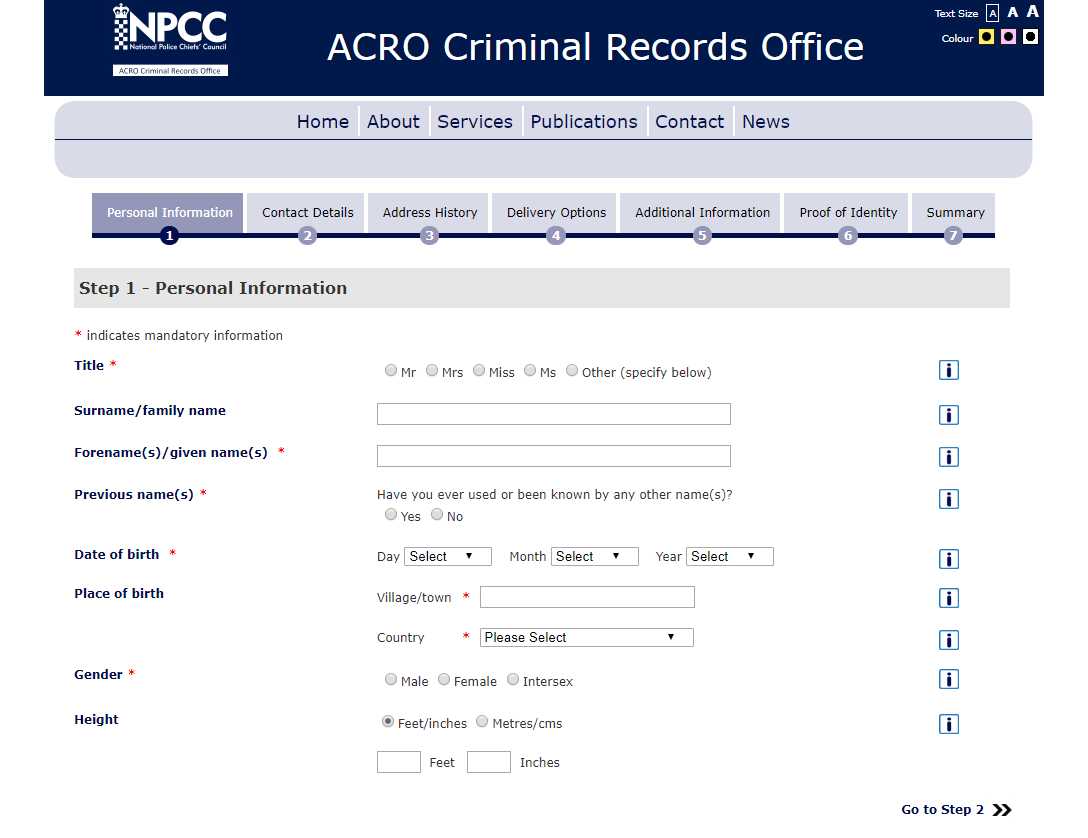
You can apply via your local Police Force. Each police force normally has a form to complete, which is usually available online but can also be requested in writing.
ACRO provides Subject Access disclosures from the Police National Computer on behalf of most police forces in England and Wales (apart from Derbyshire, Gwent and Sussex), Northern Ireland, Jersey and the Isle of Man. Requests can be made by post or online. Details of both can be found here. ACRO also have a useful further guidance page providing additional information on SAR’s.
If you want a copy of all of your personal data, you should make sure that you request to see both PNC data and any information held locally by your local police force.
You will need to contact the Data Protection team at your local Police Force. Links are available here. Many requests relate to information held on the PNC, and the majority of these are dealt with by ACRO. Their contact details are below:
A: ACRO (SAO), PO Box 623, Fareham, Hampshire, PO14 9HR
To you only. Subject Access disclosures (Police records) are not designed to be used by employers as the provisions of the Rehabilitation of Offenders Act are not applied (see ‘Other information’)
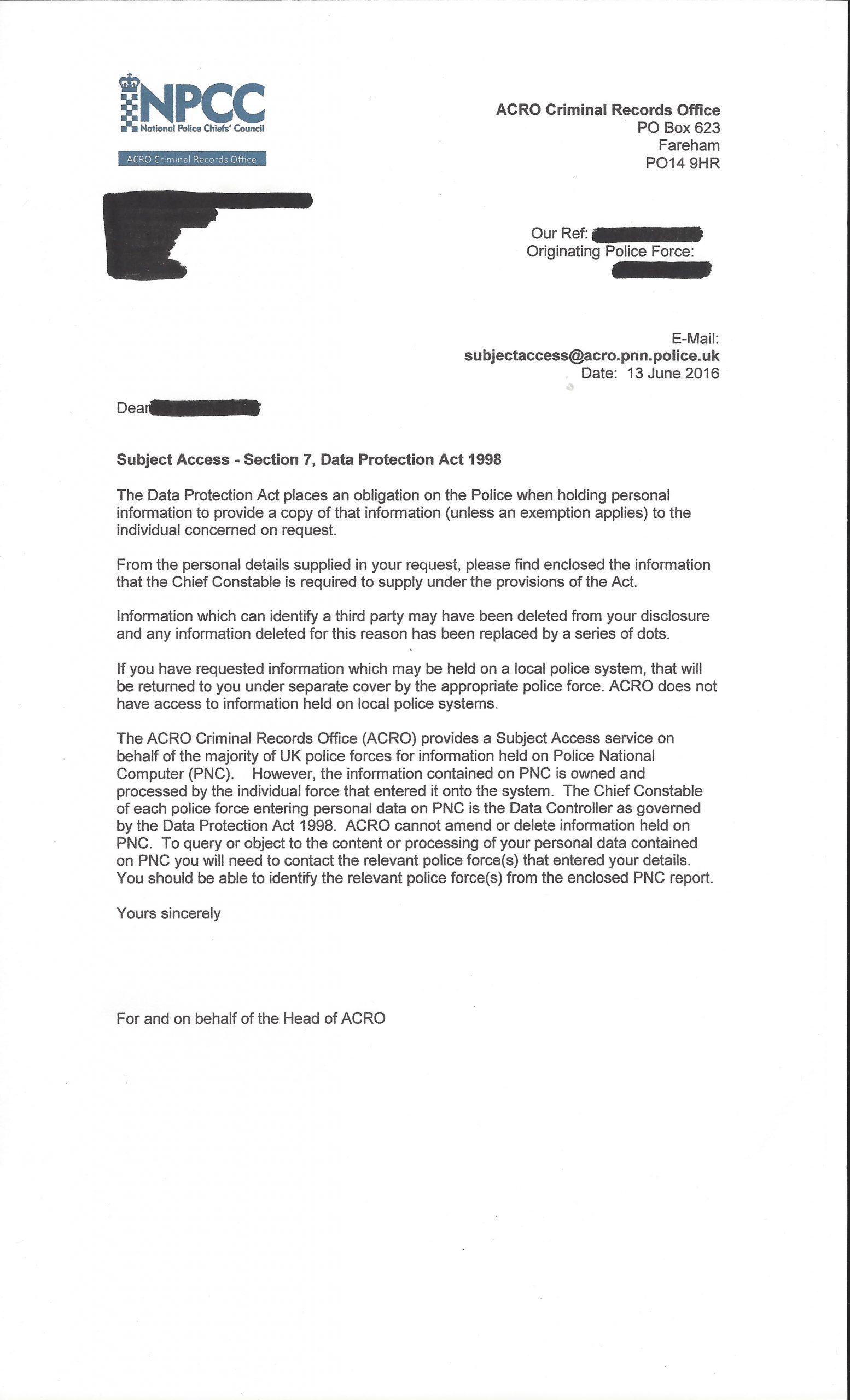
Link to anonymous examples
Click above image to go to a readable version of this letter and four examples pages of a Police Record – SAR.
How to correct inaccurate information
If you feel the information in inaccurate, you will need to contact the police force who holds the information outlining the inaccurate information. Each Chief Police Officer is the Data Controller for their PNC record, and has the ability to delete information. There is an exceptional case procedure, but this is normally confined to deleting local police information such as allegations.
Enforced subject access
It was announced in early 2014 that the final elements of the Police Act 1997 will take effect. With this comes the news that enforced subject access will be a criminal offence. This came into force on 10th March 2015. Read more here.
Pay it forward
If you found this page helpful, could you donate £1 to help someone else access our advice and support?
Prison Subject Access Request (often referred to as “Prison Records”)
Issued by
Ministry of Justice Data Access & Compliance Unit
Use
To establish what information prisons (including the Governor, security department, education staff and the healthcare department) have on their files about you
What it contains
Details of all personal information which the Prison Service holds on their records about you. This includes details of transfers and parole dossier information along with the activities you were involved in whilst being housed in each of these establishments
How to apply
In writing to the Ministry of Justice Data Access and Compliance Unit
Who can apply for it
You only
Contact details
A: Ministry of Justice, Data Access and Compliance Unit (DACU), Postal Point 10.31, Floor 10, 102 Petty France, London, SW1H 9AJ
E: data.access@justice.gsi.gov.uk
Cost
Free. However, they can charge a reasonable fee for administrative costs if they think the request is ‘manifestly unfounded or excessive’.
How long it takes
Approximately 40 working days
Where it is sent
To you only
Link to anonymous example
Not available
How to correct inaccurate information
You would need to write to the Data Access and Compliance Unit, highlighting the particular area of the file you take issue with. If you have any further information or documentation which supports your request then this should also be enclosed along with your covering letter. Upon receipt a confirmation letter will be sent, and a letter detailing the outcome will follow
Other information
If you are a serving prisoner you should enclose an authority for the DACU to deduct the £10 fee from your prisoner monies account and sufficient details to enable the DACU to trace your records. This should include your full name, date of birth, prison number and name of the prison you currently reside in. If you have served a previous custodial sentence you should also provide details of your time in custody relating to this period. If you are currently in prison, you may be able to make the application internally. More details are available in PSI 44/2014.
If you have been released from prison, you should provide details of your time in custody which should include your full name, date of birth, prison number, dates and name of the prison(s) you were held in. You will also need to include the relevant fee and ID.
Acceptable forms of ID include photocopies of recent utility bills (not more than 6 months old) or bank statements or photocopies of the photograph page of a passport or driving licence.
If you are requesting personal data on another person’s behalf, you will need to satisfy the above criteria plus include a signed consent from the person who the data concerns.
Even though cautions and convictions remain on the Police National Computer (PNC) until you are 100 years old, there are some situations where the police will destroy your biometric information (DNA and fingerprints). It’s important to know whether this will apply to you and how you go about making a request to the police.
Biometric information
Biometric information refers to fingerprints and DNA Profiles.
If you are arrested, your details will be entered onto the Police National Computer (PNC). This will include your personal details, details of your arrest and biometric information such as fingerprints and your DNA profile.
Your biometric information will be either retained or destroyed depending on whether you have been convicted or not. The table below provides further information.
Retention period for individuals convicted of an offence
Retention period for individuals not convicted for an offence
Definitions
A minor offence is defined as any recordable offencethat is not a covered under the definition of a qualifying offence.
A qualifying offence is one that is more serious; a full list of qualifying offences has been set out in Section 65A of PACE which can be found here. According to ACPO there are over 400 qualifying offences.
Effect on people with convictions
The only time that fingerprint and DNA information would be destroyed is for individuals convicted of a minor offence under 18 at the time of conviction, so long as the offence wasn’t for a qualifying offence.
However, it’s important to realise that this only relates to fingerprint and DNA information – the actual conviction will remain on the PNC.
Effect on people charged
If you are charged with a qualifying offence but not convicted you can apply for early deletion of your biometric information only if you have no previous convictions. If you are arrested and charged with a qualifying offence but not convicted, your biometric information can be retained for three years.
For more information and details regarding the deletion of biometric information please click here.
An officer may only give authorisation if he has reasonable grounds for believing that a sample will confirm or disprove the person’s involvement.
Non-Intimate Samples
A non-intimate sample is hair (that is not pubic hair); a sample taken from the nail or under nail; a swab taken from any part of the body, including a mouth swab, but not from any other body orifice; saliva and a footprint.
A non-intimate sample may be taken without consent.
Intimate Samples
An intimate sample is defined as: blood, semen, any other tissue or fluid, urine, pubic hair, dental impression or swab taken from any orifice other than the mouth.
An intimate sample may be taken from any person in police detention. An intimate sample can be taken from someone who is not in police detention but who, during an investigation, has supplied two or more non-intimate samples that have proved insufficient.
More information about whether your biometric data is likely to be on a police database can be found here
Operation Nutmeg
The following information regards the collection of DNA samples as part of Operation Nutmeg whereby police forces in England and Wales have been collecting DNA samples from 12,000 serious offenders who are not on the national DNA database.
Police forces in England and Wales have been pushing ahead with collecting DNA of people with convictions pre-dating 1994. Routine DNA collection was not implemented until after this.
July 2013
In 2013, a legal challenge was made by a person with convictions against their police force’s request to provide a non-intimate DNA sample as he argued that the request infringed on his human rights.
The judgement decided that the request was both ‘lawful and proportionate’. There are a number of helpful aspects from the judgement:
The police must strike a balance in each case to decide whether taking a DNA sample is proportionate.
It may be that in some cases the police have required an attendance at the police station before issuing an authorisation to take DNA – this would be unlawful.
The court suggested that a person should have a chance to make representations as to why it would not be proportionate to take DNA in a particular case.
As outlined in Section 62 of PACE, an officer may authorise collection if he has reasonable grounds to believe that the sample will confirm or disprove the individual’s involvement. However in this case, the grounds for DNA collection were ‘purely speculative’ but the court ruled that this was acceptable.
For full details on this particular case, please see the article from The Independent
For additional information on this case, please read the High Court Decision
October 2013
In another case, a 74 year old was required to attend the police station to provide a sample of DNA for a crime he committed 42 year earlier. This was challenged and on review of the case, the police force decided that it was not in the public interest or proportionate to pursue this DNA sample.
Guidelines relating to Operation Nutmeg now state:
“The purpose of this operation is to ensure that those convicted of Homicides and/or Sexual Offences have a confirmed DNA profile held on the National DNA Database and is correctly shown on their PNC record. To achieve this, forces will be supplied with details of subjects whose last known location is within their Force area. Each subject will need a risk assessment carried out to identify the high risk nominal’s and ensure that they are located and sampled at the earliest opportunity”
Discuss this with others
Read and share your experiences on our online forum.
Useful links
Below you will find links to useful websites relating to this page.
This page was last fully reviewed and updated in July 2017. If you’ve spotted something that needs updating, please let us know by emailing the details to advice@unlock.org.uk
The DBS (Disclosure & Barring Service) acts as the ‘middle-man’ between the Registered Body (which checks eligibility and identity) and the Police (who provide the criminal record information for the certificate).
The Registered Body submits the application to the DBS. Many employers are not registered, and have to use another company called an ‘Umbrella Body’. However, some large employers are Registered Bodies themselves and can submit applications directly to the DBS.
Registered Bodies and Umbrella Bodies are legally responsible for the process of submitting the application. This includes identification and address verification and declaring that the position is eligible for the check.
Completing the form
Official guidance
The DBS produce a step-by-step guide on filling out the application form. This is available to download from the DBS website.
Providing accurate information
The application form is used to help the DBS and the Police to find your records. This is known as ‘PNC matching’. If you do not provide accurate information, you could be confused with somebody with a different criminal record. It is an offence to intentionally provide inaccurate details.
The question about convictions
Question e-55 (see above) helps to identify your record on the Police National Computer (PNC). The declaration underneath the question means that you need to answer this question truthfully.
The question on the form was amended in March 2014 to reflect the introduction of the filtering process (more information about filtering). The question is now:
“Do you have any convictions, cautions, warnings or reprimands that would not be filtered in line with current guidance?”
If you are not sure how to answer this question, you can apply for a Police Subject Access Request (SAR) to see what is on your record. Unfortunately, this doesn’t tell you what has been filtered – it provides you with everything that is on the Police National Computer. Once you have this, you should be able to work out what would be filtered.
If you’re not sure, and you don’t have time to complete an SAR, you should think about whether to tick “Yes” or “No”. if the form gets sent back to the Umbrella Body acting on the employers’ behalf you might be okay with ticking “Yes”, as the information isn’t normally shared with the employer. If, however, the form goes back to the employer, you should think carefully before ticking “Yes” as it might mean you’ll be telling them something you might not need to. Ultimately, it will depend on how confident you are that your record will be filtered.
If you have applied to have a repealed offence (something that is no longer a crime) removed from the PNC and received confirmation from the police, you do not need to include it. A repealed offence that has been removed from the PNC will not appear on a DBS certificate.
Checking the status of your application
You can check the status of your application online. You will need your DBS application form reference and your date of birth. If you cannot remember your form reference number, you should contact the DBS.
Probation records
Name
Probation records (often referred to a “Probation Subject Access Request”)
Issued by
Local Probation Trust
Use
To see what information the Probation Trust hold on their records about you
What it contains
Any information or records which the Probation hold on their system about you. This may relate to pre-sentence reports, OASys assessments, parole dossier information and hostel reports
How to apply
Local Probation Trust
Who can apply for it
Only the person whom the information is relevant to can apply
Contact details
You can find a list of all the Probation Trusts here
Cost
£10
How long it takes
Can take up to 40 working days
Where it is sent
To you only
Link to anonymous example
How to correct inaccurate information
You would need to write directly to the local Probation Trust outlining the areas which you take issue with. They would then assess this inaccuracy against any information you have provided them with and return their findings to you via letter.
How employers should handle certificate information
This section will explain what employers should do when they receive information on a criminal record check.
Using disclosed information to make a recruitment decision
What is the DBS code of practice?
The DBS code of practice is published under Section 122 of the Police Act 1997. It aims to ensure that criminal record information is used fairly and applicants are protected from unfair discrimination due to non-relevant convictions. Anybody who receives standard or enhanced certificate information must abide by the code of practice, this includes Registered Bodies, Umbrella Bodies, recruiters and any others receiving the information.
What does the code of practice require of Registered Bodies?
The DBS code of practice requires that Registered Bodies must: –
Have a written policy on the secure handling of information which, in the case of Umbrella Bodies, should be made available to their clients. A sample policy produced by the DBS is available online
Store DBS certificate information securely
Retain DBS certificate information, its content or any representation of the same in any format for no longer than is necessary and for a maximum of six months following the recruitment decision unless a dispute is raised or, in exceptional circumstances, where DBS agreement is secured
Ensure that no reproductions of the DBS certificate or its content are made, including photocopies or scanned images, unless with the prior agreement of the DBS or as a result of a stipulated requirement relating to the e-channel service
Only share DBS certificate information with relevant persons in the course of their specific duties relevant to recruitment and vetting processes
Dispose of DBS certificate information in a secure manner
Ensure that they comply with DBS guidance on the portability of DBS certificates and their contents.
What does the code of practice require of others?
In making use of DBS checks, any organisation subject to the code of practice must: –
Ensure that all applicants for relevant positions or employment are notified in advance of the requirement for a DBS check
Notify all potential applicants of the potential effect of a criminal record history on the recruitment and selection process and any recruitment decision
Discuss the content of the DBS certificate with the applicant before withdrawing any offer of employment
Provide a copy of the DBS code of practice to the applicant upon request.
Written policies on people with a criminal record
DBS guidance states that organisations using criminal record checks should not have a complete ban on people with criminal records. The DBS requires organisations which use checks to have a policy on the recruitment of ex-offenders. Organisations are expected to only use the information on a DBS certificate in the context of such a policy.
Many organisations achieve this by simply using the example policy provided by the DBS. However, some have positive and detailed policies towards people with criminal records. To find out more about how an organisation may use the information disclosed, ask to see a copy of their policy. If you do this before apply, you may want to do this anonymously.
You may find the organisation uses vague language such as “We judge each case on its merits”. To get a clearer picture about how they will treat you, try to ask them some specific questions about your particular type of convictions and/or the particular areas of the company that interest you.
Handling and storing disclosed information
Information on a certificate
Organisations that wish to use a standard or enhanced check must comply with the DBS code of practice The code seeks to ensure that sensitive personal information is handled and stored appropriately and is kept for only as long as necessary. In particular, it is an offence for Registered Bodies to: –
Disclose information contained within a certificate to any person who is not a member, officer or employee of the Registered Body or, in the case of Umbrella Bodies, their client unless a relevant legal exception applies;
Disclose information to any member, officer or employee where it is not related to that employee’s duties;
Knowingly make a false statement for the purpose of obtaining, or enabling another person to obtain a certificate.
Persons guilty of such offences are liable to deregistration, a fine or imprisonment unless a relevant exception applies as outlined in DBS Guidance.
Self-disclosure
The DBS does not impose any rules on how organisations should handle information that you choose to disclose yourself.
However, all organisations have to follow the Data Protection Act 1998. As criminal record data is regarded as sensitive personal data under this legislation, they should have processes in place to ensure it is kept safe.
If you are worried about how an organisation will retain the information that you disclose, you should ask them for a copy of their data protection policy.
Getting a copy of your DBS records
Name
DBS records (often referred to a “DBS Subject Access Request”)
Issued by
Disclosure and Barring Service
Use
To see what information the DBS hold on their records about you. It can be useful if, for some reason, you no longer have a copy of the disclosure certificate that an employer undertook on you. Subject Access is a right provided under Section 7 of the Data Protection Act 1998 whereby any individual can ask any organisation what information they hold on them.
What it contains
This application will only return something if you have previously had a check carried out on you.
A subject access request to the DBS will provide you with copies of previous application forms, system notes, correspondence held and a print out of what was contained on the certificate(s). Please note – the printout is not a duplicate certificate; it provides a copy of what was released on the certificate in a different format. It should provide you with evidence of each check that has been completed on you and if any conviction information has been released on the certificate it would appear on the print out. The application form would also show the name of the organisation that submitted the check(s)
If you need to correct inaccurate personal information, such as your name, date of birth or address, you need to raise a data entry dispute. More details are available here
However, if it is that your conviction details are incorrect or inaccurate, you need to raise a data source dispute. This can be done online (you complete the form electronically, print and submit it by post). Alternatively, you can request a disputes form by post by calling 0870 9090 811.
Other information
The DBS does not hold a copy of the Police National Computer (PNC) record of convictions. The system held by the DBS is known as a PNC Extract. The extract contains basic identifying details such as name and date of birth of persons included on the PNC. The extract does not contain any conviction information. The police both own and maintain the Police National Computer.
Disregards and pardons: Removing historical convictions and cautions for consensual gay sex from criminal records
In January 2017, the Justice Secretary announced that thousands of gay and bisexual men convicted of sexual offences which have now been decriminalised would be posthumously pardoned. This builds on an earlier scheme that was introduced in 2012 to ‘disregard’ decriminalised sexual offences.
This page provides further information about the disregard process, which is the process that individuals have to go through.
Why is this important?
Years ago, many people were convicted of offences which are no longer illegal today. Things changed when the Sexual Offences Act 1967 came into force which decriminalised private homosexual acts between men over the age of 21 in England and Wales.
However, if you were convicted of a sexual offence which has now been decriminalised, you may find that this conviction will still appear on a formal criminal record check unless you have applied to have it disregarded.
Unfortunately, you have to proactively apply for a disregard – it doesn’t happen automatically. Many people won’t realise they have a historic offence on their record until it’s disclosed on a DBS check – at which point the damage may already be done.
Many employers have little understanding of legal definitions, and so you may find yourself being refused an interview or job on the basis of being convicted of an offence that is no longer illegal.
Introduction
The coalition government made a commitment in 2010 to change the law so that historical convictions for consensual gay sex with over 16s would not show up on criminal records checks.
The Disregards and Pardons Scheme came into force on 1 October 2012. Under the provisions of Chapter 4 of Part 5 of the Protection of Freedoms Act 2012 (s.92-101), the Home Secretary may ‘disregard’ certain convictions (which includes cautions, warnings and reprimands) for decriminalised consensual sex offences.
Under the disregard provisions, individuals can apply to the Home Secretary for a formal disregard of their convictions. If the Home Secretary considers that a disregard is appropriate, those convictions disregarded will be deleted or annotated. They will no longer be disclosed in certificates issued by the Disclosure and Barring Service.
Eligibility
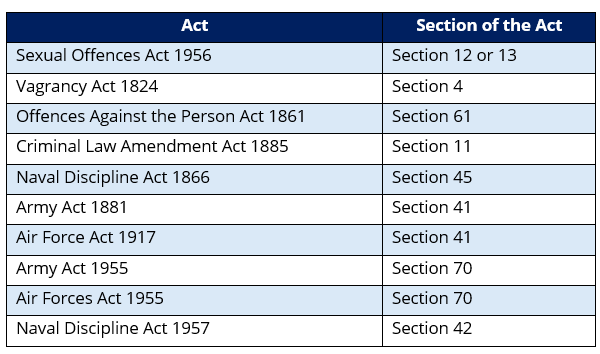
The offences that criminalised consensual sex between men over the age of consent were mainly sections 12 (buggery) and 13 (gross indecency) of the Sexual Offences Act (SOA) 1956.
The following offences are covered by the process:
People charged under these laws will only be able to have them disregarded if two key conditions are satisfied:
The activity must have been consensual – All parties involved in the conduct constituting the offence consented to it and were aged 16 or over at the time of the offence
It must not be an offence today – The scheme does not include sexual activity in a public lavatory (which is still illegal)
How to apply
The application form and guidance notes for applicants are available to download from GOV.UK.
The process is free of charge.
What happens next?
If your application is not eligible to be disregarded you will receive a letter to that effect. In all other cases you will receive an acknowledgement that your application has been received and is being processed.
The Home Office will then contact all relevant data controllers and request them to review their records and provide copies of any relevant documents to the Home Secretary to enable a decision to be made.
Once the Home Secretary has made a decision, you will be informed of the outcome. If your application is successful, the Home Secretary will write to the relevant data controllers and require them to delete or annotate their records accordingly.
What is the effect of the disregard?
Once the Home Secretary has given notice that a conviction has been disregarded and a period of 14 days thereafter has elapsed, a successful applicant will be treated in all circumstances as though the offence had never occurred and need not be disclosed for any purpose. It means, in effect, that it’s deleted.
Those successful in the disregard process are then also pardoned by the government.
What if you disagree with the Home Secretary’s decision?
If you disagree with the decision made by the Home Secretary and either have further evidence to submit or consider that an error was made on your initial application form, you should contact the Home Office so that your application can be reviewed. If you consider that the final decision reached in relation to your application is wrong, you have the right under the provisions of the Protection of Freedoms Act 2012 to seek leave to appeal the decision to the High Court.
How many people have had their offences disregarded?
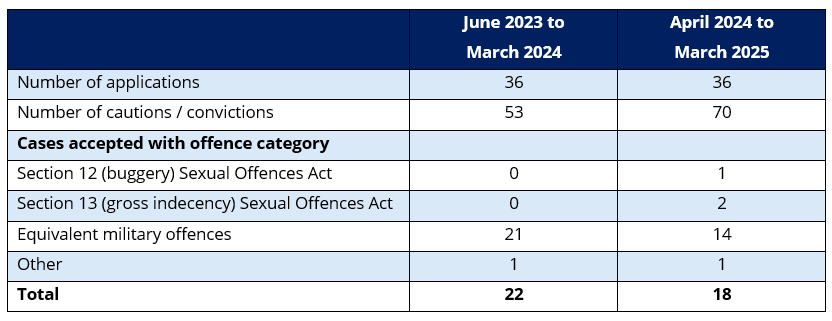
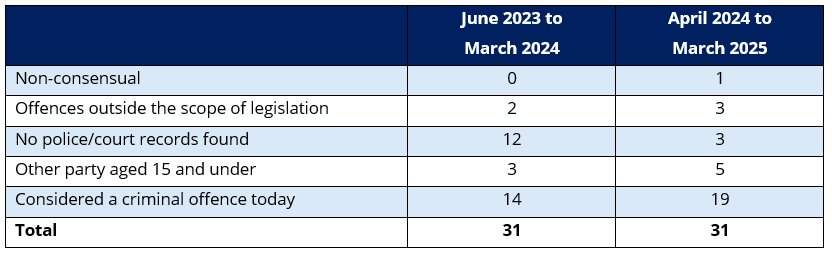
Latest figures from the Home Office show that between June 2023 and March 2025, the number of cases dealt with was 72. This is broken down as follows:
Eligible applications
Ineligible applications
Update
The Government’s 2012 Disregards and Pardons Scheme was expanded in 2023 to include women and more former military personnel affected by the pre-2000 ban on LGBT+ and service members.
Since the expansion, 40 people have been given pardons, with the majority granted to former military personnel.
Discuss this with others
Read and share your experience on our online forum.
Below you will find links to useful websites relating to this page. More specific details (including addresses and telephone numbers) of some of the organisations listed below can be found here.
Home Office– The Home Office is the government department responsible for the disregard process. You can contact them by emailing chapter4applications@homeoffice.gsi.gov.uk or writing to Chapter 4 Applications, Safeguarding Directorate, 5th Floor, Fry Building, 2 Marsham Street, London, SW1P 4DF.
Ministry of Justice – A government body who have responsibility for the Rehabilitation of Offenders Act.
Stonewall – A lesbian, gay and bisexual charity who have produced a fantastic guide about who’s eligible and how to apply.
Galop– An LGBT charity, have also produced a really useful guide in partnership with Bindmans Solicitors.
More information
To discuss this issue with others – Read and share your experiences on our online forum
This page was last fully reviewed and updated in June 2025. If you’ve spotted something that needs updating, please let us know by emailing details to advice@unlock.org.uk.
We want to make sure that our website is as helpful as possible.
Letting us know if you easily found what you were looking for or not enables us to continue to improve our service for you and others.
Was it easy to find what you were looking for?
Thank you for your feedback.
12.5 million people have criminal records in the UK. We need your help to help them.
We use cookies where necessary to allow us to understand how people interact with our website and content, so that we can continue to improve our service.
We only ever receive anonymous information, and cannot track you across other websites. Find out more
More Options
Can you pay it forward?
If you found this page helpful, could you donate just £1 to help someone else access our information and support?