
Unlock Category: 1. About criminal records

Criminal record databases

Aim of this page

This page provides details of the criminal record databases that are currently in use including the Police National Computer (PNC) and the Police National Database (PND).

Why is this important?

It’s important to have an understanding of the different types of criminal record databases and where details of any arrest, caution or conviction have been recorded by the police.

Where details are recorded will often determine what can be disclosed by the police on formal criminal record checks.

Police National Computer (PNC)

Overview

The PNC is a computer system for England and Wales governed by section 27(4) of the Police and Criminal Evidence Act 1984. It is used to record convictions, cautions, reprimands and warnings for any offence punishable by imprisonment and any other offence that is specified within regulations. Since 2013, the PNC has been managed by the Home Office (it was previously the National Policing Improvement Agency) and is used by all police forces in England and Wales.

The PNC went live in 1974, initially storing details of stolen vehicles. Its use and function has evolved over time and in recent years the range of facilities, level of detail and potential value of information stored on the PNC has grown considerably. The system can link into a number of separate databases and can access a range of records such as:

  • Information on persons who have been convicted, cautioned or recently arrested.
  • Details of registered keeper of each motor vehicle.
  • Details of people who have driving licences or are disqualified from holding one.
  • Details of certain types of stolen and recovered property including, animals, firearms, trailers, plant machinery and engines.
  • Details of people on the National Firearms Certificate Holders register.

As of February 2010 there were over 9.7 million nominal records held on the PNC.

What is recorded on the PNC?

Generally, an offence that could result in imprisonment is classed as a recordable offence (i.e. an indictable or triable-either-way offence). There are also some more minor summary offences that are designated as recordable. This additional set of specified offences has grown over time and is now substantial.

Find out more here.

If you are not sure whether your offence is classed as recordable or not, and so are unclear whether it’s held on the PNC, the best thing to do is to apply to your local police force for a police subject access request.

Is information deleted or removed?

This is covered in detail here.

ACRO

ACRO is a national police unit whose partners include the National Police Chiefs’ Council (NPCC). ACRO deals with PNC subject access requests on behalf of most police forces. They are also the provider of police certificates.

Local police records

The police store information locally (by police force) which may be disclosed as part of an enhanced check. This includes non-conviction information, and convictions for non-recorded offences (see below for the definition of a recorded offence)

You can get copies of what information the police hold locally by making a police subject access request.

Police National Database (PND)

Summary

The PND holds records on intelligence, crime, custody, domestic abuse and child abuse, and allows users (generally, the police) to search the data records of all UK forces in relation to people, objects, locations and events. It allows the named users to search full data records of all UK forces, covering People, Objects, Locations and Events (POLE):

People – individuals such as offenders, suspects or victims; and the organisations they belong to.
Objects – stolen property or other objects such as vehicle, telephone number, or email address.
Locations – different ways of expressing a ‘place’ such as an address, a building or a physical feature
Events – a robbery crime report, a custody record, or an intelligence report that links two people. Every Person, Object and Location on PND is linked to an Event.

Managed by the Home Office, it is thought that the PND will be an invaluable tool in preventing serious organised crime and will enable the police to better protect children and vulnerable people and reduce the risk of terrorist activities.

Code of Practice

The Code of Practice (the Code) for the new Police National Database (PND) was laid before Parliament on 17 March 2010 following public consultation and approval by the Association of Chief Police Officers (ACPO).

The Code takes effect from 31 March 2010 and forms the statutory framework for the lawful use of the PND across police forces and introduce safeguards to prevent misuse.

The PND was introduced following the recommendations of the Bichard Inquiry and allows police forces across the United Kingdom to share information and intelligence instantly on a national level. The Code covers the purpose of the PND, general principles and guides on using the PND.

The purpose of the Code is to promote lawful and consistent use of the PND and the information on it: to ensure that practices are in place to ensure it is effective for policing purposes; that its use is compliant with the Data Protection Act 1998 (DPA) and the Human Rights Act 1998 (HRA) and that it is not used in a way which is discriminatory or unfair. Chief Officers are responsible under the Code for developing and implementing procedures and systems to achieve this. Her Majesty’s Inspectorate of Constabulary will monitor compliance with the Code and associated guidance.

Home Office Minister for Identity, Meg Hillier MP, said: “When the PND is delivered later this year it will provide forces with a powerful new tool to fight crime and protect the most vulnerable in society. But it is vital that forces use this new information-sharing capability in a consistent and lawful way and for policing purposes only. The Code of Practice will enshrine these principles across the Police Service.”

The PND’s impact on people with convictions

In practice, the PND collates Police intelligence held locally by various police forces. Police intelligence can be anything from an informal resolution of a criminal matter, including Sexting – Outcome 21,  an acquittal for an offence, a fixed penalty notice, an arrest that led to no further action being taken, or even an unsubstantiated allegation that the police never pursued. To find out what is held on the PND, you have to request to see your local records of the relevant police force.

The PND will have a record for everyone who has been arrested and processed through custody, so even if you were convicted of a minor offence that was not recorded on the PNC, it will be held on local records and form part of the PND. This kind of information could be disclosed as part of an enhanced check.

Offenders Index

The Offenders Index is the collection of court conviction records going back to 1963; the Ministry of Justice ceased updating it after 2006.

‘Standard list’ was used to determine whether convictions for certain offences should be recorded on the Offenders Index.

All indictable or trial either way offences are ‘Standard list’ offences. Standard List offences also include some more serious summary offences, including:

  • Assault on a constable
  • Common assault – all categories
  • Brothel keeping
  • Cruelty to or neglect of children
  • Interference with a motor vehicle
  • Stealing and unauthorised taking of a conveyance
  • Aggravated vehicle taking – criminal damage of £5,000 or under
  • Indecent exposure
  • Criminal damage, £5,000 or less, and malicious damage
  • Found in enclosed premises, possessing picklocks
  • [Minor] Drugs offences
  • Offences against Immigration Act 1971
  • Other offences (excluding motoring)
  • [Criminal Justice Act 1991 Secs 38 and 65 (sub-classes 66 and 67)
  • Impersonating a police officer (sub-classes 91,92 and 93)
  • Driving etc while having a breath, urine or blood alcohol concentration in excess of the prescribed limit (sub-class 02)
  • Driving without insurance
  • Driving whilst disqualified
  • Dangerous driving

Disclosure and Barring Service (DBS)

The DBS does not hold a copy of the Police National Computer record of convictions. The system held by the DBS is known as a PNC Extract. The extract contains basic identifying details such as name and date of birth of persons included on the PNC. The extract does not contain any conviction information. The police force both own and maintain all information contained on the PNC.

Court records

The courts use a system called LIBRA to manage their records. They use this to record details of outcomes of cases.

Discuss this with others

Read and share your experiences on our online forum.

Below you will find links to useful websites relating to this page. More specific details (including addresses and telephone numbers) of some of the organisations listed below can be found here.

  • ACRO Criminal Records Office – Manage criminal record information and are responsible for subject access requests for most police forces, as well as police certificates
  • Disclosure and Barring Service – Government body responsible for producing standard and enhanced criminal record certificates

More information

  1. For practical information – More information can be found on our criminal justice system section
  2. To discuss this issue with others – Read and share your experiences on our online forum
  3. Question – If you have any questions about this, you can contact our helpline.

Get involved

Help us to add value to this information. You can:

  1. Comment on this page (below)
  2. Send your feedback directly to us
  3. Discuss your views and experiences with others on our online forum

Domestic violence disclosure scheme – ‘Clare’s Law’

Introduction

The Domestic violence disclosure scheme – ‘Clare’s Law’ became a national scheme in March 2014.

Under the scheme, an individual can ask the police to check whether a new or existing partner has a violent past (‘right to ask’). If police checks show that a person may be at risk of domestic violence from their partner, the police would consider disclosing the information. The scheme also looks at how the police can proactively release information (‘right to know’) to protect a person from domestic violence where it is lawful, necessary and proportionate to do so. Both processes can be implemented within existing legal powers.

More information about the scheme is available on the GOV.UK website, and in particular the guidance that relates to the scheme.


Reporting of criminal records in the media

Introduction

This document is designed for people with a criminal record who want to understand where they stand in relation to their past criminal record being reported in the media.

A wide definition of media is used, including all forms of online reporting. It also considers the publicising of your criminal record by public authorities involved with crime and justice, which may be the source of information for media reports.

Why can, or should, the media report criminal convictions?

What does the law say?

Under English Law it is a general principle that criminal court proceedings for adults should be held openly and in public. The verdict and sentence are normally given out in open court and so are in the public domain. The media therefore have the right to publish the outcome of all such criminal court cases.

Criminal court proceedings for juveniles taking place in Youth Courts are different. Under the Children and Young Persons Act 1933, the public is generally barred from attending Youth Court proceedings, with the exception of the media, who can attend but are prohibited from publishing the name, address or school or anything that is likely to identify a person under 18 as being concerned in proceedings, whether as a victim, witness or defendant (sections 47, 49). However, the restriction in relation to a child or young person who has been convicted may be lifted by the court, if it is satisfied that it is in the public interest.

For more information on reporting restrictions, see Reporting Restrictions in the Criminal Courts (Judicial Studies Board, Newspaper Society, Society of Editors and Times Newspapers Ltd; 2009).

What is the Government’s position?

In recent years, under both the previous Labour Government and the current Government, there has been a push for justice not only being done but being ‘seen to be done’. This has led to increased efforts to publicise sentences given to individuals. In December 2009 the Home Office announced, through the following two publications, proposals to actively promote the publicising of convictions to local communities for about a month after sentencing.

These reports propose that local communities are informed about the criminal convictions and sentencing of adult offenders living in their area (including their names and a ‘summary’ of their address) through the use of leaflets, public meetings, local newsletters or websites.

It is argued that there is a gap in local accountability due in part to the decline of court reporters and consequent reporting of fewer case outcomes in the local media. Thus these proposals are intended to increase public confidence in the criminal justice system and to reassure the public that justice has been done, whilst also deterring potential offenders. According to Publicising Criminal Convictions, 65% of the public think that is important for the public to be provided with information on the sentences handed out to offenders locally, whilst only 24% feel informed about what is happening locally to people convicted of offences. Whilst the more serious an offence is, the more likely it is to attract media attention, it may be that less ‘serious’ offences cause most concern locally and so encouraging publicity of such cases may be most able to increase public confidence in services.

More generally, the report states that, ‘As they are a matter of public record, the presumption should be in favour of publicising verdicts and sentences of Crown and magistrates’ courts in the great majority of criminal cases’. This includes the following where they are imposed as part of a sentence: fines, community sentences, absolute and conditional discharges, Financial Reporting Orders and Travel Restriction Orders.

Will details of my conviction be published?

If the media or local authorities involved with crime and justice plan to report your conviction, they probably already have. How can you find out? Google your name, or the details of your offence. Look back to local paper records around the time you were convicted.

In addition to the potential for media coverage of your sentencing, it could also be publicised in a range of ways by local authorities, for instance through leaflets, newsletters or websites. Although the report Publishing Sentencing Outcomes states that such publicity is not intended to provide the basis for an ongoing record, it is difficult to see how recording conviction, particularly on websites, can avoid this. The report recommends that when publishing details online, public authorities state that ‘the information on this page must not be stored, recorded, republished or otherwise processed without the explicit agreement of [name of the public authority]’. However, as others have noted, this ‘seems a vain hope in today’s information-wise society.’

The reporting of ‘spent’ criminal convictions

What are the rules on reporting spent convictions?

The publication of ‘spent’ convictions by the media can breach the provisions of the 1974 Rehabilitation of Offenders Act (ROA). Under the ROA, your conviction becomes spent at the end of a specified ‘rehabilitation period’ (so long as you have not been given any further convictions during this time). To calculate when your conviction will become spent, you can visit www.disclosurecalculator.org.uk or find out about other ways here.

The length of this period varies depending on the length of the sentence. However, if the prison term is more than four years (both immediate and suspended), or was an extended sentence for public protection, then the conviction will never become spent.

Under the ROA, when a conviction has become spent, it is as though, for most purposes, it has never occurred. You are not obliged to disclose a spent conviction, and you should not be prejudiced as a result of one. This means that in law, for a media organisation to report your spent conviction amounts to an untruth, meaning that they are open to accusations of defamation.

It is not a criminal offence to report a spent conviction, so the ROA does not impose a criminal penalty on journalists or media organisations who do so. As a result of the ROA, technically, anybody reading about the spent conviction shouldn’t use that information in a way that disadvantages you in any way. Of course, this is difficult to prove, and even if you could prove it, there is little you can do.

What can I do if the media reports my spent conviction?

If details of your spent record are reported in the media, you could try contacting the organisation/publication and ask them to remove reference to it as it has now been ‘wiped out by law’ – whilst this term isn’t technically accurate, for the purposes of ‘reporting’, it should have the desired effect.

If your conviction is recorded online, you will need to ask the organisation on whose website it appears both to remove it and to advise Google that any cached references need to be removed.

Suing a media organisation for defamation

If your request for the removal of a record of a spent conviction is not followed, you could inform the organisation that you consider the continued publication of the conviction as ‘malicious’ and commence legal proceedings against them. You are entitled to make a claim for defamation against a media organisation that reports your spent conviction. If proven, you would win the libel case and be paid damages for the effect that the reference to this conviction has had on your reputation. Sometimes, the threat alone is enough for them to act.

If you were to make such a claim, the organisation would, however, have various defences open to it, including:

  • The defence of justification. This allows the media to report things that can be shown to be true without fear of legal action. However, this defence fails if you can show that your conviction is spent and that the arguments about malicious intentions apply since this would mean that there was no public interest in referring to the conviction.
  • The defence of fair comment. This allows opinions about public figures relating to a conviction they have (even if it spent) to be published, if they are honestly held opinions and can be shown to be in the public interest. This defence works on the assumption that the actions of those in public positions (e.g. politicians) are open to public scrutiny.
  • The defence of privilege argues that the public interest in freedom of speech outweighs the rights of the individual making the claim for defamation. Qualified privilege can be used by the media to enable them to make fair and accurate reports of a conviction, or to quote words from a case.

However, any of these defences can be rebutted if it is proven that there was no public interest in reporting this material or that the statement was reported with malice. Malice is defined in law as ‘published with an irrelevant, spiteful or improper motive’ (Herbage v Pressdram 1984). The burden of proving malice in such a case would rest on you, and is very difficult to do so in practice.

What usually happens in practice?

The BBC’s Editorial Guidelines, which tend to be the benchmark for broadcasters, include no mention of spent convictions. The section on privacy is of most relevance here. They state that ‘an individual’s right to privacy is also qualified by their behaviour. People are less entitled to privacy where their behaviour is criminal or seriously anti-social.’ The guidelines include a list of examples of public interest, some of which may be used by media organisations in justifying their reporting of spent convictions.

There is no single definition of public interest, it includes but is not confined to:
• exposing or detecting crime
• exposing significantly anti-social behaviour
• exposing corruption or injustice
• disclosing significant incompetence or negligence
• protecting people’s health and safety
• preventing people from being misled by some statement or action of an individual or organisation
• disclosing information that allows people to make a significantly more informed decision about matters of public importance
There is also a public interest in freedom of expression itself.

In practice, newspapers tend to take a pragmatic approach about the likelihood of libel litigation set against the copies sold. Most news journalism can argue that it is serving some kind of public interest by making revelations about past convictions, including ‘spent’ convictions, and that there is no malice. This means that the media can publish the details of, and comments, on ‘spent’ convictions without fear of libel law suits and the consequences in terms of paying damages if the case was lost. Nevertheless, the potential level of hassle should hopefully mean that if you initially make a request for the media to remove references to your spent convictions, it should have the desired effect. If it doesn’t, you should complain to the Independent Press Standards Organisation (details below).

The situation is also complicated by online records of convictions. Once a conviction is online, and so in the public domain, the media can quote it in their outlets since they are not ‘revealing’ anything new, just stating a known fact. Nobody’s data is being invaded if past news sources are quoted and privacy rights are not being compromised. This seems to be true even in the case of ‘spent’ convictions. If the conviction is on record, it is likely that in certain situations the media are able to justify the ability to publish these details even though it is spent.

Furthermore, even if you are successful in getting information removed by the ‘host’, it is possible that this information has been collected on a number of other websites, and so the task of requesting them each individually to remove the information can be time consuming.

Is there anything I can do if…?

The details published about my conviction are inaccurate?

If a report of your conviction contains inaccurate or misleading information, you should contact the relevant organisation and ask that they correct the information, providing them with the relevant accurate information.

If a media organisation refuses to correct the information you should complain to the Independent Press Standards Organisation. You may also be able to make a complaint to the Information Commissioner’s Office if personal information about you is inaccurate.

Publicity about my conviction is causing harm to others or to me (beyond my objection to the publicity)?

Disclosure of a sentencing outcome can inadvertently reveal personal information about a person other than the person convicted. The Publicising Sentencing Outcomes report advises local authorities to take particular care in such situations, noting that even if the court did not consider it necessary to impose formal reporting restrictions, there may be cases where disclosure may nevertheless cause harm (for instance, where the relevant facts were not before the court at the time).

It suggests that it might not be appropriate to release information which:

  • could be used to identify offenders’ families (over and above a shared surname), especially if disclosure would place them at risk of harm (e.g. reprisals)
  • could be used to identify victims or witnesses, especially if this would cause the victim undue embarrassment or distress, or place them at risk of suffering reprisals, or expose them to unwanted media or public attention

The guidelines also recognise that care should be taken if the individual with a conviction is known to have a specific vulnerability (e.g. mental health issues or physical ill health), which might mean that publicising the conviction ‘risks unwarranted adverse consequences’ (i.e. not simply that the offender objects to the publicity). This may arise in particular if the sentence includes a drug or drink rehabilitation order or a mental health disposal.

In such cases, the guidelines argue it is not necessarily unlawful to disclose any information at all. For instance, it might be possible to address the concern by limiting the information to a small number of individuals (e.g. the community affected by the crime), by giving it out in a meeting or leaflet rather than putting it on a website so it will only be seen by people in the local area and it will be less easy to copy. In a particular case, it may be possible to reassure a community by making it known that a conviction for a specific offence has been secured without the need to disclose personal information (for instance, it might be possible to give details of the sentence without disclosing that the sentence involved a mental health disposal).

If you feel that a local authority which is reporting your conviction is not taking appropriate steps in such cases, it would be worth contacting them and citing this guidance (although note that it is not legally binding). If a media organisation is at fault, you could try contacting them and hope that they see this guidance as relevant, although it is intended for public authorities involved with crime and justice, rather than the media. You could also contact MediaWise, who provide free and confidential advice and support to members of the public on the receiving end of inaccurate, intrusive, unfair or irresponsible journalism.

A local authority is still publicising my conviction six months after the sentencing?

If a local authority is still publishing your conviction (even if it is not spent) after six months, it is worth contacting them. This is because the proposals outlined in Publishing Sentencing Outcomes advise local authorities that they should publicise sentencing outcomes to local communities in a manner that is ‘‘timely’ and ‘time-limited’’. More specifically, it recommends that ‘as a rule of thumb… convictions remain publicised for no longer than a month, and that any such publicity material (web page, leaflet, posters) be removed within six months of the conviction being recorded’.

Therefore, if you are aware that a local authority is still reporting your conviction after six months, it is worth asking them to remove the reference (refer to the Publishing sentencing outcomes report). However this is not legally enforceable, as the report notes. ‘Removal of the relevant material within the suggested time limits is not a specific legal requirement under the Data Protection Act 1998.’ In this situation, you might find it worthwhile to contact your local MP to ask them to contact the local authority on your behalf.

Useful organisations

The Independent Press Standards Organisation is an independent self-regulatory body which deals with complaints about the editorial content of most newspapers and magazines (and their websites). They monitor industry standards by training journalists and editors, and work pro-actively behind the scenes to prevent harassment and media intrusion.

The MediaWise Trust provide advice and support to those affected by inaccurate or unfair press coverage and those considering selling stories.

The Information Commissioner’s Office provide details on data protection problems, and have details on how and when to make a complaint.

Simple caution (including youth cautions)

This is part of our information section on understanding your criminal record. Details of other sentences/disposals can be found here.


Who is it issued by and how can I contact them?

Issued by the police – contact the administering force.

Does it involve guilt?

Yes – you have to make a clear and reliable admission and sign a form accepting the circumstances of the caution.

Is it recorded on the Police National Computer (PNC)?

Yes (especially if it relates to a recordable offence).

Is it classed as a conviction?

No.

How long will it be on my record?

Information is retained on the Police National Computer. Cautions can be used in future criminal proceedings as evidence of character.

When does it become spent?

Simple cautions become spent immediately at the point of issue.

When do I have to declare it?

Simple cautions are covered by the Rehabilitation of Offenders Act so you don’t have to disclose unless it is for an occupation which is an exception to the Act, like working with children.

Is it disclosed on DBS checks?

Yes, it is disclosed by both the standard and enhanced checks, unless it is eligible for filtering. It will not be disclosed on a basic check.

What guidance is there on fair process?

Accepting a caution – what it means

According to Ministry of Justice guidelines, cautions are intended to deliver swift and effective justice, reducing the burden on the police and courts, while delivering a suitable deterrent effect.

A simple caution is a formal notice, issued by a police officer, once someone has admitted an offence. A conditional caution is similar but the person must also agree to stick to certain conditions which may include paying compensation to the victim or issuing an apology for the offence.

While a police caution is not technically classed as a criminal conviction, the details are retained by the police for future reference and can be taken into account by a magistrate or a judge if the person is convicted of a further offence in the future. Cautions may be disclosed to current or prospective employers and must be declared if the person is involved in certain roles such as working with children or vulnerable adults (unless it is filtered).

Accepting a caution can affect someone’s ability to travel and work outside the European Union, with some countries reserving the right to refuse entry visas.

Anyone who has accepted a caution for an offence involving violence could also find it difficult to apply for a shotgun licence.

Do I have the right to appeal and what is the process?

There is no formal process for rescinding a simple caution once it has been administered. If you wish to complain about the decision or how the case was handled you need to make a complaint to the Chief Constable or Commissioner of the administering force.

Each police force should be willing to receive requests for cautions to be ‘expunged’ as part of their ownership as Data Controllers of the PNC. However, this is only done in exceptional circumstances, particularly where a significant amount of time has passed since receiving the caution. This will be even more difficult if you received legal advice at the time of receiving the caution. It’s also worth bearing in mind that, if you did decide to try and have caution expunged/withdrawn then, then there is a risk that your earlier admission of guilt could be used as evidence if they decided to proceed with charge in lieu.

What are the implications for life in the community?

It is not a criminal conviction but it does form part of a criminal record so you will sometimes have to disclose when asked by employers; it will not affect your chances of getting a mortgage; you need not disclose to insurers.


Suspended prison sentence

Who is it issued by and how can I contact them?

A suspended prison sentence is decided by the courts – contact the relevant court.

Does it involve guilt?

Yes – the sentence is decided after a guilty verdict.

Is it recorded on the Police National Computer (PNC)?

Yes.

Is it classed as a conviction?

Yes.

How long will it be on my record?

It will remain on the PNC indefinitely and will be used in any future criminal proceedings. If you breach any of the conditions or commit another crime you will usually go to prison to serve the sentence.

When does it become spent? (over 18)

The rehabilitation period is based on the length of the prison sentence, not the length it was suspended for.

When do I have to declare it?

Before it is spent you have to declare it, when asked, by employers and financial institutions. A prison sentence falls under the protection of the Rehabilitation of Offenders Act so after it is spent you don’t have to disclose unless it is for an occupation which is an exception to the Act, like working with children.

Is it disclosed on DBS checks?

The basic disclosure will show only unspent convictions. Standard and enhanced disclosure will disclose a custodial sentence even after it is spent.

What guidance is there on fair process?

There is CPS guidance on sentencing here

What are the implications for life in the community?

A suspended sentence is often coupled with certain requirements such as staying away from certain people or places and doing unpaid ‘community payback’ work, as with the community sentence. During the supervision period these conditions must be met and during the operational period (the period of suspension) any commission of an offence will result in serving the sentence in prison.

Eligibility for standard and enhanced checks

Aim of this page

This page is designed to bring together information relating to eligibility for standard and enhanced criminal record checks.

Why is this important?

When recruiting new staff, employers don’t always make it clear whether they intend to carry out a criminal record check or what level of check they may be applying for. In addition, some employers may try to apply for a level of check for which a role is not eligible.

If you have a criminal record, the type of check being done may be the most important part of the recruitment process. If an employer is going to do a standard or enhanced check it’s important to know that the role you’re applying for is eligible for this level of check and if it’s not, how to challenge it.

Common roles and level of criminal record check

Basic checks (roles covered by the Rehabilitation of Offenders Act)

Standard checks (roles ‘exempt’ from the Rehabilitation of Offenders Act)

Enhanced checks (roles ‘exempt’ from the Rehabilitation of Offenders Act and included in Police Act regulations)

Specific roles

We have produced an A-Z of job roles and their eligibility for basic, standard and enhanced checks. 

Categories of eligibility for standard and enhanced checks

The types of positions which may be eligible for standard or enhanced checks are contained in the Rehabilitation of Offenders Act 1974 (Exceptions) Order 1975. These can be divided into five broad categories: –

  1. Professions: e.g. medical practitioners, barristers, accountants, vets and opticians
  2. Law & Order: Those employed to uphold the law or involved in the criminal justice system (e.g. judges, constables, prison officers and traffic wardens)
  3. Certain Regulated Occupations: (e.g. firearms dealers, directors of insurance companies, those in charge of nursing homes and taxi drivers)
  4. Health and Social Care: Those who work with children, those whose work is concerned with the provision of care services to vulnerable adults and those whose work is concerned with the provision of health services (e.g. care home worker, social worker)
  5. National Security: Those whose work could put national security at risk (e.g. air traffic controllers and certain employees of the Crown)

Enhanced disclosures

If you’re engaging or planning to engage in regulated activity, it is possible for an employer or voluntary organisation to carry out an enhanced check, including checking whether you’re barred from working with children, adults or both.

It’s important to note that even if a job role now falls outside the revised definition of regulated activity, it may still be entitled to an enhanced Disclosure and Barring Service check. This is because roles which were previously subject to the Rehabilitation of Offenders Act (Exceptions Order) and the Police Act 1997 have not changed.

What is regulated activity?

‘Regulated activity’ is concerned with activities which are seen as placing someone in a vulnerable position, for example through a relationship of trust or dependency. There are different definitions of regulated activity, depending on whether an activity involves children or adults.

Guidance on eligibility

The DBS’s Eligible Positions Guidance provides details on the positions that are eligible for a standard or enhanced check. It is not comprehensive and only gives an indication of the general types of employment that are included in the Exceptions Order.

Alternatively, you can use the DBS eligibility tool to check whether the role you’re applying for would be eligible for a standard or enhanced DBS check.

Establishing eligibility

It’s not always clear what type of check a particular role is eligible for. We have produced a process that helps individuals establish the eligibility of particular roles, which runs alongside the guidance above – this is referred to as our establishing eligibility process.

Challenging eligibility

If you think an employer or organisation is carrying out a criminal record check that the position isn’t eligible for, you can challenge it.

Why does it matter?

For people with a criminal record

Any employer can do a basic check. However, only certain roles are eligible for higher levels of checks.

An employer undertaking the wrong level of check can have a huge impact. For example: –

  • If your criminal record is spent, it would not be disclosed on a basic certificate but would be disclosed on a standard or enhanced certificate.
  • If the police hold information about you locally, this wouldn’t be revealed by a basic or a standard certificate, but may be disclosed on an enhanced check.

Once a criminal record check is carried out and your employer has the relevant information, it is very difficult to stop them from applying the information to a recruitment or dismissal decision.

For employers and registered bodies

Registered Bodies (RBs) are required to comply with the DBS Conditions of Registration. This states that they must use all reasonable endeavours to ensure that each individual application submitted is eligible for the level of check requested.

The DBS service is underpinned by law. When an RB signs the declaration on the application form, they are confirming that the position is eligible for a check. It is a criminal offence to knowingly submit an application which is not eligible, and this covers employers who use Umbrella Bodies to submit applications on their behalf.

Discuss this with others

Read and share your experiences on our online forum.

Key sections include:

Below you will find links to useful websites relating to this page. More specific details (including addresses and telephone numbers) of some of the organisations listed below can be found here.

More information

  1. For practical information – More information can be found on our section on criminal record checks for employment (including DBS checks)
  2. To discuss this issue with others – Read and share your experiences on our online forum
  3. Questions – If you have any questions about this, you can contact our helpline.

Get involved

Help us add value to this information. You can:

  1. Comment on this page (below)
  2. Send your feedback directly to us
  3. Discuss your views and experiences with others on our online forum


DBS Adult First Check

Name

DBS Adult First

Issued by

Disclosure and Barring Service (DBS)

Use

DBS Adult First allows employers to check applicants against the DBS Adults’ Barred List. Dependant on the result of the check, this service allows an applicant to start work under supervision whilst waiting for their full DBS Certificate.

What it contains

An email will be sent to an employer giving 2 possible outcomes;

‘No match exists for this person on the DBS Adults Barred List’

This means the applicant can start work in a supervised capacity until the full enhanced disclosure is produced.

or

‘Please wait for the DBS Certificate before making a recruitment decision regarding this applicant’

In this case the applicant is not able to start straight away. No details are given at this stage as to why this response has been given, however, it does not necessarily mean that the person is barred. It could mean for example that:

  1. A person with a similar name or date of birth shows a match on the list or
  2. There is some criminal conviction information which would need to be seen by the employer in order for them to make a more informed recruitment decision.

How to apply

The DBS Adult First is part of the Enhanced Disclosure and Barring Service check and cannot be applied for separately. At the stage where the Enhanced DBS application form is sent off for processing, employers can apply for the DBS Adult First on an applicant’s behalf.

Who can apply for it?

The service is exclusive to those positions governed by the Care Quality Commission (CQC), and requests for the check must fulfil strict qualifying criteria and are permissible only where it is necessary to take such action because of a real danger of staffing levels falling below statutory obligations.

The DBS Adult First is a service that can be used in cases where, exceptionally, and in accordance with the terms of the Department of Health guidance, a person is permitted to start work with adults before a DBS Certificate has been obtained. This applies to adult services where DBS Certificates are required by law, such as;

  • Care homes
  • Domiciliary care agencies
  • Adult placement schemes

Cost

£6.00

How long does it take

Approximately 72 hours

Where is it sent

To the employer via email

Other Information

A DBS Adult First check is not appropriate where a person intends to work with both children and adults. Those working with both groups would need to wait for the DBS Certificate to be returned to find out whether a person is barred from working with children. There is no equivalent quick check of the children’s barred list.


Police certificate

Name

Police certificate

Issued by

The National Police Chiefs’ Council Criminal Records Office (often referred to as ACRO)

Use

For individuals that wish to emigrate to a number of countries, including Australia, Belgium, Canada, Cayman Islands, New Zealand, South Africa, and the United States of America.

They are also used to obtain a visa for immigration purposes (e.g. travel to the US for tourism purposes)

What it contains

All convictions, reprimands, warnings and cautions recorded on UK Police systems, although it doesn’t disclose anything that is eligible to be ‘stepped down’. Read more about this below and see the guidelines that set out when things are stepped down.

How to apply

Visit the Police Certificate section of the ACRO website to view the application form and guidance notes.

Who can apply for it

Anyone who has lived in the UK for any length of time, regardless of nationality

Contact details

A: ACRO (SAO), PO Box 623, Fareham, Hampshire, PO14 9HR
T: 02380 479 920
E: customer.services@acro.pnn.police.uk
W: www.acro.police.uk

Cost

Standard Service – £65

Premium Service – £115

How long it takes

The standard service takes up to 20 working days and the premium service takes up to 2 working days, not including dates of receipt or dispatch.

However, if you are due to travel shortly, ACRO suggest that you may want to consider the premium service. However, if you have an arrest/conviction on your record and are using a police certificate to go through an approval process (such as applying for a visa to travel to the US), it is unlikely that, at such short notice, you will be able to complete the other steps in the process.

Where it is sent

It is sent to the applicant at the address requested on the application form

A sample certificate

Click the image above to increase the size.  

How to correct inaccurate information

If you feel the information is inaccurate, you will need to contact your local Police Force outlining the inaccurate information. Each Chief Police Officer is the Data Controller for their PNC record, and has the ability to delete information. There is an exceptional case procedure, but this is normally confined to deleting local police information.

My police certificate doesn’t contain some details that it should / I’ve got a ‘No Live Trace’; what should I do?

If you have been arrested and/or convicted in the UK and your Police Certificate states “No Trace” or “No Live Trace” (or does not list in full your arrests/convictions), you might still be required to provide details (e.g. when applying for a visa). You may want to apply to the individual court to obtain a record of all convictions and any charges pending.

‘No Trace’ means that you have no convictions, reprimands, final warnings or cautions held on the Police National Computer.

‘No Live Trace’ means that there is criminal record information held on the Police National Computer but it has been ‘stepped down‘.  Anyone who sees this and understands this phrase can assume that you have a criminal record from the past, even if they can’t see the details. If this applies to you, we advise that you contact ACRO to obtain details of the conviction information that was not disclosed on your Certificate.  If you have requested a Police Certificate for travel purposes, many Embassies will require this detail in order to make a decision on whether or not they should issue you with a visa.  Once you receive the undisclosed information from ACRO you will be required to contact the relevant Embassy and disclose your previous conviction/s.

Once the Embassy has this information they will contact ACRO to verify that the conviction details you have provided them with are correct.  They will do this in the form of an email quoting what details you have provided and asking ACRO to confirm whether it is correct or not.  ACRO can only confirm or deny what has been related by the Embassy.  If the information you have provided isn’t correct, the Embassy will ask you to contact ACRO again in order to go through your conviction details so they can be re-submitted to the relevant Embassy.

The Embassies use this process to gauge honesty and integrity and whether you have presented yourself as someone of general good character.


Can I get “No Live Trace” changed to “No Trace”?

Probably not. As mentioned in the question above, people with “No Live Trace” can be concerned that others will know that this means they have a criminal records.

The step-down process is not set out in legislation – so ACRO do not legally have to operate it. For police certificates, the alternative would be a certificate that contained all convictions and cautions. Unfortunately, we think that any challenge to the fact that “No Live Trace” suggests there is a criminal record on file is unlikely to be successful.


Other information

  • Applications for other countries may be accepted subject to confirmation by the applicant of acceptance by the relevant Embassy, High Commission or requiring organisation
  • ACRO are currently piloting this initiative, which provides police certificates for visa purposes. This police certificate is issued solely for immigration purposes and shows details of arrests and convictions. It covers the whole of the United Kingdom and is sent to the address provided at the time of the application. It is different to a Subject Access Request (SAR), which can be used to find out any details held on the Police National Computer, including allegations
  • More information about Police Certificates is available here
  • ACRO still apply the principles of the step-down process when processing Police Certificates. More information on step-down is available here


International Child Protection Certificate (for working overseas)

Name

International Child Protection Certificate

Issued by

ACPO Criminal Records Office

Use

It is for UK nationals and residents that are working overseas. It is designed for organisations that are unable to get a Disclosure & Barring Service certificate, because these can only be done by organisations that are linked to a UK registered body that have access to a DBS check.

What it contains

It checks the PNC (E&W), Criminal History System (Scotland), Causeway (Northern Ireland).

It will contain all convictions and cautions, unless they have been stepped down, when the certificate will show “No Live Trace”.

It will also contain any pending prosecutions you may have.

How to apply

You can download the application form from the ACRO website.

Who can apply for it?

You as an individual apply for it. It gets sent back to you.

Cost

£75

How long does it take

10 days.

Where is it sent

To you as an individual.

Other information

If an applicant for an ICPC is found to have a record indicating a sexual interest in children, the application will be referred to the NCA’s CEOP Command to deal with in line with usual operating procedures prior to any certificate being issued. At the moment, we have very little evidence about how this element works in practice.

Establishing what level of check an employer can carry out


Aim of this page

What level of check an employer can carry out is important, particularly if you have spent convictions, as they wouldn’t be disclosed on a basic check.

We have general guidance on the types of jobs that are often eligible for certain types of checks. This page is designed to help you establish what level of check an employer would legally be eligible to carry out. It forms part of our section on criminal record checks for employment.

Why is this important?

We know that on occasions, employers will request DBS checks for roles that only require a basic check. Having an understanding of what level of check a job is eligible for can ensure that an employer is not able to find out more about you than legally they are allowed to know.

If you feel sure that an employer is trying to do an ineligible check, this should give you more confidence in challenging the check with the employer or the Disclosure and Barring Service.

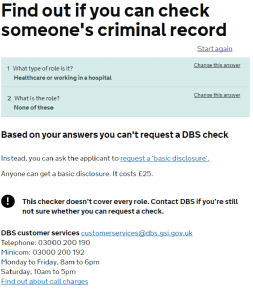
The DBS eligibility tool

The DBS recently launched an eligibility tool which may help you to establish which roles or activities could be eligible for a standard or enhanced DBS check. The eligibility tool is still relatively new and doesn’t cover every role. However, it is being continually tested and improved.

DBS tool checker

Our ‘Establishing eligibility’ process

We have developed this process (EEP) to help you establish what type of check a particular position is eligible for.

Using the EEP

The EEP is a single flow chart.  Some sections have more detailed guidance and these are clearly labelled, e.g. ‘See Note 1’.  To find out more about these steps, go to the relevant sections below.

The EEP is designed to be used before an application is made for a criminal record check when you’ve been told that a certain type of check will be carried out and you are unsure about whether it is eligible

dbsflowchart

Further down this page, reference will be made to the ‘Establishing Eligibility’ form

Note 1 – Ask the organisation

Check their paperwork

Most organisations provide details if they require a check for a specific position. Look for any mention of criminal record checks in the job description, role specification and any other information they have provided.

Check their website

Look for the organisation’s employment policies. The DBS Code of Practice requires organisations who use the DBS service to include a policy on the recruitment of people with convictions. Look to see if they have a policy on which roles require a check.

Check the DBS application form

q61

If the organisation has already given you a DBS application form to complete, look at question X-61 (position applied for) – see image above. This is normally completed by the Registered Body (RB) after you have completed the form. If it has already been completed, make sure it matches the specific job that you have applied for.

It is important to check this because the DBS do not ordinarily query eligibility based on the answer to this question unless it has been brought to their attention.

Remember that a position which may not seem eligible (e.g. “administrator”) may be eligible due to other circumstances. The RB should give as much detail as possible (e.g. “school administrator”).

Contact the organisation

Asking the organisation directly can be the quickest way to find out which type of check will be required (if any). However, if you don’t do this anonymously, you may raise suspicion that you have a criminal record.

Next steps

  • If you believe the organisation is right: You need to decide whether to give your consent to the check. You are not legally obliged to give your consent but if you refuse the employer will normally reject your application for the job.
  • If you are not sure whether they are right or wrong: Go to Note 2 (below)
  • If you believe the organisation is only entitled to a lower check: Go to Note 2 (below)

If you believe the organisation is actually entitled to a higher check: Proceed with your application. Whilst you may be able to refuse, you may want to disclose now if you want to avoid an issue at a later stage.

Note 2 – Gather more information

Some job titles are often assumed to make the role eligible for a specific level of check. For example, a “Teacher” might be assumed to be eligible for an enhanced check. However, a teacher in a University (such as a Lecturer) would normally only be eligible for a basic check.

Equally, some job titles are assumed to make the role ineligible for a specific level of check. For example, an “Office Assistant” might be assumed to be ineligible for an enhanced check but might be eligible for one if working in a school or care home.

To understand what level of check the position is eligible for, you need to find out as much information about the role as possible. The Establishing Eligibility Form provides a set of standard questions for which you should try to get answers.

Alternatively, you could use the DBS eligibility tool checker which will take you through a series of questions to estabish eligibility.

Next steps

  • Go to Note 3

Note 3 – Decide for yourself

The answers to the questions in Establishing Eligibility Form or the DBS eligibility tool checker should give you the information you need to establish eligibility or take the matter further if necessary.

Next steps

  • If you believe the organisation is right: You need to decide whether to give your consent to the check. You are not legally obliged to give your consent but if you refuse the employer will normally reject your application for the job
  • If you think that the organisation is wrong: Go to Note 4.

Note 4 – Challenge the organisation/registered body

The organisation may be a registered body itself or may have made the application via an umbrella body. In either case, you should raise your concerns with the organisation first. When you contact them, you will need to be careful not to raise suspicions that you have a criminal record.

You may want to initially speak with the organisation. However, if they insist that the position is eligible you should raise your concerns in writing and ask for a written response. This is so you have evidence which you may need to use later on. Remember to be aware that you may be identified if you share your personal information.

You should detail the reasons why you feel that the position is not eligible for the type of check being requested. Some things you might want to consider are: –

  • The organisation may already be aware of your concerns from your earlier questions
  • Ask them to reconsider undertaking a check
  • State what level of check you think the position is eligible for and offer to apply for it
  • Ask for a response in writing including reasons why they made the decision that they have.

If the organisation is not a registered body, you need to repeat the above with the umbrella body that they are using. They are the ones who are legally responsible for making the declaration about the eligibility of the check on the DBS application form.

Bear in mind that the umbrella body may not be fully aware of the details of the role. They will only know what the employer has told them. However, if you raise a query with them, they should be able to look into it and get back to you.

Next steps

  • If they agree and decide to undertake a different level of check:  Give your consent. If you disagree with the new level of check being proposed, repeat Note 4.
  • If they disagree: Go to Note 5.

Note 5 – Seek advice

Seek general advice from the DBS

If after all of the above steps a check is still being required for a position you don’t think is eligible, you should seek some advice about what to do next. When seeking advice, try to provide as much information as possible, including a completed ‘Establishing Eligibility’ form or a print out from the DBS eligibility tool checker.

However, you should also ask yourself whether, if successful, you would be in a better position. For example, if your convictions are unspent, even if you managed to show that the organisation isn’t entitled to an enhanced check, they’d still be entitled to a basic, which would show your unspent convictions.

You can contact the DBS by emailing customerservices@dbs.gsi.gov.uk or telephoning them on 03000 200 190.

Seek general advice from the Ministry of Justice

The Ministry of Justice (MoJ) has policy responsibility for the Rehabilitation of Offenders Act 1974 and Exceptions Order 1975. You can seek advice from the MoJ on the eligibility of a position. They have an online form you can use to contact them.

The MoJ may have to share your personal information with the Home Office (which is responsible for the Police Act regulations which govern enhanced checks) and other Government officials. If you do not wish this to happen, make this clear when you send your query. It may be possible for them to remove your personal information but they may be limited in how they can help. The MoJ will respond in writing, either by post or by email. A reply should be provided within 20 working days. It will state that the position is either (a) eligible, (b) not eligible or (c) may be eligible for the type of check that is being requested. In all cases they will provide reasons why. The MoJ is only able to give a general indication, based on the information you provide. Please note that this is not legal advice

The MoJ is unable to impose sanctions on an organisation as there is no offence committed in the initial asking of the questions. However, if the MoJ’s view is that the position may not be eligible, you can then present this information to the organisation.

Seek general advice from others

You may want to seek advice from organisations such as the DBS, Unlock etc.

Next steps

  • If it is not eligible: Send any evidence to the organisation and ask them to reconsider.
  • If the employer agrees: Give your consent. If you disagree with the new level of check being proposed, repeat Note 2.
  • If the employer disagrees: Go to Ineligible checks section.
  • If it is eligible: You need to decide whether to give your consent to the check. You are not legally obliged to give your consent but if you refuse the employer will normally reject your application for the job. If you decide to give your consent.
  • If it may be eligible: Either return to Note 2 (to clarify the role further before challenging the organisation and seeking official clarification again) or go to: Ineligible checks.

Discuss this with others

Read and share your experiences on our online forum.

Below you will find links to useful websites relating to this page. More specific details (including addresses and telephone numbers) of some of the organisations listed below can be found here.

  • Disclosure and Barring Service – Government body responsible for producing standard and enhanced criminal record checks
  • Disclosure Scotland – Government body responsible for providing basic criminal record checks in England, Wales and Scotland
  • Ministry of Justice – Government body working to provide a more effective and transparent criminal justice system and are responsible for the Rehabilitation of Offenders Act

Get involved

Help us to add value to this information. You can:

  1. Comment on this  page (below)
  2. Send your feedback directly to us
  3. Discuss your views and experiences with others on our online forum
  4. Share your personal story by contributing to our online magazine
  5. Help our policy work – stopping unlawful checks

We want to make sure that our website is as helpful as possible.

Letting us know if you easily found what you were looking for or not enables us to continue to improve our service for you and others.

Was it easy to find what you were looking for?

Thank you for your feedback.

12.5 million people have criminal records in the UK. We need your help to help them.

Help support us now