Looking to travel to the US? You need to know if your offence is classed as “a crime involving moral turpitude”?
‘Moral turpitude’ is a legal concept in the US and is important when trying to work out whether you can travel under the Visa Waiver Scheme (ESTA) or whether you need to apply for a visa from the US Embassy.
The information that’s available from the US Embassy can make it difficult to match your UK offence with a US equivalent, and so it’s not always easy to work out if your offence would be deemed to be a “Crime Involving Moral Turpitude” (CIMT). This confusion can mean that people who would be eligible to travel with an ESTA go to the unnecessary time and expense of applying for a visa. Likewise, some people can end up mistakenly travelling on an ESTA when they should have applied or a visa.
To try and help with this, we’ve published some new information which sets out a list of the 80 most common UK offences and those which, in our opinion, would be deemed to be a CIMT.
As this information is new, we’re keen to get your thoughts. Let us know what you think of it and how it could be improved by emailing us at feedback@unlock.org.uk or completing our feedback form.
Have you stumbled across this? You can receive these updates direct to your inbox every month for free by signing up to our mailing list (make sure you choose to receive ‘news for people with convictions’)
Updates to our information site
Here’s a summary of updates that we’ve made recently to theinformationhub. There are links within each update to where you can find more information about the update. There are also links next to many of the updates, which links to threads on our online forum where you can discuss these with other people with convictions.
About criminal records
Your right to be forgotten – We’ve written a new advice post setting out details of how you can make a request to an organisation to delete your personal data once it’s no longer necessary for them to retain it, for example once your unspent conviction is spent.
Travelling abroad
Travelling to China – We’ve updated this page to include details of how drug offences are dealt with by the Chinese Immigration authorities.
Other areas of life
Shotgun and firearms licences – We’ve added the results of a Freedom of Information request which highlights the number of Firearms Certificates issued by the Isle of Man Constabulary.
theRecord posts
Below are links to recent posts to our online magazine, theRecord. These are often linked to the practical information that we have, to help give some personal experiences.
Success – My caution is still showing on my check but so far it’s not held me back – “Almost ten years ago, I was in the last year of university and had received a teacher training placement to start later in the year. Not long after getting my placement, I was out one evening with my partner when we got into an argument and he ended up head-butting me in the face and knocked me to the floor …..”
Struggles and stigma – The difficulty trying to rehabilitate and reintegrate miles from home – “After serving 10 years in prison (2/3rd’s of a 15 year sentence) I was due for automatic release on a 15 month licence last month. During my entire incarceration I have maintained my innocence of the historic allegations for which I was convicted at the age of 69 …..”
Success – My life behind bars – from prisoner to bar owner – “When you’ve been in and out of prison as many times as I have (I only received short sentences), you’re always going to find it hard to find a job. When you’re 17 stone, over 6ft tall and have an arm full of tattoos – well you’re just living up to some people’s image of a criminal …..”
Discussions on our online forum
Below are links to recent posts to our online forum. If you’d like to join in the discussion but are not currently a forum member, find out how you can join here.
Friend thinking of disclosing my conviction to neighbours – AndyR was convicted of a downloading offence a year ago. A friend that has always been very supportive recently started to feel that he should disclose Andy’s conviction to neighbours and other friends. Does anybody have any advice they can offer?
New job and found out – Pb01 has just been suspended from his new job after his employer found out information about his criminal record. He’d never previously been asked any questions about his conviction. Has anybody had a similar experience?
Other news and developments
Below are links to other news and developments that might be of interest to people with a criminal record. For more news, check out the news and media section of our main website.
Appointing a trustee with a criminal record: reflections of a successful applicant and charity
We’ve published a blog written by a charity working within the criminal justice system that was recently successful in getting a waiver from the Charity Commission for a trustee applicant that was “disqualified” because of their criminal record.
Bloomsbury Institute breaks new ground with ban the box for staff and students
Bloomsbury Institute in London is the first higher education provider in the UK to adopt Ban the Box principles for staff as well as students, a move that could encourage other universities to follow suit. Read more here.
Helpline closing for office move
Our helpline will be closed on Monday 3rd June 2019 as we’re moving offices (we’re staying in the same building; so not going far). All being well, we expect to reopen at 10am on Tuesday 4th June.
Whilst we’re closed, you can drop us an email, text or WhatsApp message. Our contact details can be found here. We promise to respond to every enquiry we receive as soon as possible following our reopening.
If you’ve got a question that you need answering, you may find the answer on this self-help site. Have a look at our quick links section which has answers to some of the most common questions we get asked.
Your right to be forgotten
Think back to the last time you applied for a job. Did the application include a tick box question on criminal convictions?
Last year Unlock published research showing that three quarters of national employers still ask about criminal records on application forms. This can be off-putting to applicants with convictions and we don’t think it’s necessary for employers to ask this question so early on. Employers are responsible for deleting unnecessary information – whether its from applicants who don’t take the job, or employees who have left. This post looks at how you can request that your data is deleted when it’s no longer needed.
Deleting criminal records information
Where an organisation (known as a data controller) wants to
process data about criminal convictions, they must have a lawful basis for
doing so under Article 6 and a condition of processing under Article 10 of the
GDPR. As a result of GDPR, organisations need to consider what information is
necessary, and when. Here we’ll focus on employers but the same rules apply to
any organisation that collects personal data – housing providers, colleges or
universities, insurance companies. If you’re being asked to disclose
information about convictions, you should be able to access the employer’s
privacy policy which will tell you how long your data will be retained.
Employers should delete information within these timescales.
However, a CIPHR survey found that this is not always happening as it should. 137 HR professionals were asked if they had published retention periods, and whether data was being deleted at the right time. 83% had published retention periods for data, but only 69% had actually deleted the information as they should have. More than half used paper notes or calendar reminders rather than automated systems to let them know when data should be deleted.
Where data protection breaches are proven, enforcement
action could have serious consequences for organisations. The 30% of HR teams
who admitted they had not deleted data as required were exposing their
companies to significant financial penalties – the maximum fine now is £17.5
million or 4% of the company’s annual global turnover (whichever is higher).
What can you do?
The GDPR gives individuals rights over their data – we recently published guidance for individuals on this. When your information is no longer necessary, it should be securely destroyed. This is known as the right to erasure or the ‘right to be forgotten’ and means you have more power to hold data controllers to account. Where might you want to use your right to erasure?
If you have:
ticked the box on an application form for a job,
for housing or a place at college or university
disclosed more detailed information during the
recruitment process
provided your employer with a DBS certificate
disclosed an unspent conviction that has become
spent
left a job where your criminal record
information was collected during recruitment.
If any of these apply to you, consider asking the data controller to #deletemydata. You can download a template here.
If they are unable or unwilling to resolve your concern, you can raise the matter with the Information Commissioners Office within three months of your last meaningful contact with them.
Have you stumbled across this? You can receive these updates direct to your inbox every month for free by signing up to our mailing list (make sure you choose to receive ‘news for people with convictions’)
Updates to our information site
Here’s a summary of updates that we’ve made recently to theInformationHub. There are links within each update to where you can find more information about the update. There are also links next to many of the updates, which links to threads on our online forum where you can discuss these with other people with convictions.
About criminal records
What does an employer see when he checks your criminal record using the DBS update service? – We’ve written a new advice post to clarify what information an employer can see when they use the DBS Update Service to check your criminal record.
GDPR and data protection – Guidance for individuals – We’ve updated the guidance to include a section on taking a case to court if you believe that an employer or other organisation has breached your information rights.
Insurance
List of insurance brokers – We’ve updated the list to include some amended contact details and also a new broker.
theRecord posts
Below are links to recent posts to our online magazine, theRecord. These are often linked to the practical information that we have, to help give some personal experiences.
Struggles and stigma – Is it too much to expect a life without stigma following a criminal record? – “Prior to finding myself on the wrong side of the law, I was a highly skilled, tax-paying member of society. On release from prison in August 2014, I knew life was going to be hard, but I had no idea it would be this hard. The prejudice, stigma and ignorance I kind of expected, however, the lack of structure, support or framework to get skilled people back into work has been the most surprising part of the journey so far ….”
Success – Thanks Unlock for being part of my journey – Volunteering as a helpline advisor – “It was early 2018 and I was invited to attend a ‘Disclosure Workshop’ run by an organisation called Unlock. I’d never come across them before but the event looked as though it was going to cover more than just writing a disclosure statement (which it did) ….”
Success – Home sweet home – successfully appealing a Council’s decision to take a spent conviction into account – “My son Roman was aged 22 when he applied for and was accepted onto the housing register. After a year of bidding for a property, he was delighted to be offered a flat. On the day that he went to view it with a member of staff from the Council, he was asked ‘Do you have a criminal record?’ …. “
Discussions on our online forum
Below are links to recent posts to our online forum. If you’d like to join in the discussion but are not currently a forum member, find out how you can join here.
Sajid Javid – There’s been some discussion around the Home Secretary’s announcement this month that he is considering overhauling the disclosure rules around minor offences. Add your thoughts to this thread.
Other news and developments
Below are links to other news and developments that might be of interest to people with a criminal record. For more news, check out the news and media section of our main website.
Westminster Hall debate on the disclosure of youth criminal records – Following the publication of the Justice Select Committee’s report on the disclosure of youth criminal records in 2017, there followed a debate on this at Westminster Hall last month. You can read or watch the debate here.
Spring 2019 Newsletter – What we’ve been up to – Our Spring 2019 newsletter provides an update on the news at Unlock in the last 3 months.
University admissions: what’s changed? – Following the decision by UCAS to remove the question about criminal convictions for all university applicants, you can read Rachel Tynan’s blog on the work we’ve been doing in supporting universities to develop fair admissions policies for applicants with previous criminal records.
What does an employer see when checking your criminal record using the DBS Update Service?
The DBS Update Service which was introduced in 2013 allows individuals to keep their standard or enhanced DBS certificates up-to-date by paying an annual subscription fee; currently £13 per year. This means you can effectively take your certificate with you when you move jobs or roles. An employer can then carry out free, online, instant checks to see if any new information has come to light since the certificate was issued – this is referred to as a ‘status check’.
Over the last couple of weeks, we’ve received calls from individuals who’ve been confused about what an employer can see when they carry out a search with several assuming that the employer will see a copy of their latest DBS certificate.
What will an employer ask you to provide?
If you’re happy for an employer to use the Update Service to check your criminal record, you’ll need to provide them with:
Verbal or written consent to check your record
Your name and date of birth
The DBS certificate number (you’ll find this in the top right-hand corner of the certificate).
You’ll also be asked to show them the latest paper version of your standard or enhanced DBS certificate.
Even if an employer uses the Update Service, they’ll still need to see the paper version of your certificate – so make sure you keep it safe as the DBS cannot issue replacements if you lose it.
Once they have the above, an employer can start to use the online tool.
Using the Update Service
An employer will need to log in online and provide details of their organisation together with the name of the individual who is requesting the check. If you need to, you’ll be able to check which organisations have carried out status checks on you.
Once the employer has given their details, they’ll be asked to provide the applicants surname, date of birth and the DBS certificate number.
Before the employer can go any further, they’ll need to agree with a legal declaration confirming that they have the authority of the applicant to check their record and they’re carrying out the correct level of DBS check.
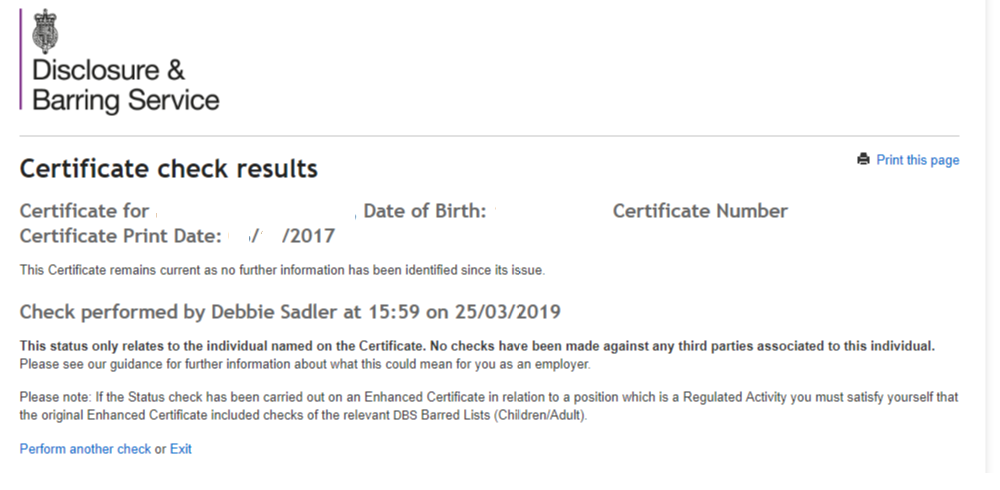
The employer will then be able to see whether there has been any new information added since your last certificate was produced or whether your current certificate remains unchanged.
What if there’s new information on your DBS certificate?
If you’ve received further cautions or convictions or you’ve been added to the barred list, your employer will see the following message:
This DBS certificate is no longer current. Please apply for a new DBS check to get the most up-to-date information.”
At this point, the employer will usually ask you to apply for a new DBS certificate.
What if there’s no new information on your DBS certificate?
If there are no changes to your certificate, the employer will see the following message:
The certificate remains current as no further information has been identified since its issue.”
What if your cautions or convictions have been filtered since your last certificate?
The filtering of a caution or conviction would not cause a status change through the update service as a status change is only prompted when there is new information to be added. An offence which has been filtered would mean a removal of information from your certificate.
If you wish to have a certificate which doesn’t show the offence that has been filtered, you’ll need to apply for a new DBS check.
Given that once something is filtered, you no longer need to disclose it, then it’s sensible to apply for a new certificate. Many employers have little understanding of the filtering process and if you’re showing them a paper certificate with a filterable offence still on it, they’ll assume that it can still be taken into account.
For more information
For practical self-help information – More information is available on the DBS Update Service
Have you just stumbled across this? You can receive these updates direct to your inbox every month for free bysigning up to our mailing list (make sure you choose to receive ‘news for people with convictions’)
Updates to our information site
Here’s a summary of the updates that we’ve made recently to the theInformationHub. There are links within each update to where you can find more information about the update. There are also links next to many of the updates, which link to threads on our online forum where you can discuss these with other people with convictions.
About criminal records
Applying to come off the Sex Offenders Register if you’re on it indefinitely – We’ve written an advice post setting out how police forces across the UK deal with applications to be removed from the Sex Offenders Register if you’ve got an indefinite notification.
Organisations that have access to the Police National Computer (PNC) – We’ve updated this page, specifically the section on non-police organisations who have restricted access to the PNC.
Work and volunteering
Looking for friendly employers – Over the last few months, some of the organisations on our list of friendly employers have amalgamated or changed names. We’ve amended this page to reflect the various changes.
Banking
Identification (ID) for opening a bank account – This page has been updated to make it easier to navigate.
Other areas of life
Sources of identification – We’ve updated this page which now includes additional information in relation to applying for a Citizencard.
theRecord posts
Below are links to recent posts to our online magazine, theRecord. These are often linked to from the practical information that we have, to help give some personal experiences.
News and views – Has ‘Ban the Box’ turned a job interview into another courtroom? – “For anybody that doesn’t know, ‘Ban the Box’ is an initiative that encourages businesses to stop asking ‘Do you have any criminal convictions?’ and including a tick box on their application forms. This box makes it far too easy for employers to immediately bin job applicants that have a criminal record, even if minor or long ago. Ban the Box means each applicant can be evaluated as an individual, on merit, rather than immediately dismissed as an ex-offender …..”
Success – Disclosing convictions received during my employment – “I’d worked for my employer for over 5 years. I’d had regular DBS checks which always came back ‘clean’ and assumed that would continue to be the case. However, for reasons I won’t go into now, things really changed for me in 2018 and I received a couple of convictions over the course of eight months …..”
Discussions on our online forum
Below are links to recent posts to our online forum. If you’d like to join in the discussion but are not currently a forum member, find out how you can join here.
Settled and pre-settled status for EU citizens and criminal records – Miguel needs to apply for settled status and wants to make sure that he discloses the correct information. Can anybody give him any advice?
Can MOSOVO officers be offered evidence that disclosure is unnecessary? – Blackbird was given a SHPO pertaining to the use of devices that connect to the internet and has been told by the police that he needs to disclose this to his new employer. Has anybody had any experience of negotiating the necessity around disclosure with the police, maybe by offering them access to a work laptop? Any thoughts anyone?
Other news and developments
Below are links to other news and developments that might be of interest to people with a criminal record. For more news, check out the news and media section of our main website.
Book now for our criminal record disclosure training on 24th April 2019
Our next ‘criminal record disclosure’ training workshop is on the 24th April. Find out how to book along with details of alternative dates.
Applying to come off the Sex Offenders Register if you’re on it indefinitely
Anyone who has been convicted of a relevant sexual offence and received a prison sentence of 30 months or more will have to notify the police (often referred to as ‘signing the sex offenders’ register) indefinitely.
However, since 2012 individuals who are subject to indefinite notification requirements have the opportunity to apply to the police for a review of this requirement, after a fixed period of time has elapsed. This is currently 15 years for an adult and 8 years for a juvenile.
Back in 2016, BBC News undertook a Freedom of Information (FOI) request which highlighted the number of people with indefinite notification requirements who had successfully applied to be removed from the Sex Offenders Register (SOR).
We were interested in updating this information and, although the previous FOI covered a four-year period, we have concentrated on just one year, namely April 2017 to March 2018. We made an FOI request for this information and have summarised the findings below. The full response can be seen here.
Some key figures
Approximately 60,000 individuals were on the sex offenders’ register as at March 2018
335 people successfully applied to have their indefinite notification revoked in the year April 2017 – March 2018 out of a total number of 588 applications – a 57% success rate.
21 police forces approved over 50% of the applications they received.
Which police forces approved the most/least applications in 2017/18?
Essex and Cumbria both approved 100% of the applications they received.
Dyfed Powys, Northamptonshire, Surrey and Warwickshire Police did not approve any requests.
The charts below give a breakdown of the forces that approved the most/least applications (click on them to enlarge)
What can we take from these figures?
If you are considering applying to have your indefinite notification revoked, then it’s probably interesting to see how the force you’re applying to have dealt with applications in previous years.
Comparing the most recent FOI with the one carried out in 2016 (which covered a four year period), Devon & Cornwall, Norfolk and North Wales Police were in the top 10 of forces that approved the most applications in both periods.
Meanwhile, Humberside, Lancashire and West Yorkshire were in the bottom 10 and approved the fewest applications in both periods.
In 2011-2015 and 2017-2018, Dyfed Powys Police did not approve any applications whilst North Wales Police were one of the forces that had approved the most.
Our advice to anybody with an indefinite notification requirement would be to request a review as soon as you are able to. If you are living in an area where historically very few applications have been approved, then it may be useful to have an informal chat with your PPU officer to get a feel for how your application will be dealt with.
For more information
For practical self-help information – More information is available on our sexual offencessection, and we have specific information on the notification requirements, including indefinite registration.
Moving on: The impact of a motoring conviction on your criminal record
This month, we’ve written a further article for InsideTime ‘Through the Gate’ Section which focuses on the impact of a motoring conviction on your criminal record.
A copy of the article can be found below.
For anyone serving a prison sentence of less than 4 years your conviction will be spent (under the Rehabilitation of Offenders Act 1974) at some time in the future. The time it takes depends on the specific sentence. However, motoring convictions are treated slightly differently which can cause confusion and often results in people failing to disclose something they need to disclose.
Endorsements
Some driving offences can result in your licence being revoked (i.e. you’re banned from driving) or even a prison sentence. However, in addition to these specific disposals your driving licence is usually endorsed.
In the days of paper licences, it was really easy to see that your licence had been endorsed. After you’d appeared in court, you’d normally be asked to send off your licence to the DVLA who would return it to you with a code added; for example SP30 (if you’ve been found guilty of speeding on a public road) or DR10 (for a drink driving conviction). Now that we no longer have paper licences, endorsements are kept electronically by the DVLA.
If you’re unsure whether you’ve got an endorsement, it’s possible to check your own driving licence using the DVLA Shared Driving Licence Scheme or alternatively, apply for a Subject Access Request from ACRO Criminal Records Office; both are done online.
When do motoring convictions become spent?
In terms of when your conviction becomes spent, it’s important to note that any endorsement imposed by a court for a road traffic offence is treated as a sentence under the Rehabilitation of Offenders Act. Every endorsement has a five year ‘rehabilitation period’ (which is the time it takes to become spent).
For example, if Mr Smith is banned from driving for three years, the time it takes for his conviction to become spent would be three years. However, Mr Smith was also given an endorsement, which means that his conviction would not actually become spent for 5 years as it would be based on the disposal with the longest rehabilitation period.
Further information on the rehabilitation periods for specific motoring convictions can be found on our website.
If you already have an unspent conviction and get another one before the first one is spent, then neither conviction becomes spent until the rehabilitation period for both offences ends. For example, Jamie received a 3 year prison sentence for possession and supply of drugs. His conviction was due to become spent in January 2019 but in December 2018 he was convicted of using a mobile phone whilst driving and received a £200 fine. This means that neither conviction would now become spent until December 2023.
Endorsements and your driving licence
The length of time that motoring offences stay on your licence is governed by road traffic legislation and is completely separate to the time it takes for it to become spent. An endorsement may be removed from your licence after 4 years but you’d still need to disclose it to employers/insurers for 5 years if asked. Likewise, an endorsement that remained on your licence for 11 years would become spent after 5 years and wouldn’t need to be disclosed.
Fixed Penalty Notices for road traffic offences
A Fixed Penalty Notice (FPN) can be used to deal with minor traffic offences, but it is not a criminal conviction or a caution unless it relates to a road traffic offence listed in Section 2 of the Road Traffic Act 1988.
Getting insurance with a motoring conviction
The majority of high street insurers will refuse you car insurance if you have an unspent motoring conviction. If you find yourself in this situation then you’ll need to purchase your insurance through a broker. Unlock has a list of specialist car insurance brokers which can be found online.
Have you just stumbled across this? You can receive these updates direct to your inbox every month for free bysigning up to our mailing list (make sure you choose to receive ‘news for people with convictions’)
Updates to our information site
Here’s a summary of the updates that we’ve made recently to the theInformationHub. There are links within each update to where you can find more information about the update. There are also links next to many of the updates, which link to threads on our online forum where you can discuss these with other people with convictions.
About criminal records
GDPR and data protection – Guidance for individuals – Following the implementation of the General Data Protection Regulations we’ve produced some new guidance which deals with the use of GDPR and the Data Protection Act for recruitment purposes and the collection and processing of criminal record data.
Coming to (and staying) in the UK
Applying for citizenship – We’ve added a link to an article by Freemovement on ‘Naturalising or registering as a British citizen: the good character requirement’ which sets out the behaviour which the Home Office believe indicates that a person is not “of good character”.
Important links and organisations – We’ve added a new section to this page with organisations that provide immigration advice.
theRecord posts
Below are links to recent posts to our online magazine, theRecord. These are often linked to from the practical information that we have, to help give some personal experiences.
Success – Prison to parenthood – “2018 was the strangest year I’ve known. It began in a prison cell with all the usual, well intended resolutions that this year would be different and to be fair, it has certainly been that. The year ended with me assisting self-representing fathers in the family court and launching the Prison to Parenthood project in prisons …..”
Struggles and stigma – Although my conviction can be filtered, 11 years seems a very long time to wait – “Back in 2015, I attended a colleague’s surprise 40th birthday party. I didn’t go out that often without my boyfriend and was excited to spend time with good friends and to celebrate with them. There was good wine and lots of interesting dance moves and myself and my good friend continued the night out in town after the party finished …..”
Success – Living and working in China after asking the police to delete my cautions – “Although I’ll admit that I’d had a bit of a troubled past in my youth, I’d always felt that the four cautions I had on my criminal record shouldn’t have been there. They’d never really caused me too many problems until I tried applying for a visa to travel to China and then I realised that as far as travel was concerned, they were likely to be a huge problem …..”
Job opportunities – New ‘Opportunities’page – “We know that getting a paid or voluntary role can be really important in helping people to turn their lives around if they have a criminal record and, although it doesn’t always seem like it, there are lots of organisations that look to proactively recruit people with convictions. As part of our work to raise awareness of these opportunities, we’ve introduced a new opportunities page …..”
Discussions on our online forum
Below are links to recent posts to our online forum. If you’d like to join in the discussion but are not currently a forum member, find out how you can join here.
Depression and a ‘virtual prison’ -Jonathan61 wants to know how people cope with their emotions after receiving a criminal record and how they deal with the fact that restrictions placed on them can put them in ‘virtual prisons’. Do you have any advice you can give him?
Unlock responds to Supreme Court judgement on criminal records disclosure regime – We’ve posted a link to our response to the Supreme Court judgement and would be interested to hear your thoughts and opinions.
Other news and developments
Below are links to other news and developments that might be of interest to people with a criminal record. For more news, check out the news and media section of our main website.
Press and media coverage of the Supreme Court judgement
There has been a significant amount of press and media attention on the judgement of the Supreme Court which ruled that the criminal records disclosure scheme as it applies to multiple convictions and childhood warnings/reprimands was found to be disproportionate. Find out more about the coverage and commentary pieces.
New proposals for all taxi drivers to undergo an enhanced DBS check
Unlock’s co-director, Christopher Stacey spoke on Radio 5 Live about the proposed new guidance from the Department of Transport which suggests that all taxi drivers should undergo an enhanced DBS check before being considered for a licence. You can listen to the program here.
A new video about our work
We’re pleased to be able to share a short video that explains a bit about the work Unlock does and why it’s so important to help the millions of people in this country who have a criminal record.
We want to make sure that our website is as helpful as possible.
Letting us know if you easily found what you were looking for or not enables us to continue to improve our service for you and others.
Was it easy to find what you were looking for?
Thank you for your feedback.
12.5 million people have criminal records in the UK. We need your help to help them.
We use cookies where necessary to allow us to understand how people interact with our website and content, so that we can continue to improve our service.
We only ever receive anonymous information, and cannot track you across other websites. Find out more