Social worker (and other health and social care professions)
Social workers and social work students are required to declare criminal convictions when registering with the Health and Care Professions Council (HCPC) . You must also inform the HCPC of formal criminal charges that are pending.
The Rehabilitation of Offenders Act 1974, which allows some convictions to become spent after a fixed period, does not apply. The law expects prospective social workers to declare convictions even if they are spent (unless they are protected by the filtering regime). The HCPC will then examine the disclosed information case by case, assessing how this affects your suitability to be a social worker or social work student.
Once registered, social workers and students are obliged to tell the HCPC of any new convictions or charges as soon as they occur. Registrants are also required to notify the HCPC of other changes in their circumstances, such as change of address or change of employer. This is a requirement of registration and failure to do so can be considered a conduct matter and could lead to you appearing before a conduct committee.
Other roles that are covered by the HCPC include:
arts therapists
biomedical scientists
chiropodists / podiatrists
clinical scientists
dietitians
hearing aid dispensers
occupational therapists
operating department practitioners
orthoptists
paramedics
physiotherapists
practitioner psychologists
prosthetists / orthotists
radiographers
social workers in England
speech and language therapists
The HCPC maintain a register.
More details about the ‘Character’ element of registration are available here.
A criminal record does not automatically bar you from working with young people and vulnerable adults, even if it involved violence. You are required to declare all your cautions and convictions, even if they are spent, unless they are eligible for filtering.
If you would like more information regarding social work employment with a violent past conviction, there is a useful report and case study that was published in 2013 on the Community Care website.
Even though cautions and convictions remain on the Police National Computer (PNC) until you are 100 years old, there are some situations where the police will destroy your biometric information (DNA and fingerprints). It’s important to know whether this will apply to you and how you go about making a request to the police.
Biometric information
Biometric information refers to fingerprints and DNA Profiles.
If you are arrested, your details will be entered onto the Police National Computer (PNC). This will include your personal details, details of your arrest and biometric information such as fingerprints and your DNA profile.
Your biometric information will be either retained or destroyed depending on whether you have been convicted or not. The table below provides further information.
Retention period for individuals convicted of an offence
Retention period for individuals not convicted for an offence
Definitions
A minor offence is defined as any recordable offencethat is not a covered under the definition of a qualifying offence.
A qualifying offence is one that is more serious; a full list of qualifying offences has been set out in Section 65A of PACE which can be found here. According to ACPO there are over 400 qualifying offences.
Effect on people with convictions
The only time that fingerprint and DNA information would be destroyed is for individuals convicted of a minor offence under 18 at the time of conviction, so long as the offence wasn’t for a qualifying offence.
However, it’s important to realise that this only relates to fingerprint and DNA information – the actual conviction will remain on the PNC.
Effect on people charged
If you are charged with a qualifying offence but not convicted you can apply for early deletion of your biometric information only if you have no previous convictions. If you are arrested and charged with a qualifying offence but not convicted, your biometric information can be retained for three years.
For more information and details regarding the deletion of biometric information please click here.
An officer may only give authorisation if he has reasonable grounds for believing that a sample will confirm or disprove the person’s involvement.
Non-Intimate Samples
A non-intimate sample is hair (that is not pubic hair); a sample taken from the nail or under nail; a swab taken from any part of the body, including a mouth swab, but not from any other body orifice; saliva and a footprint.
A non-intimate sample may be taken without consent.
Intimate Samples
An intimate sample is defined as: blood, semen, any other tissue or fluid, urine, pubic hair, dental impression or swab taken from any orifice other than the mouth.
An intimate sample may be taken from any person in police detention. An intimate sample can be taken from someone who is not in police detention but who, during an investigation, has supplied two or more non-intimate samples that have proved insufficient.
More information about whether your biometric data is likely to be on a police database can be found here
Operation Nutmeg
The following information regards the collection of DNA samples as part of Operation Nutmeg whereby police forces in England and Wales have been collecting DNA samples from 12,000 serious offenders who are not on the national DNA database.
Police forces in England and Wales have been pushing ahead with collecting DNA of people with convictions pre-dating 1994. Routine DNA collection was not implemented until after this.
July 2013
In 2013, a legal challenge was made by a person with convictions against their police force’s request to provide a non-intimate DNA sample as he argued that the request infringed on his human rights.
The judgement decided that the request was both ‘lawful and proportionate’. There are a number of helpful aspects from the judgement:
The police must strike a balance in each case to decide whether taking a DNA sample is proportionate.
It may be that in some cases the police have required an attendance at the police station before issuing an authorisation to take DNA – this would be unlawful.
The court suggested that a person should have a chance to make representations as to why it would not be proportionate to take DNA in a particular case.
As outlined in Section 62 of PACE, an officer may authorise collection if he has reasonable grounds to believe that the sample will confirm or disprove the individual’s involvement. However in this case, the grounds for DNA collection were ‘purely speculative’ but the court ruled that this was acceptable.
For full details on this particular case, please see the article from The Independent
For additional information on this case, please read the High Court Decision
October 2013
In another case, a 74 year old was required to attend the police station to provide a sample of DNA for a crime he committed 42 year earlier. This was challenged and on review of the case, the police force decided that it was not in the public interest or proportionate to pursue this DNA sample.
Guidelines relating to Operation Nutmeg now state:
“The purpose of this operation is to ensure that those convicted of Homicides and/or Sexual Offences have a confirmed DNA profile held on the National DNA Database and is correctly shown on their PNC record. To achieve this, forces will be supplied with details of subjects whose last known location is within their Force area. Each subject will need a risk assessment carried out to identify the high risk nominal’s and ensure that they are located and sampled at the earliest opportunity”
Discuss this with others
Read and share your experiences on our online forum.
Useful links
Below you will find links to useful websites relating to this page.
This page was last fully reviewed and updated in July 2017. If you’ve spotted something that needs updating, please let us know by emailing the details to advice@unlock.org.uk
The DBS (Disclosure & Barring Service) acts as the ‘middle-man’ between the Registered Body (which checks eligibility and identity) and the Police (who provide the criminal record information for the certificate).
The Registered Body submits the application to the DBS. Many employers are not registered, and have to use another company called an ‘Umbrella Body’. However, some large employers are Registered Bodies themselves and can submit applications directly to the DBS.
Registered Bodies and Umbrella Bodies are legally responsible for the process of submitting the application. This includes identification and address verification and declaring that the position is eligible for the check.
Completing the form
Official guidance
The DBS produce a step-by-step guide on filling out the application form. This is available to download from the DBS website.
Providing accurate information
The application form is used to help the DBS and the Police to find your records. This is known as ‘PNC matching’. If you do not provide accurate information, you could be confused with somebody with a different criminal record. It is an offence to intentionally provide inaccurate details.
The question about convictions
Question e-55 (see above) helps to identify your record on the Police National Computer (PNC). The declaration underneath the question means that you need to answer this question truthfully.
The question on the form was amended in March 2014 to reflect the introduction of the filtering process (more information about filtering). The question is now:
“Do you have any convictions, cautions, warnings or reprimands that would not be filtered in line with current guidance?”
If you are not sure how to answer this question, you can apply for a Police Subject Access Request (SAR) to see what is on your record. Unfortunately, this doesn’t tell you what has been filtered – it provides you with everything that is on the Police National Computer. Once you have this, you should be able to work out what would be filtered.
If you’re not sure, and you don’t have time to complete an SAR, you should think about whether to tick “Yes” or “No”. if the form gets sent back to the Umbrella Body acting on the employers’ behalf you might be okay with ticking “Yes”, as the information isn’t normally shared with the employer. If, however, the form goes back to the employer, you should think carefully before ticking “Yes” as it might mean you’ll be telling them something you might not need to. Ultimately, it will depend on how confident you are that your record will be filtered.
If you have applied to have a repealed offence (something that is no longer a crime) removed from the PNC and received confirmation from the police, you do not need to include it. A repealed offence that has been removed from the PNC will not appear on a DBS certificate.
Checking the status of your application
You can check the status of your application online. You will need your DBS application form reference and your date of birth. If you cannot remember your form reference number, you should contact the DBS.
Probation records
Name
Probation records (often referred to a “Probation Subject Access Request”)
Issued by
Local Probation Trust
Use
To see what information the Probation Trust hold on their records about you
What it contains
Any information or records which the Probation hold on their system about you. This may relate to pre-sentence reports, OASys assessments, parole dossier information and hostel reports
How to apply
Local Probation Trust
Who can apply for it
Only the person whom the information is relevant to can apply
Contact details
You can find a list of all the Probation Trusts here
Cost
£10
How long it takes
Can take up to 40 working days
Where it is sent
To you only
Link to anonymous example
How to correct inaccurate information
You would need to write directly to the local Probation Trust outlining the areas which you take issue with. They would then assess this inaccuracy against any information you have provided them with and return their findings to you via letter.
Street Trading Licence
What is street trading?
Street trading is defined as the selling or offering for sale any article in the street or from a vehicle, kiosk or moveable stall. Traders who use the public highway to sell goods or services must have a street trading licence to carry out trade from a designated site or pitch and display goods in front of a shop.
Trading from a vehicle, kiosk or moveable stall which is on the valuation roll does not require a street trader licence.
Are there exemptions?
You do not need a street trading licence if you are:-
A pedlar with a Pedlar’s Certificate issued by a police authority
A market trader operating at a licensed market venue
A news vendor selling only newspapers and periodicals
At a petrol station
As a roundsman with regular customers
As part of a charity collection if a valid permit is in force
If you are trading on private land you may not need a consent.
Why do I need a licence?
Most Council’s believe that street trading requires some form of control.
To ensure that traders in food meet an adequate standard of food hygiene and minimise any health risks to the public
To control nuisances which can be associated with street trading such as noise, smell and litter.
Who can apply?
Any person who is 18 years old or over can apply.
How do I apply?
Applications should be made to the Council in the area in which you wish to trade.
Application forms and guidance notes can be downloaded from most Council websites.
How much does it cost?
It varies from Council to Council
What if I have a conviction?
You will usually be asked to disclose all unspent convictions on application. Many Council’s now ask that you provide evidence of this by way of a basic criminal records check from Disclosure Scotland. Disclosures should not usually be older than 3 months from the date of issue. Having an unspent conviction will not necessarily be a bar to success and applications will be dealt with on a case by case basis.
Most Council’s have an Appeals process in place if your application is initially refused. Details can be found on the Council’s websites.
How employers should handle certificate information
This section will explain what employers should do when they receive information on a criminal record check.
Using disclosed information to make a recruitment decision
What is the DBS code of practice?
The DBS code of practice is published under Section 122 of the Police Act 1997. It aims to ensure that criminal record information is used fairly and applicants are protected from unfair discrimination due to non-relevant convictions. Anybody who receives standard or enhanced certificate information must abide by the code of practice, this includes Registered Bodies, Umbrella Bodies, recruiters and any others receiving the information.
What does the code of practice require of Registered Bodies?
The DBS code of practice requires that Registered Bodies must: –
Have a written policy on the secure handling of information which, in the case of Umbrella Bodies, should be made available to their clients. A sample policy produced by the DBS is available online
Store DBS certificate information securely
Retain DBS certificate information, its content or any representation of the same in any format for no longer than is necessary and for a maximum of six months following the recruitment decision unless a dispute is raised or, in exceptional circumstances, where DBS agreement is secured
Ensure that no reproductions of the DBS certificate or its content are made, including photocopies or scanned images, unless with the prior agreement of the DBS or as a result of a stipulated requirement relating to the e-channel service
Only share DBS certificate information with relevant persons in the course of their specific duties relevant to recruitment and vetting processes
Dispose of DBS certificate information in a secure manner
Ensure that they comply with DBS guidance on the portability of DBS certificates and their contents.
What does the code of practice require of others?
In making use of DBS checks, any organisation subject to the code of practice must: –
Ensure that all applicants for relevant positions or employment are notified in advance of the requirement for a DBS check
Notify all potential applicants of the potential effect of a criminal record history on the recruitment and selection process and any recruitment decision
Discuss the content of the DBS certificate with the applicant before withdrawing any offer of employment
Provide a copy of the DBS code of practice to the applicant upon request.
Written policies on people with a criminal record
DBS guidance states that organisations using criminal record checks should not have a complete ban on people with criminal records. The DBS requires organisations which use checks to have a policy on the recruitment of ex-offenders. Organisations are expected to only use the information on a DBS certificate in the context of such a policy.
Many organisations achieve this by simply using the example policy provided by the DBS. However, some have positive and detailed policies towards people with criminal records. To find out more about how an organisation may use the information disclosed, ask to see a copy of their policy. If you do this before apply, you may want to do this anonymously.
You may find the organisation uses vague language such as “We judge each case on its merits”. To get a clearer picture about how they will treat you, try to ask them some specific questions about your particular type of convictions and/or the particular areas of the company that interest you.
Handling and storing disclosed information
Information on a certificate
Organisations that wish to use a standard or enhanced check must comply with the DBS code of practice The code seeks to ensure that sensitive personal information is handled and stored appropriately and is kept for only as long as necessary. In particular, it is an offence for Registered Bodies to: –
Disclose information contained within a certificate to any person who is not a member, officer or employee of the Registered Body or, in the case of Umbrella Bodies, their client unless a relevant legal exception applies;
Disclose information to any member, officer or employee where it is not related to that employee’s duties;
Knowingly make a false statement for the purpose of obtaining, or enabling another person to obtain a certificate.
Persons guilty of such offences are liable to deregistration, a fine or imprisonment unless a relevant exception applies as outlined in DBS Guidance.
Self-disclosure
The DBS does not impose any rules on how organisations should handle information that you choose to disclose yourself.
However, all organisations have to follow the Data Protection Act 1998. As criminal record data is regarded as sensitive personal data under this legislation, they should have processes in place to ensure it is kept safe.
If you are worried about how an organisation will retain the information that you disclose, you should ask them for a copy of their data protection policy.
Getting a copy of your DBS records
Name
DBS records (often referred to a “DBS Subject Access Request”)
Issued by
Disclosure and Barring Service
Use
To see what information the DBS hold on their records about you. It can be useful if, for some reason, you no longer have a copy of the disclosure certificate that an employer undertook on you. Subject Access is a right provided under Section 7 of the Data Protection Act 1998 whereby any individual can ask any organisation what information they hold on them.
What it contains
This application will only return something if you have previously had a check carried out on you.
A subject access request to the DBS will provide you with copies of previous application forms, system notes, correspondence held and a print out of what was contained on the certificate(s). Please note – the printout is not a duplicate certificate; it provides a copy of what was released on the certificate in a different format. It should provide you with evidence of each check that has been completed on you and if any conviction information has been released on the certificate it would appear on the print out. The application form would also show the name of the organisation that submitted the check(s)
If you need to correct inaccurate personal information, such as your name, date of birth or address, you need to raise a data entry dispute. More details are available here
However, if it is that your conviction details are incorrect or inaccurate, you need to raise a data source dispute. This can be done online (you complete the form electronically, print and submit it by post). Alternatively, you can request a disputes form by post by calling 0870 9090 811.
Other information
The DBS does not hold a copy of the Police National Computer (PNC) record of convictions. The system held by the DBS is known as a PNC Extract. The extract contains basic identifying details such as name and date of birth of persons included on the PNC. The extract does not contain any conviction information. The police both own and maintain the Police National Computer.
For entry to all professional and Postgraduate Certificate in Education (PGCE) courses in England and Wales there are both academic and non-academic requirements which need to be met.
The focus of this information is in becoming a teacher in a primary or secondary school with a criminal record.
Why is this important?
When deciding which career path to follow or what college/university course to study for, it’s important to establish what, if any barriers you could potentially come up against.
For anybody thinking about becoming a teacher, it’s more than likely that you’ll need to have an enhanced Disclosure and Barring Service check which may disclose the details of previous cautions/convictions.
Depending on the nature of your offence, you may be disqualified from being a teacher.
Disclosing your criminal record to a university
Before you can start a teacher training course, you’ll be asked to disclose details of both spent and unspent cautions and convictions unless they’re eligible for filtering.
UCAS include a question about criminal records on their application form although admission to a training course will be at the discretion of the relevant institution.
As part of their application process universities will often ask you to attend a Panel Hearing to consider your cautions/convictions and determine whether:
Based on the evidence provided, it is judged that you pose an unacceptable risk to the university.
You are able to meet the particular professional or statutory requirements that exist for some courses.
You will need to undergo an enhanced criminal record check and you will usually be asked to provide a signed statement confirming that you’re not disqualified from working with children.
Being convicted of certain violent and sexual offences against children and adults which are referred to in regulation 4 and Schedules 2 and 3 of the 2018 Regulations
Being convicted of an offence overseas, which would constitute an offence regarding disqualification under the 2018 Regulations if it had been done in any part of the United Kingdom.
Your enhanced DBS certificate will usually help you to determine whether your offence would fall under one of the above relevant offences.
Schools are unable to employ anyone who is disqualified under the 2018 Regulations. However, unless you’re on the Children’s Barred List, you can apply for a waiver from Ofsted which, if granted, will allow you to work in a school.
How do schools deal with teachers who have a criminal record?
If you have a criminal record that needs to be disclosed, it will not automatically prevent you from becoming a teacher.
Offences which would be considered to be most concerning would include:
Sexual offences
Crimes of violence
Crimes of dishonesty including fraud or embezzlement
Offences relating to possession or supply of illegal drugs
Any offences against children or which raised concern with regard to child protection.
When considering a person’s suitability to become or remain a teacher schools will review:
The length of time which has passed since the offence without any further convictions
The seriousness of the offence and whether it may be relevant to a person’s position as a teacher
Whether it would be proportionate to remove a person from the profession or prevent them joining the profession on the basis of the offence committed
Were any children directly involved either as victims or in terms of being put at risk?
The explanation provided by the teacher or applicant
Misconduct guidelines for teachers
In early 2014, changes were made to the National College for Teaching and Leadership (now referred to as the Teaching Regulation Agency) document for “Teacher Misconduct: The Prohibition of Teachers”.
The advice sets out the factors to be considered by a professional misconduct hearing panel and sets out that any criminal conviction involving indecent images of children will lead to somebody being banned from teaching.
For more information and further advice please see these guidelines.
Personal experiences
The personal story below has been posted on theRecord, our online magazine.
Below you will find links to useful websites relating to this page. More specific details (including addresses and telephone numbers) of some of the organisations listed below can be found here.
UCAS – The Universities and Colleges Admissions Service is a UK-based organisation whose main role is to operate the application process for British universities.
Teaching Regulation Agency – The TRA has responsibility for the regulation of the teaching profession, including misconduct hearings and the maintenance of the database of qualified teachers.
Ofsted – The Office for Standards in Education, Children’s Services and Skills inspect and regulate services that care for children and young people. They are also responsible for the granting of waivers to teachers disqualified from teaching.
In January 2017, the Justice Secretary announced that thousands of gay and bisexual men convicted of sexual offences which have now been decriminalised would be posthumously pardoned. This builds on an earlier scheme that was introduced in 2012 to ‘disregard’ decriminalised sexual offences.
This page provides further information about the disregard process, which is the process that individuals have to go through.
Why is this important?
Years ago, many people were convicted of offences which are no longer illegal today. Things changed when the Sexual Offences Act 1967 came into force which decriminalised private homosexual acts between men over the age of 21 in England and Wales.
However, if you were convicted of a sexual offence which has now been decriminalised, you may find that this conviction will still appear on a formal criminal record check unless you have applied to have it disregarded.
Unfortunately, you have to proactively apply for a disregard – it doesn’t happen automatically. Many people won’t realise they have a historic offence on their record until it’s disclosed on a DBS check – at which point the damage may already be done.
Many employers have little understanding of legal definitions, and so you may find yourself being refused an interview or job on the basis of being convicted of an offence that is no longer illegal.
Introduction
The coalition government made a commitment in 2010 to change the law so that historical convictions for consensual gay sex with over 16s would not show up on criminal records checks.
The Disregards and Pardons Scheme came into force on 1 October 2012. Under the provisions of Chapter 4 of Part 5 of the Protection of Freedoms Act 2012 (s.92-101), the Home Secretary may ‘disregard’ certain convictions (which includes cautions, warnings and reprimands) for decriminalised consensual sex offences.
Under the disregard provisions, individuals can apply to the Home Secretary for a formal disregard of their convictions. If the Home Secretary considers that a disregard is appropriate, those convictions disregarded will be deleted or annotated. They will no longer be disclosed in certificates issued by the Disclosure and Barring Service.
Eligibility
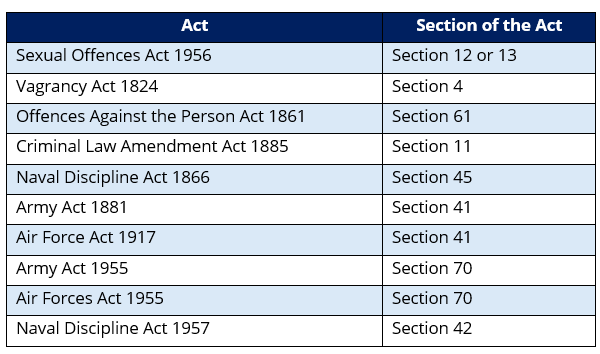
The offences that criminalised consensual sex between men over the age of consent were mainly sections 12 (buggery) and 13 (gross indecency) of the Sexual Offences Act (SOA) 1956.
The following offences are covered by the process:
People charged under these laws will only be able to have them disregarded if two key conditions are satisfied:
The activity must have been consensual – All parties involved in the conduct constituting the offence consented to it and were aged 16 or over at the time of the offence
It must not be an offence today – The scheme does not include sexual activity in a public lavatory (which is still illegal)
How to apply
The application form and guidance notes for applicants are available to download from GOV.UK.
The process is free of charge.
What happens next?
If your application is not eligible to be disregarded you will receive a letter to that effect. In all other cases you will receive an acknowledgement that your application has been received and is being processed.
The Home Office will then contact all relevant data controllers and request them to review their records and provide copies of any relevant documents to the Home Secretary to enable a decision to be made.
Once the Home Secretary has made a decision, you will be informed of the outcome. If your application is successful, the Home Secretary will write to the relevant data controllers and require them to delete or annotate their records accordingly.
What is the effect of the disregard?
Once the Home Secretary has given notice that a conviction has been disregarded and a period of 14 days thereafter has elapsed, a successful applicant will be treated in all circumstances as though the offence had never occurred and need not be disclosed for any purpose. It means, in effect, that it’s deleted.
Those successful in the disregard process are then also pardoned by the government.
What if you disagree with the Home Secretary’s decision?
If you disagree with the decision made by the Home Secretary and either have further evidence to submit or consider that an error was made on your initial application form, you should contact the Home Office so that your application can be reviewed. If you consider that the final decision reached in relation to your application is wrong, you have the right under the provisions of the Protection of Freedoms Act 2012 to seek leave to appeal the decision to the High Court.
How many people have had their offences disregarded?
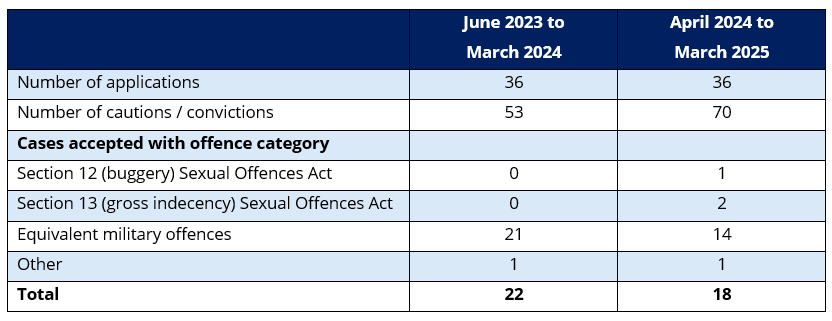
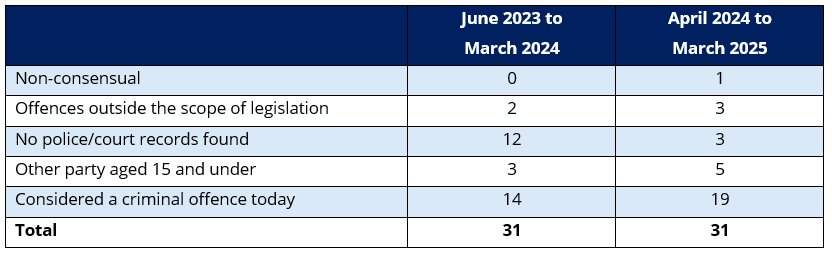
Latest figures from the Home Office show that between June 2023 and March 2025, the number of cases dealt with was 72. This is broken down as follows:
Eligible applications
Ineligible applications
Update
The Government’s 2012 Disregards and Pardons Scheme was expanded in 2023 to include women and more former military personnel affected by the pre-2000 ban on LGBT+ and service members.
Since the expansion, 40 people have been given pardons, with the majority granted to former military personnel.
Discuss this with others
Read and share your experience on our online forum.
Below you will find links to useful websites relating to this page. More specific details (including addresses and telephone numbers) of some of the organisations listed below can be found here.
Home Office– The Home Office is the government department responsible for the disregard process. You can contact them by emailing chapter4applications@homeoffice.gsi.gov.uk or writing to Chapter 4 Applications, Safeguarding Directorate, 5th Floor, Fry Building, 2 Marsham Street, London, SW1P 4DF.
Ministry of Justice – A government body who have responsibility for the Rehabilitation of Offenders Act.
Stonewall – A lesbian, gay and bisexual charity who have produced a fantastic guide about who’s eligible and how to apply.
Galop– An LGBT charity, have also produced a really useful guide in partnership with Bindmans Solicitors.
More information
To discuss this issue with others – Read and share your experiences on our online forum
This page was last fully reviewed and updated in June 2025. If you’ve spotted something that needs updating, please let us know by emailing details to advice@unlock.org.uk.
Barring (Children’s Barred List and Adults’ Barred List)
The aim of this information is to explain what is meant by barring and to set out how the DBS decide whether they should consider you for barring. Further information on how to make representations and appeal a DBS decision can be found here.
If you are included on a barred list, then you will be breaking the law if you seek to work in regulated activity with a group from which you are barred. Likewise, employers will be breaking the law if they knowingly employ somebody who is on a barred list.
You need to be aware whether your offence is an automatic barring offence or an automatic inclusion offence, as this will dictate whether you are able to make representations against being placed on a barring list.
It’s important to know that, if at the time of your caution/conviction you are not working in regulated activity and your offence is a automatic inclusion offence, then the DBS will have no reason to consider you for barring. However, they can review this at any time in the future if you wish to work in regulated activity with either children or vulnerable adults.
If you are given the opportunity to make representations, then you should do so. The DBS will be more likely to add you to a barred list if you do not make a case for them not to do so.
Introduction
In September 2012 based largely on recommendations contained in the two reports – “A Common Sense Approach” (Criminal records regime review by Sunita Mason) and the government’s own “Vetting and Barring Scheme Remodelling Review”, changes were made that affected the organisation and some of the policies, processes and procedures of both the Criminal Records Bureau (CRB) and the Independent Safeguarding Authority (ISA).
In December 2012 the functions of both these bodies (CRB and ISA) were integrated and taken over by a new non-departmental public body, the Disclosure and Barring Service (DBS).
Whilst there has been no change to existing legal prohibitions on persons recorded in either the children’s or adults’ barred lists applying for positions (employed or voluntary) involving ‘regulated activity’, the definitions of what constitutes ‘regulated activity’ have been revised; both in relation to working with children and adults.
For anyone applying for positions involving regulated activity, barred list information (child, adult or both) will be included as part of the enhanced disclosure certificate (now known as an “enhanced check for regulated activity”).
However, it is important to realise that even if a position now falls outside the revised definition of regulated activity, it may still be entitled to an enhanced check (now known as an “enhanced DBS check”). This is because the previous employment and voluntary roles which were subject to the Rehabilitation of Offenders Act (Exceptions Order) and the Police Act 1997 have not changed.
Therefore employers and voluntary organisations are still entitled to request an enhanced DBS check for certain jobs, but are only entitled to request an enhanced check for regulated activity where the position meets the new definitions of regulated activity.
The Barred Lists
There are two barred lists; the Children’s barred list and the Adults’ barred list.
Since December 2012 these lists have been maintained by the Disclosure and Barring Service (DBS).
Inclusion in one or both barred lists results from information about relevant convictions or cautions and/or any other referral information which is assessed typically using a comprehensive risk assessment process (as outlined below), and the outcome suggests the person may pose a future risk of harm.
An employer or volunteer manager is breaking the law if they knowingly employ you in regulated activity with a group that you are barred from working or volunteering with.
If you are barred, you are breaking the law if you seek, offer or engage in regulated activity with a group that you are barred from working or volunteering with.
If you were barred prior to September 2012, you may review at any time whether you now, do not meet the test for regulated activity (where you have not, are not, and there is no indication you might in the future be working in regulated activity with vulnerable groups including children); or, where certain other statutory conditions are met. This is in addition to your existing right to seek areviewafter the minimum barring period.
Notification of barring
When the DBS are advised of a relevant conviction, caution or other information indicating that you may pose some risk of harm to vulnerable groups including children, it will formally notify you of this in writing. There are two types of formal notification.
Notification of inclusion in a barred list – This is where you have been convicted of an ‘Autobar’ offence. These are the most serious offences in which there will be no opportunity to make representations for removal due to the seriousness of the offence.
Notification of ‘Minded to Bar’ – These are either automatic inclusion offences (where you have been cautioned or convicted of a ‘relevant offence’) or where the DBS has assessed information and is minded to include you in a barred list. In these cases, you will be invited to makerepresentationsas to why you should not be barred prior to any final barring decision being made.
There are three main ways that the DBS will be aware that they should consider an individual for barring:
Discretionary referrals
Applications for enhanced checks
Automatic barring offences and Automatic inclusion offences
In all cases, except automatic barring offences, the DBS cannot include an individual on a list unless they can establish that the person is, has been, or might in the future be, engaged in regulated activity with children or vulnerable adults.
The test for regulated activity will be considered by assessing all information available to the DBS including the case material, police information and evidence of an application for an enhanced disclosure certificate to work with children or vulnerable adults.
Discretionary referrals
Under the current legislation, the following organisations can make referrals to the DBS:
Local authorities
Health and social care trusts
Education authorities in Northern Ireland
Keepers of registers in England, Wales or Northern Ireland
Supervisory authorities in England, Wales or Northern Ireland
Organisations who are not included in the above list can still refer individuals to the DBS if they have any concerns regarding safeguarding issues.
In these circumstances, the DBS will usually write to you informing you that they are ‘minded to bar’ and invite you to make representations before they include you on a barred list.
If you apply for a role that involves working in regulated activity where an enhanced DBS check will be carried out, and you have previously been cautioned or convicted of an automatic inclusion offence (irrespective of how long ago it was), then the DBS will consider whether you should be included on the barred list.
You will usually be sent a “minded to bar” letter by the DBS and given the opportunity to make representations as to why you should not be placed on a barring list.
If you have an automatic barring offence, you will have no opportunity to make representations as to why you should not be placed on a barring list.
Automatic Barring Offences and Automatic Inclusion offences
There have been legislative changes with respect to Automatic Barring offences and Automatic Inclusion offences following a judicial review. The key differences between the two are explained below:
Automatic Barring Offences – These are the most serious of offences and due to the severity of them, people cautioned or convicted of these offences are not able to make representations as to why they should not be included in a barred list.
Automatic Inclusion Offences – Where an individual is cautioned or convicted for an automatic inclusion offence, they are invited to make representations before they are included in a barred list.
It is important to note that some offences may be classed by either the victim(s) involved or the victim’s age.
The DBS originally published a factsheet which didn’t make it clear which offences are regarded as ‘automatic barring offences’, and which offences are regarded as ‘automatic inclusion offences’. Unlock brought this to the attention of the DBS, and they updated their relevant offences referral guide as a result.
The legislation which relates to the circumstances in which a person will be automatically included in a barred list can be found here. Sections 3 and 5 specifically refer to those offences where there is no right to make representation and sections 4 and 6 refer to those offences where there is a right to make representation.
The option to make representations, where available, will be advised in a ‘formal notification of barring’ letter. Those wishing to make representations should be aware that there are time limitations (8 weeks) for doing so.
A person who accepts a caution or receives a conviction for a ‘relevant offence’ which is an automatic barring offence will be automatically barred from working in regulated activity with children and/or vulnerable adults.
The DBS considers cases for barring based on:
Offences (convictions and cautions)
Referral information – evidence of inappropriate behaviour likely to harm children or adults
This information is collected from a variety of sources, including the police, employer referrals and regulators (holders of professional registers).
Certain types of employers and organisations have a legal obligation to refer relevant information regarding an individual. These include any employer providing regulated activity and any suppliers of personnel for work or volunteer positions involving regulated activity.
Similar referrals are optional for those employers working with vulnerable groups where regulated activities are not carried out.
With the exception of those persons having committed an offence leading to automatic barring without right to make representations, a person can only be included in the barred lists if they are, have been in the past, or are likely in future, to engage in regulated activity.
Once barring decisions are made, they are still open to both review and/or appeal in a number of circumstances.
Barring – The decision making process
On receipt of relevant information, the process of deciding whether to include the individual’s details on either or both barred lists follows a typical series of formal stages. The process can be terminated as a non-bar decision at anytime in stages 1 to 4. However, should there still be a perceived future risk of harm after assessment, the case progresses to the next stage, resulting in an inclusion in a barred list at stage 5. The diagram below illustrates the process followed in most cases:
A detailed factsheet on the decision making process is availablehere.
Am I barred?
To find out if you’ve been referred to the DBS and/or if your name has been placed on one of the barred lists, you’ll need to write to the DBS at:
Disclosure and Barring Service, PO Box 3963, Royal Wootton Basett SN4 4HH
with relevant proof of ID.
Current name
Date of birth
Current address
Signature
Current passport
Current photocard driving licence
EU/EEA National Identity Card
Recent utility bill
Council tax bill for the current year
Bank or building society statement
Mortgage statement
Benefits society passbook showing your current address
Local council rent card
Frequently asked questions
You have applied for a role that involves regulated activity and a DBS Enhanced check is being conducted on you.
Your caution or conviction is an automatic inclusion offence, therefore the DBS will consider whether you should be included on the barred lists.
The letter the DBS has sent you is called a “minded to bar” letter, which allow you to make representations as to why you should not be placed on a barred list/s.
There is a time limit of eight weeks to make your representations.
It is worth making representations (in 2013/14, 35% of people who made representations to their “automatic inclusion offence” won their appeals.)
Discuss this with others
Read and share your experiences on our online forum.
Useful links
Below you will find links to useful websites relating to this page. More specific details (including addresses and telephone numbers) of some of the organisations listed below can be found here.
We use cookies where necessary to allow us to understand how people interact with our website and content, so that we can continue to improve our service.
We only ever receive anonymous information, and cannot track you across other websites. Find out more
More Options
Can you pay it forward?
If you found this page helpful, could you donate just £1 to help someone else access our information and support?