Information is retained on the Police National Computer. Cautions can be used in future criminal proceedings as evidence of character.
When does it become spent?
Simple cautions become spent immediately at the point of issue.
When do I have to declare it?
Simple cautions are covered by the Rehabilitation of Offenders Act so you don’t have to disclose unless it is for an occupation which is an exception to the Act, like working with children.
Is it disclosed on DBS checks?
Yes, it is disclosed by both the standard and enhanced checks, unless it is eligible for filtering. It will not be disclosed on a basic check.
According to Ministry of Justice guidelines, cautions are intended to deliver swift and effective justice, reducing the burden on the police and courts, while delivering a suitable deterrent effect.
A simple caution is a formal notice, issued by a police officer, once someone has admitted an offence. A conditional caution is similar but the person must also agree to stick to certain conditions which may include paying compensation to the victim or issuing an apology for the offence.
While a police caution is not technically classed as a criminal conviction, the details are retained by the police for future reference and can be taken into account by a magistrate or a judge if the person is convicted of a further offence in the future. Cautions may be disclosed to current or prospective employers and must be declared if the person is involved in certain roles such as working with children or vulnerable adults (unless it is filtered).
Accepting a caution can affect someone’s ability to travel and work outside the European Union, with some countries reserving the right to refuse entry visas.
Anyone who has accepted a caution for an offence involving violence could also find it difficult to apply for a shotgun licence.
Do I have the right to appeal and what is the process?
There is no formal process for rescinding a simple caution once it has been administered. If you wish to complain about the decision or how the case was handled you need to make a complaint to the Chief Constable or Commissioner of the administering force.
Each police force should be willing to receive requests for cautions to be ‘expunged’ as part of their ownership as Data Controllers of the PNC. However, this is only done in exceptional circumstances, particularly where a significant amount of time has passed since receiving the caution. This will be even more difficult if you received legal advice at the time of receiving the caution. It’s also worth bearing in mind that, if you did decide to try and have caution expunged/withdrawn then, then there is a risk that your earlier admission of guilt could be used as evidence if they decided to proceed with charge in lieu.
What are the implications for life in the community?
It is not a criminal conviction but it does form part of a criminal record so you will sometimes have to disclose when asked by employers; it will not affect your chances of getting a mortgage; you need not disclose to insurers.
Lorry, Bus and Minibus Driving
All applicants and holders of lorry and bus licences are subject to more severe conduct requirements than ordinary licence holders.
When applying for lorry entitlement, you should disclose cautions, convictions and fixed penalties relating to vehicle road worthiness, loading or drivers hours (More information about drivers hours can be found here).
If you are applying for minibus or bus entitlement, you should disclose any unspent cautions or convictions.
The relevant section on the D2 Application for lorry, bus or minibus driving licence ask:-
The Secretary of State for Transport may refer any case where a question arises relating to the conduct of a lorry or bus driver to the Traffic Commissioner for the area in which you live. In all cases the Traffic Commissioner, acting on behalf of the Secretary of State, will decide whether or not to grant you entitlement to drive a lorry, bus or minibus.
The government have released an information booklet that provides assistance with filling out your application form for a lorry, bus or minibus driving licence (INF2D). For further information please read the following leaflet (page 8).
Basic DBS checks
About Basic DBS checks
Official name
Criminal Conviction Certificate (often known as a ‘Basic DBS disclosure’ or ‘Basic DBS check’)
It is commonly used for employment positions covered by the ROA. It’s also used in other situations (e.g. insurance claims) where you might need to provide proof of your unspent convictions.
What it contains
Essentially, it contains unspent convictions. For guidance on whether your conviction is unspent, click here.
For checks carried out by the Disclosure and Barring Service the certificate will include all unspent convictions recorded on the Police National Computer, the Scottish Criminal History System and the Criminal Record Viewer (Northern Ireland Conviction System). For Access NI it is the Police National Computer and the Criminal Record Viewer.
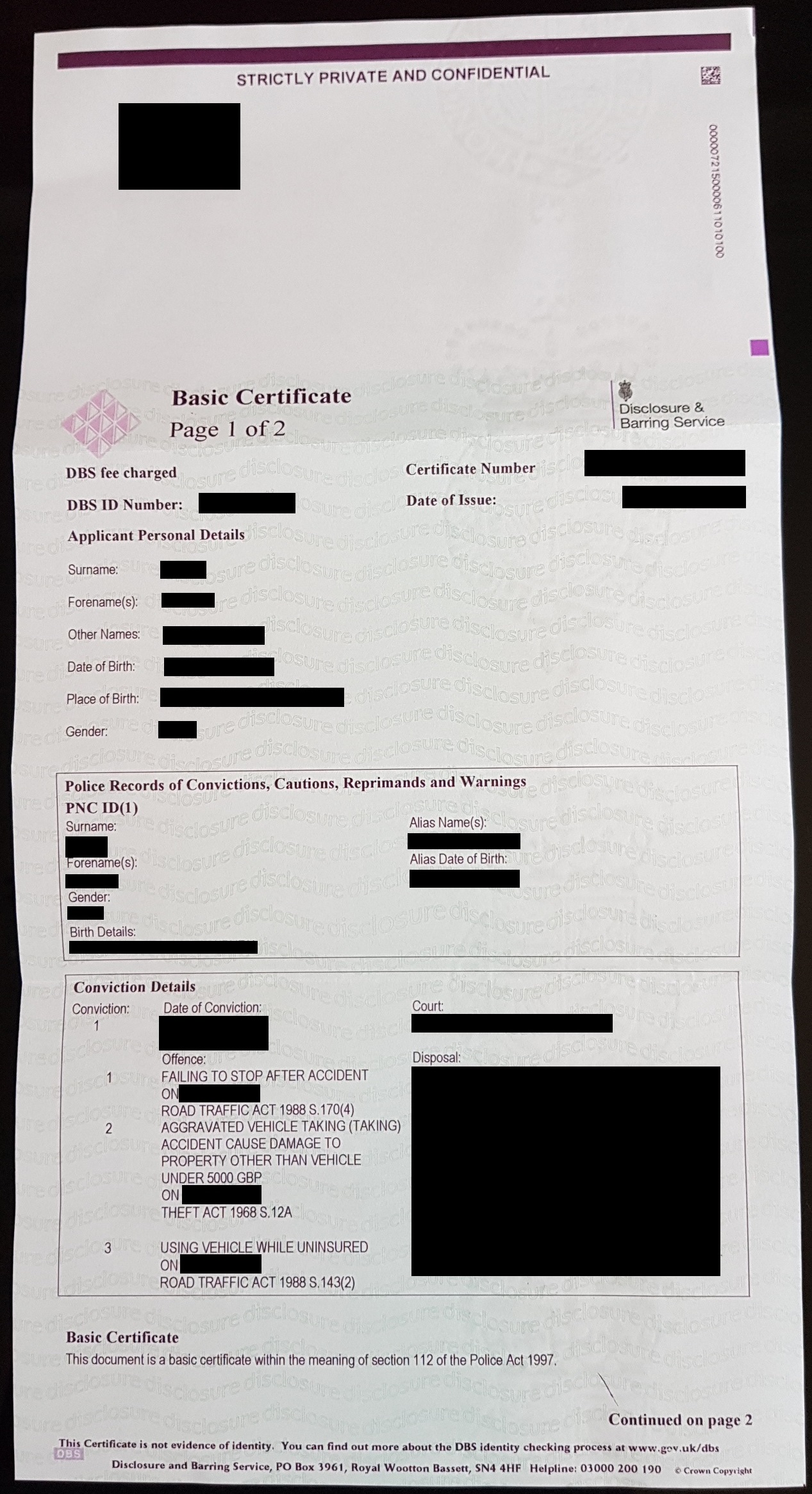
For each conviction it includes the date of conviction, the court, the offence committed, the date of offence and the sentence/disposal.
Note – The details surrounding the sentence/disposal can sometimes come as a surprise, as many people don’t realise exactly what formed part of the ‘sentence’ that they received, such as certain disqualifications, fines or prohibitions.
There is more detail about how certain sentences, disposals and other penalties are treated on basic DBS disclosures further down this page.
The example below shows what a basic DBS disclosure looks like when revealing unspent convictions.
How to apply
There are two ways of applying for a basic DBS check:
Your identity will be verified either by GOV.UK Verify or by the Post Office.
You provide all the information online.
It does not have the option to give a 3rd party consent to view the check.
It does not provide eResults to any intermediary or employer (as you have applied directly).
You can choose to have your paper certificate sent to a 3rd party.
You can apply for a basic check through an organisation that is registered with the DBS. Referred to by the DBS as a “Responsible Organisation (RO), an employer or other intermediary could be registered with the DBS. These are allowed to submit applications for basic checks via a DBS web service. The DBS has guidance on the organisation that can be used.
Key points:
The cost will vary – it will cost £21.50 plus whatever extra cost is charged by the intermediary. This might be covered by the employer.
An employer will need to be registered with the DBS themselves, or use an intermediary that is registered, to get a basic DBS check through this route.
Only one paper check is issued – if the applicant consents, the paper check can be sent to an alternative address, such as the employer’s address.
There will be an eResult sent to the registered organisation.
The check will be available online – known as an eCertificate.
The registered organisation will:
Be responsible for collecting the information about you and verifying your identity.
Be able to check the status online.
Be able to request an electronic (eResult)
Who can apply for it
You (or somebody on your behalf, with your consent).
Legally it is the individual who applies, although third parties do submit applications on behalf of individuals. Sometimes, employers will ask applicants to put the employer’s address as a ‘care of’ address so that it’s sent straight to whoever is undertaking pre-employment checks and the Disclosure and Barring Service will facilitate this.
£21.50 (Disclosure and Barring Service) £16 (Access NI)
The cost is sometimes covered by the organisation requiring it.
Where it is sent
To you, although you can choose for it to be sent to an employer as part of the application process, though in this situation you won’t receive a copy.
If you’re applying for a job at a new company and it involves a basic DBS disclosure, you might want to be aware that a high proportion of basic applications that employers apply for go via the ‘bulk electronic’ process which is likely to mean that although the disclosure will be addressed to you, it will be sent to the employer’s address. This may result in the employer opening it, particularly if you have given your consent for them to do this. Other employers might simply request that you apply for the disclosure, but put their address down as the ‘care of’ address. This makes it even more important that you make sure that you find out about your criminal record before applying for specific roles.
However, in practice the Disclosure and Barring Service (DBS) will consider a compensation order as paid in full if it:
was for an amount of less than £100; or
is over 6 years old
If your compensation is for either of the above, it means that your basic check will be processed without you having to provide proof of payment of the compensation.
If your compensation order was for more than £100 or is less than six years old, then you’ll need to provide the DBS with proof that it has been paid in full.
If you didn’t get this at the time of paying it, you should be able to get something from the court at a later stage. In England and Wales, you can obtain a letter of confirmation from the court when any compensation order has been paid in full. The DBS have also confirmed that they will accept copies of emails sent to you by the court so long as the email relates specifically to the compensation order and confirms that payment has been made in full. There is guidance in the magistrates’ courts’ staff manual as to the wording to be used by courts in a proof of payment letter relating to compensation orders.
A copy of that letter or email should be provided to the Disclosure and Barring Service either with your application or separately in confidence if your application is being submitted via a third party.
To submit proof of payment independently of submitting an application, you can send it:
By post to DBS Customer Services, PO Box 165, Liverpool L69 3JD
You should quote your application barcode or reference number, or your name, current address, and date of birth in your communication.
Once you’ve submitted proof once, the Disclosure and Barring Service should keep this on file in case you have to apply for a further disclosure in the future.
It’s important to note that if the DBS see that a compensation order is holding a conviction back from being spent, they should write to you asking whether you have any proof of payment.
If you end up receiving your basic check without providing proof and the compensation order is on there, you’ll probably have to make another application, alongside your proof of payment, to have another one issued.
This is something that we are challenging, as we don’t believe that the system of having to provide proof is workable or fair. It’s not particularly clear when you apply for a basic DBS disclosure that you have to provide this proof, and many people don’t even realise they have a compensation order.
Orders for disqualification from working with children under section 38 of the Criminal Justice and Court Services Act 2000 are not treated as ‘sentences’ as such, and so do not impact on whether the conviction appears on the basic DBS disclosure. It’s the ‘sentence’ that is used. So if you received a 3 year prison sentence, and an indefinite/lifetime disqualification, it would be the 3 year sentence that would be used to work out how long the conviction appeared on the basic DBS disclosure.
If the conviction remains unspent, the Disclosure and Barring Service are currently disclosing the fact that somebody is subject to the notification requirements. The length of time subject to these should not be taken into account when deciding whether the conviction is spent, but if it is unspent, it might be disclosed. This is something that we are challenging.
How to correct inaccurate information
For the Disclosure and Barring Service, email customerservices@dbs.gsi.gov.uk or write to the Disclosure and Barring Service, PO Box 165, Liverpool L69 3JD
For Access NI, you should write to the Department of Justice, Block B, Castle Building, Stormont Estate, Belfast, Northern Ireland, BT4 3SG
You have 90 days from the date of issue of a certificate to raise a dispute.
DBS Subject Access Requests
You’re entitled to know if the DBS holds any information about you and if so, to be provided with a copy of that information. This process is referred to as a Subject Access Request.
A suspended prison sentence is decided by the courts – contact the relevant court.
Does it involve guilt?
Yes – the sentence is decided after a guilty verdict.
Is it recorded on the Police National Computer (PNC)?
Yes.
Is it classed as a conviction?
Yes.
How long will it be on my record?
It will remain on the PNC indefinitely and will be used in any future criminal proceedings. If you breach any of the conditions or commit another crime you will usually go to prison to serve the sentence.
When does it become spent? (over 18)
The rehabilitation period is based on the length of the prison sentence, not the length it was suspended for.
When do I have to declare it?
Before it is spent you have to declare it, when asked, by employers and financial institutions. A prison sentence falls under the protection of the Rehabilitation of Offenders Act so after it is spent you don’t have to disclose unless it is for an occupation which is an exception to the Act, like working with children.
Is it disclosed on DBS checks?
The basic disclosure will show only unspent convictions. Standard and enhanced disclosure will disclose a custodial sentence even after it is spent.
What are the implications for life in the community?
A suspended sentence is often coupled with certain requirements such as staying away from certain people or places and doing unpaid ‘community payback’ work, as with the community sentence. During the supervision period these conditions must be met and during the operational period (the period of suspension) any commission of an offence will result in serving the sentence in prison.
This page is designed to bring together information relating to eligibility for standard and enhanced criminal record checks.
Why is this important?
When recruiting new staff, employers don’t always make it clear whether they intend to carry out a criminal record check or what level of check they may be applying for. In addition, some employers may try to apply for a level of check for which a role is not eligible.
If you have a criminal record, the type of check being done may be the most important part of the recruitment process. If an employer is going to do a standard or enhanced check it’s important to know that the role you’re applying for is eligible for this level of check and if it’s not, how to challenge it.
Common roles and level of criminal record check
Basic checks (roles covered by the Rehabilitation of Offenders Act)
We have produced an A-Z of job roles and their eligibility for basic, standard and enhanced checks.
Categories of eligibility for standard and enhanced checks
The types of positions which may be eligible for standard or enhanced checks are contained in the Rehabilitation of Offenders Act 1974 (Exceptions) Order 1975. These can be divided into five broad categories: –
Professions: e.g. medical practitioners, barristers, accountants, vets and opticians
Law & Order: Those employed to uphold the law or involved in the criminal justice system (e.g. judges, constables, prison officers and traffic wardens)
Certain Regulated Occupations: (e.g. firearms dealers, directors of insurance companies, those in charge of nursing homes and taxi drivers)
Health and Social Care: Those who work with children, those whose work is concerned with the provision of care services to vulnerable adults and those whose work is concerned with the provision of health services (e.g. care home worker, social worker)
National Security: Those whose work could put national security at risk (e.g. air traffic controllers and certain employees of the Crown)
Enhanced disclosures
If you’re engaging or planning to engage in regulated activity, it is possible for an employer or voluntary organisation to carry out an enhanced check, including checking whether you’re barred from working with children, adults or both.
It’s important to note that even if a job role now falls outside the revised definition of regulated activity, it may still be entitled to an enhanced Disclosure and Barring Service check. This is because roles which were previously subject to the Rehabilitation of Offenders Act (Exceptions Order) and the Police Act 1997 have not changed.
What is regulated activity?
‘Regulated activity’ is concerned with activities which are seen as placing someone in a vulnerable position, for example through a relationship of trust or dependency. There are different definitions of regulated activity, depending on whether an activity involves children or adults.
Guidance on eligibility
The DBS’s Eligible Positions Guidance provides details on the positions that are eligible for a standard or enhanced check. It is not comprehensive and only gives an indication of the general types of employment that are included in the Exceptions Order.
Alternatively, you can use the DBS eligibility tool to check whether the role you’re applying for would be eligible for a standard or enhanced DBS check.
Establishing eligibility
It’s not always clear what type of check a particular role is eligible for. We have produced a process that helps individuals establish the eligibility of particular roles, which runs alongside the guidance above – this is referred to as our establishing eligibility process.
Challenging eligibility
If you think an employer or organisation is carrying out a criminal record check that the position isn’t eligible for, you can challenge it.
Why does it matter?
For people with a criminal record
Any employer can do a basic check. However, only certain roles are eligible for higher levels of checks.
An employer undertaking the wrong level of check can have a huge impact. For example: –
If your criminal record is spent, it would not be disclosed on a basic certificate but would be disclosed on a standard or enhanced certificate.
If the police hold information about you locally, this wouldn’t be revealed by a basic or a standard certificate, but may be disclosed on an enhanced check.
Once a criminal record check is carried out and your employer has the relevant information, it is very difficult to stop them from applying the information to a recruitment or dismissal decision.
For employers and registered bodies
Registered Bodies (RBs) are required to comply with the DBS Conditions of Registration. This states that they must use all reasonable endeavours to ensure that each individual application submitted is eligible for the level of check requested.
The DBS service is underpinned by law. When an RB signs the declaration on the application form, they are confirming that the position is eligible for a check. It is a criminal offence to knowingly submit an application which is not eligible, and this covers employers who use Umbrella Bodies to submit applications on their behalf.
Discuss this with others
Read and share your experiences on our online forum.
Below you will find links to useful websites relating to this page. More specific details (including addresses and telephone numbers) of some of the organisations listed below can be found here.
Disclosure and Barring Service – Government body responsible for providing basic, standard and enhanced criminal record checks
Standard checks (officially known as Standard Criminal Record Certificates) are a type of criminal record check that can be used by employers when recruiting staff for jobs which are included in the Rehabilitation of Offenders Act 1974 (Exceptions) Order 1975.
They are issued by the Disclosure and Barring Service (DBS) using information from the Police National Computer (PNC).
What are they used for?
Employers recruiting for certain positions which are included in the Rehabilitation of Offenders Act 1974 (Exceptions) Order 1975 can request standard checks. This includes for example, people wanting to be approved by the Security Industry Authority or anybody applying to become a solicitor or barrister. We have more information on the eligibility for standard and enhanced checks.
What information does it contain?
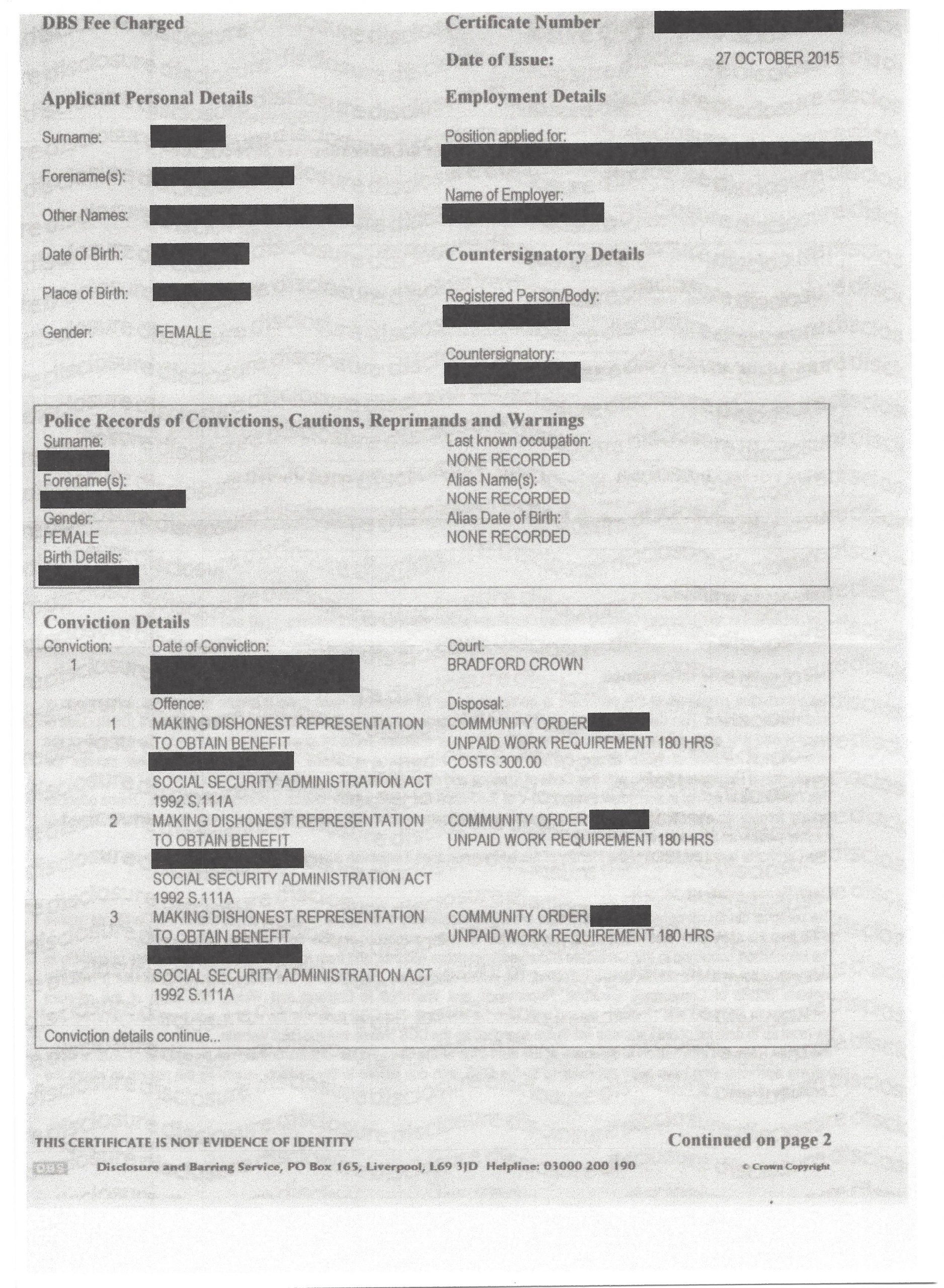
A standard certificate will include both spent and unspent convictions[1], held on the PNC which are not eligible for filtering. For each conviction, it will include:
the date of conviction
details of the court where you appeared
details of the offence committed
the date of offence
the sentence/disposal given.
How standard checks are applied for
It is not possible to apply for a standard check on yourself.
An employer can only request a standard check if the role applied for is eligible. If the employer carries out less than 100 checks per year, they will use a registered body (acting as an umbrella body) to apply for the check on their behalf. An employer will need your consent before they can apply for a standard check.
Applications can be made by post or online.
Online applications
The majority of registered bodies sign up to the DBS e-bulk service which allows them to submit applications and receive the results electronically. This generally reduces the time it takes for the check to be processed.
Once the check has been processed, the DBS will immediately send a notification to the registered body.
Where the DBS certificate contains information the registered body will receive an electronic notification to “await the paper certificate”.
Where all fields on the DBS certificate are blank, the registered body will receive an electronic notification which will state “Certificate contains no information”.
The DBS will send the certificate directly to you.
What’s the cost?
The cost of the check is £21.50 (free to volunteers), although there is often a charge by an umbrella body to undertake the check on behalf of an employer, if the employer is not a registered body.
How long does it take?
Approximately 10 working days
Where will it be sent?
The certificate will usually be sent to you unless you have signed a waiver, requesting it to be sent to your employer.
An anonymous example of a standard certificate
What can you do if the certificate contains incorrect or inaccurate information?
If your certificate contains inaccurate personal information, for example your name, date of birth or address, you will need to raise a data entry dispute with the DBS. Further details can be found on the DBS website.
However, if your conviction details are incorrect or inaccurate, you will need to raise a data source dispute. This can be done online (you complete the form electronically, print it out and then submit it by post). Alternatively, you can request a dispute form by post by ringing the DBS on 03000 200 190.
DBS Subject Access Requests
You’re entitled to know if the DBS holds any information about you and if so, to be provided with a copy of that information. This process is referred to as a Subject Access Request.
Notes
[1] Use of the word ‘convictions’ in this case refers to convictions, cautions, warnings and final reprimands. It does not include fixed penalty notices, penalty notices for disorder, or any other police or other out-of-court disposal.
Almost every criminal case in England and Wales begins in a Magistrates Court – and around 95% of all cases will be decided there. Therefore, the role of a magistrate is an important one.
The aim of this page is to set out the criteria for becoming a magistrate and how your criminal record may affect your chances of success.
Why is this important?
Whilst people with convictions are not automatically barred from becoming a magistrate, there are few guidelines available which give any indication as to whether you would be able to.
Recently the Chair of the Magistrates’ Association said that “it was completely erroneous” that those with old and minor criminal records would not be considered as candidates. He urged people with a criminal record to apply but it’s important to have an understanding of the recruitment process.
What does it take to become a magistrate?
On a daily basis, magistrates make decisions that will shape the lives of individuals for years to come, and for the vast majority of those accused of a crime, the Magistrates Court will be their only sight of the criminal justice system.
Magistrates receive training to perform their role and no prior legal knowledge is assumed or required of them. It’s not necessary for them to take any formal examinations. They will require some ‘personal qualities’ including an awareness of social issues, maturity and reliability.
Crucially, magistrates are volunteers who work part-time, often around other full-time work commitments. Each year, magistrates must be in court for at least 13 full days (or 26 half-days) and although this can put a lot of people off, your employer does have a legal obligation (under the Employment Rights Act 1996) to permit you to take time off for magistrate duties. Rotas are provided in advance, so it shouldn’t be difficult to negotiate time off with your employer. Many will agree to pay you whilst you’re performing your magistrate duties but, if they choose not to, then a basic loss of earnings allowance may be available to you.
Training in the first year can be intense, but after this only one or two days a year will be required for your further development.
There must be nothing in a magistrate’s past which could cast doubt on their credibility and standing in the eyes of the public. While a criminal offence or civil order in the past will not necessarily disqualify you for appointment, the Senior Presiding Judge will not appoint anyone in whom the public would be unlikely to have confidence.”
The ‘good character’ question, which all applicants must answer on their application form and at interview asks:
Is there anything in your private or working life, past or present, or the lives of your family or friends, which could damage your credibility as a magistrate if it became known to the public?”
Being subject to current proceedings or investigations
You must declare:
If you are currently subject to investigation by the police
If you are currently involved in any form of civil or criminal court proceedings, including as a witness (this includes divorce proceedings where the custody of children is contested)
If you are currently subject to professional disciplinary proceedings or disciplinary proceedings at work.
You should inform the Advisory Committee immediately if you become subject to any of the above during the selection process.
Cautions and convictions
Anybody applying to become a magistrate is not protected by the Rehabilitation of Offenders Act. This means that all cautions and convictions must be disclosed, however long ago they occurred.
A criminal record is not an automatic bar to appointment and if you are recommended for appointment, the Senior Presiding Judge will give careful consideration to factors such as the nature and seriousness of the offence, and when it occurred. A caution or conviction for an offence which raises questions of honesty and integrity, for example fraud or theft is liable to be taken more seriously.
When disclosing information about a caution or conviction, try to provide as much information as you can. The Advisory Committee will need this to help assess your suitability. If you are recommended for appointment, you will be required to undergo an enhanced Disclosure and Barring Service check before your appointment can be confirmed.
How will the disclosure of a criminal record be dealt with?
Applications which disclose a criminal record will be reviewed on a case-by-case basis and the following factors taken into consideration:
The nature and seriousness of the offence
How long ago it was committed
The disposal or sentence received; and
Any subsequent offences.
The Lord Chancellor and Secretary of State for Justice state that they will not appoint the following to the magistracy:
Anyone who, or whose spouse or partner, has been convicted of a serious offence or a number of minor offences if the Advisory Committee does not think the public would have confidence in them as a magistrate. For these purposes a serious offence is regarded as anything other than a minor motoring conviction for which you received points on your licence and/or a fine.
Anyone who has been convicted of one motoring offence where six penalty points or more were imposed, or three offences where three penalty points were imposed in respect of each offence, in the last five years.
Anyone who has been disqualified from driving for 12 months or more will not be appointed within 10 years from the date of conviction, and then only after careful consideration of the circumstances.
Anyone who has been disqualified from driving for less than 12 months will not be appointed within 5 years from the date of conviction, and then only after careful consideration of the circumstances.
The last three points relate specifically to people with driving convictions. The first point covers all other convictions. As a result, the decision is left solely within the hands of the Advisory Committee.
Cautions and convictions of family members
Guidance from the Ministry of Justice is keen to emphasise that the actions of another person in most cases will not mean that you are disqualified for appointment. However, they will be considered in line with the following:
The nature and seriousness of the offence
Your relationship with the individual, and the extent of your contact with that person
Whether or not you appear to condone the offence; and
Whether the circumstances could undermine your credibility and standing as a magistrate if they became known to the public.
Discuss this with others
Read and share your experiences on our online forum.
Useful links
Below you will find links to useful websites relating to this page. More specific details (including addresses and telephone numbers) of some of the organisations listed below can be found here.
Enhanced checks (officially known as Enhanced Criminal Record Certificates) are a type of criminal record check that can be used by employers when recruiting staff for jobs which are included in the Rehabilitation of Offenders Act 1974 (Exceptions) Order 1975.
They are issued by the Disclosure and Barring Service using information from the Police National Computer (PNC).
What are they used for?
Employers recruiting for certain positions which are included in the Rehabilitation of Offenders Act 1974 (Exceptions) Order 1975, as well as those being “prescribed” in regulations made under s113B, Part V of the Police Act 1997 can request enhanced checks. The majority of these positions will include frequent or intensive contact with children or vulnerable adults, for example teachers, doctors or social workers.
An enhanced certificate will include both spent and unspent convictions[1], held on the PNC which are not eligible for filtering, as well as information as to whether the person is included in a list of people barred from working in regulated activity in relation to children and / or adults (if eligible and requested ).
It is not possible to apply for an enhanced check on yourself.
An employer can only request an enhanced check if the role applied for is eligible. If the employer carries out less than 100 checks per year, they will use a registered body (acting as an umbrella body) to apply for the check on their behalf. An employer will need your consent before they can apply for an enhanced check.
Applications can be made by post or online.
Online applications
The majority of registered bodies sign up to the DBS e-bulk service which allows them to submit applications and receive the results electronically. This generally reduces the time it takes for the check to be processed.
Once processed, the DBS will immediately send a notification to the registered body.
Where the DBS certificate contains information the registered body will receive an electronic notification to “await the paper certificate”.
Where all fields on the DBS certificate are blank, the registered body will receive an electronic notification which will state “Certificate contains no information”.
The DBS will send the certificate directly to you.
What’s the cost?
The cost of the check is £49.50 (free to volunteers) although there is often a charge by an umbrella body to undertake the check on behalf of an employer, if the employer is not a registered body
How long does it take?
Approximately 28 days
However, It can take a lot longer than this, especially if one of the larger police forces (for example the Metropolitan Police) are dealing with disclosure under the ‘relevant information’ section. If the local police force have not provided information to the DBS within 60 days, the DBS can escalate your application.
You can make a request after 60 days to have your application escalated by contacting the DBS on 03000 200 190 or by using their online tracking system.
Where will it be sent?
The certificate will usually be sent to you unless you have signed a waiver, requesting it to be sent to your employer.
An anonymous example of an enhanced certificate
Click on the image above to view the first two pages of an enhanced DBS certificate
Wording at the bottom of an Enhanced Disclosure Certificate
Enhanced Certificate
This document is an Enhanced Criminal Record Certificate within the meaning of section 113B and 116 of the Police Act 1997.
Use of certificate information
The information contained in this certificate is confidential and all recipients must keep it secure and protect it from loss or unauthorised access. This certificate must only be used in accordance with the Disclosure and Barring Service’s (DBS), Code of Practice and any other guidance issued by the DBS. Particular attention must be given to the guidance in the fair use of the information in respect of those whose certificate reveals a conviction or similar information. The DBS will monitor the compliance of Registered Bodies with the Code of Practice and other guidance.
This certificate is issued in accordance with Part V of the Police Act 1997, which creates a number of offences. These offences include forgery or alteration of certificates, obtaining certificates under false pretences, and using a certificate issued to another person as if it was one’s own.
This certificate is not evidence of the identity of the bearer, nor does it establish a person’s entitlement to work in the UK.
Certificate content
The personal details contained in this certificate are those supplied by or on behalf of the person to whom the certificate relates at the time the application was made and that appear to match any conviction or other details linked to that identity.
The information contained in this certificate is derived from police records, and from records held on those who are unsuitable to work with children and/or adults where indicated. The police records are those held on the Police National Computer (PNC), that contains details of Convictions, Cautions, Reprimands and Warnings in England and Wales, and most of the relevant convictions in Scotland and Northern Ireland may also be included. The DBS reserves the right to add new data sources. For the most up to date list of data sources which are searched by the DBS please visit the DBS website.
The other relevant information is disclosed at the discretion of the Chief Police Officers or those of an equivalent level in other policing agencies, who have been approached by the DBS, with due regard to the position sought by the person to whom the certificate relates.
Certificate accuracy
The DBS is not responsible for the accuracy of police records.
If the person to whom this certificate relates is aware of any inaccuracy in the information contained in this certificate, he or she should contact the Countersignatory immediately , in order to prevent an inappropriate decision being made on their suitability. This Countersignatory will advise how to dispute that information, and if requested arrange for it to be referred to the DBS on their behalf.The information should be disputed within 3 months of the date of issue of the certificate.
The DBS will seek to resolve the matter with the source of the record and the person to whom the certificate relates. In some circumstances it may only be possible to resolve a dispute using fingerprints, for which consent of the person to whom the certificate relates will be required.
If the DBS upholds the dispute a new certificate will be issued free of charge. Details of the DBS’s disputes and complaints procedure can be found on the DBS’s website.
What can you do if the certificate contains incorrect or inaccurate information?
If your certificate contains inaccurate personal information, for example your name, date of birth or address, you need to raise a data entry dispute with the DBS.
However, if your conviction details are incorrect or inaccurate, you need to raise a data source dispute. This can be done online (you complete the form electronically, print and submit it by post) or call 03000 200 190 for a form.
DBS Subject Access Request
You’re entitled to know if the DBS holds any information about you and if so, to be provided with a copy of that information. This process is referred to as a Subject Access Request.
Notes
[1] Use of the word ‘convictions’ in this case refers to convictions, cautions, warnings and final reprimands. It does not include fixed penalty notices, penalty notices for disorder, or any other police or other out-of-court disposal.
DBS Adult First allows employers to check applicants against the DBS Adults’ Barred List. Dependant on the result of the check, this service allows an applicant to start work under supervision whilst waiting for their full DBS Certificate.
What it contains
An email will be sent to an employer giving 2 possible outcomes;
‘No match exists for this person on the DBS Adults Barred List’
This means the applicant can start work in a supervised capacity until the full enhanced disclosure is produced.
or
‘Please wait for the DBS Certificate before making a recruitment decision regarding this applicant’
In this case the applicant is not able to start straight away. No details are given at this stage as to why this response has been given, however, it does not necessarily mean that the person is barred. It could mean for example that:
A person with a similar name or date of birth shows a match on the list or
There is some criminal conviction information which would need to be seen by the employer in order for them to make a more informed recruitment decision.
How to apply
The DBS Adult First is part of the Enhanced Disclosure and Barring Service check and cannot be applied for separately. At the stage where the Enhanced DBS application form is sent off for processing, employers can apply for the DBS Adult First on an applicant’s behalf.
Who can apply for it?
The service is exclusive to those positions governed by the Care Quality Commission (CQC), and requests for the check must fulfil strict qualifying criteria and are permissible only where it is necessary to take such action because of a real danger of staffing levels falling below statutory obligations.
The DBS Adult First is a service that can be used in cases where, exceptionally, and in accordance with the terms of the Department of Health guidance, a person is permitted to start work with adults before a DBS Certificate has been obtained. This applies to adult services where DBS Certificates are required by law, such as;
Care homes
Domiciliary care agencies
Adult placement schemes
Cost
£6.00
How long does it take
Approximately 72 hours
Where is it sent
To the employer via email
Other Information
A DBS Adult First check is not appropriate where a person intends to work with both children and adults. Those working with both groups would need to wait for the DBS Certificate to be returned to find out whether a person is barred from working with children. There is no equivalent quick check of the children’s barred list.
Police certificate
Name
Police certificate
Issued by
The National Police Chiefs’ Council Criminal Records Office (often referred to as ACRO)
Use
For individuals that wish to emigrate to a number of countries, including Australia, Belgium, Canada, Cayman Islands, New Zealand, South Africa, and the United States of America.
They are also used to obtain a visa for immigration purposes (e.g. travel to the US for tourism purposes)
What it contains
All convictions, reprimands, warnings and cautions recorded on UK Police systems, although it doesn’t disclose anything that is eligible to be ‘stepped down’. Read more about this below and see the guidelines that set out when things are stepped down.
How to apply
Visit the Police Certificate section of the ACRO website to view the application form and guidance notes.
Who can apply for it
Anyone who has lived in the UK for any length of time, regardless of nationality
The standard service takes up to 20 working days and the premium service takes up to 2 working days, not including dates of receipt or dispatch.
However, if you are due to travel shortly, ACRO suggest that you may want to consider the premium service. However, if you have an arrest/conviction on your record and are using a police certificate to go through an approval process (such as applying for a visa to travel to the US), it is unlikely that, at such short notice, you will be able to complete the other steps in the process.
Where it is sent
It is sent to the applicant at the address requested on the application form
A sample certificate
Click the image above to increase the size.
How to correct inaccurate information
If you feel the information is inaccurate, you will need to contact your local Police Force outlining the inaccurate information. Each Chief Police Officer is the Data Controller for their PNC record, and has the ability to delete information. There is an exceptional case procedure, but this is normally confined to deleting local police information.
My police certificate doesn’t contain some details that it should / I’ve got a ‘No Live Trace’; what should I do?
If you have been arrested and/or convicted in the UK and your Police Certificate states “No Trace” or “No Live Trace” (or does not list in full your arrests/convictions), you might still be required to provide details (e.g. when applying for a visa). You may want to apply to the individual court to obtain a record of all convictions and any charges pending.
‘No Trace’ means that you have no convictions, reprimands, final warnings or cautions held on the Police National Computer.
‘No Live Trace’ means that there is criminal record information held on the Police National Computer but it has been ‘stepped down‘. Anyone who sees this and understands this phrase can assume that you have a criminal record from the past, even if they can’t see the details. If this applies to you, we advise that you contact ACRO to obtain details of the conviction information that was not disclosed on your Certificate. If you have requested a Police Certificate for travel purposes, many Embassies will require this detail in order to make a decision on whether or not they should issue you with a visa. Once you receive the undisclosed information from ACRO you will be required to contact the relevant Embassy and disclose your previous conviction/s.
Once the Embassy has this information they will contact ACRO to verify that the conviction details you have provided them with are correct. They will do this in the form of an email quoting what details you have provided and asking ACRO to confirm whether it is correct or not. ACRO can only confirm or deny what has been related by the Embassy. If the information you have provided isn’t correct, the Embassy will ask you to contact ACRO again in order to go through your conviction details so they can be re-submitted to the relevant Embassy.
The Embassies use this process to gauge honesty and integrity and whether you have presented yourself as someone of general good character.
Can I get “No Live Trace” changed to “No Trace”?
Probably not. As mentioned in the question above, people with “No Live Trace” can be concerned that others will know that this means they have a criminal records.
The step-down process is not set out in legislation – so ACRO do not legally have to operate it. For police certificates, the alternative would be a certificate that contained all convictions and cautions. Unfortunately, we think that any challenge to the fact that “No Live Trace” suggests there is a criminal record on file is unlikely to be successful.
Other information
Applications for other countries may be accepted subject to confirmation by the applicant of acceptance by the relevant Embassy, High Commission or requiring organisation
ACRO are currently piloting this initiative, which provides police certificates for visa purposes. This police certificate is issued solely for immigration purposes and shows details of arrests and convictions. It covers the whole of the United Kingdom and is sent to the address provided at the time of the application. It is different to a Subject Access Request(SAR), which can be used to find out any details held on the Police National Computer, including allegations
More information about Police Certificates is available here
ACRO still apply the principles of the step-down process when processing Police Certificates. More information on step-down is available here
We want to make sure that our website is as helpful as possible.
Letting us know if you easily found what you were looking for or not enables us to continue to improve our service for you and others.
Was it easy to find what you were looking for?
Thank you for your feedback.
12.5 million people have criminal records in the UK. We need your help to help them.
We use cookies where necessary to allow us to understand how people interact with our website and content, so that we can continue to improve our service.
We only ever receive anonymous information, and cannot track you across other websites. Find out more
More Options
Can you pay it forward?
If you found this page helpful, could you donate just £1 to help someone else access our information and support?