Category: News & Media

Coalition must stop minor criminal records ‘forcing people onto benefits’

  • Wipetheslateclean campaign launched by former PCC candidate forced to step down due to conviction
  • New European Court ruling could mean a change for UK criminal record disclosure

Unlock, a charity set up by people with convictions, is calling for changes to how the UK treats criminal record information.

As the polls open for the new Police and Crime Commissioners, the charity is backing a campaign led by former candidate Bob Ashford, who was forced to stand down due to having received a fine of £2 and 10 Shillings as a 13 year old in 1966.

The ‘wipe the slate clean’ campaign aims to highlight how criminal records blight entire lives. It asks whether every criminal conviction should be, in effect, a life sentence. It is also seeking a specific change in the PCC legislation so that candidates have to meet the same criminal records standards as MPs.

Bob Ashford said, “Young people and adults who have committed offences should not be damaged throughout their lives by a criminal record. Having accepted responsibility for their actions, they should be allowed to fulfil their potential and play a full and productive part in society. It’s a social and economic tragedy that we spend billions each year on criminal justice but then prevent people who turn their lives around from working and paying taxes.”

The campaign is launched as the European Court of Human Rights condemned the lack of scope for discretion in the UK’s criminal records disclosure system.

Government figures obtained by Unlock show the scale of the issue. There are now 9.2 million in the UK with criminal records on the Police National Computer, with one in three men having a criminal conviction by the age of 53. 26% of the 4.9 million open claims for benefit are made by people who have gained a conviction in the last 10 years.

Chris Bath, Unlock’s executive director said, “Under the current system, even the most minor childhood convictions are kept on record until a person’s 100th birthday. They will always be disclosed on a CRB (Criminal Records Bureau) check. Evidence from our helpline for people with convictions shows that this is forcing people onto benefits. A change would benefit the tax-payer by reducing crime, increasing tax take and reducing benefits claims.”

Changes to the Rehabilitation of Offenders Act 1974,will come into force in Spring 2013. These will reduce the periods that many people have to disclose their convictions for some jobs. However, jobs for which a CRB check is conducted will continue to bypass this legislation.

-END-

Media enquiries – Click here

unlock.devchd.com
www.wipetheslateclean.org.uk

Travelling to the UK, and should reformed offenders be given a second chance?

The news that prospective Coventry Blaze ice hockey team player Mike Denton has been refused a visa to enter the country because of his criminal conviction, sparks the debate of whether reformed offenders should be given a second chance.

We contribute to a discussion on BBC Coventry and Warwickshire. You can listen to the interview below.

Prisoners launch High Court challenge to keep more of their wages

Prisoners who take jobs outside jail have launched a High Court challenge to keep a great share of their wages, claiming too much goes to victim support.

We’re featured in the article as we’re supporting the case. Read the article here.

Money for nothing? Unspent convictions and insurance

We’ve taken part in a Radio 4 discussion about insurance and convictions. The piece can be listened to below. There is also a link to more information about the piece here.

Police checks on potential council tenants

We’ve taken part in a radio discussion on BBC West Midlands to discuss a local council with a proposed policy of carrying out police checks on potential council tenants. This is available to listen to below (in two parts)

Reformed offenders’ charity wins Guardian Charity Award

Unlock has today won the Guardian Charity Award for its work tackling the economic and social exclusion of reformed offenders. The charity was selected as one of five winners from almost 1,000 entries, the largest number ever received in the history of the awards.

The charity focuses on the ongoing discrimination which can prevent reformed offenders from contributing positively to society throughout their entire lives. unlock.devchd.com has become the leading source of information for law-abiding people with a criminal record, attracting 130,000 unique visitors a year.

The charity employs only five staff but works with volunteers to develop and deliver innovative projects, products and services, as well as campaigning for legal changes that would allow many reformed offenders to get off benefits and into employment.

The judges said Unlock was a “brilliant, very positive story” that was “tackling controversial issues”, “offering the long-term support needed” and that its use of online and media “shows huge potential”.

The charity will receive £6,000 prize money, one year free membership to NCVO, a tailored package from the FSI that includes mentoring, expert advice and training and a media package, including support from their community of journalists, from Media Trust.

-END-

Notes to editors

1. The awards highlight the work of UK based, small to medium sized charities that focus on social welfare and have been operating for two or more years with an annual income of between £5,000 and £1.5million.

2. The judging panel included: David Brindle, The Guardian (chair); Jane Asher, president of the National Autistic Society; Lynne Berry OBE, associate of Civil Exchange, Caroline Diehl, chief executive of Media Trust; Sir Stuart Etherington, chief executive of National Council for Voluntary Organisations (NCVO); Emma Harrison, chairman of trustees, the Foundation for Social Improvement; Baroness Howarth OBE, and Dame Suzi Leather, chair, Charity Commission.

3. The judges made the following comments: –
Baroness Howarth: “Brilliant, very positive story”
Jane Asher: “Remarkable and inspiring story of the chief executive turning their life around”
Pauline Broomhead: “Offering the long-term support needed after prison”
Caroline Diehl: “Use of online and media is great – shows huge potential”
Judges agreed that it is a positive story tackling controversial issues.

We win Guardian Charity Awards 2011

We are proud to announce that we have been chosen as a winner at the Guardian Charity Awards 2011 


Charity Awards - UNLOCK 1

Pictured (from left to right): Jane Asher (President, Arthritis Care, Parkinson’s UK and the National Autistic Society); Christopher Stacey, Julie Harmsworth and Chris Bath from Unlock; and Jonathan Pryce (Actor and Patron of Friendship Works). 

“Remarkable and inspiring story of the chief executive turning their life around” – Jane Asher

“Brilliant, very positive story”  – Baroness Howarth

“Offering the long-term support needed after prison” – Pauline Broomhead

“Use of online and media is great – shows huge potential” – Caroline Diehl MBE

“A positive story tackling controversial issues” – Judges summary

Find out more about the judges and the awards.


The video below was filmed as part of the Guardian Charity Award


Paying twice for crime – insurance and convictions

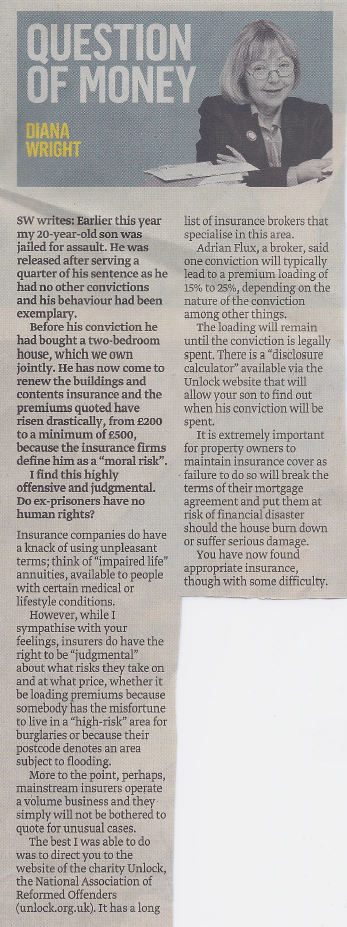
The Sunday Times have featured in their Money section a letter from somebody whose son is experiencing difficulties getting insurance. We spoke with the journalist last week, and provided her with some advice, which led to the person eventually finding some cover, and we’re featured in the published response (see below).

payingtwice

Prisoners to get Halifax bank accounts as they prepare for release

We’re featured in an article in the Mail on Sunday, which covers some recent work we’ve done with Halifax bank to extend the number of prisons that they open basic bank accounts for. The article is available to read here.

Sins of Omission – Ex-offenders get help on knowing when to own up to insurers

The Observer picked up on our launch of the Disclosure Calculator and featured this as an article, looking at how it will help people when applying for insurance. You can read the article below.

sinsofommission

We want to make sure that our website is as helpful as possible.

Letting us know if you easily found what you were looking for or not enables us to continue to improve our service for you and others.

Was it easy to find what you were looking for?

Thank you for your feedback.

12.5 million people have criminal records in the UK. We need your help to help them.

Help support us now