Category: Latest

Comment on article in The Independent – “We should encourage more employers to do the same”

The leading charity for people with convictions has defended a Tower Hamlets school employing a convicted killer and called on more employers to hire ex criminals who have become positive members of society. In response to an article in The Independent and on BBC News, Christopher Stacey, Co-director of Unlock, said:

“We speak to people with criminal convictions every day who are struggling to find work many years after they have served their sentence. With over a quarter of people out-of-work having received a criminal record in the last 10 years, it’s in society’s interest to enable people who have offended in the past to become contributors to society rather than burdens on the state.


“With over 10.5 million people in the UK with a criminal record, we need to encourage employers to treat every applicant on a case-by-case basis and not have blanket exclusions towards people with criminal records. That’s why campaigns like Ban the Box, and the recent commitment by David Cameron to apply this approach to the civil service, are so important in changing the attitudes of employers towards people with a criminal record.


“People who have committed crime cannot change the past, but they can focus on what they do in the future. Ian Devlin looks to have done everything he can since he was released from prison to become an active, positive member of society. The school clearly recognised this in their recruitment process. We should encourage more employers to do the same.”


– Ends –


Notes to editors

  1. Press/media
  2. Unlock is an independent, award-winning charity for people with convictions which exists for two simple reasons. Firstly, Unlock assists people to move on positively with their lives by empowering them with information, advice and support to overcome the stigma of their previous convictions. Secondly, Unlock seeks to promote a fairer and more inclusive society by challenging discriminatory practices and promoting socially just alternatives.
  3. There are over 10.5 million people in the UK that have a criminal record.
  4. Unlock’s website is unlock.devchd.com.

Insurers are not following good practice when dealing with criminal records

Last month, the Financial Conduct Authority published an occasional paper on access to financial services. I fed into this work, particularly focusing on the issues people with convictions face in accessing insurance. So it was good to see the authors include an especially challenging section of the report focused at a lack of buy-in to industry guidance.

There was heavy reference to the work that Unlock has done with the Association of British Insurers (ABI), including developing good practice, but highlighted how:

“it is still commonplace for proposal forms to have questions such as “have you ever been convicted””

The ABI guidance states that it is good practice to refer only to ‘unspent’ convictions, so clearly insurers are not doing this.

guidance
Extract from the FCA occasional paper

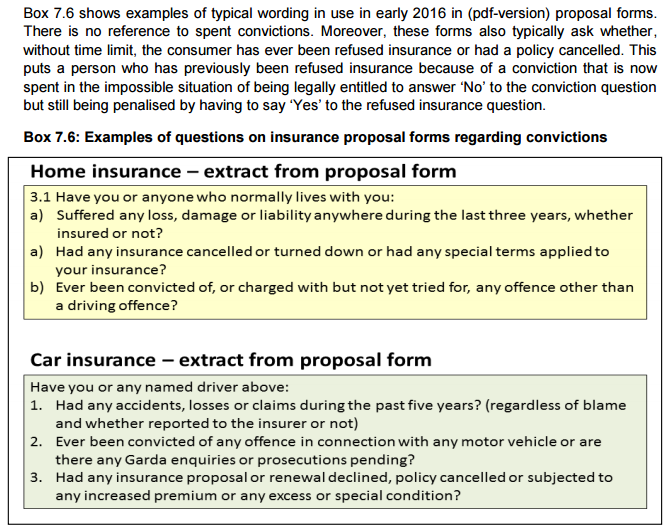
Although it didn’t name the companies involved, the FCA paper included two anonymous examples of current questions by home insurers and motor insurers.

question
Extract from the FCA occasional paper

The poor wording of questions by insurers is a major problem. Unlock’s helpline regularly gets contacted by people using insurance websites and asking us for clarity about what they do and don’t need to disclose. Very often, this is because the insurance company hasn’t made it clear that they don’t need to disclose convictions that are now spent under the Rehabilitation of Offenders Act 1974.

This is something we’re looking at. We’ve had one our helpline advisors do some research into the questions asked by insurers, and we’re in the process of pulling this together and analysing the findings.

As an aside, it was good to see a number of other issues featured in the occasional paper, including:

  1. The numbers of people affected – In the infographic that the FCA used, they said that 750,000 people with unspent convictions and their families can struggle. This comes from a figure we presented a couple of years ago, and this is a conservative estimate of the numbers with unspent convictions. Although this figure is an underestimate for another reason – it doesn’t include those that are potentially covered by some of the misleading questions that insurers ask (see below). When this is taken into account, the numbers affected by the practice of insurers runs into the millions, given there’s over 10.5 million people in the UK with a criminal record.
  2. The lack of insurance products for people with unspent convictions
  3. How people with convictions can be good customers

More information

  1. You can find out more about the FCA occasional paper.
  2. There are details of our policy work on fair access to insurance and dealing with misleading questions.
  3. For practical self-help information on insurance, visit the information section on our website.
  4. There is practical guidance for insurers

Help us to scrap ‘disqualification by association’: The government are consulting on changes to the childcare disqualification arrangements

Ever since ‘disqualification by association’ (DbA) hit the headlines about 18 months ago, we have been working to try and scrap the regulations that have had a significant and unnecessary impact on the partners of those with a criminal record.

Earlier this month, the Department for Education (DfE) published a consultation with proposals for change. The deadline for responses to the consultation is 1st July 2016.

Find out more about the consultation, details of what we’re doing and how you can help on our information site.

Unlock submits evidence to review of Youth Justice

Today we have published our submission to the review of youth justice.

Our submission focuses on criminal records, disclosure and young people.

Background

  1. In September 2015, Michael Gove announced a review of the youth justice system.
  2. In February 2016, Charlie Taylor, who’s leading the review, published his interim report.
  3. In response to his particular interest in criminal records, Unlock has submitted evidence to the review.
  4. Download: Review of Youth Justice – Unlock submission

An independent evaluation of our helpline

Today, we’re delighted to publish Unlocking the helpline, an independent analysis and evaluation of our confidential peer-run helpline carried out by Professor Sue Wilkinson of the University of York.

Ever since Unlock started as a charity over 15 years ago, we’ve provided peer advice to people with convictions. Eight years ago we employed our first dedicated member of staff to run our helpline and for over 7 years we’ve been recruiting volunteers from the community in Kent (including from nearby open prisons).

Although a lot has changed in that time, one thing has remained the same – people with convictions continue to come to us looking for information, advice and support to try and deal with the stigma and discrimination they’re facing because of their criminal record.

We speak to thousands of people every year – people facing a wide-range of issues relating to their criminal records. Finding a job, getting insurance, renting a house and going abroad on holiday, to name but a few.

However, as an independent service that’s charitably funded and reliant on trusts, foundations and donations to continue operating, it’s important that we can show that what we’re doing is making a difference and that it deserves support. As is the case with many helplines, it’s hard to show the impact it has on the people that contact us.

So we set about trying to find out more. It wasn’t really about numbers. We know how many people we speak to. We have a good idea of who they are, where they come from and what problems they’re having. What we didn’t know was answers to questions like:

  1. How useful is our helpline?
  2. How helpful is it that it’s peer run (i.e. run by people with convictions)
  3. What works well?
  4. Where could we improve?

That’s why a couple of years ago we embarked on undertaking an independent evaluation of our helpline with the support of Professor Sue Wilkinson of the University of York; she’s an expert in conversational analysis. We worked hard to make sure that the system we set up would enable a robust evaluation to take place without getting in the way of the confidentiality we attach to the helpline.

Over the space of five months, two of our helpline advisors recorded over 200 calls (with the callers’ permission). We then handed over the recordings to Sue and her team and waited for the results.What you can read below is a summary of the report and its key findings. You can also download the full report, which has been independently written by the author, Sue Wilkinson.

We are delighted with the findings in Unlocking the helpline – with this report we have strong, indepedent evidence to show how our helpline works and how it operates. It shows the value of having people with personal experience, the benefit of having a supportive voice at the end of the phone and the importance of knowing you’re speaking to somebody who knows what they’re talking about.

We hope that this report will support our efforts in continuing the run our helpline in a way that is independent, confidential, high-quality, peer run and reliable.

Some of the findings and comments in the report that stood out to me were:

“Overall, the helpline appears extremely effective as a source of information, and it is clearly also providing callers with a significant amount of non-informational support.”


“The Unlock helpline is relatively unusual in that the call-takers do not strive for neutrality: rather, one of its ‘hallmarks’ is the degree of understanding and empathy that is displayed by the call-takers, as part of the process of providing non-informational help and support for callers.”


“Call-takers promote positive thinking and discourage negative thinking.”


“Offering reassurance and boosting confidence fit well with Unlock’s aim of empowerment of people with convictions.”


“Call-takers clearly draw on their personal and professional experience”

We are grateful to Professor Sue Wilkinson of the University of York and her team for all their hard work on this report. We hope you find the report an interesting read.


Useful links

  1. Find out more about the evaluation here
  2. You can download the full evaluation here
  3. More details about the helpline that Unlock runs can be found here
  4. If you’re interested in supporting our helpline, you can donate to us here or visit the ‘get involved’ section of our website.

Unlock welcomes figures showing police are removing people from the sex offenders register


Unlock has today welcomed figures obtained by the BBC that show police forces deciding to remove individuals from the sex offenders register.

Christopher Stacey, Co-Director of Unlock, said:

“Back in 2012 we welcomed the Governments introduction of the review process. It allows people subject to lifetime registration on the sex offenders register the right to apply to have their name removed after 15 years, meaning they are no longer monitored by the police.


“The figures published today show that the police are clearly putting this review process into action. There are safeguards in place to ensure that the police only agree to remove somebody from the register where that person can demonstrate that their risk has been minimised to a degree that it is no longer necessary for them to be on there.


“At a time a reducing resources, it is important that the police are able to effectively target them towards those people who pose a genuine risk. The review process enables the police to exercise their professional judgement to remove from the register those who have turned their life around in the 15 years since they were convicted.”


– ENDS –


Notes to editors

  1. Unlock is an independent, award-winning charity for people with convictions which exists for two simple reasons. Firstly, Unlock assists people to move on positively with their lives by empowering them with information, advice and support to overcome the stigma of their previous convictions. Secondly, Unlock seeks to promote a fairer and more inclusive society by challenging discriminatory practices and promoting socially just alternatives.
  2. There are over 10.5 million people in the UK that have a criminal record.
  3. Unlock’s website is unlock.devchd.com.
  4. Details about the review process are available on Unlock’s information site.


Got a criminal record? Ever had difficulties finding employment?


If so, we want to hear from you – find out more here!

The Centre for Entrepreneurs and Unlock are working together to better understand the role of entrepreneurship in supporting people with criminal records. We know that finding employment with a criminal record can be a struggle, and we are interested in exploring whether starting a business is a viable alternative.

Find out more here

The way insurers lock out people with court convictions is bizarre


Mainstream home and car insurers have a blanket ban on people with unspent convictions – these kinds of policies are unfair and sometimes illegal

To many of the 1.2 million people convicted in court each year, it comes as a surprise to find that if they try to take out home insurance, or renew their existing policy, they’ll probably struggle. Every mainstream home insurer has a blanket ban on people with unspent convictions.

They say that ex-offenders are higher risk, citing vigilantism, arson and potential reoffending as some of the justifications. Many motor insurers do the same. Put simply, insurers use unspent convictions as a proxy for risk.

But research shows that those with a stable job, home and lifestyle are much less likely to reoffend. They become contributors to the system, rather than a burden. If we want people with convictions to be integrated into society, we have deal with the obstacles that stand in their way. If we would rather exclude them and treat them differently, we should not be surprised if stubbornly high reoffending rates continue to plague our failing criminal justice system.

Dubious practices
Insurers have the right to make risk judgments – they regularly load premiums for those living in high-crime areas – but their approach to criminal records is bizarre for an industry based on assessing risk. They place significant emphasis on whether a conviction is still unspent, which is determined by the Rehabilitation of Offenders Act 1974.

We must learn to allow people to move on with their lives once they have paid their debt to society

This affects a lot of people. If you’re convicted of an offence and receive a fine, your conviction remains unspent for a year. And if you’re sentenced to four years or more in prison – as 7,000 people a year in the UK are – your conviction will never be spent.

Insurers are not legally allowed to consider spent convictions when they give you a quote. But it’s an arbitrary line: when it’s unspent, they refuse to quote; once it’s spent, they are not allowed to know.

Yet many insurers fail to make it clear that people don’t need to disclose spent convictions. Hidden away in Churchill’s online assumptions for home insurance, it states that you must “have never been convicted of any criminal offence (other than motoring convictions)”. This statement potentially covers the 10.5 million people in the UK that have a criminal record (excluding motoring offences). At best, this is bad practice. At worst, it’s unlawful – insurers have a legal duty to follow data protection and disclosure legislation. People with spent convictions have a legal right to access the same insurance as anybody else and insurers need to be clear with their customers about this.

Ending discrimination
This problem is not new. Nearly 12 years ago, the Guardian’s prisons correspondent Eric Allison wrote about insurance companies denying cover to ex-offenders. In research carried out by Unlock in 2010, 86% of former prisoners said it was harder to get insurance and four-fifths said that when they did get it, they were charged more. This prevents people from getting a mortgage, driving vehicles, securing employment and starting up small businesses.

Things have improved. Unlock runs an online disclosure calculator to help people work out if their convictions are still unspent. If they are unspent, it’s not impossible to get insurance – there are specialist brokers – but little competition can mean increased prices.

Critically, we have never seen any robust evidence for the claim that correlates criminal records and higher risk. Quite the opposite. The specialist brokers that work quietly behind the scenes have some of the best claims ratios of all of their customers.

Mainstream insurers must stop this discrimination. Not only would it demonstrate corporate social responsibility, but there is a strong business case for entering a market that has higher premiums and low claims ratios. They could be developing more progressive, data-driven, risk-pricing models. The Financial Conduct Authority should regard this as a market failure and raise access issues that come as a result of insurers not doing proper risk-profiling.

Ultimately, we must learn to allow people to move on with their lives once they have paid their debt to society.

More information

We want to make sure that our website is as helpful as possible.

Letting us know if you easily found what you were looking for or not enables us to continue to improve our service for you and others.

Was it easy to find what you were looking for?

Thank you for your feedback.

12.5 million people have criminal records in the UK. We need your help to help them.

Help support us now