Category: For specific groups

Blog – Join the #FairChecks movement to help get a fresh start for the criminal records system

In the 1960s, when Richard was 16, he was found in possession of a small amount of cannabis. He was prosecuted for possession and given a one-year conditional discharge. As a student a few years later, Richard got into trouble again and was convicted of taking an item of food from a warehouse where he worked stacking shelves. He was given a one-year conditional discharge and put the mistake behind him.

After fifty years of good behaviour, a productive career and many positions of responsibility, Richard believed his record was clear. He was approaching seventy when his son wanted to join a choir and as a dad, Richard needed an enhanced DBS check. He suddenly discovered that the police were still listing his youthful mistakes as criminal convictions. Richard feels he is being punished for things that happened decades ago.

When you look at this record, it looks dreadful. But I was never really the drug taking thief that it suggests – I was a young person who made a couple of silly mistakes. But it’s harder than you would ever believe to correct the impression this record creates, even though no-one apart from me knows or should care about what happened over forty years ago.”

Because of this “new” old record, Richard had to go through the shame and embarrassment of disclosing a criminal record that was older than some of the panel considering his case. He feels unable to apply for third sector work he would like to do. He believes he is being prevented from contributing to society in a way the justice system never intended.

“I thought that conditional discharges were invented to help people get back on track – but since the invention of the CRB/DBS, people like me are shackled with old records they cannot get deleted. This creates a problem that never goes away. We have lost faith in the capacity of people to learn from their mistakes and to change for the better.”

Around one in six people in England & Wales have a criminal record. Whether it resulted in a prison sentence or a fine, a criminal record can be disclosed on a standard or enhanced criminal record check for the rest of their life. Even a minor criminal history produces lifelong barriers that can block reintegration and participation in society. The vast majority of people won’t have been to prison, and many don’t even realise they still have a criminal record until they apply for a new job or volunteer role that involves a standard or enhanced criminal record check.

People like Richard must declare their convictions if they want to be a traffic warden or taxi driver aged 50.  A person can change quickly, particularly when they are young, but their criminal record remains.

Our current criminal records disclosure regime prevents people from achieving their full potential. It can be particularly crippling for employment, with 75% of employers discriminating against applicants because of a criminal record, and 50% of employers saying they would not recruit offenders or ex-offenders. The stigma attached means that if a conviction or caution is revealed, people often don’t get the chance to explain how they have turned their life around.

An increasing number of employers require DBS checks, and we know that many convictions and cautions that are revealed on these checks can be from many years, sometimes decades, ago. For example, research published by Unlock in 2018 showed that in the previous 5 years, over 1 million criminal records that related to offences from more than 30 years ago (when the person involved was between the ages of 10-25) were disclosed on standard or enhanced criminal record checks.

This happens without any good evidence that shows disclosing criminal records makes society safer. What the evidence does show is that time-passed is a key indicator – research from the US academic Karl Hanson shows that after 10 years offence-free (5 years for children), the risk presented by most individuals with a criminal record is not meaningfully different from that of the general population This begs the question why so many convictions from so many years ago keep on being disclosed on DBS checks.

In January 2019, the Supreme Court gave its judgment in an important case that Unlock intervened in. The case focused on the rules that determine what gets disclosed on standard and enhanced DBS checks. The Supreme Court ruled that two aspects of the rules are disproportionate and in breach of Article 8 of the European Convention on Human Rights. The government has yet to properly respond to this ruling.

The inclusion of old and minor offences on DBS checks carried out for employment and volunteering opportunities remains the single biggest issue that people contact Unlock about. This ultimately comes down to the rules (known as ‘filtering’ rules) that determine what gets revealed and what comes off a standard or enhanced check. Working to change the rules has been one of our priority areas for a number of years.

That’s why, together with Transform Justice, Unlock has set up the #FairChecks movement. The #FairChecks movement has been launched to advocate for reform of our outdated criminal records regime. We would like the government to reduce the length of time a record is revealed and remove out of date information from DBS checks. And we are asking MPs to get the government to work out how to do this by launching a major review of the legislation on the disclosure of criminal records. If you are interested in reforming the criminal records system so that everybody can fulfil their potential, visit fairchecks.org.uk where you can join the movement and write to your local MP.

Launch of #FairChecks – A fresh start for the criminal records system

Together with the charity Transform Justice, Unlock has launched the #FairChecks movement to help push for a fresh start for the criminal records system.

Our outdated criminal records regime is holding hundreds of thousands of people back from participating fully in society. Even a minor criminal history can produce lifelong barriers to employment, volunteering, housing and even travelling abroad, many years after people have moved on from their past. The system needs to change.

The #FairChecks movement is calling for the government to launch a major review of the legislation on the disclosure of criminal records to reduce the length of time a record is revealed.

Commenting on the site, Christopher Stacey, co-director of Unlock, said:

“People who have made mistakes in the past find themselves locked out of jobs and opportunities, unable to fully contribute to society or to achieve their potential because of a criminal record that is effectively a life sentence. Helping people to secure employment, support their families and contribute to the economy is one of the best ways of making communities safer. Yet the law as it stands means people are forced to reveal criminal records to employers and others for many years – sometimes for the rest of their lives.

“Unlock is delighted to be partnering with Transform Justice to launch the #FairChecks movement to help push for a major review of the legislation on the disclosure of criminal records. Everyone should have the opportunity to unleash their potential and make a positive contribution to society. Everyone should have the opportunity of a fresh start. The #FairChecks site is a crucial way for people to show their MP that they support reform of the criminal record disclosure system.”

Penelope Gibbs, director of Transform Justice, said:

“People want to move on from their past but our criminal records disclosure system is a barrier. Transform Justice is pleased to be partnering with Unlock to launch a movement for reform of the system. We know that everybody who has been in trouble with the law should have the opportunity of a fresh start”

How can you help?

Use the #FairChecks site to get the support of your local MP.
Because it is the government that has to make changes to the law, we need the support of MPs. You can help by getting the support of your local MP. The first step is to use the #FairChecks website to send them a letter letting them know that a fair criminal records system is important to you.

Share the #FairChecks site on social media.
Please tweet a link to the site using the hashtag #FairChecks, share it on Facebook and LinkedIn and highlight it with your networks, directing people to the website www.fairchecks.org.uk.

Support it as an organisation.
Alongside encouraging individuals to use #FairChecks to write to their MP, we are keen for organisations to be part of this too. We want to encourage organisations to show their public support for #FairChecks through Twitter, other social media and blogs, and please do get in touch with us if your organisation is interested in showing its support in other ways.


For more information about #FairChecks, visit unlock.devchd.com/fairchecks

Some examples of people we’ve helped

Looking back over the last couple of months, we’ve written up a few examples of the people we’ve helped.

We hope they give a good idea of how we help people.

However, more importantly than our role, we think that these examples show how people with convictions are able to overcome some of the barriers that have been put in their way due to their criminal record.

We’ve posted the examples below as case studies in the support section of our website:

Aishah – University removes Disqualification by Association (DbA) form from their application process

Charlie – “I disclosed my conviction and still got a job” 

Harold“I successfully challenged a council’s taxi licensing decision in court and got my taxi licence”

SheilaTravelling to the USA on an ESTA despite having a criminal record 

Toni – “I disclosed my conviction for a teaching assistant job and was successful”

Monthly update – December 2019

We’ve just published our update for December 2019.

This months update includes:

  1. New information on travelling to Russia with a criminal record.
  2. A personal story highlighting how an individual was dismissed from his job after his employers unlawfully became aware of his 31 year old criminal record.
  3. A link to a discussion on theForum around the media interest in a person with a conviction involved in the terrorist attack at London Bridge.
  4. A review of the work that Unlock has been doing and criminal record developments over the last 12 months.
  5. Details of our priorities for government in 2020.

The full update provides a summary of:

  1. the latest updates to our self-help information site for people with convictions
  2. recent posts to our online magazine, theRecord
  3. discussions on our online forum
  4. other news and developments that might be of interest to individuals with a criminal record.

Read the December 2019 update in full.

Best wishes,

Unlock

Notes

Our priorities for government in 2020 – A fresh start for criminal records

We’ve published our priorities for government in 2020. We are calling on the government to commit to five priorities to bring about a fresh start for law-abiding people with criminal records.

For 20 years Unlock has, as an independent charity, provided a voice and support for people who are facing stigma and obstacles because of their criminal record, often long after they have served their sentence. We believe in a society where people can thrive and are not held back by their past. This means a fair and inclusive society that removes unnecessary barriers and supports the reintegration of law-abiding people with a criminal record. Government has an important role to play in finding solutions so that no one is left behind.

We need a fair justice system – one that gives a second chance to people who have served their time and want to make a fresh start. Helping people with convictions to secure employment, support their families and contribute to the economy is one of the best ways of making communities safer. Yet the law as it stands means people are forced to disclose convictions to employers and others for many years – sometimes for the rest of their lives. While in some cases this will be necessary to protect the public, the current approach does little to make our country safer. Instead people are locked out of jobs and opportunities, unable to contribute to society or to achieve their potential because of a criminal record that is effectively a life sentence.

There are over 11 million people with a criminal record and every year we hear from thousands of people held back unnecessarily – locked out of employment, refused home insurance, excluded from higher education and professional membership.

But 2020 can be one of opportunity: to radically rethink the people who have turned their backs on crime can and should have the opportunity to unleash their potential and make a positive contribution to society.

That’s why we’ve published our priorities for government in 2020. We are calling on the government to commit to five priorities to bring about a fresh start for law-abiding people with criminal records:

  1. Enable a fresh start – Conduct a root and branch review of the criminal record disclosure regime
  2. Ensure a fresh start – Mend the broken DBS filtering rules
  3. Encourage a fresh start – Develop a legislative footing for ‘ban the box’
  4. Energise a fresh start – Incentivise employers to recruit people with convictions
  5. Embed a fresh start – Protect people from post-sentence discrimination

You can find out more about our priorities for government and download a detailed version of our priorities here.

Monthly update – November 2019

We’ve just published our update for November 2019.

This months update includes:

  1. Examples of templates which can be used to challenge an ineligible check being carried out by the Disclosure and Barring Service.
  2. A link to a survey asking users of our Information Hub for their thoughts and opinions about the site.
  3. A personal story highlighting the challenges of being in a relationship with someone who has been convicted of a sexual offence.
  4. A link to a discussion on theForum from an individual who is finding it difficult getting into work due to his criminal record and gaps in his CV.
  5. Details of Unlock’s Annual Report 2018-19 which provides an overview of what we’ve been doing during the year.

The full update provides a summary of:

  1. the latest updates to our self-help information site for people with convictions
  2. recent posts to our online magazine, theRecord
  3. discussions on our online forum
  4. other news and developments that might be of interest to individuals with a criminal record.

Read the November 2019 update in full.

Best wishes,

Unlock

Notes

Unlock volunteer shortlisted for helpline volunteer of the year award

We’re delighted that one of Unlock’s long-standing helpline volunteers, Simon, was shortlisted for the Helpline Partnership’s ‘Helpline Volunteer of the Year’ award.

On hearing the news, Simon said:

“I’m delighted to have been shortlisted for the Helpline Partnership ‘Volunteer of the year’ award. As much as this is recognition that the work I do for Unlock is truly appreciated, what I have given to Unlock is a moot point in comparison to what they have done for me.”

Commenting on the news, Debbie Sadler, Unlock’s advice manager and lead for our volunteer programme, said:

“Simon has volunteered for Unlock as a helpline advisor for over 5 years. His background in education makes him ideally placed to provide high-quality information, advice and support delivered in such a way that callers find it easy to understand and utilise.

“Back in 2014 Simon joined us for 2 days per week but, such is his commitment and passion for the charity that during a particularly busy period recently, he not only manned our helpline but helped us redecorate and move office. This commitment is even more extraordinary because for many years Simon has suffered from an anxiety disorder which means that it’s frequently a struggle for him to leave his own home.

“I can’t thank Simon enough for everything he has done and continues to do for Unlock and him being shortlisted for volunteer of the year goes to show how he’ll continue to be one in a million to us”

We’d like to congratulate the eventual winner of the award, Deborah Gascoyne from Myeloma UK.

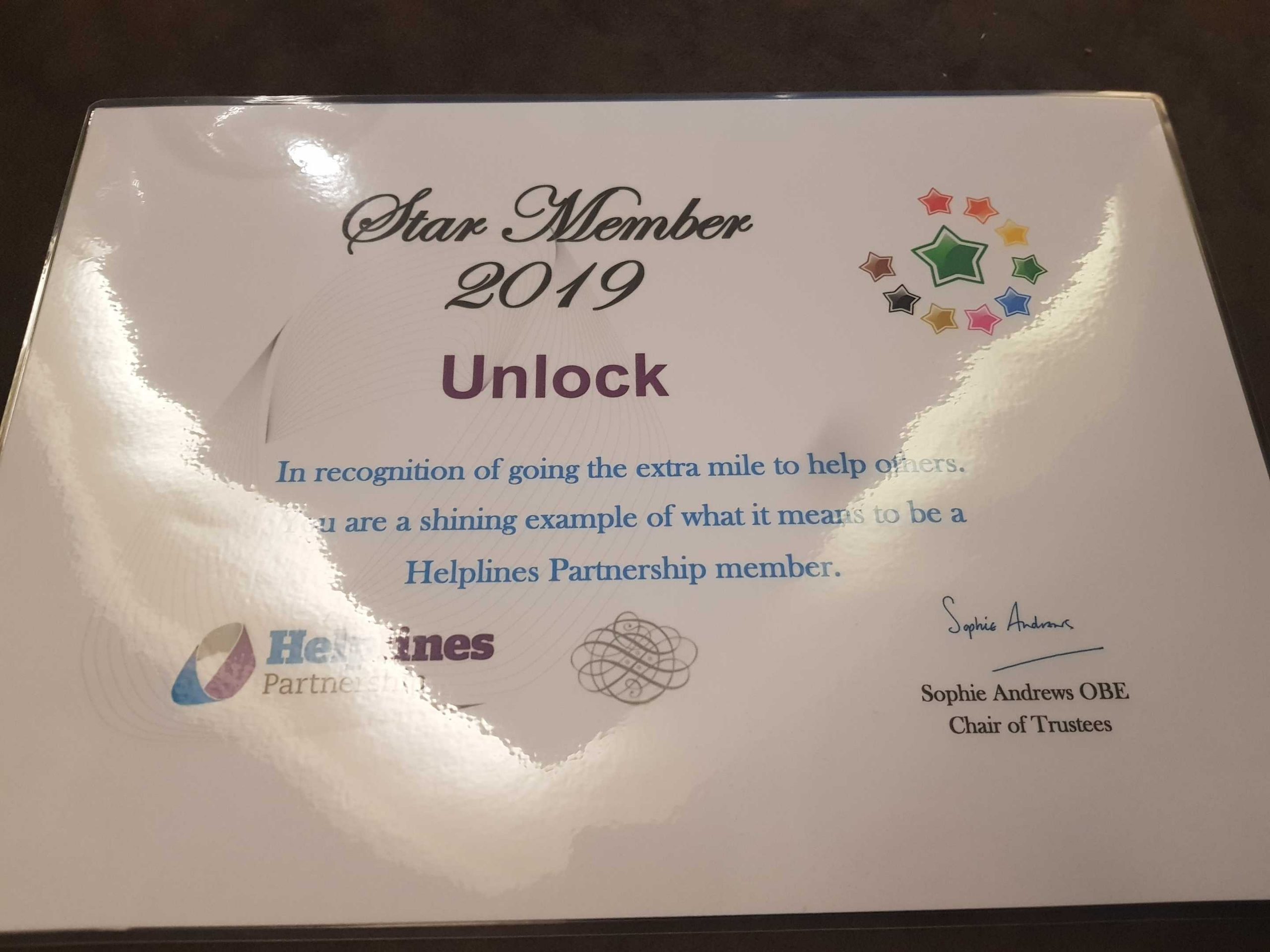
At the same event, Unlock came away with a ‘Star member’ award, in recognition of Unlock “going the extra mile to help others”, saying that we were “a shining example of what it means to be a Helpline Partnership member.”

More information

  1. You can find out more about our volunteer programme.
  2. The winners of the Helpline Awards are on the Helplines Partnership website.

Monthly update – October 2019

We’ve just published our update for October 2019.

This months update includes:

  1. An update on the new costs of all Disclosure and Barring checks.
  2. A personal story highlighting Lucy’s success in getting a newspaper to remove an article relating to her conviction.
  3. A link to a discussion on theForum around a probation officer’s insistence that an individual disclose their conviction to a new employer even though the employer had not asked them to do so.
  4. A blog setting out the governments summary of responses to their call for evidence on the employment of people with convictions
  5. Details of ten universities who have signed up to the ‘Fair Chance for Students with Convictions’ pledge.

The full update provides a summary of:

  1. the latest updates to our self-help information site for people with convictions
  2. recent posts to our online magazine, theRecord
  3. discussions on our online forum
  4. other news and developments that might be of interest to individuals with a criminal record.

Read the October 2019 update in full.

Best wishes,

Unlock

Notes

Ten UK universities lead the way by signing the ‘Fair Chance for Students with Convictions’ pledge

Trailblazing UK universities are leading the way in helping people with convictions access higher education by signing the ‘Fair Chance for Students with Convictions’ pledge.

The pledge is the result of a 12-month project conducted by Unlock, a charity for people with convictions, and supported by the UPP Foundation, a charity founded by University Partnerships Programme, the leading provider of on campus student accommodation infrastructure and support services in the UK.

So far, ten UK universities have signed up to this important pledge which sees institutions make a commitment to offering a fair chance to students with a criminal record. The pledge also signals an institution’s support to giving individuals a second chance at life by opening doors to higher education, giving them the best chance of new employment prospects and opportunities.

The project, designed to support fair admissions and improve access and participation for universities has three key objectives. These include putting policies in place at each university; a toolkit for other universities to use to develop their admissions policies and a pledge for universities to sign up to. The pledge will be launched at a roundtable event with admissions leaders taking place in central London later today.

Universities that have signed the pledge include University of Nottingham, University of Liverpool, Birkbeck, University of London, University of Essex, University of Kent, University of Lincoln, University of the West of England, Bristol, London Metropolitan University, Bloomsbury Institute and University of Southampton. To ensure applicants are aware of the commitment, signatories will be asked to include a link to the pledge in their admissions policy going forward.

Richard Brabner, Director of The UPP Foundation said:

“We are proud to be working alongside Unlock to help universities remove the barriers to higher education that are currently facing people with convictions. We recognise that this is a relatively new area for universities and are delighted to see a number of universities signing the pledge and boldly taking steps towards a fairer admission policy.

“Access and participation is more important than ever. Removing barriers for students with convictions and improving access to universities benefits both students, the tax payer and higher education institutions.”

Christopher Stacey, Co-director at Unlock said:

“Education creates opportunities, opens doors, and changes people’s lives. We are delighted to be working alongside the UPP Foundation and higher education institutions to help people with convictions access the life changing opportunities that higher education can offer.

“People with convictions often face stigma and obstacles because of their criminal records, even long after they have served their sentence. There are over 11 million people in the UK with a criminal record. These people have the potential to make positive and meaningful contributions to our society but are often denied this opportunity because of their past. We are delighted to see universities leading the way in removing the systemic barriers that face people with convictions and look forward to more universities signing the pledge and committing to fairer admission policies in the coming months.”

Notes

  1. For press/media enquiries,
  2. Unlock is an independent, award-winning national charity that provides a voice and support for people with convictions who are facing stigma and obstacles because of their criminal record, often long after they have served their sentence. Unlock’s website is unlock.devchd.com.
  3. The UPP Foundation is a registered charity that offers grants to universities, charities and other higher education bodies. In recent years, as higher education has expanded, the burden of paying for a degree has shifted towards the individual. This naturally presents difficulties in terms of maintaining the ‘University for the Public Good’, as well as ensuring there is greater equity in terms of going to, succeeding at and benefiting from the university experience. We believe the UPP Foundation can make a small but significant contribution in helping universities and the wider higher education sector overcome these challenges. The UPP Foundation was created in 2016 by University Partnerships Programme (UPP), the leading provider of on campus student accommodation infrastructure and support services in the UK. UPP is the sole funder of the UPP Foundation. The UPP Foundation is an autonomous charity and all of its grants are reviewed and authorised by its Board of Trustees. The Foundation is supported by an Advisory Board. More information is available at the UPP Foundation website: www.upp-foundation.org.
  4. The ‘Fair Chance for Students with Convictions’ pledge is below. More details are available here.
  5. A toolkit to help universities make admissions fair has also been published. That is available here.
  6. Details about the Unlocking students with conviction project are available here.
  7. For more information about the project, email university@unlock.org.uk.

The Fair Chance for Students with Convictions pledge

We believe everyone with the potential and ambition to go to university should have the opportunity to do so, regardless of background. People with criminal convictions face obstacles and barriers to accessing university, yet higher education has the power to transform their lives by helping them move forward and make a positive contribution to society. Therefore, as the leaders of our institutions we pledge to give applicants with a criminal record a fair chance by…  

  • Asking applicants about criminal records only if – and when – it is necessary
  • Asking targeted and proportionate questions during the admissions process
  • Making our policy transparent and accessible to all applicants
  • If necessary, offering applicants a chance to discuss their case in person before a decision is made
  • Considering flexible adjustments and alternatives for applicants
  • Ensuring staff are trained to make fair and impartial judgements about applicants
  • Supporting students with criminal records to help them achieve academic success
  • Communicating positively about the benefits of a fair admissions process

Blog – How can people with criminal records access higher education?

Evidence shows that some groups are disproportionately criminalised: care leavers, people from low income households and some ethnic groups.

Despite education being widely recognised as a key factor in successful rehabilitation, admissions policies to date have presented psychological and practical challenges to access. When UCAS removed the criminal convictions tick box for applicants to non-regulated courses, universities had the perfect opportunity to re-evaluate their approach.

Now the Universities of Liverpool, Southampton and Nottingham have joined others in pledging to offer a fair chance to students with a criminal record. These universities have recognised that widening participation means looking at the range of barriers under-represented students face – including a criminal record.

Unlocking talent

Over the last 12 months Unlock, supported by the UPP Foundation, have worked with partner universities on their approach to applicants with criminal records. The project had three objectives: to get policies in place at each of the partner universities; a toolkit for other universities to use to develop their admissions policies; and a pledge for universities to sign up to.

The project was designed to focus on admissions, whilst recognising that this is only the first stage of the student journey. Accommodation, visa compliance and voluntary placements might require asking about criminal records but for admission to non-regulated courses this is almost always unnecessary. Admissions decisions should focus on an applicant’s ability to fulfil their potential. A fair chance means looking at ways to include rather than exclude those people who are trying to move on positively with their lives.  People like Connor.

Connor applied for a post-graduate degree, disclosing his unspent conviction at that time. The university decided that as his offence was ‘serious’ his application could not be accepted. Determined not give up, Connor submitted information about his conviction and letters of support from previous tutors and others people in his life. Eventually, the university overturned its decision.

Concerns about safeguarding or capacity to complete the course could be managed by engaging with the applicant themself. Offering applicants the opportunity to disclose conditions or restrictions that could affect their ability to succeed on their programme means universities can advise on adjustments or alternatives, addressing their concerns. Applicants can feel confident to ask for support at the earliest stage and throughout their course.

Primarily this is a widening participation issue. Admissions decisions for students with convictions can and should be in line with the principles of fair admissions, as set out in the Schwartz review.

It’s also an issue of legal compliance; any organisation that processes criminal record data must have a lawful basis under Article 6 and a condition under Article 10 of the General Data Protection Regulation (GDPR). It’s difficult for a university to identify an article 10 condition for non-regulated courses. Where a DBS check is needed for a placement based programme, universities have a legal obligation to check criminal records. For non-regulated courses, this doesn’t apply. Asking a voluntary question about restrictions or conditions means universities can rely on consent when processing criminal records data.

What have we learned?

Three key themes have emerged from the project and we encourage any university looking at this issue to bear these in mind.

First, focus on inclusion: ask ‘how can we safely include’ rather than ‘how can we legitimately exclude’. Applicants with criminal records are a diverse group and fit into traditional widening participation groups. Excluding people because of their past is likely to result in exclusion of under-represented groups

Second, take a ‘whole institution approach’: Identify what information is necessary – or not – at different stages in the student lifecycle; bringing decision makers together, as well as looking at support for students

Third, words matter: Policies of all kinds reflect the values and culture of the university. An inclusive culture begins with inclusive language. If a university is committed to widening participation and including all under-represented groups, the language used to address them is the starting point.

Students with convictions have usually overcome significant barriers already. They are determined and hardworking and, while they may need support to succeed, their inclusion ultimately benefits us all. Recidivism already costs the economy £18bn a year. Education, employment and opportunity are strongly associated with a reduction in reoffending. Can we really afford to ignore those who are working hard to get their lives on track?

What’s next?

Pledging to offer a Fair Chance to Students with Convictions means:

  • Asking applicants about criminal records only if – and when – it is necessary
  • Asking targeted and proportionate questions during the admissions process
  • Making the policy transparent and accessible to all applicants
  • Offering applicants a chance to discuss their case in person before a decision is made
  • Considering flexible adjustments and alternatives for applicants
  • Ensuring staff are trained to make fair and impartial judgements about applicants
  • Supporting students with criminal records to help them achieve academic success
  • Communicating positively about the benefits of a fair admissions process

Signatories include Universities of Nottingham, Lincoln, Kent, Southampton, Essex and Liverpool, UWE; Birkbeck, University of London; London Metropolitan University and the Bloomsbury Institute. We look forward to more universities signing the pledge in the coming months and working with them to make improvements to their practices.

Our toolkit for higher education providers provides a blueprint for universities to make sure their admissions processes are fair and inclusive. We worked with the Office for students on their effective practice guide to working with students with convictions.

Our longer term focus is on the retention and success of students with convictions – how universities can support them to achieve their potential, and to successfully transition into employment. This includes academic and pastoral support and links with employers. Education can be transformative, and universities have an opportunity to help transform the lives of individuals with convictions and their communities.

This blog was written by Rachel Tynan and originally published by Wonkhe

We want to make sure that our website is as helpful as possible.

Letting us know if you easily found what you were looking for or not enables us to continue to improve our service for you and others.

Was it easy to find what you were looking for?

Thank you for your feedback.

12.5 million people have criminal records in the UK. We need your help to help them.

Help support us now