
Category: Information Hub

An update on the Rehabilitation of Offenders Act

It’s been just over 3 months since the changes to the Rehabilitation of Offenders Act 1974 came into force in England & Wales. At that time, we published an updatewhich featured new materials that we’d produced, as well as our updated detailed guidance.

Since that point, we’ve learnt quite a bit about how these changes are working in practice, mainly through cases that have come through our helpline. So we thought it was about time we produced another update, highlighting a couple of important practical areas.

Read this update in full on our Information Hub.


Summary of the update

  1. The importance of getting a copy of your basic disclosure
  2. The way that ‘court orders’ such as restraining orders and SOPO’s can impact on when a conviction becomes spent
  3. The way that ‘compensation orders’ work with Disclosure Scotland and basic checks
  4. The confusion that surrounds motoring convictions
  5. New ‘Easy Read’ guide on the ROA published
  6. Updated ‘ROA FAQ’s’
  7. Send us your examples/evidence

 
Find out more about all of these in the full update on our Information Hub.

Google’s ‘right to be forgotten’

Information Hub Update

Read this update in full on our Information Hub.

You might have seen in the news recently that Google has launched a system where people can request information be removed from Google’s search results. This has come about because of a ruling on the 13th May by the Court of Justice of the European Union. The case was brought by a Spanish man who complained that an auction notice of his repossessed home on Google’s search results infringed his privacy. The court found in his favour, and this has potentially wide-reaching consequences for search engines like Google.

The ruling only covers the removing of the search results – the information will still exist on the website that published the original article but Google won’t be able to deliver matches to some enquiries that are entered. Deletion of the original information would still be the responsibility of the website owner, and in our experience, it’s very rare that websites agree to remove details relating to convictions (see more in reporting of criminal records in the media).

Information will only disappear from searches made in Europe. Queries piped through its sites outside the EU will still show the relevant search results.

However, many people are still seeing the ruling as a potential way of dealing with the ‘google-effect’ that often haunts people for lots of different reasons, and our Helpline and Forum have already seen this being raised by quite a few people when it comes to past convictions that have been reported online. So the important question for us is whether it will actually help people with convictions?

We’ve published a new section on our Information Hub looking at this, and written a ‘latest update‘ post for our Information Hub. We expect that this information will be regularly updated as we learn more about how the system works in practice.

We’re keen to see how Google are dealing with applications from people with convictions.

To do this, we’re encouraging people with spent convictions to complete Google’s online form, and get a decision from them. Bear in mind that they’re dealing with a lot of applications at the moment, so there might be quite a wait before you get a decision.

Once you receive a decision, please forward it to us to let us know what their decision is and why. You can forward their reply to us by sending it to policy@unlock.org.uk (we won’t share your personal details externally). This will help us to collect evidence of how Google are dealing with requests from people with convictions, and help us to improve the information and advice we’re giving on this issue.

The Disclosure & Barring Service update the question they ask about convictions

This update is taken from our Information Hub

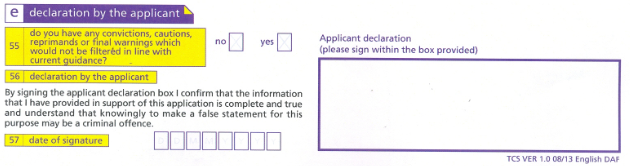
Following our complaint to the Information Commissioners Office which recently led to the Disclosure & Barring Service signing an undertaking to update their application form, we have now had it confirmed by the DBS that their application form has now been updated. A copy of this is below.

e55

As you can see from the above image, the question (e.55) now asks only about convictions, cautions, reprimands or final warnings which would not be filtered. This means that, if your conviction or caution would be filtered at the time of completing the application, you can tick “no”.

You can find out more about completing a criminal record check application.

How do you know if you conviction or caution will be filtered? The DBS should be including guidance with the application form. We have also produced a simple guide and a detailed guide that should also help.

We’ve produced a simple guide to the filtering process

This update is taken from our Information Hub

We know how complicated the criminal records process can be.

The ‘filtering’ process that came in in May 2013 has been quite a culture shock to many people who were previously told that all cautions and convictions would come back on standard and enhanced checks.

At the time, we developed a detailed guide on filtering.

But, through our helpline, we’ve been finding it quite difficult to make filtering simple and easy to understand. Also, as part of delivering our training masterclasses, we found that practitioners were forgetting how this fitted within the broader framework for disclosure.

So, we’ve recently put together a simple guide on filtering. This is available as adownloadable A4 document (click the image below).

filteringsimple

We hope you find it helpful. Let us know what you think by using our feedback form.

Sexual offences and the ROA

This update is taken from our Information Hub

Since we got the news about the changes to the ROA coming in on the 10th March 2014, our helpline has had lots of people contacting us wanting to be sure about how it effects them.

One of the common mistakes we’re seeing is that people with convictions for sexual offences think that this alters the time they are subject to the notification requirements.

Unfortunately, the Government made it clear when passing these changes that they didn’t have any plans to alter the notification periods under the Sexual Offences Act 2003.

This means that it’s perfectly possible for you to have your conviction regarded as ‘spent’ under the ROA changes, but you still be subject to the notification requirements.

We’ve added some information to our page on sexual offences that hopefully helps to clarify this.

Updates to the DBS filtering process

This update has been taken from our Information Hub

December has seen a couple of updates from the Disclosure & Barring Service regarding the filtering process.

Nothing has substantially changed – it’s simply that the DBS are trying to improve the way that they’re explaining how the filtering process works.

So what has changed?

Firstly, the DBS has updated their list of offences that will never be filtered. This increases the list of offences to over 1,000, as well as those offences such as attempting or conspiring to commit the offences listed). This update isn’t the result of a change in the law – it comes from the Home Office, who are trying to produce a list that is more accurate and easier to use. Unfortunately, they still haven’t produced a list of offences that would be eligible for filtering so long as they meet the other criteria (which we’ve suggested would be useful).

Secondly, the DBS has updated their filtering guidance. Helpfully, they’ve given some advice to employers on how they should change their application forms to ask a more accurate question which takes into account filtering.

Although we’re not the publishers of these two pieces of information, we always appreciate feedback on what you think about them, and particularly in raising any issues that you find, so that we can raise them with the Home Office and DBS. Please get in touch.

Successes in getting visas to travel to the US

This is taken from an update to our Information Hub

As part of our attempts to make sure this Hub reflects the genuine experiences of people with convictions, we want to make sure that were highlighting some key examples which we think are relevant to people making use of this site

One particular update that we’ve made today is to include a couple of positive experiences that we’ve had reported to us, where people have been granted a visa to travel to the US.

We have updated the Travelling to America section, but have copied their experiences below;

“I received a caution for possession of a controlled substance (Class A) in 2009. By mid-2010, I had applied for and been granted a visa which was valid for 10 years. I went suited and booted and they just asked me whether I was still misusing drugs. I think possession is extremely minor in the spectrum of drugs-related offences”
“I had visa interview this morning (Paris Embassy) and was granted. Passport coming back end of week. My record – 2 arrests – 1 caution for D&D in 2005, 1 for ABH in 2010 which resulted in 10-week tag, 260 hours community service, £400 fine from Magistrates. 

I applied for B1/B2 visa from US Embassy in Paris, as currently at university in France. Filled in standard visa application, whereby I declared both caution and conviction. I also got ACPO certificate but this is not mandatory for visas from France. Booked appointment online, and turned up with confirmation of payment, Stamped Addressed Envelope, photos, etc.

Arrived at 0730 (smartly dressed in suit and tie!), given a number, and gave all docs for registration. about 20 mins later, was called to a screen with US immigration officer. There was no private room, just a rank of booths not unlike a bank branch. She asked me what I was doing in France, what I wanted to go to the US for, and how was I going to finance it. I gave her a copy of my uni course confirmation, and my bank statements.

She then asked me to give more detail about the 2 arrests / convictions which I did, and also handed over the ACPO certificate. After she tapped away on a computer for a bit, she then said “I just have to go and check something”, and 5 minutes later she came back and said, “Everything is fine, and you’ll get your passport back with the visa in 2-3 days”.

Total time at Embassy – 1 hour. Obviously there will be some minor procedural differences between Paris and London, but the key takeaway is that the system can work, and the bureaucracy not be so bad. Clearly it’s not all quite there, as I won’t believe the final hurdle is overcome until I set foot on American soil. It’s a major weight off my mind, however.”

 

Launch of unlock.devchd.com/information-and-advice/

Today, we’re announcing the launch of unlock.devchd.com/information-and-advice/, our brand new online Information Hub. It aims to be the country’s most comprehensive source of online self-help information on wide range of issues that criminal convictions can affect.

The site builds on the information we’ve had on our main website for a number of years. We’ve wanted to establish a self-help information site specifically for people with convictions. We’re also working on a new main website for the charity, and this will be launched shortly. You may also notice that we’ve also created a new ‘look’, which is shown in our new logo on this site.

Through the Hub, people with convictions will now have access to easy-to-use information that is specifically designed for them. Given the way that we work as a charity, we believe it is critically important that individuals, and those that work with them, have access to accurate, reliable, up to date information on issues that affect them because of their convictions. This will be backed up by our confidential peer advice helpline.

Hopefully, the site is much more user friendly and easier to navigate. For those who want to familiarise themselves with the site, please see the user guide.

In short, the Hub is made up of three main areas;

Knowledge base

This section is the main part of the site. The Knowledge Base contains details information, advice and experiences relating to specific areas of life that a criminal conviction can impact on. It is broken down into different sections.

Frequently asked questions

This section is regularly updated and is designed to provide specific advice to specific situations, based on the kinds of questions that we receive from people who have used the Hub but have further questions about their own situation.

Latest updates

This section provides a summary of the latest updates to the site. You can also sign up to receive updates by email so that you are sent the details of the updates as and when they happen.

Feedback

We hope you like the site. Now that it’s been launched, we’re trying to get as much feedback as possible, so that we can continue to develop and improve it. Please let us know what you like, what you don’t like, and what you think can be improved. Click to leave your feedback.

DBS Update Service and One Certificate

This is an update taken from our Information Hub

Today, we’ve published a brief guide which explains some of the changes that the DBS has introduced this week.

The Update Service is a new subscription service lets you keep your DBS certificate up-to-date so you can take it with you when you move jobs or roles. The employer can then carry out free, online, instant checks to see if any new information has come to light since the certificate’s issue – this is called a ‘status check’.

To coincide with launching the Update Service, the DBS will now only issue certificates to you; they’ll no longer send a copy to the Registered Body. This change is being referred to as ‘One Certificate’. Employers will now need to ask you for sight of your DBS Certificate.

The guide we’ve put together discusses some of the issues and questions that people with convictions are likely to be interested in, including some of the benefits and potential downsides to these changes.

Read the guide we’ve published here.

Questions?

If you have any questions about this information, please contact us.

If you’d like to discuss this information with others, there is a specific thread on our online forum.

Changes to insurance disclosure

The below is post from our Information Hub

The reason for this update is to let you know of some changes to insurance disclosure, which came into force in April 2013, which should help many people with convictions. We updated the guidance on our website at the time, but to raise awareness of this, we thought we’d send around an e-update as well!

For many years, people with convictions have found themselves in a difficult situation when purchasing insurance. This is because of archaic insurance law dating back to the Marine Insurance Act 1906, which imposed heavy duties on all consumers to disclose all material facts, even if the insurer didn’t ask about them specifically. If you failed to guess what the insurer wanted to know, your claim could be rejected.

In 2008, the Law Commission consulted on whether the law should be changed. Unlock made a submission which highlighted the problems that the law caused for people with convictions. Following this consultation, the Law Commission recommended a change in the law. Unlock, along with a number  of other consumer organisations (including Age UK, Consumer Focus and Which?), worked hard to push  the Government to change the law. This was successful in March 2012, when the Consumer Insurance (Disclosure and Representations) Act 2012 received Royal Assent.

The Consumer Insurance (Disclosure and Representation) Act 2012 came into force on 6th April 2013. It removes the duty on consumers to volunteer ‘material facts’ if not asked. The onus is now on the insurer to ask the right questions. For people with convictions, this will help to clarify the law when companies do not ask about certain convictions (e.g. non-motoring convictions). Previously, you had to disclose all unspent criminal convictions, regardless of whether you were asked about them. This is no longer the case.
The onus now sits squarely with the insurer to ask you the questions that they want to know information about. Instead of a duty to volunteer material facts, now the law requires you to answer the questions that are put to you fully and accurately. You need to “take reasonable care”, and one of the factors that will be taken into account is whether the questions asked by the insurer were clear and specific.

For more information

We’ve published a guide on the changes to insurance disclosure. We’ve also updated our simple and detailed guides, as well as updating our list of insurance brokers and list of motor insurers. As always, all of this can be downloaded from the insurance section of our website.


Can you help us improve our lists?

Since these changes have come in, some insurers have changed the questions they ask. Some mainstream motor insurers, for example, have started asking about non-motoring convictions, meaning we’ve had to take them off our specific list of motor insurers that didn’t ask about non-motoring convictions.

However, there are many other insurers that ask quite specific questions about convictions (e.g. convictions in the last 5 years). For these insurers, even if your conviction is unspent, if it was after this period, you do not need to disclose.

As a result, we’re in the process of reviewing our list of motor insurers, to identify more mainstream companies that do not ask about certain convictions. We’re also looking to produce a similar list of home insurers, providing details of companies that ask quite specific questions. If you come across any specific insurers that you think should be included in either of these, please let us know by emailing the details to advice@unlock.org.uk.

We want to make sure that our website is as helpful as possible.

Letting us know if you easily found what you were looking for or not enables us to continue to improve our service for you and others.

Was it easy to find what you were looking for?

Thank you for your feedback.

12.5 million people have criminal records in the UK. We need your help to help them.

Help support us now