
Category: News on policy issues

Local credit unions support efforts to reduce re-offending

New report finds credit union accounts improve the prospects of people leaving prison

Research carried out by Unlock and the Research Unit for Financial Inclusion at Liverpool John Moores University has highlighted 13 credit unions working in partnership with 21 local prisons to reduce re-offending. Credit unions are providing savings accounts to people in prison, with some offering a current account on release.

The Unlocking Credit Unions report, launched at Parliament today, shows that membership of a community financial institution can have positive economic, social and psychological effects that support desistance from crime. It also suggests that credit unions may be critical in delivering flagship reforms within the justice system, including the Work Programme and Universal Credit. However, the report also questions how sustainable such partnerships are in the light of budget cuts and argues they must be properly resourced.

With stable housing and work as the key factors in reducing re-offending, local initiatives by credit unions have been welcomed by prison staff involved in resettlement.

“[Access to credit union services] opens up a market with regards to employment and accommodation that would not have normally been available…It is an important aspect of the resettlement process”.
– Prison Officer quoted in the report

The high rate of re-offending immediately after prison has been linked to the £46 ‘discharge grant’, which often has to last several weeks before wages or benefits come through. With average prison wages estimated at below £10 a week, opportunities to save are limited. However, credit unions have inspired some people in prison to save to avoid reliance on state benefits on release.

One person featured in the report is Charles. Before coming into prison he had never had a bank account and managing in cash had caused problems due to his drug problem. In prison, the credit union inspired him to save for a motorbike. In two years he saved £800 which he was able to take with him when on release. He said:

“I only used prison toiletries and never used the phone. I went without to save for the bike…it made me feel brilliant; it was a sense of achievement. It was probably the first time I had saved in my life and it made me feel good. I felt proud and normal” – Charles, a person in prison

The report also highlights how credit unions could help families who send money in to loved-ones in prison. Increasingly hard-pressed families are currently forced to use postal orders, which incur a 15% charge.

Nine further credit unions are working with local probation, charities and housing associations to provide services to people in the criminal justice system and their families.

Chris Bath, Executive Director at Unlock and co-author of the report, said: “Access to basic financial services is a keystone to leaving crime behind and building a positive life; working, paying taxes, spending and saving. Partnerships between credit unions and justice agencies have the potential to help deliver that, but they must be properly resourced to be effective.”

Paul A Jones, Reader in the Social Economy at LJMU and co-author or the report, added: “The unique contribution of credit unions is enabling people to save whilst in prison. Saving builds people’s confidence, self-worth and ability to plan for the future, all of which are important if people are desist from crime and resettle effectively in the community”.

-END-
Media enquiries – click here

CRB’s and second chances

As part of of the ongoing Court of Appeal case about CRB checks, we’ve written an article for thejusticegap.com.

You can read the article here.

Banking before release

We’ve written a letter in this month’s edition of Inside Time, the prison newspaper, updating people on the progress of our Unlocking Banking project.

You can read the letter here.

Immigration and nationality decisions are now exempt from the ROA

This update is taken from our Information Hub

As of the 1st October 2012, changes made through the Legal Aid, Sentencing and Punishment of Offenders Act 2012 (s.140 in particular) mean that immigration or nationality decision making, including initial decisions and any subsequent proceedings, are exempt from the Rehabilitation of Offenders Act 1974. This means that spent convictions can also be considered as part of these processes. This includes convictions obtained before October 2012.

It does not, however, affect any proceedings which began before October 2012 (or decisions made but not finally determined).

Please note: At the time of writing, the UKBA’s website has yet to be amended to reflect the above changes, and hence references to the ROA still remain in our own information above. This will be amended in due course, in line with changes to the UKBA website. It is possible, for example, that the UKBA will set their own guidelines for disregarding certain convictions. Check out our Coming to the UK section for the last information.

All these changes mean is that the UKBA now has the freedom to take into account spent convictions. The UKBA are yet to publish their own guidelines on how they intend to put this possibility into operation.

A useful article on this change is available from the Immigration Lawyers Gherson.

Travelling to the UK, and should reformed offenders be given a second chance?

The news that prospective Coventry Blaze ice hockey team player Mike Denton has been refused a visa to enter the country because of his criminal conviction, sparks the debate of whether reformed offenders should be given a second chance.

We contribute to a discussion on BBC Coventry and Warwickshire. You can listen to the interview below.

Prisoners launch High Court challenge to keep more of their wages

Prisoners who take jobs outside jail have launched a High Court challenge to keep a great share of their wages, claiming too much goes to victim support.

We’re featured in the article as we’re supporting the case. Read the article here.

Money for nothing? Unspent convictions and insurance

We’ve taken part in a Radio 4 discussion about insurance and convictions. The piece can be listened to below. There is also a link to more information about the piece here.

Police checks on potential council tenants

We’ve taken part in a radio discussion on BBC West Midlands to discuss a local council with a proposed policy of carrying out police checks on potential council tenants. This is available to listen to below (in two parts)

Paying twice for crime – insurance and convictions

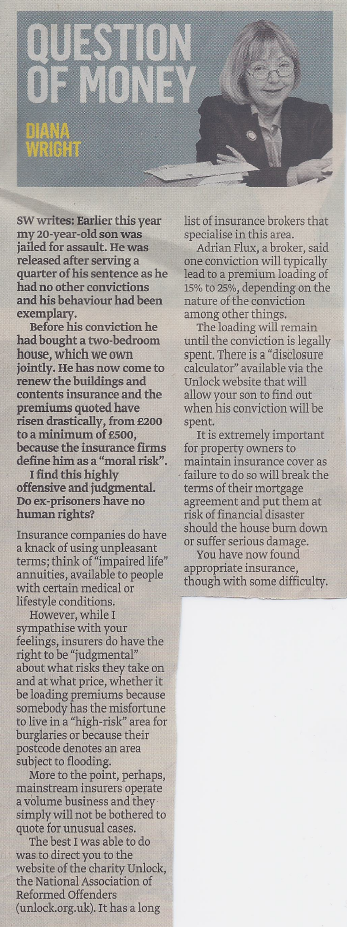
The Sunday Times have featured in their Money section a letter from somebody whose son is experiencing difficulties getting insurance. We spoke with the journalist last week, and provided her with some advice, which led to the person eventually finding some cover, and we’re featured in the published response (see below).

payingtwice

Prisoners to get Halifax bank accounts as they prepare for release

We’re featured in an article in the Mail on Sunday, which covers some recent work we’ve done with Halifax bank to extend the number of prisons that they open basic bank accounts for. The article is available to read here.

We want to make sure that our website is as helpful as possible.

Letting us know if you easily found what you were looking for or not enables us to continue to improve our service for you and others.

Was it easy to find what you were looking for?

Thank you for your feedback.

12.5 million people have criminal records in the UK. We need your help to help them.

Help support us now