
We’ve taken part in a Radio 4 discussion about insurance and convictions. The piece can be listened to below. There is also a link to more information about the piece here.
Author: Unlock Admin
Police checks on potential council tenants
We’ve taken part in a radio discussion on BBC West Midlands to discuss a local council with a proposed policy of carrying out police checks on potential council tenants. This is available to listen to below (in two parts)
Reformed offenders’ charity wins Guardian Charity Award
Unlock has today won the Guardian Charity Award for its work tackling the economic and social exclusion of reformed offenders. The charity was selected as one of five winners from almost 1,000 entries, the largest number ever received in the history of the awards.
The charity focuses on the ongoing discrimination which can prevent reformed offenders from contributing positively to society throughout their entire lives. unlock.devchd.com has become the leading source of information for law-abiding people with a criminal record, attracting 130,000 unique visitors a year.
The charity employs only five staff but works with volunteers to develop and deliver innovative projects, products and services, as well as campaigning for legal changes that would allow many reformed offenders to get off benefits and into employment.
The judges said Unlock was a “brilliant, very positive story” that was “tackling controversial issues”, “offering the long-term support needed” and that its use of online and media “shows huge potential”.
The charity will receive £6,000 prize money, one year free membership to NCVO, a tailored package from the FSI that includes mentoring, expert advice and training and a media package, including support from their community of journalists, from Media Trust.
-END-
Notes to editors
1. The awards highlight the work of UK based, small to medium sized charities that focus on social welfare and have been operating for two or more years with an annual income of between £5,000 and £1.5million.
2. The judging panel included: David Brindle, The Guardian (chair); Jane Asher, president of the National Autistic Society; Lynne Berry OBE, associate of Civil Exchange, Caroline Diehl, chief executive of Media Trust; Sir Stuart Etherington, chief executive of National Council for Voluntary Organisations (NCVO); Emma Harrison, chairman of trustees, the Foundation for Social Improvement; Baroness Howarth OBE, and Dame Suzi Leather, chair, Charity Commission.
3. The judges made the following comments: –
Baroness Howarth: “Brilliant, very positive story”
Jane Asher: “Remarkable and inspiring story of the chief executive turning their life around”
Pauline Broomhead: “Offering the long-term support needed after prison”
Caroline Diehl: “Use of online and media is great – shows huge potential”
Judges agreed that it is a positive story tackling controversial issues.
We win Guardian Charity Awards 2011
We are proud to announce that we have been chosen as a winner at the Guardian Charity Awards 2011

Pictured (from left to right): Jane Asher (President, Arthritis Care, Parkinson’s UK and the National Autistic Society); Christopher Stacey, Julie Harmsworth and Chris Bath from Unlock; and Jonathan Pryce (Actor and Patron of Friendship Works).
“Remarkable and inspiring story of the chief executive turning their life around” – Jane Asher
“Brilliant, very positive story” – Baroness Howarth
“Offering the long-term support needed after prison” – Pauline Broomhead
“Use of online and media is great – shows huge potential” – Caroline Diehl MBE
“A positive story tackling controversial issues” – Judges summary
Find out more about the judges and the awards.
The video below was filmed as part of the Guardian Charity Award
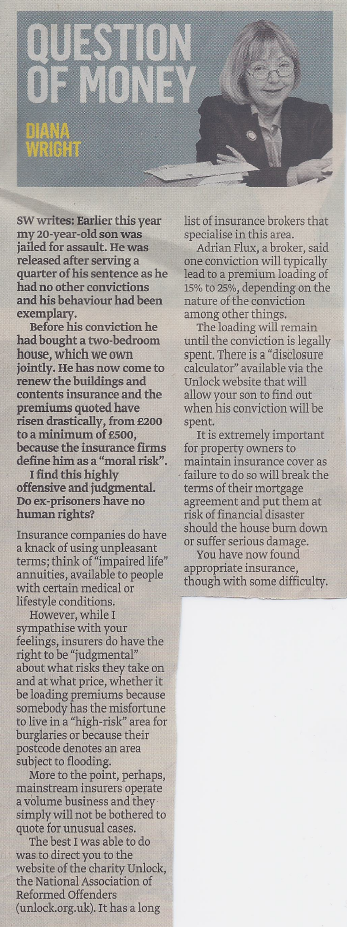
Paying twice for crime – insurance and convictions
The Sunday Times have featured in their Money section a letter from somebody whose son is experiencing difficulties getting insurance. We spoke with the journalist last week, and provided her with some advice, which led to the person eventually finding some cover, and we’re featured in the published response (see below).
Prisoners to get Halifax bank accounts as they prepare for release
We’re featured in an article in the Mail on Sunday, which covers some recent work we’ve done with Halifax bank to extend the number of prisons that they open basic bank accounts for. The article is available to read here.
Sins of Omission – Ex-offenders get help on knowing when to own up to insurers
The Observer picked up on our launch of the Disclosure Calculator and featured this as an article, looking at how it will help people when applying for insurance. You can read the article below.

Life after prison
We’ve contributed to an article in ProgressOnline, alongside the Criminal Justice Alliance, which looks at the issues surrounding life after prison. The article is available to read here.
Calculator to help ex-offenders
As part of the launch of our Disclosure Calculator, we sent out a newswire which was picked up by Media Trust. The article is available here.
Launch of the Disclosure Calculator
This October we took to the House of Lords, armed with one Minister and two Lords, to launch the Unlock Criminal Record Disclosure Calculator. It’s a new online tool to help people determine when their conviction will be ‘spent’.
The Rt Hon Lord McNally – Minister of State for the Ministry of Justice; Lord Navnit Dholakia OBE PC DL; and Unlock President, Lord David Ramsbotham GCB CBE , congregated with Unlock staff, volunteers and members, plus insurers, barristers and more for the highlight of our year.
Opening the meeting, Unlock called for a “right of access to a normal life for reformed offenders” which isn’t currently available under the ROA.
Christopher Stacey of Unlock explained how the calculator can be used to determine when a conviction will become “spent” under the ROA. Stacey said: “Currently the ROA is very complicated, so we need a calculator that’s easy to update in response to any changes. It’s been developed with our members and feedback from various organisations, supported by a grant from Persula Foundation”.
Members echoed the sentiments and welcomed the new calculator: “It’s so simple to use and you don’t have to worry talking to people, where they might judge you on a past offence. You can use it in the comfort of your own home. And it’s free too.” said an Unlock member.
Closing the meeting Lord McNally congratulated the work. His speech is provided below to give you an insight into what the Government has to say about your least favourite law.
Further feedback on the calculator has also been positive with news of its launch sweeping across various online social networks. To use it is simple. You just need to register with an email and some brief personal details such as your DOB, gather and enter information pertaining to your conviction, sentence or disposal received and agree to the terms and conditions.
The calculator is sponsored by online insurance providers homeprotect whose website is at www.homeprotect.co.uk. To find out when your conviction will be spent visit www.disclosurecalculator.org.uk to try it out for yourself.
Speech by Lord McNally
“I would like to congratulate UNLOCK on achieving what some previously considered impossible. The Rehabilitation of Offenders Act is a complex but important piece of legislation that can have a significant impact on many people’s lives. It is crucial therefore that it can be understood. The introduction of the UNLOCK criminal disclosure calculator helps to break down these complexities and through this simple tool, individuals will be able to find out what the ROA and their conviction means to them.
The Government understands that the ROA may be difficult to understand for the lay person and that on occasion, incorrect information is given by individuals who are asked about their criminal record history. This could prevent the ROA from achieving one of its aims of improving access to employment for reformed offenders.
When an employer asks a reformed offender if they have any previous convictions, the reformed offender does not generally want to hide his conviction in an attempt to deceive. Through correspondence with offenders, we know that what they actually want is a fair chance at getting a job and to be honest with their future employer. However, through hearing about yours and others experience this is easier said than done.
Because ordinary citizens might find it difficult to apply the ROA to their particular situation, it is not wholly surprising that some reformed offenders are confused about what they can and can’t conceal. This confusion can result in a reformed offender inadvertently misleading an employer about their criminal record.
In some instances, individuals fail to disclose information that they should because they believe their conviction to be spent when it is in fact not. If and when an employer learns of the conviction, not only are they dealing with a previous offender, but in their mind they are dealing with someone who has lied about their past. It is very difficult for that individual to justify why he failed to reveal his conviction.
Alternatively, through fear of this happening, individuals often reveal information when they don’t have to. They don’t realise that a conviction is spent, or aren’t sure, and so tell their employer and can be penalised for their honesty. Once the information is known, it is very hard for the individual to persuade a prospective employer that it is not relevant because the conviction is spent. We all know it would be hard to forget such information, even if it is completely irrelevant.
Neither situation seems fair, but we know, through working with organisations such as UNLOCK, that both do occur.
This unfairness and confusion is, of course, undesirable. The ROA is designed to improve the chances of ex-offenders finding employment; employment reduces the likelihood of someone being an offender. The benefits of assisting offenders into work are therefore plain to see.
One of the obstacles to achieving this has today been broken down. The launch of UNLOCK’s disclosure calculator helps both individuals and employers to understand when a conviction is spent and so helps the ROA achieve an important aim.
No single act will remove all the barriers faced by an ex-offender seeking to reintegrate into society. One, simple step however is to tackle the prejudices that exist around employing ex-offenders, regardless of whether an individual has a spent conviction or not. We are working to improve employers’ and members of the public’s understanding of criminal records, and why most individuals with convictions a long time in their past should be considered equally with those with no convictions. Guidance being developed and provided by UNLOCK and across Government will go some way towards this.
I hope that the hard work of UNLOCK will continue and that through that work, together we can remove some of the unnecessary obstacles faced by offenders who want to lead normal, law abiding lives. Part of that is improving individual’s understanding of the ROA. I am sure you will all agree with me that the launch of this calculator marks a significant step towards achieving that aim.”
