Under the Licensing Act of 2003, it is mandatory for anyone operating or wishing to operate licensed premises to be a Personal Licence Holder. The personal licence is separate from the licence which authorises the premises to be used for the supply of alcohol. The aim of this page is to assist you in applying for a personal licence if you have a criminal record and, how to appeal a decision if your application for a licence is refused.
Why is this important?
Applicants for a personal licence will need to disclose any unspent convictions and a basic Disclosure and Barring Service check will form part of the application process. It’s important to have a good understanding of how your criminal record will be dealt with before you apply for a licence and before you invest any money in getting the necessary qualifications.
Getting the right qualifications
In order to obtain a Personal Licence, you must attend a one-day course and pass the BIIAB Level 2 Award for Personal Licence Holders (formerly known as the National Certificate for Personal Licence Holders or NCPLH). The aim of the qualification is to ensure that licence holders are aware of licensing laws and the wider social responsibilities attached to the sale of alcohol.
Personal licence application form
Obtain a personal licence application form from the Licensing department of the local authority in which you live. You can also download a disclosure of convictions & declaration form. Whilst you will be unable to send off the application form at this stage (there are a number of further documents you’ll need to obtain), it will save you time later on.
The form itself will require certain details to be provided, and you’ll be required to provide additional information and documents such as:
2-x passport sized photographs
the application fee which is currently £37.
If it appears that there are convictions for any relevant or foreign offences, then the licensing authority will give a notice to the chief officer of the police for the area.
What are ‘relevant offences’
A ‘relevant offence’ refers to the offences listed in the Licensing Act that could, on conviction, rule out the grant or renewal of a personal licence to the applicant concerned.
Convictions for offences (other than relevant offences) under the law of any place outside England and Wales, including other parts of the United Kingdom such as Scotland and Northern Ireland, are counted as foreign offences. Details of these will also need to be given. The reason for the separate terms is that offences under the law of places outside England and Wales, which are equivalent to relevant offences, will not necessarily exist in exactly the same form as relevant offences.
When applying for the grant of a personal licence or for the renewal of a personal licence, you must include details of any relevant or foreign offences for which you have been convicted or, in the case of applications for the renewal of the licence, have been convicted since the grant or last renewal of the licence. However, as the position of Licensee is not exempt from the Rehabilitation of Offenders Act 1974, you do not need to disclose any convictions that are spent under the Act.
For relevant offences the police will consult either their own records or those of the relevant police force if the offence was committed in a different area. The Chief Police Officer will then notify the licensing authority if he is satisfied that granting or renewing the personal licence would undermine the licensing objective of preventing crime and disorder. For foreign offences the police will take steps to contact their counterparts in the region or country where the conviction occurred.
If the police make no objections within a 14-day period then the licence must be granted.
A personal licence does not authorise its holder to supply alcohol anywhere, but only from establishments with a premises licence authorising the supply of alcohol in accordance with the premises licence. An individual may only hold one personal licence at any one time.
Criminal record check
A basic Disclosure & Barring Service (DBS) criminal record check is required as part of the application, and this can be obtained from the (DBS). This will not disclose any convictions that are regarded as spent under the Rehabilitation of Offenders Act 1974.
Under 2003 Licensing Act Guidance (4.6) regulations, a licensing authority can, for the granting of a personal licence, request a criminal conviction certificate, a criminal record certificate (both of these are basic DBS checks), or the results of a subject access search of the Police National Computer by the National Identification Service to the licensing authority. This means that whilst an enforced subject access request (SAR) is now illegal, it can be requested for the granting of a personal licence.
We would recommend that when applying for your licence, you provide a basic DBS check, as a SAR is a copy of your complete criminal record and will disclose all cautions and convictions, whilst a basic DBS check will only disclose those which are unspent.
An identifier for the licensing authority which granted it
A photograph of the holder
A unique number allocated by the licensing authority
The date of expiry
The second part of the licence will contain the above information, with the exception of the photograph, and will also contain details of any relevant or foreign offence which the holder has been convicted.
Once you are granted your personal licence, if you are then charged with a relevant offence, you must produce your personal licence to the court. If that is not practical, then you must tell the court that you hold a personal licence, who the issuing authority is and the reason why you cannot produce your licence. If you are then convicted, the court will notify the relevant licensing authority about the conviction, and may order the forfeit or suspension of the licence.
Failure to produce or notify the court about your licence, without reasonable excuse, is an offence under section 128 of the Act. The sentence on conviction of this offence is a fine of up to £500 and could result in the forfeit or suspension of the licence.
Licence hearings
The hearings process is set out in the Licensing Act 2003. Section 120 sets this out for an application for a grant of a personal licence.
If the Local Authority thinks that the applicant has a conviction for a relevant offence or foreign offence, it must notify the police;
If the police think that granting the licence would undermine the crime prevention objective, they must within 14 days of receiving initial notice from the Local Authority send notice of their objection to the Local Authority;
If no objection is made by the police within this period, the Local Authority must grant the licence;
If the police do object, the Local Authority must hold a hearing to consider it (unless everyone involved [i.e. applicant, police, Local Authority] agrees that this isn’t necessary) and can then either reject the application if they agree that granting the application would undermine the crime prevention objective – but otherwise grant the application;
Regulations fill out the detailed process, including (i) the Local Authority must hold the hearing within 20 working days beginning with the day after the end of the 14 day period within which the police can object, and (ii) the Local Authority must notify the applicant and police of the hearing date, (iii) the Local Authority must send the applicant the police objection with the notice of hearing
There are additional regulations concerning how the hearing itself is conducted.
Appeals
You have the right of appeal if your application is rejected by the local authority.
You can appeal the local authority’s decision made at a hearing or if the local authority rejected the application after initially receiving it because, for example, the local authority took the view that you weren’t aged 18 or over etc. The right of appeal is prescribed by paragraph 17 of Schedule 5 to the Licensing Act 2003.
The appeal lies to the Magistrates’ Court and must be made within 21 days of the applicant being notified of the LA’s decision to reject the application. You should also note that the police have a right of appeal if they’ve objected but the local authority has decided to grant the application after having the hearing.
If the Magistrates’ Court doesn’t allow an appeal, the party bringing the appeal could make a further application to the High Court.
Useful links
Below you will find links to useful websites relating to this page. More specific details (including addresses and telephone numbers) of some of the organisations listed below can be found here.
Statutory guidance – this is aimed at local authorities but may also be of interest to applicants. Section 4 refers to personal licences, and specifically sections 4.5-4.10, to criminal records. The guidance states that the Secretary of State recommends that, where the police have issued an objection notice, the licensing authority should normally refuse the application.
International Child Protection Certificate (for working overseas)
Name
International Child Protection Certificate
Issued by
ACPO Criminal Records Office
Use
It is for UK nationals and residents that are working overseas. It is designed for organisations that are unable to get a Disclosure & Barring Service certificate, because these can only be done by organisations that are linked to a UK registered body that have access to a DBS check.
What it contains
It checks the PNC (E&W), Criminal History System (Scotland), Causeway (Northern Ireland).
It will contain all convictions and cautions, unless they have been stepped down, when the certificate will show “No Live Trace”.
It will also contain any pending prosecutions you may have.
How to apply
You can download the application form from the ACRO website.
Who can apply for it?
You as an individual apply for it. It gets sent back to you.
Cost
£75
How long does it take
10 days.
Where is it sent
To you as an individual.
Other information
If an applicant for an ICPC is found to have a record indicating a sexual interest in children, the application will be referred to the NCA’s CEOP Command to deal with in line with usual operating procedures prior to any certificate being issued. At the moment, we have very little evidence about how this element works in practice.
Establishing what level of check an employer can carry out
What level of check an employer can carry out is important, particularly if you have spent convictions, as they wouldn’t be disclosed on a basic check.
We know that on occasions, employers will request DBS checks for roles that only require a basic check. Having an understanding of what level of check a job is eligible for can ensure that an employer is not able to find out more about you than legally they are allowed to know.
If you feel sure that an employer is trying to do an ineligible check, this should give you more confidence in challenging the check with the employer or the Disclosure and Barring Service.
The DBS eligibility tool
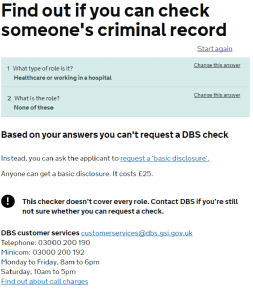
The DBS recently launched an eligibility tool which may help you to establish which roles or activities could be eligible for a standard or enhanced DBS check. The eligibility tool is still relatively new and doesn’t cover every role. However, it is being continually tested and improved.
Our ‘Establishing eligibility’ process
We have developed this process (EEP) to help you establish what type of check a particular position is eligible for.
Using the EEP
The EEP is a single flow chart. Some sections have more detailed guidance and these are clearly labelled, e.g. ‘See Note 1’. To find out more about these steps, go to the relevant sections below.
The EEP is designed to be used before an application is made for a criminal record check when you’ve been told that a certain type of check will be carried out and you are unsure about whether it is eligible
Further down this page, reference will be made to the ‘Establishing Eligibility’ form
Most organisations provide details if they require a check for a specific position. Look for any mention of criminal record checks in the job description, role specification and any other information they have provided.
Check their website
Look for the organisation’s employment policies. The DBS Code of Practice requires organisations who use the DBS service to include a policy on the recruitment of people with convictions. Look to see if they have a policy on which roles require a check.
Check the DBS application form
If the organisation has already given you a DBS application form to complete, look at question X-61 (position applied for) – see image above. This is normally completed by the Registered Body (RB) after you have completed the form. If it has already been completed, make sure it matches the specific job that you have applied for.
It is important to check this because the DBS do not ordinarily query eligibility based on the answer to this question unless it has been brought to their attention.
Remember that a position which may not seem eligible (e.g. “administrator”) may be eligible due to other circumstances. The RB should give as much detail as possible (e.g. “school administrator”).
Contact the organisation
Asking the organisation directly can be the quickest way to find out which type of check will be required (if any). However, if you don’t do this anonymously, you may raise suspicion that you have a criminal record.
Next steps
If you believe the organisation is right: You need to decide whether to give your consent to the check. You are not legally obliged to give your consent but if you refuse the employer will normally reject your application for the job.
If you are not sure whether they are right or wrong: Go to Note 2 (below)
If you believe the organisation is only entitled to a lower check: Go to Note 2 (below)
If you believe the organisation is actually entitled to a higher check: Proceed with your application. Whilst you may be able to refuse, you may want to disclose now if you want to avoid an issue at a later stage.
Note 2 – Gather more information
Some job titles are often assumed to make the role eligible for a specific level of check. For example, a “Teacher” might be assumed to be eligible for an enhanced check. However, a teacher in a University (such as a Lecturer) would normally only be eligible for a basic check.
Equally, some job titles are assumed to make the role ineligible for a specific level of check. For example, an “Office Assistant” might be assumed to be ineligible for an enhanced check but might be eligible for one if working in a school or care home.
To understand what level of check the position is eligible for, you need to find out as much information about the role as possible. The Establishing Eligibility Form provides a set of standard questions for which you should try to get answers.
Alternatively, you could use the DBS eligibility tool checkerwhich will take you through a series of questions to estabish eligibility.
If you believe the organisation is right: You need to decide whether to give your consent to the check. You are not legally obliged to give your consent but if you refuse the employer will normally reject your application for the job
If you think that the organisation is wrong: Go to Note 4.
Note 4 – Challenge the organisation/registered body
The organisation may be a registered body itself or may have made the application via an umbrella body. In either case, you should raise your concerns with the organisation first. When you contact them, you will need to be careful not to raise suspicions that you have a criminal record.
You may want to initially speak with the organisation. However, if they insist that the position is eligible you should raise your concerns in writing and ask for a written response. This is so you have evidence which you may need to use later on. Remember to be aware that you may be identified if you share your personal information.
You should detail the reasons why you feel that the position is not eligible for the type of check being requested. Some things you might want to consider are: –
The organisation may already be aware of your concerns from your earlier questions
Ask them to reconsider undertaking a check
State what level of check you think the position is eligible for and offer to apply for it
Ask for a response in writing including reasons why they made the decision that they have.
If the organisation is not a registered body, you need to repeat the above with the umbrella body that they are using. They are the ones who are legally responsible for making the declaration about the eligibility of the check on the DBS application form.
Bear in mind that the umbrella body may not be fully aware of the details of the role. They will only know what the employer has told them. However, if you raise a query with them, they should be able to look into it and get back to you.
Next steps
If they agree and decide to undertake a different level of check: Give your consent. If you disagree with the new level of check being proposed, repeat Note 4.
If they disagree: Go to Note 5.
Note 5 – Seek advice
Seek general advice from the DBS
If after all of the above steps a check is still being required for a position you don’t think is eligible, you should seek some advice about what to do next. When seeking advice, try to provide as much information as possible, including a completed‘Establishing Eligibility’ form or a print out from the DBS eligibility tool checker.
However, you should also ask yourself whether, if successful, you would be in a better position. For example, if your convictions are unspent, even if you managed to show that the organisation isn’t entitled to an enhanced check, they’d still be entitled to a basic, which would show your unspent convictions.
The Ministry of Justice (MoJ) has policy responsibility for the Rehabilitation of Offenders Act 1974 and Exceptions Order 1975. You can seek advice from the MoJ on the eligibility of a position. They have an online form you can use to contact them.
The MoJ may have to share your personal information with the Home Office (which is responsible for the Police Act regulations which govern enhanced checks) and other Government officials. If you do not wish this to happen, make this clear when you send your query. It may be possible for them to remove your personal information but they may be limited in how they can help. The MoJ will respond in writing, either by post or by email. A reply should be provided within 20 working days. It will state that the position is either (a) eligible, (b) not eligible or (c) may be eligible for the type of check that is being requested. In all cases they will provide reasons why. The MoJ is only able to give a general indication, based on the information you provide. Please note that this is not legal advice
The MoJ is unable to impose sanctions on an organisation as there is no offence committed in the initial asking of the questions. However, if the MoJ’s view is that the position may not be eligible, you can then present this information to the organisation.
Seek general advice from others
You may want to seek advice from organisations such as the DBS, Unlock etc.
Next steps
If it is not eligible: Send any evidence to the organisation and ask them to reconsider.
If the employer agrees: Give your consent. If you disagree with the new level of check being proposed, repeat Note 2.
If it is eligible: You need to decide whether to give your consent to the check. You are not legally obliged to give your consent but if you refuse the employer will normally reject your application for the job. If you decide to give your consent.
If it may be eligible: Either return to Note 2 (to clarify the role further before challenging the organisation and seeking official clarification again) or go to: Ineligible checks.
Discuss this with others
Read and share your experiences on our online forum.
Useful links
Below you will find links to useful websites relating to this page. More specific details (including addresses and telephone numbers) of some of the organisations listed below can be found here.
Disclosure Scotland – Government body responsible for providing basic criminal record checks in England, Wales and Scotland
Ministry of Justice – Government body working to provide a more effective and transparent criminal justice system and are responsible for the Rehabilitation of Offenders Act
Get involved
Help us to add value to this information. You can:
The Magistrate Court that you were convicted and/or sentenced at
Use
For official details of the outcome of a case that you were involved in. It is particularly useful if you have only ever been to court once.
What it contains
Written or oral information about certain material in a case file, or copies of any documents served to the court by you or served to you by the court, or information about any direction or order directed to you, or made on an application by you, or information about the outcome of the case.
If the court permits, any further information that the court holds may be supplied, but this additional information must be specifically requested. See Criminal Procedure Rules 2012, Part 5, here
How to apply
By making an application directly to the court officer of the issuing court, specifying the information or document required, and paying any prescribed fee. You should make the application in writing, and explain why you want the information. In certain instances, a request may be made orally and information also given orally by the court to the applicant.
Who can apply for it
A person who is, or was a party to a particular court case
Contact details
The convicting/sentencing court. Click here to use the HM Courts & Tribunals Services Court Finder
Cost
Free of charge currently
How long it takes
Between 5 to 10 working days from the time of the application being received by the court
Where it is sent
To you only
Link to anonymous example
Not available
How to correct inaccurate information
You would need to write to the court of sentence, outlining the areas you wish to have amended, and providing as much information as possible in order that this can be checked against the court register or file
Other information
This will only contain case-specific information from the convicting court, and so does not necessarily reflect your entire criminal record.
A Memorandum of Conviction may be more appropriate for certain categories of applicants and may be issued to a specified person for a specified purpose. It will usually contain key details of a conviction. Subject to any legislative requirements, a person who wants such a certificate must apply in writing to the court officer, specify the certificate or extract that is required, explain under what legislation and for what purpose it is required, and pay any prescribed fee (this is currently £60). A certificate will only contain information held by the convicting court. See Criminal Procedure Rules 2012, Part 5, here.
The supply of court records may also be subject to varying legislative provisions and these will be considered before the court agrees to release any information to an applicant.
Pay it forward
If you found this page helpful, could you donate £1 to help someone else access our advice and support?
The Royal Mail Group currently employs around 150,000 people in the UK and they have their own set of employment policies and regulations.
On application, the Royal Mail Group will require your consent to carry out a basic criminal record check as part of the recruitment process. There is also a list of ‘unspent’ criminal offences that are considered unacceptable in new employees. This list isn’t exhaustive, but includes:
Theft and all offences of dishonest appropriation (including going equipped to burgle, taking a vehicle without consent, handling stolen property, making-off without paying)
Fraud, forgery or counterfeiting offences (including benefit deception, traveling on public transport without paying)
Firearms and weapons offences (including possessing a sharp object in public, possession of a noxious gas)
Terrorism (other than certain conflict-related offences subject to the Northern Ireland Good Friday Agreement – these do not need to be declared during application and will be considered by applying the employers’ guidance issued by the Office of the First Minister & Deputy First Minister, Northern Ireland)
Offences under the Postal Services Act 2000 and prior legislation
Arson
Supply or intent to supply any category of drugs or possession of category A drugs
Offences against the Justice System (including perjury, bribery, making false statements, contempt of court)
Offences against the person (including assault, causing grievous or actual bodily harm, battery, affray, racial or verbal harassment, making threats)
Sexual offences
Breaches of orders
This list of offences and further information regarding employment with the Royal Mail Group can be found on the Royal Mail site here.
The new law states that scrap metal dealers will now have to undergo Basic criminal record checks in order to trade.
Councils now have the power to issue licences and make it compulsory for dealers to carry this licence when trading. These tighter regulations have been enforced in an attempt to “curb metal theft which is increasingly growing”, according to ACPO.
Dealers will now be asked to provide a Basic Disclosure certificate which details any unspent convictions. Refusal to supply one, or a certificate which disclosures a previous conviction, could lead to the council revoking, or refusing an existing licence.
If you are trading but do not have a licence you may be fined up to £5000. Other conditions include the requirement to renew your licence every three years.
If you want more information or wish to apply for a licence please click here.
Disclosure of police intelligence on enhanced checks (approved information)
Each Police Force maintains a local record of information, which can be used to disclose information referred to on a disclosure in the ‘other relevant information’ section on an enhanced check. This is formally known as ‘approved information’. It is often more commonly referred to as ‘non-conviction information’ or ‘police intelligence’.
This page aims to set out when this information is likely to be disclosed and, how to make a request to the police that they do not disclose it.
Why is this important?
‘Police intelligence’ generally relates to somebody who has never actually been convicted for the offence involved, but it may occasionally include additional information relating to a conviction.
If you have never been convicted or cautioned for a criminal offence, then there is no legal requirement for you to disclose this ‘additional information’. However, if it is disclosed on an enhanced criminal record check, then an employer may decide to take it into consideration when making a recruitment decision.
If the ‘police intelligence’ relates to a conviction, then you may find that the police will disclose more detail than you would have elected to disclose yourself.
It’s important to have an understanding of what options are open to you if the police do decide to disclose additional information about you.
What ‘local police information’ means
For the purposes of this page, local police information can include:
Fixed Penalty Notices (FPN’s)
Penalty Notices for Disorder (PND’s)
Findings of innocence
Acquittals
Cautions and convictions of those that you live with
Other Police intelligence (including allegations)
It does not include information held on the Police National Computer, including:
Cautions
Reprimands
Final warnings
Convictions
Cautions, reprimands and final warnings are not criminal convictions. However, in terms of disclosure, they are covered by the Rehabilitation of Offenders Act (which means, once spent, they do not need to be disclosed and you are protected by the ROA) and are also included in the Police Act 1997 as being disclosed on standard and enhanced checks as these are carried out for positions exempt from the ROA.
Who decides whether to disclose this information?
The decision as to whether to disclose local police information is made by the Chief Police Officer in the relevant police force area. Following the Protection of Freedoms Act 2012, this ‘decision-making process’ has two main guidance documents. These are the Statutory Disclosure Guidance, and the Quality Assurance Framework.
Guidance on how the police make the decision to include locally held information can be found here.
Statutory disclosure guidance
The statutory disclosure guidance follows on from a review of the criminal records regime conducted by Mrs Sunita Mason, the Government’s Independent Advisor for Criminality Information in February 2011. The guidance comes as a result of the Protection of Freedoms Act 2012.
The guidance came into force on 10 September 2012 and is designed to assist chief officers of police in making decisions in providing information from local police records for inclusion in enhanced criminal record certificates.
Quality Assurance Framework
The latest version the QAF is available to download from the DBS website.
Within this framework, there is detailed information available in relation to making representations against the disclosure of local police information.
How often is police information disclosed?
** Shows the number of applications where there was a match against local police records. This is known as the police local cross referencing system or PLX system.
The above figures show that, since the statutory disclosure guidance (mentioned above) came into force in 2012, the amount of ‘approved information’ disclosed on enhanced checks has decreased significantly. In the year 2013/14, information was disclosed in only 0.83% of cases where there was a match against local police records.
Trying to stop it from being disclosed on an enhanced check
While there is no real hope of getting local police information deleted from police records, there are steps you can take to try and stop it from being disclosed on an enhanced check.
If you’ve not yet applied for a job involving an enhanced check
We suggest that you make sure that you have a full understanding about the information that is held on you by the Police. If you don’t know this already, you should look to do a Police Subject Access request and ask to see any local records held. This will give you details of any local information held on you. You should also contact your local police force and ask to see a copy of their policy/process for dealing with whether to disclose information of this type. It’s unlikely that the police will tell you at this stage whether they would be likely to disclose information on a particular enhanced check.
If you’ve applied for a job involving an enhanced check
Most police forces will normally contact you if they are thinking of disclosing information in the ‘other relevant information’ section, giving you the chance to make representations. However, this doesn’t always happen, so if you think that you might have information held about you and you’re worried that it might be disclosed, you should contact your local police force. You should ask them to give you the chance to make representations if they feel the need to disclose any information. Whilst there is no guarantee that they will do this, there have been reports that asking the police to do this will lead them to doing it through fear of being challenged legally for failing to do so. If/when the police get in touch, you should make sure that you make strong representations why the information is no longer relevant.
Independent monitor
If the police decide to disclose information, you will be sent this certificate to give to the employer. At this point, if you disagree with the decision to disclose ‘other relevant information’, you can challenge this through the Independent Monitor.
If you wish to make a referral to the independent monitor, you can complete a form on the DBS website or write to: DBS, Disputes, Customer Services, FREEPOST RTHU-TRJY-KSHY, PO Box 165, Liverpool, L69 3JD. Tel: 03000 200 190.
The DBS will refer your application to the relevant police service on behalf of the independent monitor to give the chief officer the opportunity to consider your dispute first.
If you are not satisfied with the police dispute response, your case will be referred to the independent monitor.
If you disagree with the findings of the Independent Monitor then your next step would be to seek judicial review.
The Supreme Court case of L v Commissioner of Police of the Metropolis in 2009 considered the issue of non-conviction information and what ought to be included. The Court decided that the police must strike a balance between the interests of the employer and the individual’s right to his private life. Provided the information is relevant to the position applied for and strikes this balance, it is reasonable for the police to disclose it.
Who can help
If you wish to challenge the disclosure of local police information, you should be able to go through a number of steps yourself. However, you may find the contact below useful.
Libertywere involved in the case of L (above) and have a strong interest in the civil liberties argument surrounding the disclosure of non-conviction information on a disclosure.
The legal contacts below are detailed because they have been involved in dealing with these types of cases in one way or another. It is not our aim to promote the services of legal advisors, but we do want to be able to provide information on contacts who may be able to help. You may also find the general section on legal advice in our Information Hub helpful.
John Ford Solicitors instructed Stephen Cragg and Charlotte Kilroy (of Doughty Street Chambers) to represent L in the case detailed on this page.
Slater and Gordon Lawyers have offered their services to people in these situations on a number of online forums, and so you may be able to source some help from them.
Trying to get it deleted
Under theACPO Retention Guidelines, there is an Exceptional Case Procedure for the removal of DNA, fingerprints and PNC records. As each Chief Police Officer is the Data Controller of their PNC, they have the discretion to authorise the deletion of any specific data entry on the PNC owned by them. However, this discretion is only ever exercised in exceptional cases.
Exceptional cases will, by definition, be rare. They might include cases where it can be proved that the arrest was unlawful, or where it is established beyond doubt that no offence existed. A library of circumstances have been collected by the DNA and Fingerprint Retention Project (DNAFRP) that have been viewed as exceptional cases, and this is used to assist Chief Officers by providing a bank of precedents when considering requests to remove records.
To request removal:
Write to your local police force. Ask for the record to be deleted. Ask for their policy on deletion, including what types of cases they will regard as exceptional.
You should be sent a letter informing you that the record is held lawfully and that your request is being refused unless you believe it should be regarded as exceptional. You will be invited to state the grounds upon which you believe your case is exceptional.
Write back outlining the reasons why you believe it should be deleted.
The Chief Officer should then consider your response and either reply directly refusing your request, or refer the case papers to the DNAFRP to ensure a consistent national approach. If referring to the DNAFRP, the Chief Officer will receive an informed response. He/she will then notify you of their decision.
Some forces have published their policies publicly.
Background
Is this kind of disclosure legal?
The simple answer is yes. However, the disclosure of such information has been challenged a number of times by the courts (as discussed below) which has influenced the process that is used to decide whether information should or should not be disclosed.
There is a very good article written by Barrister Timothy Pitt-Payne covering a recent case which looked at, amongst other things, the legality and process of disclosing non-conviction information.
History
Guidance was previously covered in Home Office Circular 05/2005 Criminal Records Bureau: local checks by police forces, but since 24th September 2010 this has no longer been in force.
In once case which demonstrates the process that South Yorkshire adopted, they contacted the individual concerned, notifying them of the their intention to disclose non-conviction information. The letter explained the legal powers supporting the disclosure of such information, stated that they are minded to disclose the information, and then provided details of the proposed wording. The letter went on to state that the purpose of the letter was to afford the individual the right to make any representations that they consider relevant to the Chief Officers decision. The letter set a relatively tight time limit to reply (2 weeks from the date the letter was sent).
In response to this, the individual Unlock member wrote some rather detailed representations. The result was that he received a response back from the police stating that “on this occasion it has been decided not to proceed with the disclosure” and, when his check was issued, no non-conviction information was disclosed. However, it is important to note that the convictions that he had from many years ago were still disclosed, as currently this process doesn’t apply to cautions/convictions.
If you receive a similar letter proposing disclosure, or you simply want to make representations in advance of disclosure of non-conviction information, it would be sensible to look to get a copy of the Police Forces decision making process regarding non-conviction information, as well as using the statutory guidance and QAF process above, so that you are able to target your representations at elements which may affect the Chief Officers decision.
The process following L
Following the L case, many police forces have given individuals an opportunity to comment on the disclosure that the Police intend to make. As the Court in L was clear that there is no presumption in favour of disclosure, you could argue that the disclosure was not relevant to the new post/job you are seeking or that it is so old, vague, misleading or inappropriate that it ought not be disclosed at all.
If an inappropriate disclosure is made, you can challenge the quality of the information with the criminal records bureau or you can bring a judicial review in the High Court to have disclosure looked at afresh by a Judge. Time limits are tight and both steps must be taken within 3 months from the date of the certificate.
If disclosure affects your reputation, personal feelings or causes you to lose earnings (for example, if you lose your job or a promotion opportunity) you can seek damages as part of a judicial review application. Legal aid may be available.
Discuss this with others
Read and share your experiences on our online forum.
Useful links
Below you will find links to useful websites relating to this page. More specific details (including addresses and telephone numbers) of some of the organisations listed below can be found here.
ACRO Criminal Records Office – ACRO are responsible for subject access requests for most police forces, as well as police certificates
Disclosure and Barring Service – The DBS are a government body responsible for carrying out standard and enhanced criminal record checks
Get involved
Help us to add value to this information. You can:
The easiest and cheapest way to find out your criminal record is to apply for a copy of your police records from the Police.
You’re entitled to exercise your rights to obtain information that is held about you under the Data Protection Act 1998. This process is known as a Subject Access Request.
Although this relates to lots of different government agencies, in relation to the police, a subject access request is your right of access to verify the information held about you on police computers.
A subject access request to the Police National Computer will either provide a certificate stating that there is currently no information held about you on the Police National Computer, or it will provide a list of all the information held on the computer including all convictions, whether they are spent or unspent.
You can also choose to ask to see what is held locally by the Police. This can include arrests, allegations, and Not Guilty findings
This page will explain this in more detail.
Name
Police Subject Access Request (often referred to as “Police records” )
Issued by
Local police force (or ACRO, who disclose PNC data on behalf of most forces) under the Data Protection Act 1998
Use
To establish what information the Police hold on you for your own purposes to ensure that police information is accurate.
What it contains
Details of all personal information which the Police hold on you, including what is held on the PNC and what is held on local police records (depending on what information you ask to see)
How to apply
You can apply via your local Police Force. Each police force normally has a form to complete, which is usually available online but can also be requested in writing.
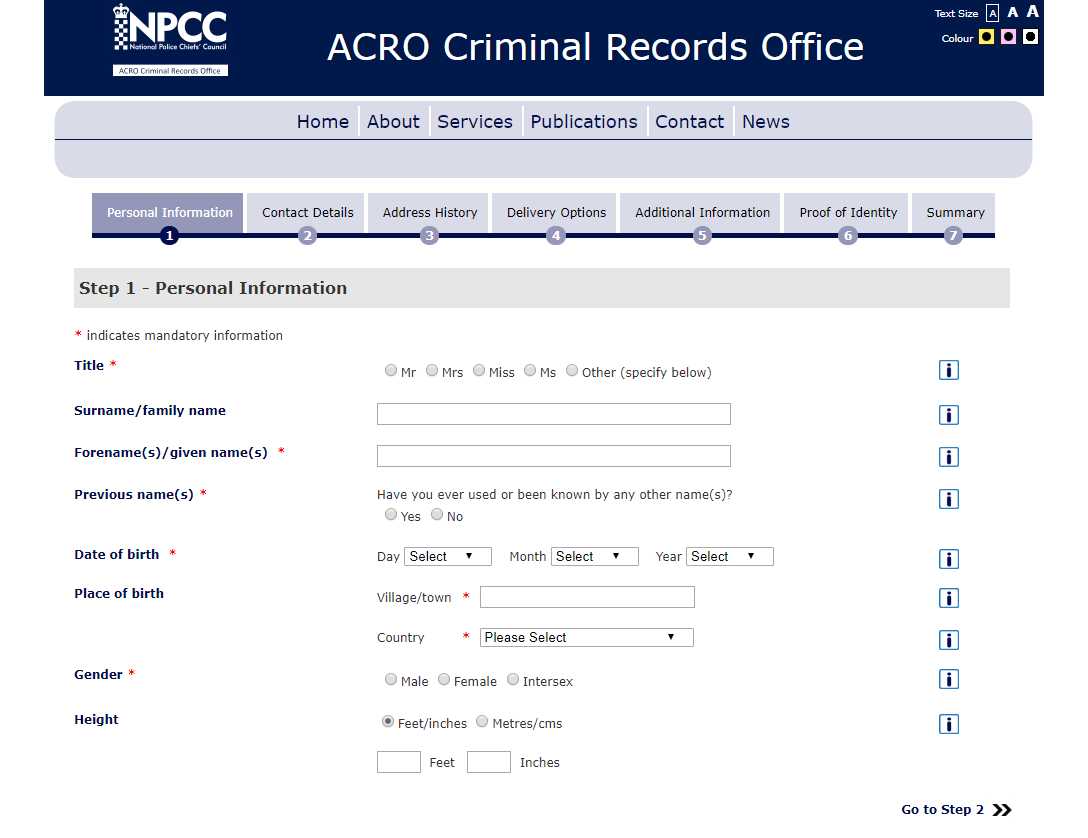
ACRO provides Subject Access disclosures from the Police National Computer on behalf of most police forces in England and Wales (apart from Derbyshire, Gwent and Sussex), Northern Ireland, Jersey and the Isle of Man. Requests can be made by post or online. Details of both can be found here. ACRO also have a useful further guidance page providing additional information on SAR’s.
If you want a copy of all of your personal data, you should make sure that you request to see both PNC data and any information held locally by your local police force.
You will need to contact the Data Protection team at your local Police Force. Links are available here. Many requests relate to information held on the PNC, and the majority of these are dealt with by ACRO. Their contact details are below:
A: ACRO (SAO), PO Box 623, Fareham, Hampshire, PO14 9HR
To you only. Subject Access disclosures (Police records) are not designed to be used by employers as the provisions of the Rehabilitation of Offenders Act are not applied (see ‘Other information’)
Link to anonymous examples
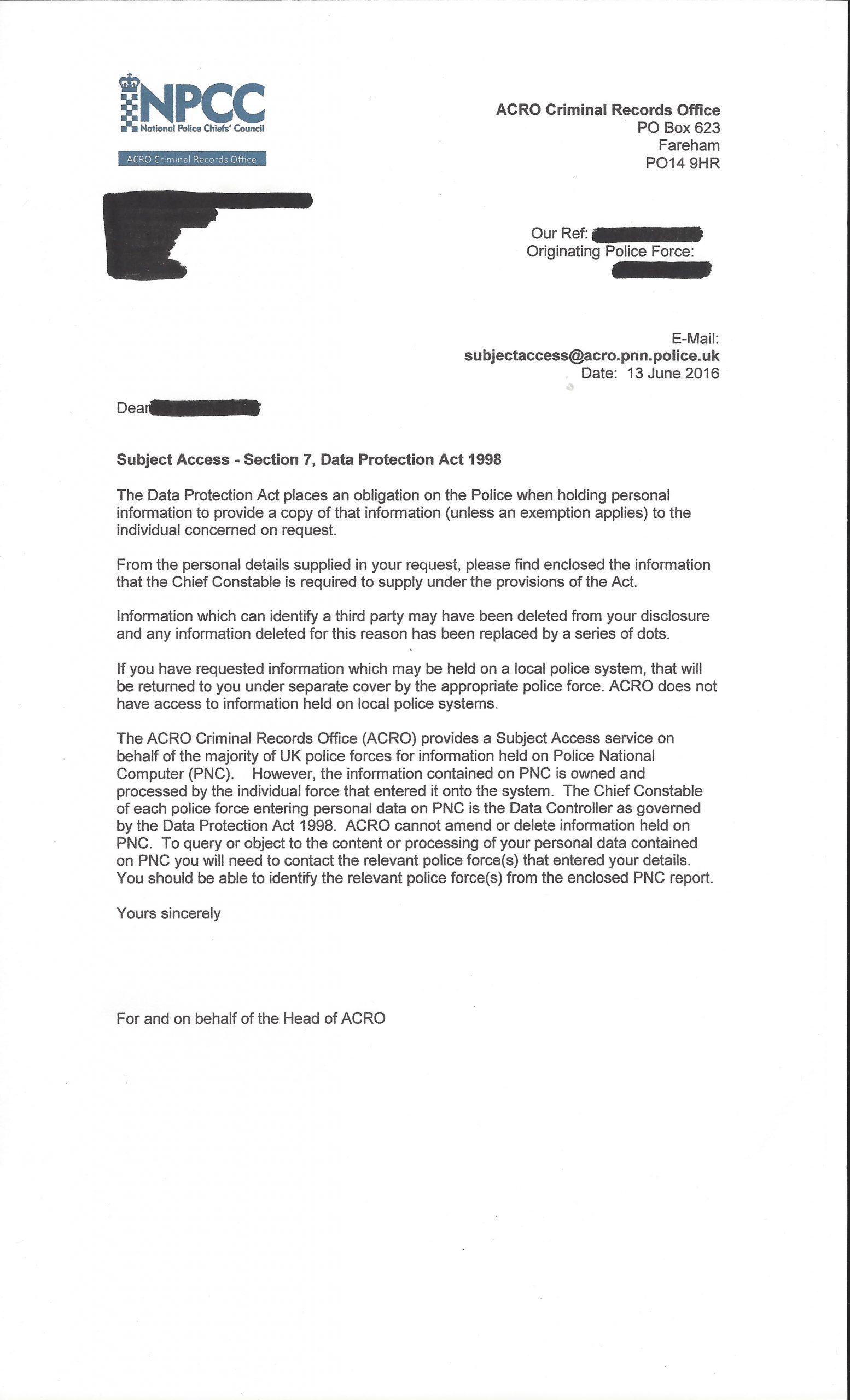
Click above image to go to a readable version of this letter and four examples pages of a Police Record – SAR.
How to correct inaccurate information
If you feel the information in inaccurate, you will need to contact the police force who holds the information outlining the inaccurate information. Each Chief Police Officer is the Data Controller for their PNC record, and has the ability to delete information. There is an exceptional case procedure, but this is normally confined to deleting local police information such as allegations.
Enforced subject access
It was announced in early 2014 that the final elements of the Police Act 1997 will take effect. With this comes the news that enforced subject access will be a criminal offence. This came into force on 10th March 2015. Read more here.
Pay it forward
If you found this page helpful, could you donate £1 to help someone else access our advice and support?
Undertaking training courses and applying for an SIA licence can be time consuming and costly. It’s important therefore to find out whether the SIA are likely to grant you a licence before you invest too much time and money in the process.
The SIA
The Security Industry Authority (SIA) is the organisation responsible for regulating the private security industry. They are an independent body that reports to the Home Secretary under the terms of the Private Security Industry Act 2001. The SIA has 2 main duties:
Compulsory licensing of individuals working in specific sectors of the private security industry
To manage the Approved Contractor Scheme. This measures private security companies against a set of independently assessed criteria.
Before applying for a licence, either a new one or a renewal, you should look to see whether the SIA will require mitigation from you due to your criminal record (see below) as you may want to get this prepared in advance of any application, so that when you are asked for it you are ready to respond with the relevant information.
New Licence
You can apply for a licence by completing an application form here.
You should allow for the time it will take to complete any training you need, sit any examinations and get your qualification. You must have the relevant qualification before applying for a licence.
The SIA aim to process a minimum of 80% of all correctly completed applications within 25 working days. Complex applications, e.g. applications subject to additional criminality or qualification enquiries and those requiring overseas criminality checks, may take longer.
Renewals
If you already hold an SIA licence then you will need to apply for a new one before your current one expires. Your licence renewal application can be made up to 4 months before your existing licence expires. For more information and an online application form clickhere.
Using the Criminal Record Indicator tool
The SIA have a useful tool on their website, the Criminal Record Indicator. This tool can only give you an indication of whether or not you meeting the criminal criteria set by the SIA in order to get a licence.
Applying for an SIA licence
The SIA carry out a standard criminal record check on any individual who applies for a licence. If you do have a criminal record, it does not necessarily mean that you will not get a licence. The SIA have a very detailed guide to how they handle applications from people with a criminal record in their Get Licensed handbook.
However, if you do have any convictions, warnings, cautions, absolute/conditional discharges, admonishments or charges awaiting trial for offences, then you will have to disclose them as part of your application (this includes both spent and unspent convictions that have not been filtered), as the SIA is exempt from the provisions of the Rehabilitation of Offenders Act 1974.
When assessing the disclosure of a criminal record, the SIA will take the following into consideration to:
Whether the offence you have been convicted of is considered ‘relevant’ (a full list of offences can be found at Appendix A of the Get Licensed handbook).
The seriousness of the offence.
The actual sentence or disposal given to you for the offence
How recent the offences were. This is measured against the date that the SIA make the decision to grant or refuse your licence and not the date you originally submitted your application.
Assessing criminal records
The table below provides an overview of how a criminal record affects the SIA’s decision on a licence application. It shows how a single offence that is relevant to licensing will be assessed by the SIA.
Time since sentence restrictions ended
Caution/warning, community resolution, absolute/conditional discharge
Fine, community disposal
Suspended sentence
Prison sentence
Less than or equal to 12 months
Consider Additional Factors
Refuse
Refuse
Refuse
More than 12 months and less than (or equal to) 2 years
Grant*
Consider Additional Factors
Refuse
Refuse
More than 2 years and less than (or equal to) 4 years
Grant*
Grant*
Consider Additional Factors
Refuse
More than 4 years and less than (or equal to) 7 years
Grant*
Grant*
Consider Additional Factors
Consider Additional Factors
More than 7 years
Grant*
Grant*
Grant*
Grant*
* If you have ever received a conviction resulting in imprisonment of longer than 48 months, or life imprisonment, there will either be an automatic refusal or you will fall into the ‘Consider Additional Factors’ category, depending on how long it has been since sentence restrictions passed.
Free of sentence restrictions
Under the rules of the SIA, you will automatically be rejected for a licence unless you have been free of the sentence restrictions for a conviction for at least 12 months (and up to 5 years in more serious cases) before your licence application. Explanations of how the SIA start to count the ‘free of sentence restrictions’ for sentences, fines and disposals are as follows:
Imprisonment: If you have a conviction which resulted in a custodial sentence, the SIA will begin counting the ‘free of sentence restrictions’ time from the end of your sentence and not from the date when you were sentenced or when the offence(s) were committed. For example, if you have been convicted of an offence and spent time in custody, the date for deciding whether the offence is still relevant for licensing purposes is the day after the sentence would have ended. If you were released early, the SIA will still not begin counting you as being ‘free of sentence restrictions’ until the date when the sentence restrictions would have ended had the full term been served.
Suspended sentences: If you received a suspended sentence then you will be deemed ‘free of sentence restrictions’ from the end of the sentence period and not the period of suspension. For example, if you received a 6-month sentence suspended for 2 years then the SIA would consider you ‘free from sentence restrictions’ after 6 months from the date of conviction and not after the 2 year suspension.
Community orders: If you received a community order or other similar sentences undertaken in the community then you will be deemed ‘free of sentence restrictions’ at the end of the period of the order. However, if no date is given on the CRB check the SIA will deem you ‘free from sentence restrictions’ 12 months after the date of sentence.
Fines and other disposals: If you received a fine, caution, warnings, absolute/conditional discharges or admonishments the SIA will deem you ‘free from sentence restrictions’ from the day after the sentence or disposal was imposed.
Multiple sentences
If your conviction resulted in multiple sentences/disposals the SIA will only take into consideration the one with the ‘greatest’ penalty. For example, if you received a fine and a prison sentence of six months, the SIA would only take into account the prison sentence.
Multiple convictions
If you have multiple convictions the SIA will automatically refuse your application if you have a combination of the following:
Three or more convictions – where all of the sentence restrictions have ended in the past seven years for relevant offences where the disposal for each offence would have resulted in ‘Consider Additional Factors’.
Two or more convictions – where all the sentence restrictions have ended within the past four years for relevant offences.
A prison sentence – where all of the sentence restrictions have ended within the seven years before the criminality is assessed, plus any conviction, caution, community resolution order, absolute/conditional discharge – where the sentence restrictions ended within the past four years for relevant offences.
Relevant offences
Offences in the following categories will be deemed relevant for the purposes of an SIA licence. A full list of relevant offences can be found at Annex A of the Get Licensed handbook.
Violent/Abusive Behaviour – including violent/abusive offences and stalking/harassment offences.
Espionage/Terrorism – including offences in the Aviation Security Act 1982, Anti-Terrorism, Crime and Security Act 2001, Prevention of Terrorism Act 2005 and the Terrorism Act 2000.
Offensive Weapons – including offences relating to the possession, use or sale of offensive weapons such as knives, blades, crossbows and chemical/biological weapons.
Firearms Offences – including offences relating to the acquisition, possession, certification, carrying and use of firearms.
Dishonesty (Theft and Fraud) – including offences relating to theft, burglary, robbery, handling stolen goods, blackmail, attempting to pervert the course of justice, perjury, breach of bail conditions, conveyance of prohibited items onto or out of prison, counterfeiting and forgery, fraud, deception, dishonesty and unauthorised modification of computer material.
Proceeds of Crime – including offences in the Proceeds of Crime Act 2002.
Abuse or Neglect of Children – including cruelty to children, indecent photography of children, child abduction, child begging and prostitution.
Sexual Offences – including all offences in the Sexual Offences Act 2003, Sexual Offences (Scotland) Act 2009, Sexual Offences (Northern Ireland) Order 2008.
Drug Offences – including trafficking, importation, production, supply, cultivation or possession of controlled drugs.
Criminal Damage – including the destruction or damaging of property, racially or religiously aggravated offences, threats to damage or destroy property and vandalism.
Social Security Offences – including breaches of social security regulations, false representations for obtaining a benefit, the making of statements known to be false and fraud and negligence in relation to statutory maternity pay and sick pay.
Private Security Industry Offences – including engaging in conduct prohibited without a licence, providing false information, contravening licence conditions, using unlicensed operative and misuse of approved status.
Licensing Act 2003 – including offences under the Licensing Act 2003 and equivalent instruments in Scotland and Northern Ireland.
Driving Offences – including offences relating to causing death or serious injury by careless or dangerous driving.
The Decision Making Process
Automatic Refusal
Sometimes the SIA will automatically refuse an application. You can challenge an automatic refusal if you believe that there are factual errors in the SIA’s decision-making process. Evidence of factual errors may include:
an error in identity;
an error in assessing criminality;
proof of remand time which impacts on the time you have been free from sentence restrictions so as to change the decision from an automatic refusal to ‘Consider Additional Factors’;
proof that a community order was discharged early, and which impacts on recency sufficiently to change the decision from an automatic refusal to ‘Consider Additional Factors’.
‘Consider Additional Factors’
If your criminal record is such that the SIA feel that they need to ‘Consider Additional Factors (CAF) then they will write to you to invite you to submit mitigation which may include evidence of other influencing factors, and character references.
Submitting Mitigation
The mitigation that you submit may include you providing:
evidence of other influencing factors
character references
evidence of your rehabilitation since your offence.
There will be a deadline date, usually 21 days from the date of the letter notifying you of being able to submit mitigation, for you to provide this information to the SIA. Any letters provided from you which do not comply with these requirements may not be considered.
The number of documents you supply in support of your application will not necessarily add weight to your case; it is the nature and content of the mitigation which is considered. If you do not feel that you can get this information to the SIA by the given date then it is important that you write to them to ask for more time at the earliest opportunity.
Character references
The SIA will give more credence to your references if they are from independent, verifiable and objectives sources that have no vested interest in the licensing decision. For example, information from previous employers or other people of standing in the community such as your doctor, police officer, MP/Councillor or church leader. Any character references provided must clearly state the capacity in which they know you, how long they have known you, and confirm that they know about the relevant offence and that they are still prepared to give the reference. If possible, the reference should show their understanding or why you committed the offences and what you have done since. All references should be signed and dated and include full contact details (including a telephone number) for the referee.
Evidence of rehabilitation
The SIA will look favourably on applicants who have provided evidence of their rehabilitation. For example, if you served a custodial sentence you could include details of courses that you did which relate to your offence (including certificates if possible). You should also detail any voluntary work or community projects that you have been involved in either whilst in prison or since receiving your sentence/disposal which shows you are making a positive change towards a crime free life. The SIA do not want to re-hear all about your offence but more about how you have realised your errors and have tried to put practices in place to ensure that the same thing does not happen again.
The decision
Grant
If your application for a licence is successful, you will receive a letter from the SIA informing you of their decision, and enclosing your licence.
Factual Errors
If the SIA judge it necessary to refuse your licence application then they will write to you notifying you of their intention to refuse a licence, and also providing you with the basis for their decision and they may invite you to supply them with further information. This is not asking for mitigation at this stage, but the SIA are giving you the opportunity to look at the factual information that they have about you and to see if there are any errors. An error could mean the difference between an automatic refusal or consider additional factors, which gives you the chance then to provide mitigation. Factual errors may include:
An error in identity
An error in assessing your criminality
Proof of remand time which impacts on recency sufficiently to change the decision from an automatic refusal to a Consider Additional Factors (CAF) or from a CAF to Grant decision
Proof that a Community Order was discharged early and which impacts on recency sufficiently to change the decision from an automatic refusal to a Consider Additional Factors (CAF) or from CAF to a Grant decision
You will have 21 days, from the date on the SIA’s letter and not the date you receive it, in order to provide a response. If a response is not received by the SIA from you within 21 days then your licence will be refused. If you do send a response within 21 days, the SIA will give it due consideration and will then write to you informing you of their final decision
Notification of a refusal
If the final decision by the SIA is still to refuse your licence, then you will have 21 days from the final decision letter in which to exercise a right of appeal to a Magistrate’s, Sheriff Court or District Court. There may be costs involved with an appeal to court, both in lodging an appeal and if you lose the appeal at court for which you would have to bear these. Currently the cost of lodging the appeal is £200, however if you receive you receive one of the following 5 means tested benefits then there will be no cost:
Income Support
Employment supported job seekers allowance
Pension allowance
Working tax credit which does not include child tax credit
Employment & support allowance
However, if you lose your appeal then the SIA may ask that their costs are paid by yourself. There are no set documents, form or procedure for lodging an appeal. Therefore it is advisable to contact the Magistrates Court where you wish to lodge your appeal to see what their process is.
If you are considering appealing to a Magistrates Court, you should try and seek legal advice.
If taking this action, it is advisable to look at the case of SIA v Stewart & Others (2007) in the High Court, where it was ruled that magistrate’s courts must follow the criteria set out in the SIA ‘Get Licensed’ booklet when considering appeals. For example, magistrate’s courts considering decisions the SIA have made as a result of their criminality criteria cannot consider factors outside of those criteria, such as the circumstances or gravity of the offence(s) committed.
Once a final decision is made the SIA has no power to revisit the decision, no matter how good the mitigation or obvious factual error, without the direction of a Court.
If you already hold a licence
If you already hold a current licence issued by the SIA there may be instances when the SIA deem it necessary to either take this away from you permanently or temporarily suspend it.
Revoking a licence
The SIA will revoke your licence if:
You are not the person to whom the licence has been issued
You received a conviction, caution, warning, conditional/absolute discharge or admonishment for a relevant offence
You do not have the training qualifications that you claimed you had on the application
You have been working with an SIA licence without the right to work or if the SIA have been informed by the relevant authorities that you do not have the right to work or are in the UK illegally
You break the conditions upon which your licence was issued
The SIA hold information which indicates you are not a fit and proper person to hold a licence
You become subject to detention or other compulsory measures due to mental disorder
If the SIA judge it necessary to revoke your licence, you will be informed in writing of this along with the basis for their decision and they will invite you to supply further information. You will have 21 days to provide a response to the revocation letter.
If you do not send a response within the 21 days then the decision to revoke your licence will take immediate effect 21 days after the revocation letter. You will again have a further 21 days in which to exercise the right of appeal to a Magistrate’s, Sheriff or District Court.
If you do send in a response within the 21 days then the SIA will give it due consideration and will write to you to inform you of their final decision. If they still feel it necessary to revoke your licence then you will have 21 days from the date of this letter in which to exercise the right of appeal to a Magistrate’s, Sheriff or District Court.
Suspending a licence
The SIA will normally consider suspension of licences only where they are reasonably satisfied that a clear threat to public safety could exist if they did not suspend the licence. This usually means that a serious offence has allegedly taken place where you have been charged but bailed. Licence suspensions have immediate effect. This means that you cannot legally work in any licensable sector even if you work for an approved contractor.
If it is in the public interest, the SIA will suspend licences in other circumstances. If the SIA judge it necessary to suspend your licence then they will write to inform you of this, providing the basis for their decision which will have immediate effect. You will then have 21 days in which to exercise a right of appeal to the Magistrate’s, Sheriff or District Court. At the same time you may also wish to tell the SIA of any factual errors in their assessment, e.g. an error of identity.
Your licence will remain suspended until the matter is resolved. The SIA monitor the suspensions and review them every 90 days. If, after suspension, the SIA judge it necessary to revoke your licence they will be revoking a suspended licence. This means that you will still be unable to work even if you appeal against revocation.
If your appeal against the revocation is successful, your licence will normally revert to its suspended status and be subject to the normal review process of 90 days.
Working in the security industry
What checks can employers do?
Although the SIA is exempt from the provisions of the ROA and will carry out a standard DBS check at application stage, the majority of job roles in the security industry are covered by the ROA. This means that an employer would only be able to ask you about unspent convictions and could only carry out a basic criminal record check.
If an employer wishes to undertake a DBS check and you have good reason to believe that it is an ineligible check, you should challenge this through the DBS.
Discuss this with others
Read and share your experiences on our online forum.
Disclosure and Barring Service – The government body responsible for carrying our standard and enhanced criminal record checks.
Get Licensed – Published by the SIA, it has a detailed guide to how they deal with applicants who have a criminal record.
Criminal Record Indicator – An online tool which will give you an indication as to whether you may or may not meet the SIA’s criminality criteria in order to obtain an SIA licence.
Prison Subject Access Request (often referred to as “Prison Records”)
Issued by
Ministry of Justice Data Access & Compliance Unit
Use
To establish what information prisons (including the Governor, security department, education staff and the healthcare department) have on their files about you
What it contains
Details of all personal information which the Prison Service holds on their records about you. This includes details of transfers and parole dossier information along with the activities you were involved in whilst being housed in each of these establishments
How to apply
In writing to the Ministry of Justice Data Access and Compliance Unit
Who can apply for it
You only
Contact details
A: Ministry of Justice, Data Access and Compliance Unit (DACU), Postal Point 10.31, Floor 10, 102 Petty France, London, SW1H 9AJ
E: data.access@justice.gsi.gov.uk
Cost
Free. However, they can charge a reasonable fee for administrative costs if they think the request is ‘manifestly unfounded or excessive’.
How long it takes
Approximately 40 working days
Where it is sent
To you only
Link to anonymous example
Not available
How to correct inaccurate information
You would need to write to the Data Access and Compliance Unit, highlighting the particular area of the file you take issue with. If you have any further information or documentation which supports your request then this should also be enclosed along with your covering letter. Upon receipt a confirmation letter will be sent, and a letter detailing the outcome will follow
Other information
If you are a serving prisoner you should enclose an authority for the DACU to deduct the £10 fee from your prisoner monies account and sufficient details to enable the DACU to trace your records. This should include your full name, date of birth, prison number and name of the prison you currently reside in. If you have served a previous custodial sentence you should also provide details of your time in custody relating to this period. If you are currently in prison, you may be able to make the application internally. More details are available in PSI 44/2014.
If you have been released from prison, you should provide details of your time in custody which should include your full name, date of birth, prison number, dates and name of the prison(s) you were held in. You will also need to include the relevant fee and ID.
Acceptable forms of ID include photocopies of recent utility bills (not more than 6 months old) or bank statements or photocopies of the photograph page of a passport or driving licence.
If you are requesting personal data on another person’s behalf, you will need to satisfy the above criteria plus include a signed consent from the person who the data concerns.
We want to make sure that our website is as helpful as possible.
Letting us know if you easily found what you were looking for or not enables us to continue to improve our service for you and others.
Was it easy to find what you were looking for?
Thank you for your feedback.
12.5 million people have criminal records in the UK. We need your help to help them.
We use cookies where necessary to allow us to understand how people interact with our website and content, so that we can continue to improve our service.
We only ever receive anonymous information, and cannot track you across other websites. Find out more
More Options
Can you pay it forward?
If you found this page helpful, could you donate just £1 to help someone else access our information and support?