Category: Unlock’s blog

Blog – Why we’ve launched a website for employers

There’s a talent pool of over 10.5 million people that many companies are overlooking. People with criminal records make good employees. This new website that we’re launching today helps employers to make sure they’re not missing out on the diverse skills and experience of people with criminal records.

With over 750,000 unfilled job vacancies in the UK, it makes business sense to recruit people with convictions. There are many examples of companies that take a positive approach, such as Timpson, Greggs and Virgin Trains. Campaigns like Ban the Box, which calls on employers to remove the tick-box question about criminal records, are having a real impact too. The announcement by David Cameron in February of the civil service banning the box in their recruitment process shows the tide is beginning to turn. There is still stigma surrounding “ex-offenders” that prevents many companies from getting involved, yet two-thirds of employers say that recruiting people with convictions has had a positive impact on their corporate reputation. One aim of this new website is to share good practice and show what positive steps employers are taking to help inspire other companies.

Although nine out of ten employers have said that they’re open to the idea of recruiting people with convictions, in practice less than 20% say they have knowingly done so.  We also know that there is lots of bad practice, and there are legal implications for employers if they get it wrong. For example, taking into account spent convictions can be illegal, and carrying out the wrong level of criminal record check is a criminal offence. That’s why we’ve published a number of examples where we’ve worked with companies to improve their recruitment process, so that other employers can learn from their mistakes.

It’s easy to overlook how complex recruitment processes can be. Criminal record disclosure processes are confusing for applicants and companies alike. Most employers are not experts in rehabilitation legislation, which has had significant changes in recent years – there are many myths out there. We regularly get enquiries from companies that are trying to get their heads around what they can and can’t do. That’s why we’ve produced a range of free, accurate and reliable guidance and tools to help companies develop, adopt and follow inclusive, fair and lawful policies and practices in the recruitment and retention of people with criminal records. We’re basing this work on ten principles of fair chance recruitment that encourage employers to recruit people with convictions and deal with criminal records fairly.

We’re excited about the months ahead. We’re planning to share more examples of good and bad practice, feature more employers, and produce more guidance based on the questions and issues that come to us.

There’s a lot of stigma and discrimination by employers towards people coming out of prison and those with a criminal record, and we know this gets in the way of the so-called ‘rehabilitation revolution’ that the government wants to see. It’s important that people are given education, training and skills, but if there are no employment opportunities at the end of it, it undermines the whole model. This new website comes at this issue from an employers’ perspective, starting from the basis that it’s important to recognise the huge talent pool that they might be overlooking and supporting them to make sure they’re not missing out.


This article covers today’s launch of this site and links back to the press release, also published today. Find out more about the launch.

Insurers are not following good practice when dealing with criminal records

Last month, the Financial Conduct Authority published an occasional paper on access to financial services. I fed into this work, particularly focusing on the issues people with convictions face in accessing insurance. So it was good to see the authors include an especially challenging section of the report focused at a lack of buy-in to industry guidance.

There was heavy reference to the work that Unlock has done with the Association of British Insurers (ABI), including developing good practice, but highlighted how:

“it is still commonplace for proposal forms to have questions such as “have you ever been convicted””

The ABI guidance states that it is good practice to refer only to ‘unspent’ convictions, so clearly insurers are not doing this.

guidance
Extract from the FCA occasional paper

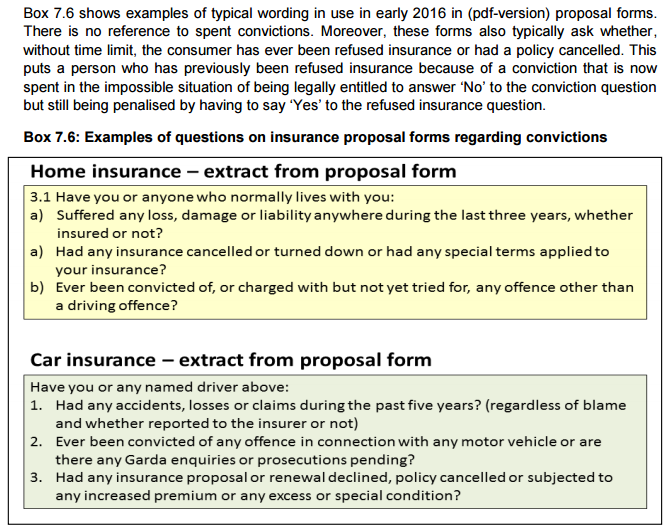
Although it didn’t name the companies involved, the FCA paper included two anonymous examples of current questions by home insurers and motor insurers.

question
Extract from the FCA occasional paper

The poor wording of questions by insurers is a major problem. Unlock’s helpline regularly gets contacted by people using insurance websites and asking us for clarity about what they do and don’t need to disclose. Very often, this is because the insurance company hasn’t made it clear that they don’t need to disclose convictions that are now spent under the Rehabilitation of Offenders Act 1974.

This is something we’re looking at. We’ve had one our helpline advisors do some research into the questions asked by insurers, and we’re in the process of pulling this together and analysing the findings.

As an aside, it was good to see a number of other issues featured in the occasional paper, including:

  1. The numbers of people affected – In the infographic that the FCA used, they said that 750,000 people with unspent convictions and their families can struggle. This comes from a figure we presented a couple of years ago, and this is a conservative estimate of the numbers with unspent convictions. Although this figure is an underestimate for another reason – it doesn’t include those that are potentially covered by some of the misleading questions that insurers ask (see below). When this is taken into account, the numbers affected by the practice of insurers runs into the millions, given there’s over 10.5 million people in the UK with a criminal record.
  2. The lack of insurance products for people with unspent convictions
  3. How people with convictions can be good customers

More information

  1. You can find out more about the FCA occasional paper.
  2. There are details of our policy work on fair access to insurance and dealing with misleading questions.
  3. For practical self-help information on insurance, visit the information section on our website.
  4. There is practical guidance for insurers

We must encourage and support employers to recruit people from prison

Whilst government announcements last month to reform prisons and improve prisoner education are welcomed, much more needs to be done to encourage and support employers to recruit people with a criminal record.

Employers like Timpsons and Greggs have shown that people with convictions can make fantastic employees and that there is actually a business as well as a social benefit in opening up job vacancies to them. That’s why the Ban the Box campaign, led by Business in the Community, has been so important. Similarly, the Employer Forum for Reducing Reoffending (EFFRR) does excellent work, but as Dame Sally Coates noted in her review, it is still relatively small in scale. There’s also the national See Potential campaign led by the Department for Work and Pensions; they have focused in on people with a criminal record in encouraging employers to think differently about how they recruit.

People with convictions are not inherently ‘a risk’. There is a broad range of ‘ex-offenders’ and in our work with employers we emphasise the importance of recruiters not discounting applicants simply because of their criminal record. For those leaving prison, the cost of unemployment strongly translates into increased chances of reoffending.

Reforms to prisons must go hand-in-hand with more work done at a local, regional and national level to encourage and support employers. So-called ‘reform prisons’ will need to focus on the employment outcomes of those released, which is also important. Community Rehabilitation Companies will be an important part of this puzzle too, supporting people as they leave prison or serving their sentence in the community, yet there is little evidence of CRC’s supporting employers in an effective way.

The national work of Ban the Box, See Potential and EFFRR are important in changing attitudes. Regional employer networks, as recommended by the Coates Review, may well be an important connector between national initiatives and individual prisons supporting individuals to find employment on release.

More information 

  1. You can find out more about our fair access to employment project

The way insurers lock out people with court convictions is bizarre


Mainstream home and car insurers have a blanket ban on people with unspent convictions – these kinds of policies are unfair and sometimes illegal

To many of the 1.2 million people convicted in court each year, it comes as a surprise to find that if they try to take out home insurance, or renew their existing policy, they’ll probably struggle. Every mainstream home insurer has a blanket ban on people with unspent convictions.

They say that ex-offenders are higher risk, citing vigilantism, arson and potential reoffending as some of the justifications. Many motor insurers do the same. Put simply, insurers use unspent convictions as a proxy for risk.

But research shows that those with a stable job, home and lifestyle are much less likely to reoffend. They become contributors to the system, rather than a burden. If we want people with convictions to be integrated into society, we have deal with the obstacles that stand in their way. If we would rather exclude them and treat them differently, we should not be surprised if stubbornly high reoffending rates continue to plague our failing criminal justice system.

Dubious practices
Insurers have the right to make risk judgments – they regularly load premiums for those living in high-crime areas – but their approach to criminal records is bizarre for an industry based on assessing risk. They place significant emphasis on whether a conviction is still unspent, which is determined by the Rehabilitation of Offenders Act 1974.

We must learn to allow people to move on with their lives once they have paid their debt to society

This affects a lot of people. If you’re convicted of an offence and receive a fine, your conviction remains unspent for a year. And if you’re sentenced to four years or more in prison – as 7,000 people a year in the UK are – your conviction will never be spent.

Insurers are not legally allowed to consider spent convictions when they give you a quote. But it’s an arbitrary line: when it’s unspent, they refuse to quote; once it’s spent, they are not allowed to know.

Yet many insurers fail to make it clear that people don’t need to disclose spent convictions. Hidden away in Churchill’s online assumptions for home insurance, it states that you must “have never been convicted of any criminal offence (other than motoring convictions)”. This statement potentially covers the 10.5 million people in the UK that have a criminal record (excluding motoring offences). At best, this is bad practice. At worst, it’s unlawful – insurers have a legal duty to follow data protection and disclosure legislation. People with spent convictions have a legal right to access the same insurance as anybody else and insurers need to be clear with their customers about this.

Ending discrimination
This problem is not new. Nearly 12 years ago, the Guardian’s prisons correspondent Eric Allison wrote about insurance companies denying cover to ex-offenders. In research carried out by Unlock in 2010, 86% of former prisoners said it was harder to get insurance and four-fifths said that when they did get it, they were charged more. This prevents people from getting a mortgage, driving vehicles, securing employment and starting up small businesses.

Things have improved. Unlock runs an online disclosure calculator to help people work out if their convictions are still unspent. If they are unspent, it’s not impossible to get insurance – there are specialist brokers – but little competition can mean increased prices.

Critically, we have never seen any robust evidence for the claim that correlates criminal records and higher risk. Quite the opposite. The specialist brokers that work quietly behind the scenes have some of the best claims ratios of all of their customers.

Mainstream insurers must stop this discrimination. Not only would it demonstrate corporate social responsibility, but there is a strong business case for entering a market that has higher premiums and low claims ratios. They could be developing more progressive, data-driven, risk-pricing models. The Financial Conduct Authority should regard this as a market failure and raise access issues that come as a result of insurers not doing proper risk-profiling.

Ultimately, we must learn to allow people to move on with their lives once they have paid their debt to society.

More information

Breakthrough or cosmetic? Prime Minister supports ‘banning the box’

Quite understandably, David Cameron’s speech on Monday was applauded for being the first one dedicated to prison reform by a Prime Minister in over 20 years. Interestingly though, as he set out his ‘agenda for a revolution in the prison system’, one of the things that caught Unlock’s attention appeared towards the end of his speech and was not, strictly speaking, about prisons.

It was about people with criminal records applying for jobs, and the difficulties they face because of the stigma of their record.

“There’s a simple problem: today, ex-offenders are often rejected for jobs out right because of their past. I want us to build a country where the shame of prior convictions doesn’t necessarily hold them back from working and providing for their families.”
David Cameron

The Prime Minister was addressing a major social problem that affects more than the 85,000 people in prison. There are over 10 million people in the UK with a criminal record.

When you last applied for a job, can you remember whether there were boxes on the application form that you quickly ticked ‘No’ to? Well, what happens if you happen to have to tick ‘Yes’ to one? This is a concern that millions of people with criminal convictions have because many employers still continue to ask about criminal records, and ticking that box often leads to your application being put in the bin.

That’s why I welcome David Cameron’s announcement that he supports the Ban the Box campaign, with the commitment that all of the civil service would be ‘banning the box’ from their initial recruitment process.

The Ban the Box campaign, led by Business in the Community and supported by Unlock, started in America. In the two years since it was launched in the UK, 58 employers with a combined workforce of 425,000 have banned the box. This helps employers to access a huge talent pool of people that are often put off from applying due to the tick-box. It also gives people with convictions a chance to enter work – significantly reducing their likelihood of re-offending.

The civil service is one of the country’s biggest employers, so this news is a welcome boost to the employment prospects of the millions of people with a criminal record. However, in a blog post on the GOV website, Robert McNeil, the chief people officer of the Civil Service, set out some details to their approach which raises a couple of questions.

First, what jobs will it apply to? Mr McNeill says: “We recognise there may be some roles with specific security requirements and these will be exempt from this approach: for example roles in law enforcement such as prison officers.” This is unnecessary. There’s no reason why any role should be closed off to banning the box.

To suggest otherwise misunderstands the concept. It’s not about not asking about convictions; instead, it’s about when. Take the example of prison officers. Yes, they require security clearance, but this doesn’t take place at the initial application process. For regulated activity roles working with children, it might be appropriate to check that the person isn’t barred, given that those that are barred would not be legally able to be employed in the role, but that doesn’t mean asking a broad question about criminal records. Only around 0.5% of people with convictions are barred from working with children, so this wouldn’t act as a barrier for the vast majority.

Second, instead of asking on the application form, when will they ask? In his speech, David Cameron gave two potential options: ‘Might this be done a bit later, at interview stage or before an actual offer of work is made?’ he said. Mr McNeill says: ‘The Civil Service will still ask about criminal convictions during the recruitment process, but we will do this after the initial application form stage.’

Unlock suggests that employers ask after a conditional job offer is made. Employers only need to consider the criminal record of the person they decide is the best person the job.

Change of culture
These questions are important to the integrity of the ‘ban the box’ movement. Employers that have signed up so far have genuinely changed their recruitment process, and it’s been more than just about banning the box. If it’s not done right, there’s a risk that people simply get rejected further down the line.

There has to be a change of culture. Banning the box is an important practical change to a recruitment process, but it needs to be alongside a package of changes. In our work with employers, we work on a number of principles that together set employers up for a fairer and more inclusive recruitment policy and practice.

The announcement is, we hope, just the start of a process that moves the Civil Service towards being an employer that recruits people with convictions and treats criminal records fairly. With the Government’s endorsement, we hope many more employers will join the campaign and develop recruitment policies that consider whether an applicant is the best person for the job before looking at their criminal record.

Useful links

  1. This article was originally published on The Justice Gap.
  2. For more information on Ban the Box, click here.
  3. For more information on Unlock’s Fair Access to Employment project, click here.

Unlock supports legal challenge to disproportionate criminal records disclosure scheme

The High Court will tomorrow hear a legal challenge, with the support of Unlock, to the Government’s criminal records disclosure scheme.

There are two cases being heard on Tuesday 8th December, both focusing on how the system forces people with more than one conviction to disclose them forever when applying for areas of work that involve standard or enhanced DBS checks – regardless of specific circumstances.

One case is being brought by Liberty. Their client – referred to in this case as P – committed two extremely minor offences in 1999 while suffering from a then undiagnosed mental illness. P has committed no crimes since and – more than 16 years later – is seeking voluntary positions in schools with a view to achieving her aim of working as a teaching assistant. However, under current rules, she is forced to disclose her two convictions when applying and – in explaining the circumstances of the offences – to reveal details of her medical history. Liberty will argue that this represents a breach of P’s rights under Article 8 of the Human Rights Act – the right to a private and family life. Liberty will also argue that the system is too arbitrary and disproportionate, and requires urgent reform to allow for greater consideration of individual circumstances.

Unlock is supporting this case by providing a witness statement for the High Court.

The second case is being brought by Stephensons. Their client – referred to in this case as A – was convicted of two minor crimes in 1981 and 1982 when aged 17 and 18. He has since worked as an accountant, a company finance director and now project manager – work that often requires due diligence and criminal record checks – and is concerned that he may be forced to disclose his convictions.

The current system

The Police Act 1997 created the Disclosure and Barring Service (DBS – formerly the Criminal Records Bureau), which provides details of a job applicant’s previous convictions. For certain types of work, particularly work with children or vulnerable adults, standard or enhanced certificates issued by the DBS used to list all the job applicant’s previous convictions.

However, in 2013, the Government amended this scheme following a Court of Appeal ruling to introduce a “filtering” process. Single convictions for non-violent, non-sexual offences that did not lead to a suspended or custodial sentence will be “filtered” (i.e. not disclosed) after 11 years (five-and-a-half years if the person was under 18 at the time of the offence).

The new filtering process does not apply if a person has more than one conviction – regardless of the minor nature of the offences or the person’s circumstances at the time.

The Rehabilitation of Offenders Act 1974, which governs the circumstances in which a person has to admit to a previous conviction if asked, operates in a similar way. A person applying to work with children or vulnerable adults does not have to disclose a conviction which is “filtered”.

James Welch, Legal Director for Liberty, said:

“Too many people find their work prospects blighted because of minor offences committed in their distant pasts.


“The Government accepted the logic of letting people move on when it introduced “filtering” two years ago. But, in restricting this to those with only one conviction, it has created a scheme which is deeply unfair to people like my client, with two very minor – and, in this case, connected – convictions.


“We need a system that’s flexible enough to consider individual circumstances – and we hope the High Court will agree that the DBS scheme still needs reform.”

Christopher Stacey, Co-Director of Unlock, a charity for people with criminal records, said:

“Since the filtering scheme was introduced in 2013, we know it’s helped many people with old and minor criminal records to be free of the stigma and discrimination that so many face when they have something on their criminal record. However, it simply doesn’t go far enough. We’ve had thousands of people contact us who continue to have old and minor records disclosed to employers when they have no relevance to the role they’re applying for. That’s why we’re supporting this legal challenge.  The current system is blunt, too restrictive and disproportionate.”

More information

Marking 15 years of Unlock

Unlock has now been a charity for fifteen years. To mark the occasion, supporters and beneficiaries joined staff, trustees, patrons, Peers and volunteers at a reception hosted by our President, Lord Ramsbotham.

With the kind permission of The Lord Speaker, Baroness D’Souza, Lord Ramsbotham sponsored our use of the stunning House of Lords River Room; a room reserved primarily for functions held by UK charities, which Lord Ramsbotham described as the loveliest room in the whole of the House. In his welcome speech to guests, he talked about his involvement with Unlock from its beginning and how we have achieved so much whilst remaining true to our founding principal that people with convictions remain at the heart of the charity. Moreover, we have come to play a valuable role in informing government policy by bringing to it a unique insight informed by the experience of thousands of people who we support.

IMG_4327
Lord Ramsbotham (President of Unlock) and Andrew Selous MP (Minister for Prisons, Probation and Rehabilitation)

A point similarly acknowledged by one of our guest speakers, Andrew Selous MP, Minister for Prisons, Probation and Rehabilitation.  With rehabilitation very much at the top of the Minister’s agenda, he described how impressed he was with Unlock’s past and present work and how important it was that we continue. Remarking on a recent visit to a prison, he had been impressed to find prisoners there opening bank accounts as an important part of their pre-release planning, acknowledging how having an account underpinned their ability to get jobs, accommodation and access to services that would be essential in reducing the likelihood of them re-offending. He paid tribute to Unlock’s work with banks, government and prisons that introduced the, now, routine practice. The Minister went on to stress the importance of employment for people with convictions and was keen to learn more about Unlock’s work to challenge and support employers in changing the way employers manage their employment practices.

Another guest speaker was Catherine Sermon, Employment Director of Business in the Community. Catherine echoed the Minister’s emphasis on the importance of employment and in particular, of the work Unlock is doing alongside the BITC to change the way employers set about recruitment by its ‘Ban the Box’ approach. That is, to remove the tick-box on application forms that asks people to declare unspent convictions and deferring it to a later stage when an individual’s application had been judged solely on merit and a candidate invited for interview or even offered the job.

The room was then moved to hear two people – Donald and Sam (names changed to protect their identities) – describe their experience of how it feels to be judged on their past convictions when looking for work and how Unlock had helped them both practically and emotionally to move on positively in their lives. It was humbling to listen to them talk about how their lives had been made better by the work we do. There were a few tissues being discreetly applied to eyes all around the room!

Our final speaker was one of our newer trustees – Val Woodcock. Val had found Unlock after seeing the effect that having a conviction had been on a family friend. She recounted how she learned first-hand how her friend found living with a conviction was as bad if not worse than his time in prison. It was a double-punishment. A story we hear time and again from people coming to us for help.

Meeting so many of the people who support Unlock and also the people we in turn help, was a very special occasion. The charity has come a long way in the past fifteen years and we’ve achieved some outstanding successes along the way. We’re grateful to everyone who came along and helped us mark this milestone and to all those who were unable to come but who continue to support the work we do.

We look forward to the next fifteen years!


Written by Julie Harmsworth, Co-Director of Unlock

Google ordered to remove search results about a spent conviction

In an interesting development to the issue of the ‘google-effect’ and spent convictions, the Guardian has reported that Google has been ordered by the Information Commissioner’s Office to remove nine links to current news stories about older reports which themselves were removed from search results under the ‘right to be forgotten’ ruling.

The search engine had previously removed links relating to a 10 year-old criminal offence by an individual after requests were made as the offence is now spent under the Rehabilitation of Offenders Act.

Removal of the original links from Google’s search results led to new news posts detailing the removals, which were then indexed by Google’s search engine. Google refused to remove these further links, which included details of the original criminal offence, despite them forming part of search results for the individual’s name, arguing that they are an essential part of a recent news story and in the public interest.

Google now has 35 days from the 18 August to remove the links from its search results for the individual’s name.

We will be keeping a close eye on how this case develops, and hope that Google will take the sensible steps of removing the links and upholding the privacy of the individual concerned.


Useful links

  • Have you managed to get details of your convictions removed from search results? Let us know – send us your experience
  • More information on issue of the ‘google-effect’ and spent convictions can be found on our policy page here.
  • We also have practical information for people dealing with the google-effect on our information site.

The ‘non-contracted’ voluntary sector and probation services (Part 2)

Following up on my previous article, here is the second part of my blog originally published as a Clinks Guest Blog, in which I look at the changing relationship between the voluntary sector and probation service provision, and how Unlock is responding. 


There’s one common factor amongst everyone who works with people on probation – their clients have a criminal record.

At Unlock, a key focus is the importance of people with convictions receiving accurate, reliable advice on understanding and dealing with the effects of their criminal record. That means that we provide information, advice and support directly, through things like our self-help information site and our peer-run helpline. However, these are charitably-funded forms of support, for the benefit of individuals directly.

A possible unfortunate consequence of the recent reforms is that voluntary sector organisations have to compete against one another. Some may say this is a good thing – personally, I struggle to match ‘competition’ with the traditional concept of ‘charity’. That’s why we’re taking a different approach.

I recognise that Unlock cannot do everything. Instead, we listen, we respond to gaps, and we develop alternatives. With the changing probation landscape, that has given us a real opportunity to achieve our aim – that people with convictions receive accurate, reliable advice on understanding and dealing with the effects of their criminal record. Of course, many people are no longer on probation, but for those that are, the need is arguably even greater.

So what have we done? Instead of seeking to be commissioned by NOMS or sub-contracted by ‘prime providers’, our role in this context is one of ‘supporting others’.

That’s why, in the last 18 months alone, we’ve provided more of our one-day criminal record disclosure training course, ‘Advising with Conviction’, than ever before. We’ve trained over 400 practitioners, with over 40% being probation-related staff. Some of these have been core ‘ETE’ probation officers – others have been staff of voluntary sector agencies working with probation, such as Michael.

And the feedback has been tremendous. For example, one attendee wrote afterwards that the course was “one of the most useful I’ve done in my 25 year career. Everyone who helps and gives advice to people with criminal records should do this – it should be mandatory”.

But the feedback we’ve had has also made us think. Often, we’re told that this is a very complex subject, and that a day simply isn’t long enough. That’s why we’ve recently responded by developing and announcing dates for a new 2-day course. This has been designed specifically for probation providers, staff in CRC’s, and specialists helping people with convictions to get into employment.

The conversations we’ve had with probation service providers are promising. But it’s clear that it’s taking time for the new providers to get their operating practices in place.

Ultimately, it’s important for me that Unlock remains true to its vision. That means that, in this context, making sure that people with convictions receive accurate, reliable advice on understanding and dealing with the effects of their criminal record.  That’s why we will always try to provide free information and advice to people with convictions.

However, how that works with ‘providers of services’ funded by Government (whether that is probation providers, work programme providers, careers advisors or others) will vary. Our focus isn’t to “sell training” (we don’t profit out of it, as any income simply supports our charitable work) and it’s important to me that Unlock’s work isn’t seen as operating in any kind of ‘competitive’ environment.

Nonetheless, it’s important that probation providers recognise their role in this. As I mentioned in my first blog, we’ve seen an increasing reliance by ‘practitioners’ on our ‘client-facing’ services – and that’s not sustainable for a small, independent charity like Unlock.

It’s right that providers and commissioners properly resource their work, and if they need help to do it, they need to respond accordingly. That’s where there’s a change in the nature of the relationship. For Unlock, it’s an important relationship for us to maintain, as we know that people with convictions often fall down because of the poor advice they’ve received at an earlier stage. We look forward to working with those providers who understand and respect our role, in the same way that we do theirs.


The ‘non-contracted’ voluntary sector and probation services (Part 1)

In this article, originally published as a Clinks Guest Blog, I share my thoughts on the challenges that are emerging from the changing relationship between the voluntary sector and probation service provision. This is the first of two blogs – the second will look at how I see the voluntary sector responding.


What’s the role of charities and voluntary agencies in delivering ‘rehabilitation’ or probation services? That’s not an easy question to answer nowadays, particularly after all of the changes that have come about through Transforming Rehabilitation.

The short answer depends, to some extent, on what type of charity you’re thinking of. Clearly, the bigger service-orientated charities, such as St Giles Trust, Nacro and Catch 22, are playing a big role in contracting and partnering on a regional level to deliver probation and rehabilitation services. Yet what about the medium-sized and smaller charities – what role do they have? Many do fantastic work, on a local/regional level. Yet, in the public announcements about ‘Transforming Rehabilitation’ providers, it was really just the bigger charities that featured. I get the sense that the smaller ones are gradually being included in sub-contracts, but it remains to be seen how much of a role they play. To varying degrees, I’d categorise this group as the ‘contracted’ voluntary sector.

But what about those charities that don’t compete to deliver government-funded services? Or, to put it another way, the ‘non-contracted’ voluntary sector. It doesn’t feel like there are too many around nowadays – there tends to be less focus from government, as they’re not delivering the states responsibilities for them, but there are more than most people would think, and that’s the category that Unlock is in. For us, we’re always trying to get the balance right between providing practical charitably-funded support to people with convictions, while also identifying issues and working at a policy level to try and resolve the problems people face due to their criminal record. We believe that this ‘twin-track’ approach, which has our ‘independent’ status at its heart, is critical in making sure we stay true to the issues that people with criminal records face.

So what does that mean for smaller charities that are not in contractual arrangements with probation providers?

I can only really relate to my experience at Unlock. Firstly, it’s worth bearing in mind that the majority of people we help are no longer in prison or on probation – they’re simply living their life, and have a criminal record. This makes sense when you consider there’s over 10 million people in the UK with a criminal record, and only around 250,000 people on probation.

Yet over recent years, we’ve seen a huge increase in the number of ‘referrals’ we receive from probation agencies in particular. I say ‘referrals’ as we’ve never actually promoted or agreed to take ‘formal referrals’ as might happen with other organisations – it’s not in the nature of our work. We’ve also seen huge increases in direct contact from probation agencies and employment advisors.

At Unlock, we’re principally funded by charitable trusts, foundations and donations. That makes our mandate fairly clear, as we’ve usually set out the work we want to do – either working at a practical level providing support, or working at a policy level to secure long-term changes – and then worked hard to secure the funding to do it.

So how does that work interact or overlap with probation service providers? I think that’s where the nature of the relationship has changed. Rather than recognising the ‘added-value’ that charities can provide, the embedding of charities as ‘core’ providers of services is having a knock-on effect for those that aren’t ‘providers’ in the same way. In other words, there’s an increasing expectation that charities “are funded to do this”, when they might not be. Certainly, the idea of probation services ‘referring’ clients to voluntary sector agencies, when there’s no formal arrangement in place, raises a number of questions. How can charities like Unlock work with probation providers given the current direction of travel? How can probation providers work with charities like Unlock?

I start from a position, organisationally, of mutual respect. It’s important to understand the role of probation services, and understand what is expected of them. Likewise, it’s important to understand the work of the voluntary sector, to be clear about what they’re able to offer, and to whom.

In my next blog, I’ll discuss how we’re trying to overcome some of these questions, so that as an organisation we can remain true to our values and principles, but that we’re able to work in a way which enables us to support providers of probation services, so that ultimately, people with convictions benefit.


We want to make sure that our website is as helpful as possible.

Letting us know if you easily found what you were looking for or not enables us to continue to improve our service for you and others.

Was it easy to find what you were looking for?

Thank you for your feedback.

12.5 million people have criminal records in the UK. We need your help to help them.

Help support us now