Category: Unlock publications

We’ve produced a simple guide to the filtering process

This update is taken from our Information Hub

We know how complicated the criminal records process can be.

The ‘filtering’ process that came in in May 2013 has been quite a culture shock to many people who were previously told that all cautions and convictions would come back on standard and enhanced checks.

At the time, we developed a detailed guide on filtering.

But, through our helpline, we’ve been finding it quite difficult to make filtering simple and easy to understand. Also, as part of delivering our training masterclasses, we found that practitioners were forgetting how this fitted within the broader framework for disclosure.

So, we’ve recently put together a simple guide on filtering. This is available as adownloadable A4 document (click the image below).

filteringsimple

We hope you find it helpful. Let us know what you think by using our feedback form.

People with convictions as trustees – Consultation response by Unlock

Following our recent news about the proposed changes by the Charity Commission, we’ve now submitted our response

As a charity that exists to support the efforts of people with convictions in moving on positively with their lives, and as an organisation which itself has sought to recruit trustees who themselves have convictions, we are concerned about the potential impact of these proposals, as well as being concerned about how the current system operates.

There is a common theme that runs throughout our response – our aim is to ensure that the processes of the Charity Commission work in a way which allows charities the freedom to recruit people as trustees who have unspent convictions, where the charity believes that the individual can fulfil their obligations as a trustee and the charity can show it has taken reasonable steps to protect the interests of the charity.

In addition to drawing on our own experience as an organisation, and the individuals that we’ve worked with, we sought to raise awareness of this consultation amongst organisations that we know keen to have people with convictions involved at a management level within their organisations. In particular, we have worked with Clinks, which is a charity that supports voluntary organisations that work with offenders and their families.

As well as encouraging responses from other organisations, we have included in our response anonymous extracts from the responses that we received, in order to raise awareness of the concerns of other organisations.

Download our response here.


New guide published – Unlocking Criminal Record Checks

On a daily basis, our helpline gets calls from people who are applying for work and don’t know where they stand because of criminal record checks that (increasingly) employers are carrying out.

A couple of years ago, we approached the DBS (Disclosure & Barring Service – known as the CRB at that time) and raised this as a matter of concern. They agreed to support the production of a guide, specifically for people with a criminal record, designed to explain in detail the criminal record checking process, with particular focus on the specific issues that people with a criminal record might face.

The result is a detailed guide which was written by Unlock and which was circulated by the DBS (it was announced in DBS News September 2013). Download the guide here or click the image below.

For Unlock, this guide represents a number of things:

  1. The DBS has recognised people with a criminal record as being a particular audience, and have responded by supporting the production and circulation of this guide
  2. During the writing of the guide, Unlock asked a number of questions of the DBS about their processes, and in a number of respects, the DBS have responded by working to improve aspects of their process
  3. In particular, the guide shines a light on the process of ‘eligibility’. The Establish Eligibility Process Flow-chart (page 19) sets out a clear and detailed process for individuals to follow if they believe that an employer might be asking for the wrong level of criminal record check. It also documents the specific ‘Eligibility query’ process that the DBS has in place to respond to concerns around eligibility from individuals
  4. It provides a starting point by which evidence can be collected about how employers and the DBS are dealing with eligibility issues

Since the guide was published, we’ve already started getting feedback from people. A couple of examples include:

People asking questions of employers: “I went into Human Resources and asked why they were asking for enhanced checks. They wasn’t sure, and once I pointed out that a basis disclosure could be used, they were happy to accept this, and changed their policy as a result. Given my criminal record is spent, it means I don’t have to resign, which I feel I would have had to do otherwise”

People using the DBS’s ‘Eligibility query’ process: “My employer was insisting on an enhanced level check for a job working as a door-to-door salesman. I tried to talk to them, but they wouldn’t listen, so I didn’t have any other option but to consent to the check. Following Unlock’s guidance, I raised a query with the DBS, and they looked into it. The outcome of this was that the DBS wrote to my employer saying that they didn’t think that the position was eligible, and that they should do a basic level check. Result!”

This guide is an important first step, but there is still a long way to go to ensure that employers are carrying out the correct level of checks and at the right time.

We’re keen to get your feedback on this guide, and in particular if you’ve tried to make use of the advice contained it in, either in your dealings with an employer or in raising an eligibility query with the DBS.

Insurance industry and Unlock publish guidance to help people with past convictions to buy insurance

Today we’ve launched guidance with the ABI (Association of British Insurers), to both insurers and individuals, to try to help people to understand what they do and don’t have to disclose, and what insurers should and shouldn’t ask for.

The guidance is available to download here.

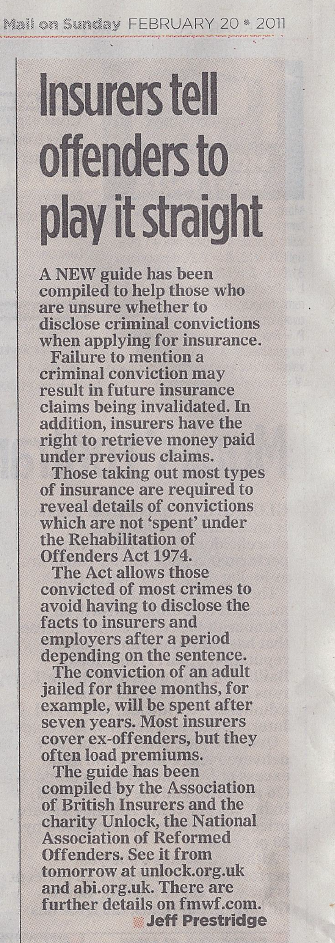
This news was released via the Mail on Sunday (see below) and has been picked up in a number of press outlets, including:


mailonsunday

New insurance guidance to help 8 million consumers with past criminal convictions

Unlock has joined up with the Association of British Insurers (ABI) to produce guidance for consumers and insurers on the complex issue of criminal convictions and insurance.

According to government figures, more than 8 million people in England and Wales have a criminal conviction and one in three men are convicted by the age of fifty-three.

Consumers are legally required to declare convictions even if insurers do not ask about them, unless they are considered ‘spent’ under the Rehabilitation of Offenders Act 1974. A fine or community order must be declared for five years, while short custodial sentences must be declared for between seven and ten years. People sentenced to more than thirty months must disclose their convictions for the rest of their life.

The laws apply to anyone covered by a policy, including partners and children on home policies and named drivers on motor policies. If a child receives a fine then their parents must disclose the conviction for 30 months as disclosure periods are shorter for people convicted when under the age of eighteen.

Many insurers take unspent convictions into account when assessing risk. If ‘unspent’ convictions are not disclosed insurers are able to avoid any claims made on the policy.

Unlock’s guidance, which has been sponsored by online insurers homeprotect, highlights consumers’ legal obligations and provides advice on how to buy insurance. The ABI’s guidance covers insurers’ legal obligations and industry best practice, such as including clear questions about convictions to make sure consumers get appropriate cover.

Chris Bath, Director of Projects at Unlock said: “Financial services are a crucial foundation for engagement in modern society. If we want people to lead productive lives; working, paying taxes and providing their family with a home, we cannot allow the justice system to sever people from their finances, even less to create lifelong financial exclusion.”

Nick Starling, the ABI’s Director of General Insurance and Health, said: “Access to, and fair treatment by, financial services providers is a key part of financial inclusion. We recognise that some people with criminal convictions and related offences may encounter difficulties when looking for insurance. We have produced guidance for our members to ensure that people with criminal convictions get a fair deal from insurers. Customers can expect insurers following the guidance to provide clear information about how they use criminal convictions, ask clear and concise questions, and help those to whom they may be unable to insure.”


If you have a press/media enquiry, click here.

We want to make sure that our website is as helpful as possible.

Letting us know if you easily found what you were looking for or not enables us to continue to improve our service for you and others.

Was it easy to find what you were looking for?

Thank you for your feedback.

12.5 million people have criminal records in the UK. We need your help to help them.

Help support us now