
Our Chris Bath has written a powerful article in a fascinating publication, Civil Dialogue. The article looks at the relationship between Government and the Voluntary Sector. You can download the publication here (see page 12 for the start of the Unlock piece).
Category: Unlock in the media
The role of the financial services industry in reducing re-offending
Linked to the launch of Time is Money, we’ve written a Think Piece for the Chartered Insurance Institute. You can read the article here.
The impact of CRB checks on people
We discuss on BBC Radio Essex about the problems that CRB checks cause people with convictions, and how the system should be improved. You can listen to the piece below.
Caught fare dodging? How even a minor conviction could have a huge impact on your insurance
Today we were featured in a Daily Mail article which looked at how minor convictions can have a huge impact on your insurance. You can read the article here.
The article was also featured on the thisismoney.co.uk website.
New insurance guidance to help 8 million consumers with past criminal convictions
Unlock has joined up with the Association of British Insurers (ABI) to produce guidance for consumers and insurers on the complex issue of criminal convictions and insurance.
According to government figures, more than 8 million people in England and Wales have a criminal conviction and one in three men are convicted by the age of fifty-three.
Consumers are legally required to declare convictions even if insurers do not ask about them, unless they are considered ‘spent’ under the Rehabilitation of Offenders Act 1974. A fine or community order must be declared for five years, while short custodial sentences must be declared for between seven and ten years. People sentenced to more than thirty months must disclose their convictions for the rest of their life.
The laws apply to anyone covered by a policy, including partners and children on home policies and named drivers on motor policies. If a child receives a fine then their parents must disclose the conviction for 30 months as disclosure periods are shorter for people convicted when under the age of eighteen.
Many insurers take unspent convictions into account when assessing risk. If ‘unspent’ convictions are not disclosed insurers are able to avoid any claims made on the policy.
Unlock’s guidance, which has been sponsored by online insurers homeprotect, highlights consumers’ legal obligations and provides advice on how to buy insurance. The ABI’s guidance covers insurers’ legal obligations and industry best practice, such as including clear questions about convictions to make sure consumers get appropriate cover.
Chris Bath, Director of Projects at Unlock said: “Financial services are a crucial foundation for engagement in modern society. If we want people to lead productive lives; working, paying taxes and providing their family with a home, we cannot allow the justice system to sever people from their finances, even less to create lifelong financial exclusion.”
Nick Starling, the ABI’s Director of General Insurance and Health, said: “Access to, and fair treatment by, financial services providers is a key part of financial inclusion. We recognise that some people with criminal convictions and related offences may encounter difficulties when looking for insurance. We have produced guidance for our members to ensure that people with criminal convictions get a fair deal from insurers. Customers can expect insurers following the guidance to provide clear information about how they use criminal convictions, ask clear and concise questions, and help those to whom they may be unable to insure.”
If you have a press/media enquiry, click here.
Insurance industry and Unlock publish guidance to help people with past convictions to buy insurance
Today we’ve launched guidance with the ABI (Association of British Insurers), to both insurers and individuals, to try to help people to understand what they do and don’t have to disclose, and what insurers should and shouldn’t ask for.
The guidance is available to download here.
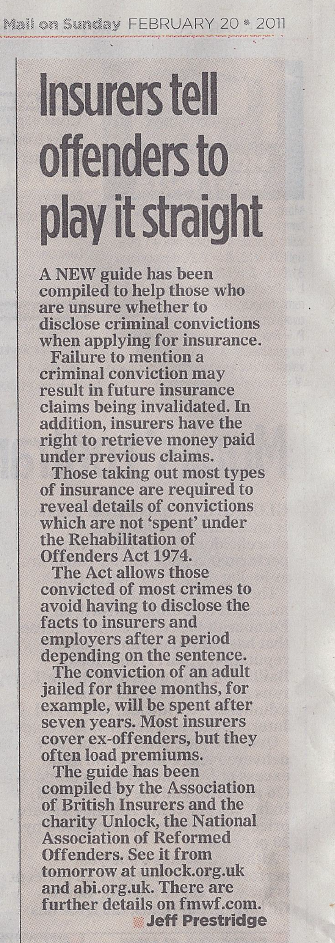
This news was released via the Mail on Sunday (see below) and has been picked up in a number of press outlets, including:
- thisismoney.co.uk – ‘Insurers tell offenders to play it straight
- FinancialPlanner – ABI guide aims to help people with past criminal convictions
- Politics Home – ABI publishes guidance to help people with past criminal convictions buy insurance
- Insurance Daily – ABI: new guidance for customers with criminal convictions
Kent and East Sussex council CRB checks ‘unjustified’
We’re featured in a BBC article that has investigated the use of CRB checks by local councils. Read the article here.
Taking service-user involvement to the next level
We’ve written an article for the Winter 2010/11 Clinks News magazine on service-user involvement. This is available to download here.
Our response to ‘Breaking the Cycle’
We spoke on BBC Radio Kent about the Governments response to the Breaking the Cycle consultation. You can listen to the interview below.
Visit to Northern Ireland / NIACRO / Difficulties with employment interview
Today we’ve been hosted by NIACRO, which is a charity that helps people with convictions in Northern Ireland. They asked us to visit to speak to them about the work that we do, the issues that we face, and to speak to their service user group.
While we were there, we also gave an interview to BBC Radio Ulster, about the difficulties people face in employment. This is available to listen to below.
