
We’ve written an article for The Justice Gap, arguing that the ‘filtering’ process doesn’t go far enough.
Category: For specific groups
Dealing with criminal convictions – embedding a positive process of disclosure
Christopher Stacey, Co-Director, Unlock comments on the issues discussed in a recent Ban the Box webinar.
Quite rightly, the Ban the Box campaign is focused on a specific issue, that being the tick-box that appears on many job application forms, frightening the life out of somebody who has a criminal record.
Many people with convictions see “the box” and immediately de-select themselves out of the job opportunity, usually because their experiences to date have been ones of rejection whenever they’ve ticked that dreaded box. The obvious result to employers is that you’re missing out on a huge pool of talent, which is why this issue is so important.
But ‘banning the box’ is only one part of the puzzle. What this simple concept allows organisations to do is have a much considered recruitment process that firstly focuses on finding the best person for the job, while also recognising that, as an organisation, you might still need to look at criminal convictions once you have a preferred candidate.
This is something that I know from experience. Having worked with employers for many years, I know that some employers can see the benefit of this issue in principle, but when you begin to try and ‘implement’ this, it’s then that it can feel like it’s getting more complicated. What do we do if somebody discloses a conviction? Are we allowed to employ them? Who do we have to tell?
These are all genuine questions that you have to think about, and often this means looking in the round as to what your policy and process are. If you don’t have either of these, you’ll need to seriously consider getting them.
It’s all about building on the principle of ‘banning the box’ and establishing something that works for your organisation. Ultimately, there’s no one-size-fits-all model. As we heard from Interserve in the a recent Ban the Box webinar, they have developed a policy and process that’s unique to them. We have developed a policy at Unlock which we think sends the kind of message that we want to applicants to hear.
However, no matter how good your policy, if this isn’t embedded within your organisation, it probably won’t work. Policies are only as good as the people that use them. Senior managers, HR colleagues and recruiting managers in particular need to feel equipped to make positive decisions about employing somebody with a conviction. That’s one reason why we provide support to employers, because lots of recruiters have myths about criminal records. They don’t understand what they can and can’t ask for, and don’t understand how to deal on an individual case-by-case basis with people with have convictions.
Ultimately, ‘banning the box’ could easily be meaningless to an organisation, even if they’ve signed up to it. It’s perfectly possible (and a genuine risk for the campaign) for the ‘banning of the box’ to end up simply delaying the rejection of applicants with convictions. In many organisations, this requires a cultural shift away from seeing convictions as a ‘negative’ part of the process, and rather looking at how you can deal with them in a positive, informed way. ‘Banning the box’ is a simple but effective first step on a journey which enables employers to see beyond the label of ‘criminal record’ and see the person for the fantastic employee that they could potentially become.
This blog was originally published on the 10th June 2014 at www.bitc.org.uk . The direct link [accessed 13th June 2014] is http://www.bitc.org.uk/blog/post/dealing-criminal-convictions-embedding-positive-process-disclosure
An update on the Rehabilitation of Offenders Act
It’s been just over 3 months since the changes to the Rehabilitation of Offenders Act 1974 came into force in England & Wales. At that time, we published an updatewhich featured new materials that we’d produced, as well as our updated detailed guidance.
Since that point, we’ve learnt quite a bit about how these changes are working in practice, mainly through cases that have come through our helpline. So we thought it was about time we produced another update, highlighting a couple of important practical areas.
Read this update in full on our Information Hub.
Summary of the update
- The importance of getting a copy of your basic disclosure
- The way that ‘court orders’ such as restraining orders and SOPO’s can impact on when a conviction becomes spent
- The way that ‘compensation orders’ work with Disclosure Scotland and basic checks
- The confusion that surrounds motoring convictions
- New ‘Easy Read’ guide on the ROA published
- Updated ‘ROA FAQ’s’
- Send us your examples/evidence
Find out more about all of these in the full update on our Information Hub.
Google’s ‘right to be forgotten’
Information Hub Update
Read this update in full on our Information Hub.
You might have seen in the news recently that Google has launched a system where people can request information be removed from Google’s search results. This has come about because of a ruling on the 13th May by the Court of Justice of the European Union. The case was brought by a Spanish man who complained that an auction notice of his repossessed home on Google’s search results infringed his privacy. The court found in his favour, and this has potentially wide-reaching consequences for search engines like Google.
The ruling only covers the removing of the search results – the information will still exist on the website that published the original article but Google won’t be able to deliver matches to some enquiries that are entered. Deletion of the original information would still be the responsibility of the website owner, and in our experience, it’s very rare that websites agree to remove details relating to convictions (see more in reporting of criminal records in the media).
Information will only disappear from searches made in Europe. Queries piped through its sites outside the EU will still show the relevant search results.
However, many people are still seeing the ruling as a potential way of dealing with the ‘google-effect’ that often haunts people for lots of different reasons, and our Helpline and Forum have already seen this being raised by quite a few people when it comes to past convictions that have been reported online. So the important question for us is whether it will actually help people with convictions?
We’ve published a new section on our Information Hub looking at this, and written a ‘latest update‘ post for our Information Hub. We expect that this information will be regularly updated as we learn more about how the system works in practice.
We’re keen to see how Google are dealing with applications from people with convictions.
To do this, we’re encouraging people with spent convictions to complete Google’s online form, and get a decision from them. Bear in mind that they’re dealing with a lot of applications at the moment, so there might be quite a wait before you get a decision.
Once you receive a decision, please forward it to us to let us know what their decision is and why. You can forward their reply to us by sending it to policy@unlock.org.uk (we won’t share your personal details externally). This will help us to collect evidence of how Google are dealing with requests from people with convictions, and help us to improve the information and advice we’re giving on this issue.
Welcome to our new website
Summary
What’s changed?
Where does this new site fit in?
What do you think?
New links…we need your help
Summary
This week we launched our new website; if you haven’t already seen it, please take a look at unlock.devchd.com.
When we first set out on developing the new site in mid-2013, we carried out a survey to learn more about how people used the site site and how they think it could be improved.
Since then, we launched a dedicated Information Hub in November 2013, and we’ve now added to this with a new core-website.
We’re now looking for your feedback – please complete our short survey here.
What’s changed?
We’ve spent a lot of time sorting out some of the issues we were having with old our site, given it was nearly 10 years old. Some of the key changes;
- The navigation on the site has been improved
- The content on the site has been completely reviewed and updated
- The way our news and updates work should make it a lot easier to find relevant news
- We’ve removed the use of ‘google adverts’
- Some people were finding that their anti-virus software was preventing them from accessing our site. This should now be resolved.
There’s still work to do – it’s not completely finished just yet, but we were keen to make it live as soon as it was possible to publish it – so things will continue to change behind the scenes.
Where does this new site fit in?
This new core website now sits at the heart of the sites that we have. As a quick summary, we have:
- unlock.devchd.com – This is our main/core website, where we explain more about Unlock as a charity, who is involved, the support that we provide, our current areas of focus, and latest news/developments
- unlock.devchd.com/information-and-advice/ – This is our information hub, which we maintain as the country’s most comprehensive source of online self-help information on a wide range of issues that criminal convictions can affect
- forum.unlock.org.uk – This is an online peer-to-peer forum enabling people with convictions to support one another
- www.disclosurecalculator.org.uk – This is a tool that enables you to work out when your convictions become spent under the Rehabilitation of Offenders Act 1974
- unlock.devchd.com/community – This is an online magazine for and by people with convictions
What do you think?
Now that we’ve launched our new core website, we want to know what you think about the new site, as well as how you think our sites could be improved.
We’d be really grateful if you could spare a few minutes to complete our short online survey – this will help us find out what you think to the new site, as well as your thoughts on our other sites. It’s anonymous – none of your personal details are shared with us, so you can be completely honest!
Click here to take part in the survey.
Thank you in advance to those who complete the survey.
New links – we need your help!
The links that used to go to our old site will no longer work (for example, our old homepage used to be unlock.devchd.com/main.aspx and this no longer works).
In the coming days and weeks, we’ll be targeting websites and organisations that still have links to our old site, and asking them to update their links to our new site.
If you know of anybody that links to our site, we’ve provided a list below of some of the most popular parts of our old site, and where they can now be found on the new site. It would be great if you could share this around, or let us know of any out of date links that are being used elsewhere by emailing us at admin@unlock.org.uk:
- Home page – unlock.devchd.com
- Information/advice as somebody with a conviction? Try our Information Hub – some of the more popular areas include:
Rehabilitation of Offenders Act
Disclosure & Barring Service checks / filtering / eligibility
Specific professions / areas of work
Insurance information
Travel abroad
Information on sexual offences
Ways to find out about your criminal record - Support as an employer? Visit our section for employers
- Support as a practitioner? Visit our section for practitioners
- A news or media article? Visit our news section
- Opportunities to volunteer, or ways to donate? Visit our get involved section.
- Our contact details? Visit our contact us section
We would usually recommend you use unlock.devchd.com when linking to our site, as deeper links are subject to change in the future.
Second chances and ‘invisible punishment’
We’re featured in an article that has been published on thejusticegap.com website on second chances and ‘invisible punishment’.
Unlock on Prison Radio talking about the changes to the Rehabilitation of Offenders Act
We’ve recorded a piece with the Prison Radio Association as part of their ‘Outside In’ programme, which is run in partnership with the BBC andgets aired across the prison radio network.
Christopher Stacey spoke about the changes to the Rehabilitation of Offenders Act 1974 and what this means for people serving a prison sentence.
You can listen to the interview below.
Latest voluntary vacancies @ Unlock
We’re recruiting for a number of voluntary positions to work as part of our Helpline.
Roles include Helpline Advisors, Helpline Administrators, and Information Hub Researchers.
More information, including role descriptions and application details, can be found here.
We’ve produced a simple guide to the filtering process
This update is taken from our Information Hub
We know how complicated the criminal records process can be.
The ‘filtering’ process that came in in May 2013 has been quite a culture shock to many people who were previously told that all cautions and convictions would come back on standard and enhanced checks.
At the time, we developed a detailed guide on filtering.
But, through our helpline, we’ve been finding it quite difficult to make filtering simple and easy to understand. Also, as part of delivering our training masterclasses, we found that practitioners were forgetting how this fitted within the broader framework for disclosure.
So, we’ve recently put together a simple guide on filtering. This is available as adownloadable A4 document (click the image below).

We hope you find it helpful. Let us know what you think by using our feedback form.
The Disclosure & Barring Service update the question they ask about convictions
This update is taken from our Information Hub
Following our complaint to the Information Commissioners Office which recently led to the Disclosure & Barring Service signing an undertaking to update their application form, we have now had it confirmed by the DBS that their application form has now been updated. A copy of this is below.
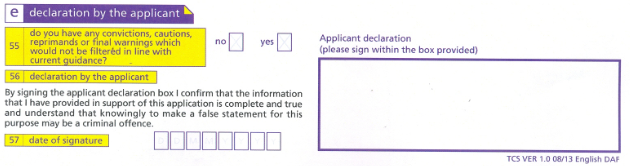
As you can see from the above image, the question (e.55) now asks only about convictions, cautions, reprimands or final warnings which would not be filtered. This means that, if your conviction or caution would be filtered at the time of completing the application, you can tick “no”.
You can find out more about completing a criminal record check application.
How do you know if you conviction or caution will be filtered? The DBS should be including guidance with the application form. We have also produced a simple guide and a detailed guide that should also help.
