
Category: For specific groups

Insurers are not following good practice when dealing with criminal records

Last month, the Financial Conduct Authority published an occasional paper on access to financial services. I fed into this work, particularly focusing on the issues people with convictions face in accessing insurance. So it was good to see the authors include an especially challenging section of the report focused at a lack of buy-in to industry guidance.

There was heavy reference to the work that Unlock has done with the Association of British Insurers (ABI), including developing good practice, but highlighted how:

“it is still commonplace for proposal forms to have questions such as “have you ever been convicted””

The ABI guidance states that it is good practice to refer only to ‘unspent’ convictions, so clearly insurers are not doing this.

guidance
Extract from the FCA occasional paper

Although it didn’t name the companies involved, the FCA paper included two anonymous examples of current questions by home insurers and motor insurers.
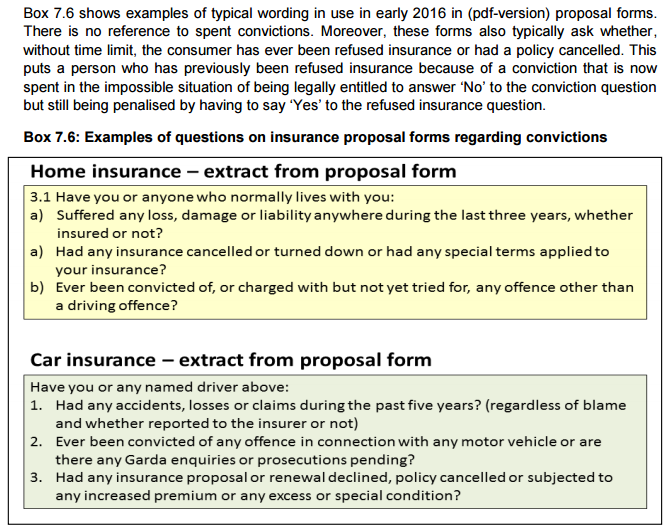
question
Extract from the FCA occasional paper

The poor wording of questions by insurers is a major problem. Unlock’s helpline regularly gets contacted by people using insurance websites and asking us for clarity about what they do and don’t need to disclose. Very often, this is because the insurance company hasn’t made it clear that they don’t need to disclose convictions that are now spent under the Rehabilitation of Offenders Act 1974.

This is something we’re looking at. We’ve had one our helpline advisors do some research into the questions asked by insurers, and we’re in the process of pulling this together and analysing the findings.

As an aside, it was good to see a number of other issues featured in the occasional paper, including:

  1. The numbers of people affected – In the infographic that the FCA used, they said that 750,000 people with unspent convictions and their families can struggle. This comes from a figure we presented a couple of years ago, and this is a conservative estimate of the numbers with unspent convictions. Although this figure is an underestimate for another reason – it doesn’t include those that are potentially covered by some of the misleading questions that insurers ask (see below). When this is taken into account, the numbers affected by the practice of insurers runs into the millions, given there’s over 10.5 million people in the UK with a criminal record.
  2. The lack of insurance products for people with unspent convictions
  3. How people with convictions can be good customers

More information

  1. You can find out more about the FCA occasional paper.
  2. There are details of our policy work on fair access to insurance and dealing with misleading questions.
  3. For practical self-help information on insurance, visit the information section on our website.
  4. There is practical guidance for insurers

From inmates to entrepreneurs

Last month, the Centre for Entreprenuers (CfE) published some brilliant research, From inmates to entreprenuers, looking at the role of setting up businesses and how they can help to break the cycle of reoffending.

We were pleased to support the research by carrying out a survey alongside the CfE which had 158 responses from people with convictions in the community.

As part of the research, 83% said that having a criminal record made it harder to start a business, with 89% saying it made it harder to get insurance for your business.

I was asked to provide a comment for the report. I explained how we know that people with convictions face significant stigma and discrimination from employers as a direct result of their criminal record. Although more work needs to be done on combating this, entrepreneurship is an important alternative that, for some, is the right path towards a productive life as a law-abiding member of society. This research is an important contribution to this area and makes recommendations at both a strategic and operational level to maximise the opportunity that entrepreneurship provides people in achieving their potential.


Written by Christopher Stacey, Co-director of Unlock

Ever been to prison? What support did you get applying for benefits, finding work and returning to normal life?

The House of Commons Work and Pensions Select Committee have launched an inquiry into the benefits and employment support available to people with convictions when they leave prison.

They are interested in hearing from anybody who has had experience of the prison system.

The deadline for consultation is 15th July 2016.

Find out how to have your say on our information site.

Help us to scrap ‘disqualification by association’: The government are consulting on changes to the childcare disqualification arrangements

Ever since ‘disqualification by association’ (DbA) hit the headlines about 18 months ago, we have been working to try and scrap the regulations that have had a significant and unnecessary impact on the partners of those with a criminal record.

Earlier this month, the Department for Education (DfE) published a consultation with proposals for change. The deadline for responses to the consultation is 1st July 2016.

Find out more about the consultation, details of what we’re doing and how you can help on our information site.

Lord Ramsbotham introduces Private Members Bill to shorten rehabilitation periods

Lord Ramsbotham, Unlock’s President, has introduced a Private Members Bill into the House of Lords which would shorten the rehabilitation periods that apply under the Rehabilitation of Offenders Act 1974 (ROA).

The Bill, which had it’s first reading yesterday, proposes a number of changes. One of most significant elements is that sentences of over 4 years in prison would become spent 4 years after the end of the full sentence.

Although the Bill is a long way from becoming law, it’s a welcome step forward in getting further reform to the ROA back on the agenda.

More information

  1. You can follow the progress of the Bill on the Parliament website.
  2. You can find out more information about our work to get further reform to the Rehabilitation of Offenders Act 1974.
  3. There is practical information on how the law currently operates on our information site.

Were the effects of accepting a caution explained to you? Send us a copy of what you were given

Our helpline receives enquiries every day from individuals who have accepted cautions without feeling like they understand the effects of it.

The Home Office guidance on cautions states that ‘the significance of the admission of guilt in agreeing to accept a caution must be fully and clearly explained to the individual before they are cautioned.’

However, different police forces give different guidance and have different forms in place.

We’re interested in seeing copies of cautions that people have accepted in the last two years. This will give us a good idea of the type of written information people were given before they signed to accept the caution.

Find out more on our information site.

Monthly update – May 2016

We’ve just published our update for May 2016.


This months update includes:

  1. A new page about information on the internet, online and through search engines like Google which includes a search engine removal request
  2. Advice on the importance of understanding how Police Certificates are used when working abroad
  3. A personal view on the experiences of working as a volunteer at Unlock
  4. A link to the details of workshops Unlock has been running on criminal records and disclosure in prisons
  5. Details of information we are seeking from people who have received a caution in the last two years


The full update provides a summary of:

  1. the latest updates to our self-help information site for people with convictions
  2. recent posts to our online magazine, theRecord
  3. other news and developments that might be of interest to individuals with a criminal record


Read the May 2016 update in full


Best wishes,

Unlock


Notes

  • All previous updates can be found in full in the ‘Latest updates‘ section of our Information Hub
  • For more self-help information, please visit unlock.devchd.com/information-and-advice/
  • If you have any questions about this information, please contact our helpline
  • If you’ve been forwarded this email, you can sign up to receive these updates directly by clicking here and selecting to receive ‘News/updates for people with convictions’
  • If you have found this information useful, please leave us your feedback and/or consider making a donation.


Timetable for implementation – Charities Act 2016

The Cabinet Office has published a timetable for implementation of the Charities Act 2016, which received Royal Assent on the 16th May 2016.

The relevant section that impacts on people with criminal records will come into force on 1st April 2017.

We’re working with the Charity Commission and there’ll be more news in the coming months. We’ll be posting updates onto our dedicated policy page.

Unlock submits evidence to review of Youth Justice

Today we have published our submission to the review of youth justice.

Our submission focuses on criminal records, disclosure and young people.

Background

  1. In September 2015, Michael Gove announced a review of the youth justice system.
  2. In February 2016, Charlie Taylor, who’s leading the review, published his interim report.
  3. In response to his particular interest in criminal records, Unlock has submitted evidence to the review.
  4. Download: Review of Youth Justice – Unlock submission

We want to make sure that our website is as helpful as possible.

Letting us know if you easily found what you were looking for or not enables us to continue to improve our service for you and others.

Was it easy to find what you were looking for?

Thank you for your feedback.

12.5 million people have criminal records in the UK. We need your help to help them.

Help support us now