
Category: Way ROA works

Dealing with criminal convictions – embedding a positive process of disclosure

Christopher Stacey, Co-Director, Unlock comments on the issues discussed in a recent Ban the Box webinar.

Quite rightly, the Ban the Box campaign is focused on a specific issue, that being the tick-box that appears on many job application forms,  frightening the life out of somebody who has a criminal record.

Many people with convictions see “the box” and immediately de-select themselves out of the job opportunity, usually because their experiences to date have been ones of rejection whenever they’ve ticked that dreaded box. The obvious result to employers is that you’re missing out on a huge pool of talent, which is why this issue is so important.

But ‘banning the box’ is only one part of the puzzle. What this simple concept allows organisations to do is have a much considered recruitment process that firstly focuses on finding the best person for the job, while also recognising that, as an organisation, you might still need to look at criminal convictions once you have a preferred candidate.

This is something that I know from experience.  Having worked with employers for many years, I know that some employers can see the benefit of this issue in principle, but when you begin to try and ‘implement’ this, it’s then that it can feel like it’s getting more complicated. What do we do if somebody discloses a conviction? Are we allowed to employ them? Who do we have to tell?

These are all genuine questions that you have to think about, and often this means looking in the round as to what your policy and process are.  If you don’t have either of these, you’ll need to seriously consider getting them.

It’s all about building on the principle of ‘banning the box’ and establishing something that works for your organisation. Ultimately, there’s no one-size-fits-all model. As we heard from Interserve in the a recent Ban the Box webinar, they have developed a policy and process that’s unique to them. We have developed a policy at Unlock which we think sends the kind of message that we want to applicants to hear.

However, no matter how good your policy, if this isn’t embedded within your organisation, it probably won’t work. Policies are only as good as the people that use them. Senior managers, HR colleagues and recruiting managers in particular need to feel equipped to make positive decisions about employing somebody with a conviction. That’s one reason why we provide support to employers, because lots of recruiters have myths about criminal records.  They don’t understand what they can and can’t ask for, and don’t understand how to deal on an individual case-by-case basis with people with have convictions.

Ultimately, ‘banning the box’ could easily be meaningless to an organisation, even if they’ve signed up to it. It’s perfectly possible (and a genuine risk for the campaign) for the ‘banning of the box’ to end up simply delaying the rejection of applicants with convictions. In many organisations, this requires a cultural shift away from seeing convictions as a ‘negative’ part of the process, and rather looking at how you can deal with them in a positive, informed way. ‘Banning the box’ is a simple but effective first step on a journey which enables employers to see beyond the label of ‘criminal record’ and see the person for the fantastic employee that they could potentially become.

This blog was originally published on the 10th June 2014 at www.bitc.org.uk . The direct link [accessed 13th June 2014] is http://www.bitc.org.uk/blog/post/dealing-criminal-convictions-embedding-positive-process-disclosure
 

An update on the Rehabilitation of Offenders Act

It’s been just over 3 months since the changes to the Rehabilitation of Offenders Act 1974 came into force in England & Wales. At that time, we published an updatewhich featured new materials that we’d produced, as well as our updated detailed guidance.

Since that point, we’ve learnt quite a bit about how these changes are working in practice, mainly through cases that have come through our helpline. So we thought it was about time we produced another update, highlighting a couple of important practical areas.

Read this update in full on our Information Hub.


Summary of the update

  1. The importance of getting a copy of your basic disclosure
  2. The way that ‘court orders’ such as restraining orders and SOPO’s can impact on when a conviction becomes spent
  3. The way that ‘compensation orders’ work with Disclosure Scotland and basic checks
  4. The confusion that surrounds motoring convictions
  5. New ‘Easy Read’ guide on the ROA published
  6. Updated ‘ROA FAQ’s’
  7. Send us your examples/evidence

 
Find out more about all of these in the full update on our Information Hub.

Unlock on Prison Radio talking about the changes to the Rehabilitation of Offenders Act

We’ve recorded a piece with the Prison Radio Association as part of their ‘Outside In’ programme, which is run in partnership with the BBC andgets aired across the prison radio network.

Christopher Stacey spoke about the changes to the Rehabilitation of Offenders Act 1974 and what this means for people serving a prison sentence.

You can listen to the interview below.


Unlock complaint leads to ruling that the Disclosure and Barring Service breached the Data Protection Act

We’re pleased to report that the Information Commissioners Office (ICO) has today issued a press release which sets out their ruling that the Disclosure and Barring Service (DBS) has breached the Data Protection Action after failing to stop collecting information about criminal conviction data that was no longer required because of a filtering regime that was introduced in May 2013.

The DBS hadn’t updated their application forms, and so although the ‘filtering’ process meant that certain cautions and convictions are no longer disclosed on standard and enhanced checks, the DBS were still asking whether applicants had “ever been convicted of a criminal offence or received a caution…” as part of their application form. The result of this was that employers were finding out information which they weren’t entitled to know about.

We made the original complaint to the ICO in September 2013, after our helpline had received a number of calls about this problem. In particular, we highlighted two cases where individuals had disclosed information they no longer needed to disclose, but had subsequently had their offers of employment withdrawn. The two cases are explained in more detail below.

Christopher Stacey, Co-Director at Unlock, said; “We’re pleased to see that the DBS has responded to this issue by updating their application form and improving their guidance to applicants. It is important that people with convictions are able to understand what they do and don’t have to disclose during the recruitment process, and the DBS have an important part to play to make this clear and easy to understand.”

“It remains difficult for people to find out whether a caution or conviction that they have is eligible for filtering, and we would like to see the DBS respond to this issue by introducing a system which allows individuals to obtain a copy of their DBS certificate before they start applying for jobs or volunteer work, so that they can be confident that they’re disclosing the appropriate level of information. We would also like to encourage employers that are entitled to carry out standard and enhanced checks to make sure that they look at their own recruitment processes and make sure that they are only asking about cautions and convictions that would not be filtered by the DBS”.

Brief details of the cases that formed part of our complaint to the ICO

Case One
An individual ticked ‘Yes’ to the question because the question hadn’t changed, and they didn’t see the accompanying guidance. To them, it was clear what question they were being asked, and so despite their conviction being one that would be filtered, they ticked ‘Yes’ which meant, because they handed the form back to the employer to submit, they had disclosed they had a conviction to the employer. The employer asked further questions about this, and decided to withdraw the job offer.

Case Two
An individual ticked ‘Yes’ to this question because they were not sure whether their conviction would be filtered. As there was no other means of definitively finding out whether it would be filtered or not, they erred on the side of caution and ticked ‘Yes’, believing that, if it would be filtered, it wouldn’t matter what they put. It turned out that their conviction was due to be filtered, but because they had ticked yes, their employer got to find out when they handed the form back, and subsequently decided to withdraw the job offer.

-END-

Notes to editors

  1. Press/media
  2. More information relating to the filtering process is available here.

Raising awareness in prisons of changes to the ROA

We’re continuing our efforts to raise awareness of the changes to the ROA, but this time we’ve been focusing on prisons.

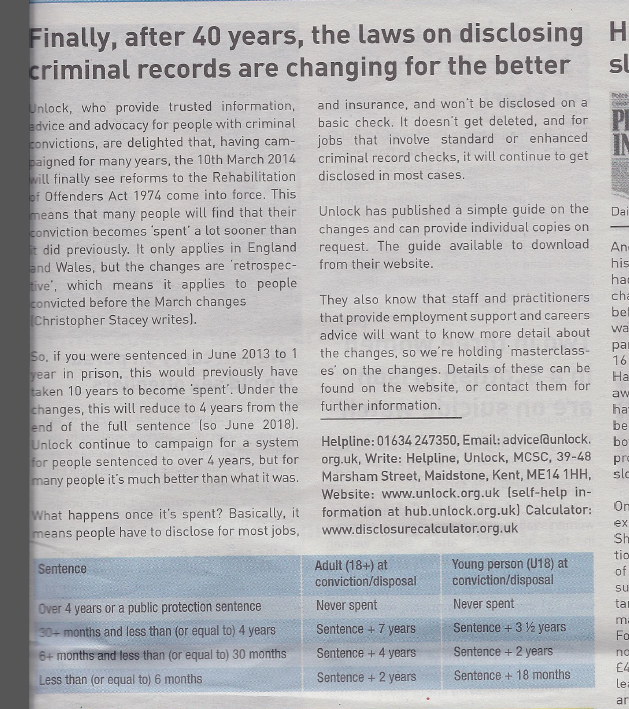
Firstly, we wrote a news piece for the March 2014 edition of Inside Time. A copy of the news piece is below.

We’ve also recorded a piece for the Prison Radio Associations’ ‘Outside In’ programme, which is done in partnership with Radio 4 and recorded by former prisoners. A copy of the audio will be available here shortly.

insidetimeroa

Criminals get better insurance – but not speeding motorists

The Telegraph’s Money section has published a very interesting article about the changes to the ROA and how these do (or don’t) impact on people with motoring offences.

We spoke with the journalist as she was developing this piece, although we’re not specifically referenced.

This article highlights a number of issues that we’re taking forward as part of our ongoing work around the ROA.

You can read the article here.

Raising awareness of the changes to the ROA

In the last couple of days, we’ve been very busy. We’ve been working hard to raise awareness of the changes to the ROA.

Yesterday (10th March) we appeared on BBC Breakfast.

We also took part in a number of regional radio discussions, including BBC London, BBC Radio 5 Live, BBC Leeds, BBC Coventry, BBC West Midlands, BBC Merseyside and BBC Kent.

We also worked with ITN News to provide them with a case study of somebody who’s convictions became spent as of yesterday. This was briefly featured in their lunchtime news programme.

More broadly, we wrote an article for Open Democracy (The right of offenders to get back on track) and an article for Criminal Law and Justice Weekly (Changing laws on disclosure)

Reforms to the Rehabilitation of Offenders Act “will make a huge difference to thousands of people, but they don’t go far enough” says Unlock

On Monday 10th March, the UK Government will finally implement reforms to the 1974 Rehabilitation of Offenders Act. The charity Unlock has campaigned for changes for many years.

Christopher Stacey, Co-Director at Unlock, says:

“There are over 9 million people in England & Wales with a criminal record and more than 1.2 million people get convicted at court every single year. For the majority of these people, these changes mean that the length of time they’ll need to disclose their conviction for will be reduced – for example, more than 800,000 people a year receive a fine at court, and the rehabilitation period for this will reduce from 5 years to 1 year.“


“We know from our helpline that there are thousands of people who were convicted many years ago and have lived law-abiding lives ever since, yet they’ve struggled to find stable employment and pay their taxes because of a conviction that was previously never spent. For many of these people, the reforms will reduce the likelihood that they will face prejudice from employers when applying for most jobs. That’s why we’re publishing updated guidance on the changes so that people know where they stand, and we’ve also updated our free online tool, www.disclosurecalculator.org.uk, which helps people work out when their convictions become ‘spent’ under the Act.”


“Nevertheless, the reforms don’t go far enough. For example, because of the way that the Government has responded to concerns raised by the insurance industry, many people with minor motoring offences will still find themselves having to disclose a conviction to employers for 5 years, which is now longer than somebody who receives an 8 month prison sentence. The law will also continue to tell over 7,200 individuals ever year who are sentenced to over 4 years in prison that they can never be legally rehabilitated, no matter what they do to change their ways.”


“The Rehabilitation of Offenders Act has also been weakened over the years with an increasing number of exceptions to it. Over 4 million standard and enhanced criminal record checks are carried out every year, and these disclose spent convictions without any real assessment as to whether they’re relevant to the job role. We want to see the Government review this exceptions list, and look more closely at what is disclosed on these checks, so that only relevant spent convictions are disclosed.”


“The Government must also do more to clamp down on employers carrying out ineligible standard or enhanced checks. The changes on the 10th March focus specifically on when convictions become spent, and any employer is entitled to carry out a basic disclosure as part of their recruitment process. However, figures releases to us last week from the Disclosing and Barring Service shows that, between March 2012 and February 2014, the DBS stopped 1,385 applications from employers who were looking to carry out a level of criminal record check that they weren’t entitled to.”


“It is clear to us through the work we do with employers that many recruitment and HR managers do not understand this important area of the law and how this effects their recruitment process. It’s important to recognise that this legislation doesn’t deal with how employers should deal with unspent criminal convictions as part of their recruitment process. Part of our focus is in providing practical support to employers so that they’re able to develop safe and effective recruitment processes which enable them to find the best person for the job and not simply rule people out because they have a criminal conviction.”

END

Notes to editors
1. Press/media contact: Christopher Stacey, Co-Director, christopher.stacey@unlock.org.uk / 07557 676433
2. Unlock is an independent award-winning charity, providing trusted information, advice and support for people with criminal convictions. Our staff and volunteers combine professional training with personal experience to help others overcome the long-term problems that having a conviction can bring. Our knowledge and insight helps us to work with government, employers and others, to change policies and practices to create a fairer and more inclusive society so that people with convictions can move on in their lives. Our website is unlock.devchd.com.
3. More information about changes to the Rehabilitation of Offenders Act can be found at unlock.devchd.com/information-and-advice//changestotheroa
4. Unlock’s updated guidance on the Act will be available here from Monday 10th March 2014

Sexual offences and the ROA

This update is taken from our Information Hub

Since we got the news about the changes to the ROA coming in on the 10th March 2014, our helpline has had lots of people contacting us wanting to be sure about how it effects them.

One of the common mistakes we’re seeing is that people with convictions for sexual offences think that this alters the time they are subject to the notification requirements.

Unfortunately, the Government made it clear when passing these changes that they didn’t have any plans to alter the notification periods under the Sexual Offences Act 2003.

This means that it’s perfectly possible for you to have your conviction regarded as ‘spent’ under the ROA changes, but you still be subject to the notification requirements.

We’ve added some information to our page on sexual offences that hopefully helps to clarify this.

Unlock welcomes the implementation of reforms to the Rehabilitation of Offenders Act 1974

Christopher Stacey, Co-Director at Unlock, said “We are pleased that the Government has announced today that the long-overdue reforms to the Rehabilitation of Offenders Act 1974 will come into force on the 10th March 2014. For far too long, people who have served their sentence and changed their ways have been prevented from moving on in their lives. As a result of these changes, many people with convictions who have in the past have been languishing on benefits will now be able to go out and get work and contribute positively to society”.

“Since the law was passed in 2012, our helpline has been receiving calls on a daily basis from people who have been putting their lives and careers on hold, waiting for the changes to come in. It’s clear to us that these changes will make a huge difference to thousands of people whose convictions will now be spent under these changes, giving them a fresh start when applying for many jobs, education courses and insurance services.”

“However, we must not forget that these changes are far from perfect. It will remain the case that anybody who receives a prison sentence of over 4 years will have to continue to disclose their convictions for the rest of their lives whenever they are asked, and this remains a huge stumbling block for many people who are trying to change their lives for the better. If the Government wants to truly transform our criminal justice system, it must recognise that access to stable employment is the most important factor in people desisting from crime, and having a criminal record disclosure system that continues to punish people for the rest of their lives is not in anybody’s interest”.

-END-

Press/media

We want to make sure that our website is as helpful as possible.

Letting us know if you easily found what you were looking for or not enables us to continue to improve our service for you and others.

Was it easy to find what you were looking for?

Thank you for your feedback.

12.5 million people have criminal records in the UK. We need your help to help them.

Help support us now