Category: State use of criminal records

Employers – New criminal offence; make sure you check your recruitment processes!

Tomorrow, the 10th March 2015, a new criminal offence of ‘enforced subject access’ comes into force, which employers and organisations need to be aware of.

This news has implications on the recruitment processes of employers and organisations. In particular, it has an impact on those that ask individuals to obtain a copy of their police record, for example as part of the recruitment process.

To help to understand the practical implications of this news, and what employers should do, we’ve produced a simple guidance leaflet which explains this in more detail.

We have also produced guidance for individuals with convictions. A link to this, and more background information, can be found in our main news piece.

If you have any questions about this as an employer, you can contact us for advice.

Finally, ‘enforced subject access’ becomes a criminal offence

From tomorrow, 10th March 2015, a practice known as ‘enforced subject access’ becomes a criminal offence, as section 56 of the Data Protection Act comes into force.

As we originally reported in an update to our Information Hub in June 2014, this is an important step in making sure that employers and organisations don’t take part in the unsavoury practice of requiring individuals to provide a copy of their police records through their rights of subject access.


Today, to help people understand what this means in practice, we’re:

  1. Publishing brief guidance for individuals on our self-help Information Hub
  2. Providing a news update for employers, as well as brief guidance for employers and organisations
  3. Highlighting the technical guidance that the Information Commissioners Office has published.


Christopher Stacey, Co-Director  of Unlock, said; “Subject access is an important right of individuals to be able to obtain copies of their own criminal record. However, ever since the Data Protection Act came into force, there has been clear evidence of unsavoury practices where employers and others have abused this right by requiring individuals to use this route as a way of checking an individuals’ criminal record, which is a clear abuse, and bypasses the official disclosure regimes which have safeguards built into them.”

“The criminal offence that comes into force will finally give the Information Commissioners Office the tools that they need to deal with the problem. We’ll be monitoring the practices of employers and organisations, and where appropriate, we’ll be challenging those organisations. We also look forward to working closely with the ICO, so that this type of practice can be stamped out. We’re encouraging anybody who knows of practices like this to get in touch with our helpline”.


“Enforced subject access” will become a criminal offence on 10th March 2015

We’ve learnt from the Information Commissioners Office that section 56 of the Data Protection Act 1998 will be brought into force on the 10th March 2015.

This means that “enforced subject access” will finally become a criminal offence. As we explained back in June 2014 when this was first announced, this is an important development for people with convictions.

There is more information about this news on our self-help information site.

Article in Inside Time on ‘filtering’

We’ve written an article for Inside Time on the ‘filtering of convictions.

You can read the article here.

Do you have a caution or conviction that can never be filtered?

The filtering rules set up following Supreme Court’s judgment in R (On the application of T and another) [2014] UKSC 35 mean some cautions and convictions can be filtered from standard and enhanced DBS checks after a period of time. Convictions for specified offences, custodial or suspended sentences and multiple convictions could not be filtered.

In R (On the application of P, G and W) [2019] UKSC 3, it was argued that the rules didn’t go far enough. The court ruled that multiple convictions ought to be filterable, and we’re gathering evidence to show how important it is that these changes are made quickly.


We’d like to hear from you if:

  • you’ve only been to court once, but you were charged for two ‘counts’.
  • you have two separate convictions.

We still don’t think these changes go far enough to help people move on positively with their lives. The court did not rule that the list of offences that can never be filtered should be changed. None of the cases addressed the question of whether custodial or suspended sentences should be filtered. We are gathering evidence to show why this should change. We want to hear from you if you:

  • served a short prison sentence, or suspended sentence, for an offence that could be filtered
  • have a caution or conviction for an offence that currently cannot be filtered – such as
    • Assault occasioning ABH (s.47 Offences Against the Person Act 1861)
    • Robbery (s.8 Theft Act 1981)
    • Loitering for purposes of prostitution (s.27 Sexual Offences Act 1992)

What we need from you

If you are affected by the filtering rules, contact us at policy@unlock.org.uk using the subject header ‘Call for evidence: DBS filtering’. Please include:

  • Your name
  • Your date of birth
  • Contact details (email and telephone) and how you’d be happy for us to contact you
  • Which example above you think your case fits into
  • Details of your cautions/convictions including the dates and a DBS certificate if you have one
  • The difficulties you’ve faced, recently or in the past, as a result of your criminal record not being filtered.
  • Whether you would be willing to contribute to any media coverage on this issue in future (this is for our reference, we won’t share your details without consent)

Any information you provide will be kept in line with our confidentiality policy. Any personal information provided to us will not be shared externally without your consent.

Find out more about how we handle your data.

Find out more about our work on DBS filtering


Employers’ access to ‘subject access’ records will become a criminal offence from December 2014

We’ve learnt today that the Ministry of Justice are planning to bring section 56 of the Data Protection Act (DPA) 1998 into force on the 1st December 2014.

There’s more information about this in an update on our Information Hub.

Supreme Court rules that minor cautions and convictions shouldn’t be disclosed on criminal record checks, and the filtering process remains

The Supreme Court has today ruled on a landmark case, referred to as T. The full judgement can be downloaded here: [2014] UKSC 35.The two individuals involved in the case had originally appealed against the decision to disclose details of their criminal records in job applications. The individuals had been issued warnings and cautions several years ago, and while one of them had been a child. They argued that the disclosure of these warnings and cautions on their enhanced criminal record certificates, which preventing them from getting certain employment, violated their ECHR, Article 8 rights for respect for private life.The Court of Appeal had previously held that the criminal record check process as part of the Police Act 1997 was incompatible with Article 8. This led to theGovernment introducing a filtering process in May 2013. Despite this, the Government appealed to the Supreme Court.

The Supreme Court today unanimously dismissed the appeals against the declaration of incompatibility in relation to the 1997 Act. Although the court did allow the appeal against the declaration by the Court of Appeal that the 1975 Exceptions Order was ultra vires, this is unlikely to have any practical impact, as it’s the first aspect of the appeal, which was dismissed, which has more practical relevance.

The Court said the disclosures in the two cases “were not necessary in a democratic society” and “were not based on any rational assessment of risk”.

Christopher Stacey, Co-Director at Unlock, today said “We welcome today’s decision. The way that criminal record checks have worked in the past were disproportionate and not based on any rational assessment of risk. We were pleased that the Government tried to resolve this by introducing a filtering system in May 2013, and we’re glad that this system will remain in force following this judgement.”

“However, the filtering system doesn’t go far enough. We know from our Helpline that many people with minor cautions and convictions continue to be excluded from the filtering system that the Government set up, simply because they were charged with more than one offence. As a result, in the first 3 months that the filtering system operated, only 15% of people with convictions had a conviction filtered from their record. This means that 85% will continue to have convictions disclosed on standard and enhanced checks for the rest of their lives.”

“We believe that the filtering process must go further. We will be looking at this judgement carefully to look at what can be done to widen the scope of the filtering process to better enable people with convictions to move on positively with their lives once they’ve become law-abiding citizens.”

For a useful legal summary of this case, click here to visit the UKSC Blog.

For more information on the current filtering process that applies to standard and enhanced criminal record checks, click here.

– END – 
 

Notes to editors
2. Unlock is an independent award-winning charity, providing trusted information, advice and supportfor people with criminal convictions. Our staff and volunteers combine professional training with personal experience to help others overcome the long-term problems that having a conviction can bring. Our knowledge and insight helps us to work with government, employers and others, to change policies and practices to create a fairer and more inclusive society so that people with convictions can move on in their lives.
3. Our website is unlock.devchd.com.

Unlock article on TheJusticeGap about ‘filtering’

We’ve written an article for The Justice Gap, arguing that the ‘filtering’ process doesn’t go far enough.

You can read the article here.

The Disclosure & Barring Service update the question they ask about convictions

This update is taken from our Information Hub

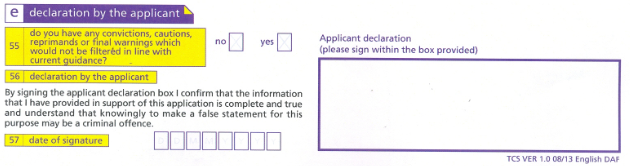
Following our complaint to the Information Commissioners Office which recently led to the Disclosure & Barring Service signing an undertaking to update their application form, we have now had it confirmed by the DBS that their application form has now been updated. A copy of this is below.

e55

As you can see from the above image, the question (e.55) now asks only about convictions, cautions, reprimands or final warnings which would not be filtered. This means that, if your conviction or caution would be filtered at the time of completing the application, you can tick “no”.

You can find out more about completing a criminal record check application.

How do you know if you conviction or caution will be filtered? The DBS should be including guidance with the application form. We have also produced a simple guide and a detailed guide that should also help.

We’ve produced a simple guide to the filtering process

This update is taken from our Information Hub

We know how complicated the criminal records process can be.

The ‘filtering’ process that came in in May 2013 has been quite a culture shock to many people who were previously told that all cautions and convictions would come back on standard and enhanced checks.

At the time, we developed a detailed guide on filtering.

But, through our helpline, we’ve been finding it quite difficult to make filtering simple and easy to understand. Also, as part of delivering our training masterclasses, we found that practitioners were forgetting how this fitted within the broader framework for disclosure.

So, we’ve recently put together a simple guide on filtering. This is available as adownloadable A4 document (click the image below).

filteringsimple

We hope you find it helpful. Let us know what you think by using our feedback form.

We want to make sure that our website is as helpful as possible.

Letting us know if you easily found what you were looking for or not enables us to continue to improve our service for you and others.

Was it easy to find what you were looking for?

Thank you for your feedback.

12.5 million people have criminal records in the UK. We need your help to help them.

Help support us now