
Category: State use of criminal records

Lord Ramsbotham introduces Private Members Bill to shorten rehabilitation periods

Lord Ramsbotham, Unlock’s President, has introduced a Private Members Bill into the House of Lords which would shorten the rehabilitation periods that apply under the Rehabilitation of Offenders Act 1974 (ROA).

The Bill, which had it’s first reading yesterday, proposes a number of changes. One of most significant elements is that sentences of over 4 years in prison would become spent 4 years after the end of the full sentence.

Although the Bill is a long way from becoming law, it’s a welcome step forward in getting further reform to the ROA back on the agenda.

More information

  1. You can follow the progress of the Bill on the Parliament website.
  2. You can find out more information about our work to get further reform to the Rehabilitation of Offenders Act 1974.
  3. There is practical information on how the law currently operates on our information site.

Were the effects of accepting a caution explained to you? Send us a copy of what you were given

Our helpline receives enquiries every day from individuals who have accepted cautions without feeling like they understand the effects of it.

The Home Office guidance on cautions states that ‘the significance of the admission of guilt in agreeing to accept a caution must be fully and clearly explained to the individual before they are cautioned.’

However, different police forces give different guidance and have different forms in place.

We’re interested in seeing copies of cautions that people have accepted in the last two years. This will give us a good idea of the type of written information people were given before they signed to accept the caution.

Find out more on our information site.

Unlock in prison!

In February 2016, we were invited by Plias Resettlement to visit Wormwood Scrubs and Pentonville prisons to present workshops on criminal records and disclosure (they deliver the National Careers Service contract there). The aim was to look at the ongoing effects of a criminal record, how this can affect a person’s ability to reintegrate into society upon release from prison, and how to overcome these.


‘We recommend the workshops that Unlock deliver; they are informative, relevant and provide people with convictions with up to date and accurate information that enables them to move on with their lives.’  PLIAS Resettlement, 2016 


Plias gave us a fairly flexible brief in running a 2-hour workshop. This is where the idea behind our Top 10 things to know about a criminal record came from (which we developed at the same time). We wanted to keep things simple, but wanted to cover some of the key areas of life that people need to be aware of.


Wormwood Scrubs Workshop

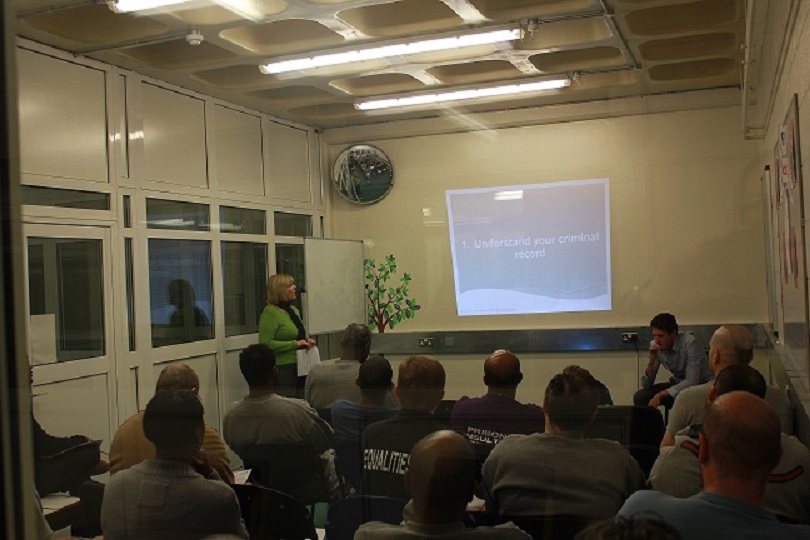
Our 1st workshop at Wormwood Scrubs (photograph courtesy of PLIAS with permission from the prison)


The result was a new ‘Moving on with Conviction’ workshop. The idea being that we would highlight 10 key areas which we think, from experience of running our helpline, are important for anybody with a criminal record to know about, with plenty of opportunity for questions.

We had about 20 men come along to the classroom in the education department at Wormwood Scrubs. With a relatively small number of people, we were able to make the session very interactive with lots of questions and answers and many of the men shared their own personal experiences. Some comments after the event were:-


I think workshops like the one today should take place more often – enlightening


Very positive approach and really well presented


Full of confidence from the first one, we headed off to Pentonville a couple of days later. This one was quite different; it took place in the large prison chapel with around 70 men turning up. The size of the room and the number of people meant that the session had to be far more ‘controlled’ which made it difficult for too much interaction. Initially, this made it quite difficult to engage with the group.

We recognise how hard it is to take any positives out of being in prison and it’s easy to think that a criminal record will prevent you being able to move on successfully in the future. It was clear that many of the men in Pentonville felt this way.

Explaining to the group that there were may employers out there that were willing to give people a second chance and highlighting how 50% of Unlock’s staff and trustees had a criminal record seemed to endorse the positive message we were trying to put across.

From then on, the atmosphere in the room seemed to change, with the session becoming more upbeat. Comments from the men included:-


I understand a lot now about jobs and how to disclose


I felt the event was done very well under pressure


We are grateful to the support of Plias in covering our costs in preparing and delivering these sessions. We’ve come away with some ideas of how we might be able to do more of these in the future, as it’s clear to us that many people in prison are simply not made aware of things they need to be alert to in dealing with the impact of having a criminal record once they’re released.


Written by Debbie Sadler, Advice Manager


More information

You can find out more about our fair access to employment project here or get in touch with us.

Practical self-help information can be found on understanding your criminal record and disclosing to employers.


New research into impact of childhood criminal records and launch of campaign


A child who has offended in England and Wales is shackled to the mistakes of their past by a criminal record system which is punitive, and holds them back from reaching their full potential, according to a report released today by the Standing Committee for Youth Justice (SCYJ).

The report, which reviews criminal record systems in over a dozen countries, finds England and Wales to be an outlier in the extent to which it ties children to past offending.

“A child in England and Wales is not only more likely to acquire a criminal record, but this record will affect them for longer, and more profoundly, than in any of the countries reviewed”

said Penelope Gibbs, Chair of the SCYJ.

“A child who has shoplifted a couple of times will suffer the disproportionate penalty of not only having the offences recorded for life, but also having to disclose it at key points – such as entering university or applying for certain jobs, such as a teacher, or a police officer. No other country reviewed inflicts such tough penalties on a child who offends.”

The far reaching effects on a child go well beyond their sentence. Children with a criminal record face stigma and discrimination in accessing education, training, employment, travel and housing and these obstacles can follow a child into adulthood impacting adversely on their life chances and their ability to reintegrate positively in to society.

In 2013/14 over 60,000 cautions and convictions – all with criminal record implications – were handed out to children in England and Wales. These records will have to be disclosed for many years, and some forever.

The SCYJ is launching a campaign today calling for radical reform of the law on childhood criminal records. Its recommendations include shorter rehabilitation periods, expanding the current filtering system, and wiping the slate clean after ten years.

Christopher Stacey, Co-director of Unlock, in supporting SCYJ’s campaign for reform, said:

“There are over 10.5 million people in the UK with a criminal record, with the vast majority of these being obtained when people are young. Every day we’re contacted by people who are facing stigma and discrimination because of offences they committed when they were under 18. This directly impacts on children’s chances long into adulthood, often for the rest of their lives.”


“Children that commit crime need to be rehabilitated and our youth justice system is supposed to be specifically designed to not impose retributions. However, when it comes to criminal records, the system treats children in a very similar way to adults.”


“There are many parts to the criminal record disclosure system that are disproportionate and unnecessary. A specific attempt to ensure that criminal records do not blight the lives of children is long-overdue. That’s why we’re actively supporting the campaign launched today. The recommended changes would result in a fairer and more calibrated system.”


More information

  1. More information about the report and campaign can be found on the SCYJ website.
  2. The Standing Committee for Youth Justice (SCYJ) is a membership body, representing over fifty organisations, campaigning for a better youth justice system. They pool the expertise of their members to work on issues surrounding children in trouble with the law. Their work focuses on policy and legislation affecting all aspects of the youth justice system and young people caught up in it – from policing to resettlement.
  3. Unlock is supporting this campaign as part of our policy and campaign work.
  4. More information about Unlock’s policy work on the DBS filtering process.
  5. Unlock press/media enquiries.

Disproportionate criminal records disclosure scheme declared unlawful by the High Court

Press Release – 22nd January 2016

The High Court has today declared the Government’s criminal records disclosure scheme incompatible with Article 8 of the Human Rights Act.

The judgment relates to the rule that anyone who has more than one conviction on their criminal record – regardless of the minor nature of the offences, how long ago they were committed and the person’s circumstances at the time – is required to disclose them forever when applying for certain types of work that involve standard or enhanced checks.

Lord Justice McCombe and Mrs Justice Carr declared this rule unlawful under Article 8 of the Human Rights Act, the right to a private and family life.

The case was brought by Liberty and Stephensons, supported by Unlock.

Christopher Stacey, Co-Director of Unlock, a charity for people with criminal records, said:

“Unlock is delighted with the court’s decision in this important case which stands to affect many thousands of people with convictions. Since the filtering scheme was introduced in 2013, it’s helped many people with old and minor criminal records to be free of the stigma and discrimination that so many face when they have something on their criminal record.


“However, the current system doesn’t go far enough: it is blunt, restrictive and disproportionate. These shortcomings have today been recognised by the High Court and we are excited about the improvements which will follow. They will not only benefit those with convictions to move on positively with their lives but it will also contribute towards building a fairer and more inclusive society.”

The argument put forward in the case was that the current system breached rights under Article 8 of the Human Rights Act, that the system is arbitrary and disproportionate, and requires urgent reform to allow for greater consideration of individual circumstances.

Unlock has long argued that a more flexible system, which considers individual circumstances in cases of old and minor convictions, should be introduced. The defendants in this case argued that such a review scheme would be unworkable – but Lord Justice McCombe said he was “far from convinced” by this argument.

The Court has yet to decide on remedies.

James Welch, Legal Director for Liberty, said:

“This ruling will bring reassurance for the very many people who have had their ambitions dashed because of very small mistakes they made years, or even decades, in the past.


“The Government must urgently fix this broken system, which rightly allows people with a single minor offence to move on with their lives, while those with two – no matter the nature or circumstances of their crimes – cannot.


“We are delighted the High Court has recognised the importance of the human right to privacy in allowing people to rebuild their lives.”

Mike Pemberton, head of public law and civil liberties at Stephensons, said:

“The judgment of the High Court recognises that it cannot be necessary or justifiable for an individual to have minor offences disclosed indefinitely from many years ago; merely because there is more than one minor offence.


The court heard that a more serious offence of the same type would be filtered and accepted that there could not be any rationale for the disclosure of the minor offences. I welcome the fact that the court has effectively applied what is common sense to the issue of criminal records”.

END

Notes to editors

  1. Press/media 
  2. Unlock is an independent, award-winning charity for people with convictions which exists for two simple reasons. Firstly, we assist people to move on positively with their lives by empowering them with information, advice and support to overcome the stigma of their previous convictions. Secondly, we seek to promote a fairer and more inclusive society by challenging discriminatory practices and promoting socially just alternatives.
  3. Our website is unlock.devchd.com.
  4. The judgement is available online.
  5. This judgement does not have any immediate impact on the current DBS filtering scheme.
  6. A press release from Liberty is available on their website.
  7. A press release from Stephensons is available on their website.
  8. We have practical self-help information on how the current filtering system works on our information hub.
  9. Find out more information about our policy work on the DBS filtering process here.
  10. The current system is explained below:

One of the cases was referred to as P. In August 1999, P was charged with shoplifting a 99p book. She was bailed to appear before a Magistrates’ Court 18 days later, but failed to attend and was therefore convicted of a second offence under the Bail Act 1976. In November 1990, she was given a conditional discharge in respect of both offences. P’s two convictions relate to a very specific and short period of her life, and she has no subsequent criminal history of any kind. At the time, she had untreated schizophrenia – a condition which was later diagnosed and treated. P now wishes to work as a teaching assistant and has sought voluntary positions in schools. However with each application she is required to disclose her two convictions, which has the effect of leading to the disclosure of her medical history.

The other case was referred to as A. A was convicted of two minor crimes in 1981 and 1982 and was concerned that he would be forced to disclose his convictions as part of his current employment. The Police Act 1997 created the Disclosure and Barring Service (DBS – formerly the Criminal Records Bureau), which provides details of a job applicant’s previous convictions to prospective employers.

For certain types of work, particularly work with children or vulnerable adults, the standard or enhanced certificates issued by the DBS used to list all the job applicant’s previous convictions. However, in 2013, the Government amended this scheme following a Court of Appeal ruling (T v Chief Constable of Greater Manchester) to introduce a “filtering” process. Single convictions for non-violent, non-sexual offences that did not lead to a custodial sentence (including a suspended one) will be “filtered” (i.e. not disclosed) after 11 years (five-and-a-half years if the person was under 18 at the time of the offence).

The new filtering process does not apply if a person has more than one conviction – regardless of the minor nature of the offences or the person’s circumstances at the time.

The Rehabilitation of Offenders Act 1974, which governs the circumstances in which a person has to admit to a previous conviction if asked, operates in a similar way. A person applying to work with children or vulnerable adults does not have to disclose a conviction which is “filtered”.

Unlock supports legal challenge to disproportionate criminal records disclosure scheme

The High Court will tomorrow hear a legal challenge, with the support of Unlock, to the Government’s criminal records disclosure scheme.

There are two cases being heard on Tuesday 8th December, both focusing on how the system forces people with more than one conviction to disclose them forever when applying for areas of work that involve standard or enhanced DBS checks – regardless of specific circumstances.

One case is being brought by Liberty. Their client – referred to in this case as P – committed two extremely minor offences in 1999 while suffering from a then undiagnosed mental illness. P has committed no crimes since and – more than 16 years later – is seeking voluntary positions in schools with a view to achieving her aim of working as a teaching assistant. However, under current rules, she is forced to disclose her two convictions when applying and – in explaining the circumstances of the offences – to reveal details of her medical history. Liberty will argue that this represents a breach of P’s rights under Article 8 of the Human Rights Act – the right to a private and family life. Liberty will also argue that the system is too arbitrary and disproportionate, and requires urgent reform to allow for greater consideration of individual circumstances.

Unlock is supporting this case by providing a witness statement for the High Court.

The second case is being brought by Stephensons. Their client – referred to in this case as A – was convicted of two minor crimes in 1981 and 1982 when aged 17 and 18. He has since worked as an accountant, a company finance director and now project manager – work that often requires due diligence and criminal record checks – and is concerned that he may be forced to disclose his convictions.

The current system

The Police Act 1997 created the Disclosure and Barring Service (DBS – formerly the Criminal Records Bureau), which provides details of a job applicant’s previous convictions. For certain types of work, particularly work with children or vulnerable adults, standard or enhanced certificates issued by the DBS used to list all the job applicant’s previous convictions.

However, in 2013, the Government amended this scheme following a Court of Appeal ruling to introduce a “filtering” process. Single convictions for non-violent, non-sexual offences that did not lead to a suspended or custodial sentence will be “filtered” (i.e. not disclosed) after 11 years (five-and-a-half years if the person was under 18 at the time of the offence).

The new filtering process does not apply if a person has more than one conviction – regardless of the minor nature of the offences or the person’s circumstances at the time.

The Rehabilitation of Offenders Act 1974, which governs the circumstances in which a person has to admit to a previous conviction if asked, operates in a similar way. A person applying to work with children or vulnerable adults does not have to disclose a conviction which is “filtered”.

James Welch, Legal Director for Liberty, said:

“Too many people find their work prospects blighted because of minor offences committed in their distant pasts.


“The Government accepted the logic of letting people move on when it introduced “filtering” two years ago. But, in restricting this to those with only one conviction, it has created a scheme which is deeply unfair to people like my client, with two very minor – and, in this case, connected – convictions.


“We need a system that’s flexible enough to consider individual circumstances – and we hope the High Court will agree that the DBS scheme still needs reform.”

Christopher Stacey, Co-Director of Unlock, a charity for people with criminal records, said:

“Since the filtering scheme was introduced in 2013, we know it’s helped many people with old and minor criminal records to be free of the stigma and discrimination that so many face when they have something on their criminal record. However, it simply doesn’t go far enough. We’ve had thousands of people contact us who continue to have old and minor records disclosed to employers when they have no relevance to the role they’re applying for. That’s why we’re supporting this legal challenge.  The current system is blunt, too restrictive and disproportionate.”

More information

Unlock responds to Scottish filtering consultation

In September, the Scottish Government announced a consultation on a Remedial Order that they’d brought into force on the 10th September.

This, in practice, brought into force a filtering process that applied to standard and enhanced checks processed by Disclosure Scotland, similar to the filtering process operated by the Disclosure & Barring Service.

Although our work as a charity doesn’t directly extend into Scotland, we felt it was important to respond to this consultation to make a number of comments based on the approach that the UK Government took in England & Wales when it introduced a similar process in 2013, as well as raising a couple of practical considerations which we believe are important when reflecting on the current approach of the UK Government.

You can download our response to the consultation here.


Useful links

Help us to challenge employment discrimination

Work is progressing well to lay the foundations for our project to challenge employment discrimination. We’re now at the stage where we want to start opening out the conversation, to help to shape the project.

This update is the first of what we hope will be an ongoing conversation – with employers, with people with convictions, and with others who have an interest in ensuring that employers have fair and inclusive policies and procedures that support the recruitment of people with convictions.

There’s a number of things we’re working on, and we’re keen to get your input.


  1. Help us develop good practice and resources for employers
  2. Send us evidence of bad practice
  3. How would you like to be treated when applying for work?

Help us develop good practice and resources for employers

One of the key focuses of the project is to support employers in developing good policies and practices. One way we’re going about this by developing a resource centre specifically for employers.

So, we’re going back to basics. We want to make sure that we support employers who choose to consider criminal records by helping them to do so in a way that is fair, inclusive and lawful. However, we also want to challenge the inappropriate use of criminal records and to question the assumption amongst some employers that criminal records checks should always form part of their recruitment process in all circumstances.

To help us do this, we want to know what you think ‘good practice’ looks like.

We’re keen to get the thoughts of a range of people. We’re particularly keen to hear from employers about what you would find useful in helping you in this process. We’re keen to highlight the different ways that employers have tried to make themselves more open and inclusive towards people with convictions. We’re also looking for suggestions of existing resources that you’ve found useful.

We’ve put together a short set of questions, and we’d be grateful if you could spare a few minutes to share your thoughts (you can stay anonymous if you wish).

Complete the online survey here.

Alternatively, you can read the questions here and email your answers and other thoughts on this topic to employer@unlock.org.uk.

Send us evidence of bad practice

Alongside our work to support employers to develop good practice, we’re also on the look-out for evidence of bad practice by employers with regards to the policies and processes that they have in place for job applicants with criminal records.

This could include employers that:

  1. Have a blanket policy of not recruiting anybody with unspent convictions
  2. Carry out DBS checks for roles not eligible for them
  3. Request applicants to provide a copy of their ‘police record’ (also known as ‘enforced subject access’)
  4. Don’t give applicants an opportunity to explain their criminal record

Find out more details here about how to send us examples and evidence of bad practice.

How would you like to be treated when applying for work?

Alongside our survey of employers, we’re also keen to hear from people with convictions about how they’d like to be treated when applying for work.

In particular, we’d like to know what you think is a ‘fair’ way of dealing with criminal records as part of the recruitment process.

To do this we’ve put together a short survey for people with convictions.

You can complete the survey online survey here (you can stay anonymous if you wish).

Alternatively, you can read the questions here and email your answers to employer@unlock.org.uk.


Interesting in keeping updated about this work?

You can subscribe to receive these types of updates by email by signing up to our email updates and choosing to receive ‘News on our work challenging employment discrimination’.

We want to make sure that our website is as helpful as possible.

Letting us know if you easily found what you were looking for or not enables us to continue to improve our service for you and others.

Was it easy to find what you were looking for?

Thank you for your feedback.

12.5 million people have criminal records in the UK. We need your help to help them.

Help support us now