
Category: News on policy issues

Unlock submits evidence to review of Youth Justice

Today we have published our submission to the review of youth justice.

Our submission focuses on criminal records, disclosure and young people.

Background

  1. In September 2015, Michael Gove announced a review of the youth justice system.
  2. In February 2016, Charlie Taylor, who’s leading the review, published his interim report.
  3. In response to his particular interest in criminal records, Unlock has submitted evidence to the review.
  4. Download: Review of Youth Justice – Unlock submission

Unlock in prison!

In February 2016, we were invited by Plias Resettlement to visit Wormwood Scrubs and Pentonville prisons to present workshops on criminal records and disclosure (they deliver the National Careers Service contract there). The aim was to look at the ongoing effects of a criminal record, how this can affect a person’s ability to reintegrate into society upon release from prison, and how to overcome these.


‘We recommend the workshops that Unlock deliver; they are informative, relevant and provide people with convictions with up to date and accurate information that enables them to move on with their lives.’  PLIAS Resettlement, 2016 


Plias gave us a fairly flexible brief in running a 2-hour workshop. This is where the idea behind our Top 10 things to know about a criminal record came from (which we developed at the same time). We wanted to keep things simple, but wanted to cover some of the key areas of life that people need to be aware of.


Wormwood Scrubs Workshop

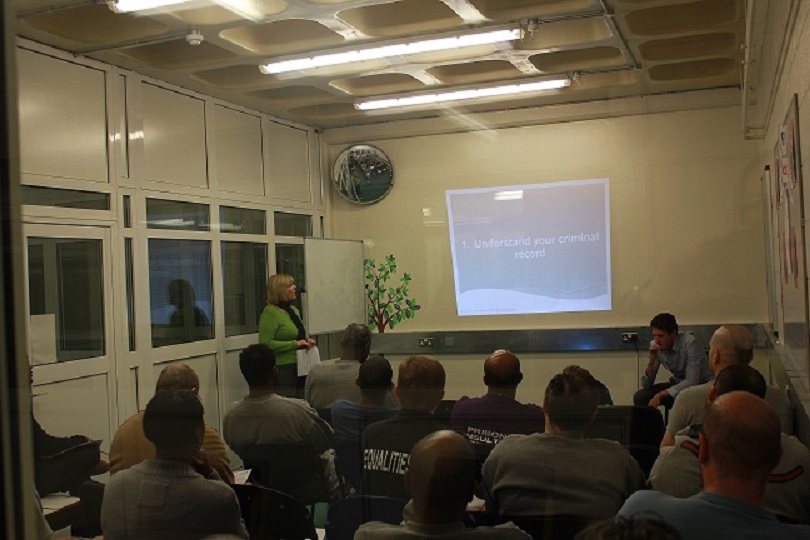
Our 1st workshop at Wormwood Scrubs (photograph courtesy of PLIAS with permission from the prison)


The result was a new ‘Moving on with Conviction’ workshop. The idea being that we would highlight 10 key areas which we think, from experience of running our helpline, are important for anybody with a criminal record to know about, with plenty of opportunity for questions.

We had about 20 men come along to the classroom in the education department at Wormwood Scrubs. With a relatively small number of people, we were able to make the session very interactive with lots of questions and answers and many of the men shared their own personal experiences. Some comments after the event were:-


I think workshops like the one today should take place more often – enlightening


Very positive approach and really well presented


Full of confidence from the first one, we headed off to Pentonville a couple of days later. This one was quite different; it took place in the large prison chapel with around 70 men turning up. The size of the room and the number of people meant that the session had to be far more ‘controlled’ which made it difficult for too much interaction. Initially, this made it quite difficult to engage with the group.

We recognise how hard it is to take any positives out of being in prison and it’s easy to think that a criminal record will prevent you being able to move on successfully in the future. It was clear that many of the men in Pentonville felt this way.

Explaining to the group that there were may employers out there that were willing to give people a second chance and highlighting how 50% of Unlock’s staff and trustees had a criminal record seemed to endorse the positive message we were trying to put across.

From then on, the atmosphere in the room seemed to change, with the session becoming more upbeat. Comments from the men included:-


I understand a lot now about jobs and how to disclose


I felt the event was done very well under pressure


We are grateful to the support of Plias in covering our costs in preparing and delivering these sessions. We’ve come away with some ideas of how we might be able to do more of these in the future, as it’s clear to us that many people in prison are simply not made aware of things they need to be alert to in dealing with the impact of having a criminal record once they’re released.


Written by Debbie Sadler, Advice Manager


More information

You can find out more about our fair access to employment project here or get in touch with us.

Practical self-help information can be found on understanding your criminal record and disclosing to employers.


New research into impact of childhood criminal records and launch of campaign


A child who has offended in England and Wales is shackled to the mistakes of their past by a criminal record system which is punitive, and holds them back from reaching their full potential, according to a report released today by the Standing Committee for Youth Justice (SCYJ).

The report, which reviews criminal record systems in over a dozen countries, finds England and Wales to be an outlier in the extent to which it ties children to past offending.

“A child in England and Wales is not only more likely to acquire a criminal record, but this record will affect them for longer, and more profoundly, than in any of the countries reviewed”

said Penelope Gibbs, Chair of the SCYJ.

“A child who has shoplifted a couple of times will suffer the disproportionate penalty of not only having the offences recorded for life, but also having to disclose it at key points – such as entering university or applying for certain jobs, such as a teacher, or a police officer. No other country reviewed inflicts such tough penalties on a child who offends.”

The far reaching effects on a child go well beyond their sentence. Children with a criminal record face stigma and discrimination in accessing education, training, employment, travel and housing and these obstacles can follow a child into adulthood impacting adversely on their life chances and their ability to reintegrate positively in to society.

In 2013/14 over 60,000 cautions and convictions – all with criminal record implications – were handed out to children in England and Wales. These records will have to be disclosed for many years, and some forever.

The SCYJ is launching a campaign today calling for radical reform of the law on childhood criminal records. Its recommendations include shorter rehabilitation periods, expanding the current filtering system, and wiping the slate clean after ten years.

Christopher Stacey, Co-director of Unlock, in supporting SCYJ’s campaign for reform, said:

“There are over 10.5 million people in the UK with a criminal record, with the vast majority of these being obtained when people are young. Every day we’re contacted by people who are facing stigma and discrimination because of offences they committed when they were under 18. This directly impacts on children’s chances long into adulthood, often for the rest of their lives.”


“Children that commit crime need to be rehabilitated and our youth justice system is supposed to be specifically designed to not impose retributions. However, when it comes to criminal records, the system treats children in a very similar way to adults.”


“There are many parts to the criminal record disclosure system that are disproportionate and unnecessary. A specific attempt to ensure that criminal records do not blight the lives of children is long-overdue. That’s why we’re actively supporting the campaign launched today. The recommended changes would result in a fairer and more calibrated system.”


More information

  1. More information about the report and campaign can be found on the SCYJ website.
  2. The Standing Committee for Youth Justice (SCYJ) is a membership body, representing over fifty organisations, campaigning for a better youth justice system. They pool the expertise of their members to work on issues surrounding children in trouble with the law. Their work focuses on policy and legislation affecting all aspects of the youth justice system and young people caught up in it – from policing to resettlement.
  3. Unlock is supporting this campaign as part of our policy and campaign work.
  4. More information about Unlock’s policy work on the DBS filtering process.
  5. Unlock press/media enquiries.

The Charities Bill receives Royal Assent


On the 16th March, the Charities Bill received Royal Assent.

Following on from concerns raised by Sir Edward Garnier in January, we’re pleased to see that:

  1. The Government has delayed the introduction of the changes to a minimum of 12 months (which is up from potentially only 6 months) which gives charities and people affected by the changes a chance to understand them and prepare accordingly
  2. The Government has responded to our concern about how offences from overseas were going to be treated by, instead, applying the Rehabilitation of Offenders Act as it applies in this country
  3. The Charity Commission has set up a working group and will consult with charities on the review of the waiver process
  4. The Government is going to lay a report on the impact of the bill on people with criminal records

We’re now focusing our efforts on working with the Charity Commission to ensure that:

  1. The review of the waiver process results in a fairer and more inclusive approach towards dealing with people who have convictions that want to become trustees of charities.
  2. There is clear guidance available to both charities and individuals on the impact of these changes and how they can work with the waiver process

We will continue to keep the trustee section of our website up to date with news and developments as they arise.


Useful links

Briefing for insurers on criminal convictions

Back in late January, we took part in a briefing event for the insurance industry on criminal convictions and insurance.

In our day-to-day work, and especially through our helpline, we regularly come across examples of poor practice by insurers. Whether it’s a poor understanding of when convictions become spent, insurers insisting that spent convictions need to be disclosed or claims handlers telling those who make a claim that they have to provide their full police record. All of these are situations that people with convictions regularly face. We want to put a stop to this kind of practice.

That’s why we were pleased to take part in the event in January, hosted by the Association of British Insurers (ABI). We had three main aims:

  1. To help insurers’ understanding of disclosure periods for offences under the Rehabilitation of Offenders Act 1974
  2. To promote good practice when asking for criminal records
  3. To provide guidance to insurers on the proper channels for accessing unspent conviction histories

It was good to see a number of big insurers represented, and it’s clear that there’s a lot more work to do.

We’ve published the briefing that we prepared for the event. We’re also reviewing the questions that insurance companies ask and are working on those examples that we come across that are misleading.

Ultimately, we want to see insurers take a fairer approach towards people with convictions.

More information

The way insurers lock out people with court convictions is bizarre


Mainstream home and car insurers have a blanket ban on people with unspent convictions – these kinds of policies are unfair and sometimes illegal

To many of the 1.2 million people convicted in court each year, it comes as a surprise to find that if they try to take out home insurance, or renew their existing policy, they’ll probably struggle. Every mainstream home insurer has a blanket ban on people with unspent convictions.

They say that ex-offenders are higher risk, citing vigilantism, arson and potential reoffending as some of the justifications. Many motor insurers do the same. Put simply, insurers use unspent convictions as a proxy for risk.

But research shows that those with a stable job, home and lifestyle are much less likely to reoffend. They become contributors to the system, rather than a burden. If we want people with convictions to be integrated into society, we have deal with the obstacles that stand in their way. If we would rather exclude them and treat them differently, we should not be surprised if stubbornly high reoffending rates continue to plague our failing criminal justice system.

Dubious practices
Insurers have the right to make risk judgments – they regularly load premiums for those living in high-crime areas – but their approach to criminal records is bizarre for an industry based on assessing risk. They place significant emphasis on whether a conviction is still unspent, which is determined by the Rehabilitation of Offenders Act 1974.

We must learn to allow people to move on with their lives once they have paid their debt to society

This affects a lot of people. If you’re convicted of an offence and receive a fine, your conviction remains unspent for a year. And if you’re sentenced to four years or more in prison – as 7,000 people a year in the UK are – your conviction will never be spent.

Insurers are not legally allowed to consider spent convictions when they give you a quote. But it’s an arbitrary line: when it’s unspent, they refuse to quote; once it’s spent, they are not allowed to know.

Yet many insurers fail to make it clear that people don’t need to disclose spent convictions. Hidden away in Churchill’s online assumptions for home insurance, it states that you must “have never been convicted of any criminal offence (other than motoring convictions)”. This statement potentially covers the 10.5 million people in the UK that have a criminal record (excluding motoring offences). At best, this is bad practice. At worst, it’s unlawful – insurers have a legal duty to follow data protection and disclosure legislation. People with spent convictions have a legal right to access the same insurance as anybody else and insurers need to be clear with their customers about this.

Ending discrimination
This problem is not new. Nearly 12 years ago, the Guardian’s prisons correspondent Eric Allison wrote about insurance companies denying cover to ex-offenders. In research carried out by Unlock in 2010, 86% of former prisoners said it was harder to get insurance and four-fifths said that when they did get it, they were charged more. This prevents people from getting a mortgage, driving vehicles, securing employment and starting up small businesses.

Things have improved. Unlock runs an online disclosure calculator to help people work out if their convictions are still unspent. If they are unspent, it’s not impossible to get insurance – there are specialist brokers – but little competition can mean increased prices.

Critically, we have never seen any robust evidence for the claim that correlates criminal records and higher risk. Quite the opposite. The specialist brokers that work quietly behind the scenes have some of the best claims ratios of all of their customers.

Mainstream insurers must stop this discrimination. Not only would it demonstrate corporate social responsibility, but there is a strong business case for entering a market that has higher premiums and low claims ratios. They could be developing more progressive, data-driven, risk-pricing models. The Financial Conduct Authority should regard this as a market failure and raise access issues that come as a result of insurers not doing proper risk-profiling.

Ultimately, we must learn to allow people to move on with their lives once they have paid their debt to society.

More information

Progress is made on the Charities Bill


On the 26th January, the Charities Bill was discussed again in Parliament. Sir Edward Garnier MP, a patron of Unlock and a trustee of the Prison Reform Trust, raised a number of the concerns that we’ve been highlighting. He also discussed an amendment that he put forward.

There are some key extracts of what was said below, but in terms of progress, we’re pleased to see that:

  1. The Government has delayed the introduction of the changes to a minimum of 12 months (which is up from potentially only 6 months) which gives charities and people affected by the changes a chance to understand them and prepare accordingly
  2. The Government has responded to our concern about how offences from overseas were going to be treated by, instead, applying the Rehabilitation of Offenders Act as it applies in this country
  3. The Charity Commission has set up a working group and will consult with charities on the review of the waiver process
  4. The Government is going to lay a report on the impact of the bill on people with criminal records

We’re very grateful to the support of Edward Garnier for helping us in this work, and we’re now focusing our efforts on working with the Charity Commission to ensure that:

  1. The review of the waiver process results in a fairer and more inclusive approach towards dealing with people who have convictions that want to become trustees of charities.
  2. There is clear guidance available to both charities and individuals on the impact of these changes and how they can work with the waiver process

We will continue to keep the trustee section of our website up to date with news and developments as they arise.


Some key extracts from the discussion in Parliament

“A number of the provisions of clause 9 represent a direct threat to charities that work to rehabilitate people with criminal records, many of which employ former offenders either as trustees or in senior management positions…”


“Unlock’s direct experience and the support it has provided to other organisations have shown the waiver process to be inadequate and not workable in a way that allows charities such as Unlock to fulfil their charitable purposes. To ensure the process is fair and transparent, much greater clarity is needed regarding the criteria adopted by the commission in assessing waiver applications and the weight given to the views of the trustees of the charity or charities concerned.” Sir Edward Garnier


“Charities and the voluntary sector play a significant role in the support and rehabilitation of ex-offenders, and we should recognise and encourage their important contribution to reducing reoffending and helping former offenders to reintegrate into society. I want to ensure that the Bill’s provisions do not have an undue impact on that very important work…


“For the record, I can confirm that we will not commence the automatic disqualification provisions in clause 9 for 12 months following enactment…


“I have asked the Charity Commission to engage closely with rehabilitation charities, such as Unlock, as it develops new guidance on the waivers ahead of the commencement of the provisions. It has agreed to do so and has started to set up a working group to consider how the changes will be implemented. For example, it has invited several rehabilitation charities to a workshop in February to discuss the Bill and the implementation of these provisions” Rob Wilson MP, Minister for Civil Society


“I agree with my right hon. and learned Friend the Member for Harborough (Sir Edward Garnier) that, in extending disqualification, we must take extra care not to undermine the vital work done by charities involved in the rehabilitation of offenders. I am confident that the waiver process will allow those who have changed their ways a route back into charity trusteeship or senior management.” Matthew Hancock, Minister for the Cabinet Office


Useful links

Civil service to “ban the box” to help rehabilitate people with convictions

This week David Cameron unveiled a raft of prison reform measures.  One of these will be  to scrap the declaration of criminal convictions in the initial application stage for civil service jobs.

Responding to this announcement, Unlock’s  Christopher Stacey said:

“We welcome David Camerons’ commitment to the Ban the Box campaign and in changing the recruitment practice of the Civil Service towards people with convictions.


The Civil Service represents a significant employer and this news is a welcome boost to the employment prospects of the millions of people with a criminal record.


There’s no reason why any role should be closed off to banning the box and we look forward to ensuring that the Civil Service implement the Prime Ministers’ commitment alongside a number of other measures to make it a fairer and more inclusive employer towards people with convictions.


We work closely with employers to encourage them to recruit people with convictions and deal with criminal records fairly. We look forward to working with Government, alongside BITC and others, to encourage more employers to take this proactive approach in removing the barriers people with convictions face when looking for work.”

Our quote was featured in an article in Civil Service World.


Notes to editors

  • Press/media
  • Unlock is an independent, award-winning charity for people with convictions which exists for two simple reasons. Firstly, we assist people to move on positively with their lives by empowering them with information, advice and support to overcome the stigma of their previous convictions. Secondly, we seek to promote a fairer and more inclusive society by challenging discriminatory practices and promoting socially just alternatives.
  • Our website is unlock.devchd.com.
  • David Camerons’ full speech can be read here.
  • More information about Ban the Box here.

Disproportionate criminal records disclosure scheme declared unlawful by the High Court

Press Release – 22nd January 2016

The High Court has today declared the Government’s criminal records disclosure scheme incompatible with Article 8 of the Human Rights Act.

The judgment relates to the rule that anyone who has more than one conviction on their criminal record – regardless of the minor nature of the offences, how long ago they were committed and the person’s circumstances at the time – is required to disclose them forever when applying for certain types of work that involve standard or enhanced checks.

Lord Justice McCombe and Mrs Justice Carr declared this rule unlawful under Article 8 of the Human Rights Act, the right to a private and family life.

The case was brought by Liberty and Stephensons, supported by Unlock.

Christopher Stacey, Co-Director of Unlock, a charity for people with criminal records, said:

“Unlock is delighted with the court’s decision in this important case which stands to affect many thousands of people with convictions. Since the filtering scheme was introduced in 2013, it’s helped many people with old and minor criminal records to be free of the stigma and discrimination that so many face when they have something on their criminal record.


“However, the current system doesn’t go far enough: it is blunt, restrictive and disproportionate. These shortcomings have today been recognised by the High Court and we are excited about the improvements which will follow. They will not only benefit those with convictions to move on positively with their lives but it will also contribute towards building a fairer and more inclusive society.”

The argument put forward in the case was that the current system breached rights under Article 8 of the Human Rights Act, that the system is arbitrary and disproportionate, and requires urgent reform to allow for greater consideration of individual circumstances.

Unlock has long argued that a more flexible system, which considers individual circumstances in cases of old and minor convictions, should be introduced. The defendants in this case argued that such a review scheme would be unworkable – but Lord Justice McCombe said he was “far from convinced” by this argument.

The Court has yet to decide on remedies.

James Welch, Legal Director for Liberty, said:

“This ruling will bring reassurance for the very many people who have had their ambitions dashed because of very small mistakes they made years, or even decades, in the past.


“The Government must urgently fix this broken system, which rightly allows people with a single minor offence to move on with their lives, while those with two – no matter the nature or circumstances of their crimes – cannot.


“We are delighted the High Court has recognised the importance of the human right to privacy in allowing people to rebuild their lives.”

Mike Pemberton, head of public law and civil liberties at Stephensons, said:

“The judgment of the High Court recognises that it cannot be necessary or justifiable for an individual to have minor offences disclosed indefinitely from many years ago; merely because there is more than one minor offence.


The court heard that a more serious offence of the same type would be filtered and accepted that there could not be any rationale for the disclosure of the minor offences. I welcome the fact that the court has effectively applied what is common sense to the issue of criminal records”.

END

Notes to editors

  1. Press/media 
  2. Unlock is an independent, award-winning charity for people with convictions which exists for two simple reasons. Firstly, we assist people to move on positively with their lives by empowering them with information, advice and support to overcome the stigma of their previous convictions. Secondly, we seek to promote a fairer and more inclusive society by challenging discriminatory practices and promoting socially just alternatives.
  3. Our website is unlock.devchd.com.
  4. The judgement is available online.
  5. This judgement does not have any immediate impact on the current DBS filtering scheme.
  6. A press release from Liberty is available on their website.
  7. A press release from Stephensons is available on their website.
  8. We have practical self-help information on how the current filtering system works on our information hub.
  9. Find out more information about our policy work on the DBS filtering process here.
  10. The current system is explained below:

One of the cases was referred to as P. In August 1999, P was charged with shoplifting a 99p book. She was bailed to appear before a Magistrates’ Court 18 days later, but failed to attend and was therefore convicted of a second offence under the Bail Act 1976. In November 1990, she was given a conditional discharge in respect of both offences. P’s two convictions relate to a very specific and short period of her life, and she has no subsequent criminal history of any kind. At the time, she had untreated schizophrenia – a condition which was later diagnosed and treated. P now wishes to work as a teaching assistant and has sought voluntary positions in schools. However with each application she is required to disclose her two convictions, which has the effect of leading to the disclosure of her medical history.

The other case was referred to as A. A was convicted of two minor crimes in 1981 and 1982 and was concerned that he would be forced to disclose his convictions as part of his current employment. The Police Act 1997 created the Disclosure and Barring Service (DBS – formerly the Criminal Records Bureau), which provides details of a job applicant’s previous convictions to prospective employers.

For certain types of work, particularly work with children or vulnerable adults, the standard or enhanced certificates issued by the DBS used to list all the job applicant’s previous convictions. However, in 2013, the Government amended this scheme following a Court of Appeal ruling (T v Chief Constable of Greater Manchester) to introduce a “filtering” process. Single convictions for non-violent, non-sexual offences that did not lead to a custodial sentence (including a suspended one) will be “filtered” (i.e. not disclosed) after 11 years (five-and-a-half years if the person was under 18 at the time of the offence).

The new filtering process does not apply if a person has more than one conviction – regardless of the minor nature of the offences or the person’s circumstances at the time.

The Rehabilitation of Offenders Act 1974, which governs the circumstances in which a person has to admit to a previous conviction if asked, operates in a similar way. A person applying to work with children or vulnerable adults does not have to disclose a conviction which is “filtered”.

We want to make sure that our website is as helpful as possible.

Letting us know if you easily found what you were looking for or not enables us to continue to improve our service for you and others.

Was it easy to find what you were looking for?

Thank you for your feedback.

12.5 million people have criminal records in the UK. We need your help to help them.

Help support us now