Author: Unlock Admin

Launch of unlock.devchd.com/information-and-advice/

Today, we’re announcing the launch of unlock.devchd.com/information-and-advice/, our brand new online Information Hub. It aims to be the country’s most comprehensive source of online self-help information on wide range of issues that criminal convictions can affect.

The site builds on the information we’ve had on our main website for a number of years. We’ve wanted to establish a self-help information site specifically for people with convictions. We’re also working on a new main website for the charity, and this will be launched shortly. You may also notice that we’ve also created a new ‘look’, which is shown in our new logo on this site.

Through the Hub, people with convictions will now have access to easy-to-use information that is specifically designed for them. Given the way that we work as a charity, we believe it is critically important that individuals, and those that work with them, have access to accurate, reliable, up to date information on issues that affect them because of their convictions. This will be backed up by our confidential peer advice helpline.

Hopefully, the site is much more user friendly and easier to navigate. For those who want to familiarise themselves with the site, please see the user guide.

In short, the Hub is made up of three main areas;

Knowledge base

This section is the main part of the site. The Knowledge Base contains details information, advice and experiences relating to specific areas of life that a criminal conviction can impact on. It is broken down into different sections.

Frequently asked questions

This section is regularly updated and is designed to provide specific advice to specific situations, based on the kinds of questions that we receive from people who have used the Hub but have further questions about their own situation.

Latest updates

This section provides a summary of the latest updates to the site. You can also sign up to receive updates by email so that you are sent the details of the updates as and when they happen.

Feedback

We hope you like the site. Now that it’s been launched, we’re trying to get as much feedback as possible, so that we can continue to develop and improve it. Please let us know what you like, what you don’t like, and what you think can be improved. Click to leave your feedback.

Unlock reception at the House of Lords

“I’ve got to run soon,” says Lord Ramsbotham, life peer in the House of Lords and president of Unlock. Speaking at Unlock’s reception, he adds: “But before I do I have to say, this is one of the nicest rooms in the House of Lords. It was a drawing room for the Lords Chancellor and now it’s the Lord Speakers room. He stipulated that the only people who could use it would be do-ers organisations. Organisations like Unlock. This charity represents to me something very remarkable because the people have been there and are coming and doing it for other people.”

We’re gathered in this plush room in the House of Lords tonight to learn about the new direction of Unlock. Now known as Unlock – for people with convictions, the new name has a double meaning. It’s not just criminal records that the new title eludes to. It’s also people’s convictions to reach their full potential.

Political freedom fighter and playwright, Charlie Ryder says: “I welcome Unlock’s name change to ‘people with convictions’. Ex-offender is so offensive. I feel it’s a permanent label based on the worst thing you’ve ever done. It focuses on the past rather than the future. None of us would like to be judged at the lowest point in our lives.”

Unlock trustee Carlotta Allum can relate: “I am someone with a conviction from 16 years ago and the ignorance and prejudice I have faced shocked me. Immediately after my crime I kept my head down. I trained to be an art teacher. But lots of people started judging me on my conviction even though I was doing well at my placement in school.”

But charities like Unlock can help with this. They’re currently responding to social and political climate. It isn’t enough to make a difference, they say, and so they prove it day in, day out.

“We hold true to the ethos that our charity should be led by people with convictions. This makes all the difference.” says Julie Harmsworth Director of Operations at the charity.

Unlock are looking forward. They have their new terminology. They’re launching a new website at the end of the year. And they’ve launched their new information hub – the most comprehensive source of self-help information, reaching a quarter of a million people every year, and growing.

One such person Unlock has reached out to is Steve Smith, a former Unlock volunteer. Steve discovered Unlock at the end of a custodial sentence. He soon became the charity’s first volunteer.

Steve says: “When I arrived at Unlock, I wanted to get back into the construction industry. But my mind was open to take on what I could and resettle back into the community. After volunteering with Unlock an opportunity came up for an Office Manage post at Changing Paths, helping people with convictions back into employment. I went to the interview and they gave me the job. I soon started in the role. Today I am the Project Manager at Changing Paths.”

DSC_0050

Pictured above: Judge John Samuels QC (Unlock Vice President), Stephen Smith (Project Manager at Changing Paths) and Linda PIzani-Williams (Chair of Trustees at Unlock)

Thanks to Unlock, many people, like Steve, have succeeded in finding work or fulfilling goals. “I’m thrilled to be an Unlock trustee today” says Carlotta, “As I’m sure you’ll understand, it’s a cause close to my heart.”

Then, before tonight’s ensemble of trustees, supporters, peers and legal eagles, Julie concludes: “You’ve just heard some of the reasons I work for Unlock.”

Written by Erica Crompton, published in theRecord

Unlock endorses ‘Ban the box’

Unlock has today lent its support and endorsement to the ‘ban the box’ campaign, which is being led by Business in the Community. The aim of the campaign is to increase the opportunity for people with convictions to compete for jobs.

Christopher Stacey, Co-Director at Unlock, said “We believe that that, by banning the box, employers are better able to consider convictions at a more appropriate stage in the recruitment process, and at the same time are able to give people with convictions a better opportunity to compete for jobs. Far too often we hear from people who are unable to get past the application part of a recruitment process simply because they have to tick ‘yes’ to the questions about convictions. For employers, the end goal has to be to try and find the best person for the job, and with over 9 million people in the UK with a criminal record, banning the box about convictions is one simple step towards this goal.”

“Critically, we believe that it’s important for this campaign to be led by the business community itself, and that’s why we are wholeheartedly behind BITC in their efforts to take this campaign forward. Behind the scenes, we are able to provide confidential advice, support and training to employers on how they can best put the principles of this campaign into practice in their company, using our knowledge and experience of working with both individuals who have convictions as well as employers who are actively looking to improve their recruitment policies and practices.” 

“In so far as our own recruitment process, Unlock has banned the box for both paid and voluntary opportunities. We have a specific policy on the disclosure of convictions, where we explain to applicants that we do not ask about convictions at application stage. We provide individuals who are invited to interview with a self-disclosure form, which we ask them to complete and bring with them to their interview. At the end of the interview, we have a separate discussion where we ask questions about the information they have disclosed on this form, and we make it clear that this will only be considered once we have made a decision about whether they are the right person for the job.” 

More information about Ban the Box from BITC is available from bitc.org.uk/banthebox and #BantheBoxUK

Ban the Box Interactive Video

Did you skip? Watch the film again to see the story a different way.

Support for the Ban the Box campaign

As part of our support for Ban the Box, we spoke on Radio 5 Live about the campaign.

You can listen to the interview below.

Further delays to changes to the Rehabilitation of Offenders Act 1974

Please see below an update that we have received from the Ministry of Justice late last week regarding planned changes to the Rehabilitation of Offenders Act 1974.

Although we’re disappointed to bring you this news, we felt it was important to provide an update as soon as we knew that the situation had formally changed. This will not come as a surprise to some – the lack of an update from Government has led many people to rightly question whether the changes were going to come in by November. A thread has been running on our forum since January this year, questioning originally whether the changes were going to come in by Spring 2013.

Sadly, while it’s frustrating that it is no longer going to be November, the situation is undoubtedly made worse by the lack of a specific future date. To put it simply, although they are optimistic that they will be able to put an end to the uncertainty on the date of commencement fairly soon, they are still unable to give a definite timetable.

In our view, the combination of a delay plus the lack of a specific delay is unforgivable. When the initial reforms were passed in April 2012, a 12 month window was given to allow the Government time to get the necessary systems in place. The initial implementation date of Spring 2013 led to many people planning their lives on these changes. Our Helpline has been inundated with enquiries ever since from people who are desperately waiting for the changes to come in.

We are continuing to do all that we can so that the Government implement the reforms as soon as possible. We are urging the Government to announce a specific date for when the changes will be introduced. We are also meeting with MP’s with an interest on this issue to see what can be done to speed up this process.

To help, we encourage anybody who is personally affected by these delays, or feels passionately about the way this is being managed by Government, to write to their MP and ask them to raise this issue as a matter of priority with the Ministers of State for both the Home Office and the Ministry of Justice. You can encourage your MP’s office to contact us directly if they want to help in some way. Ultimately, it’s important that the Government realise how important these changes are, and how many peoples’ lives are being put on hold by these delays. However, the difficulty at this stage is in finding practical ways in which this process can influenced.

Update from the Ministry of Justice

Whilst the Government was aiming to commence the reforms by November this is not going to be possible but it remains committed to seeing these reforms in place, which will to the benefit of many ex-offenders, and it will give a firm timetable on commencement as soon as it can. As you know, the critical prerequisite for the commencement of the reforms is to put in place a system for producing basic disclosure certificates, which show unspent convictions, reflecting the new rehabilitation periods in England and Wales. Until we do that there would be no way for an individual to obtain an official statement of their unspent convictions under the new rules.

Currently, basic disclosures reflecting the existing rehabilitation periods are available from Disclosure Scotland and this service is provided to residents of England and Wales as well as Scotland. However, the reforms to the ROA only revise rehabilitation periods for England and Wales, leaving the position in Scotland unchanged under its legislation. This complicates matters and creates two different rehabilitation regimes within Great Britain.

One option to address this situation is to agree with Disclosure Scotland that they will provide two differential basic disclosure services, one reflecting the rules in Scotland and the other the rules in England and Wales. Another option is for the Disclosure and Barring Service to initiate a basic disclosure service for England and Wales which adheres to the reformed rules in this jurisdiction. Neither of these options is straightforward and there are significant business and technical issues to work through. However, the Government expects these issues to be resolved shortly.”

Questions?

If you have any questions about this information, please contact us.
If you’d like to discuss this information with others, there is a specific thread on our online forum.

Further delays to changes to the Rehabilitation of Offenders Act

Please see below an update that we have received from the Ministry of Justice late last week regarding planned changes to the Rehabilitation of Offenders Act 1974.

Although we’re disappointed to bring you this news, we felt it was important to provide an update as soon as we knew that the situation had formally changed. This will not come as a surprise to some – the lack of an update from Government has led many people to rightly question whether the changes were going to come in by November. A thread has been running on our forum since January this year, questioning originally whether the changes were going to come in by Spring 2013.

Sadly, while it’s frustrating that it is no longer going to be November, the situation is undoubtedly made worse by the lack of a specific future date. To put it simply, although they are optimistic that they will be able to put an end to the uncertainty on the date of commencement fairly soon, they are still unable to give a definite timetable.

In our view, the combination of a delay plus the lack of a specific delay is unforgiveable. When the initial reforms were passed in April 2012, a 12 month window was given to allow the Government time to get the necessary systems in place. The initial implementation date of Spring 2013 led to many people planning their lives on these changes. Our Helpline has been inundated with enquiries ever since from people who are desperately waiting for the changes to come in.

We are continuing to do all that we can so that the Government implement the reforms as soon as possible. We are urging the Government to announce a specific date for when the changes will be introduced. We are also meeting with MP’s with an interest on this issue to see what can be done to speed up this process.

To help, we encourage anybody who is personally affected by these delays, or feels passionately about the way this is being managed by Government, to write to their MP and ask them to raise this issue as a matter of priority with the Ministers of State for both the Home Office and the Ministry of Justice. You can encourage your MP’s office to contact us directly if they want to help in some way. Ultimately, it’s important that the Government realise how important these changes are, and how many peoples’ lives are being put on hold by these delays. However, the difficulty at this stage is in finding practical ways in which this process can influenced.

Update from the Ministry of Justice

“Whilst the Government was aiming to commence the reforms by November this is not going to be possible but it remains committed to seeing these reforms in place, which will to the benefit of many ex-offenders, and it will give a firm timetable on commencement as soon as it can. As you know, the critical prerequisite for the commencement of the reforms is to put in place a system for producing basic disclosure certificates, which show unspent convictions, reflecting the new rehabilitation periods in England and Wales. Until we do that there would be no way for an individual to obtain an official statement of their unspent convictions under the new rules.


Currently, basic disclosures reflecting the existing rehabilitation periods are available from Disclosure Scotland and this service is provided to residents of England and Wales as well as Scotland. However, the reforms to the ROA only revise rehabilitation periods for England and Wales, leaving the position in Scotland unchanged under its legislation. This complicates matters and creates two different rehabilitation regimes within Great Britain.


One option to address this situation is to agree with Disclosure Scotland that they will provide two differential basic disclosure services, one reflecting the rules in Scotland and the other the rules in England and Wales. Another option is for the Disclosure and Barring Service to initiate a basic disclosure service for England and Wales which adheres to the reformed rules in this jurisdiction. Neither of these options is straightforward and there are significant business and technical issues to work through. However, the Government expects these issues to be resolved shortly.”

‘How to employ with conviction’ – An Unlock Webcast for EFFRR (the Employers Forum for Reducing Reoffending)

Today we delivered a training session to the Employers Forum for Reducing Reoffending (EFFRR), covering a range of common questions that employers have when they are looking to recruit people with convictions. 

Download a factsheet that was produced after the session.

Find out more information about our support for employers here.

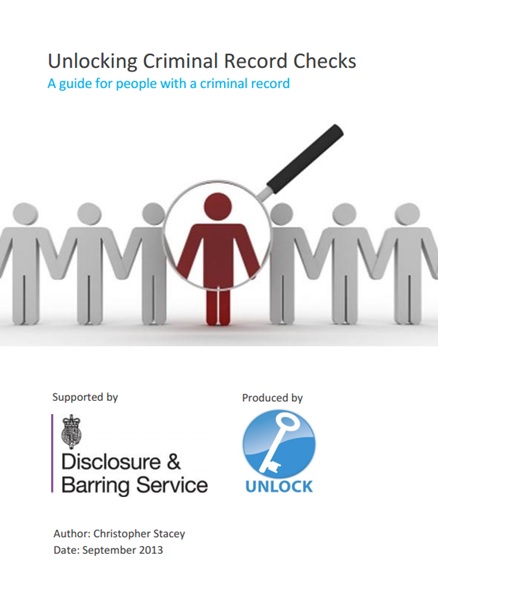
New guide – Unlocking Criminal Record Checks

On a daily basis, our helpline gets calls from people who are applying for work and don’t know where they stand because of criminal record checks that (increasingly) employers are carrying out.

A couple of years ago, we approached the DBS (Disclosure & Barring Service – known as the CRB at that time) and raised this as a matter of concern. They agreed to support the production of a guide, specifically for people with a criminal record, designed to explain in detail the criminal record checking process, with particular focus on the specific issues that people with a criminal record might face.

The result is a detailed guide which was written by Unlock and which was circulated by the DBS (it was announced in DBS News September 2013). Download the guide here or click the image below.

unlockingcriminalrecordchecks

For Unlock, this guide represents a number of things:

  • The DBS has recognised people with a criminal record as being a particular audience, and have responded by supporting the production and circulation of this guide
  • During the writing of the guide, Unlock asked a number of questions of the DBS about their processes, and in a number of respects, the DBS have responded by working to improve aspects of their process
  • In particular, the guide shines a light on the process of ‘eligibility’. The Establish Eligibility Process Flow-chart (page 19) sets out a clear and detailed process for individuals to follow if they believe that an employer might be asking for the wrong level of criminal record check. It also documents the specific ‘Eligibility query’ process that the DBS has in place to respond to concerns around eligibility from individuals
  • It provides a starting point by which evidence can be collected about how employers and the DBS are dealing with eligibility issues

Since the guide was published, we’ve already started getting feedback from people. A couple of examples include:

People asking questions of employers:

I went into Human Resources and asked why they were asking for enhanced checks. They wasn’t sure, and once I pointed out that a basis disclosure could be used, they were happy to accept this, and changed their policy as a result. Given my criminal record is spent, it means I don’t have to resign, which I feel I would have had to do otherwise”

People using the DBS’s ‘Eligibility query’ process:

My employer was insisting on an enhanced level check for a job working as a door-to-door salesman. I tried to talk to them, but they wouldn’t listen, so I didn’t have any other option but to consent to the check. Following Unlock’s guidance, I raised a query with the DBS, and they looked into it. The outcome of this was that the DBS wrote to my employer saying that they didn’t think that the position was eligible, and that they should do a basic level check. Result!”

This guide is an important first step, but there is still a long way to go to ensure that employers are carrying out the correct level of checks and at the right time.

We’re keen to get your feedback on this guide, and in particular if you’ve tried to make use of the advice contained it in, either in your dealings with an employer or in raising an eligibility query with the DBS.

To go alongside this guide, we’ve also recently published two articles that will help people with convictions understand a bit more about dealing with their criminal record in the world of work:

  • ‘Ways to find out about your criminal record’ available here
  • ‘Disclosing your convictions to employers’ available here

Questions?

If you have any questions about this information, please contact us.
If you’d like to discuss this information with others, there is a specific thread on our online forum.

New guide published – Unlocking Criminal Record Checks

On a daily basis, our helpline gets calls from people who are applying for work and don’t know where they stand because of criminal record checks that (increasingly) employers are carrying out.

A couple of years ago, we approached the DBS (Disclosure & Barring Service – known as the CRB at that time) and raised this as a matter of concern. They agreed to support the production of a guide, specifically for people with a criminal record, designed to explain in detail the criminal record checking process, with particular focus on the specific issues that people with a criminal record might face.

The result is a detailed guide which was written by Unlock and which was circulated by the DBS (it was announced in DBS News September 2013). Download the guide here or click the image below.

For Unlock, this guide represents a number of things:

  1. The DBS has recognised people with a criminal record as being a particular audience, and have responded by supporting the production and circulation of this guide
  2. During the writing of the guide, Unlock asked a number of questions of the DBS about their processes, and in a number of respects, the DBS have responded by working to improve aspects of their process
  3. In particular, the guide shines a light on the process of ‘eligibility’. The Establish Eligibility Process Flow-chart (page 19) sets out a clear and detailed process for individuals to follow if they believe that an employer might be asking for the wrong level of criminal record check. It also documents the specific ‘Eligibility query’ process that the DBS has in place to respond to concerns around eligibility from individuals
  4. It provides a starting point by which evidence can be collected about how employers and the DBS are dealing with eligibility issues

Since the guide was published, we’ve already started getting feedback from people. A couple of examples include:

People asking questions of employers: “I went into Human Resources and asked why they were asking for enhanced checks. They wasn’t sure, and once I pointed out that a basis disclosure could be used, they were happy to accept this, and changed their policy as a result. Given my criminal record is spent, it means I don’t have to resign, which I feel I would have had to do otherwise”

People using the DBS’s ‘Eligibility query’ process: “My employer was insisting on an enhanced level check for a job working as a door-to-door salesman. I tried to talk to them, but they wouldn’t listen, so I didn’t have any other option but to consent to the check. Following Unlock’s guidance, I raised a query with the DBS, and they looked into it. The outcome of this was that the DBS wrote to my employer saying that they didn’t think that the position was eligible, and that they should do a basic level check. Result!”

This guide is an important first step, but there is still a long way to go to ensure that employers are carrying out the correct level of checks and at the right time.

We’re keen to get your feedback on this guide, and in particular if you’ve tried to make use of the advice contained it in, either in your dealings with an employer or in raising an eligibility query with the DBS.

First information session for people with convictions

Why?

  • We’ll be explaining about Unlock and our Helpline, which provides confidential peer advice on overcoming the effects of criminal convictions
  • Different topics will be covered in detail at each session
  • Our Helpline Advisors will be on hand to answer any questions you might have
  • You’ll have the opportunity to book a free one-to-one session the following week
  • If you’re still not convinced, there’ll also be free hot drinks and biscuits!

When? The first will be held on Thursday 3rd October 2013, 5pm – 7pm

Where? Maidstone Community Support Centre, 39-48 Marsham St, Maidstone, Kent, ME14 1HH

Interested?
Just turn up on the evening. However, if you do plan to come along, it would be useful if you could let us know, so that we have a better idea of how many people to expect on the evening


Background

As part of our running our Helpline, we think it’s important that we try to reach people that wouldn’t ordinarily contact us. As a result, we’re holding our first ever series of local information sessions.

Spread the word

If you work with people who have convictions and you think they may be interested in attending, please pass on this email to them. You’re also welcome to print this out and put  it up on any noticeboards you might have.

Any questions?

Please contact our helpline; call 01634 247350 or email advice@unlock.org.uk.

We want to make sure that our website is as helpful as possible.

Letting us know if you easily found what you were looking for or not enables us to continue to improve our service for you and others.

Was it easy to find what you were looking for?

Thank you for your feedback.

12.5 million people have criminal records in the UK. We need your help to help them.

Help support us now