Author: Unlock Admin

The Disclosure & Barring Service update the question they ask about convictions

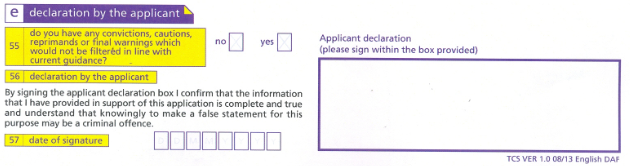
Following our complaint to the Information Commissioners Office which recently led to the Disclosure & Barring Service signing an undertaking to update their application form, we have now had it confirmed by the DBS that their application form has now been updated. A copy of this is below.

e55

As you can see from the above image, the question (e.55) now asks only about convictions, cautions, reprimands or final warnings which would not be filtered. This means that, if your conviction or caution would be filtered at the time of completing the application, you can tick “no”.

You can find out more about completing a criminal record check application.

How do you know if you conviction or caution will be filtered? The DBS should be including guidance with the application form. We have also produced a simple guide and a detailed guide that should also help.

We’ve produced a simple guide on the DBS ‘filtering’ process

We know how complicated the criminal records process can be.

The ‘filtering’ process that came in in May 2013 has been quite a culture shock to many people who were previously told that all cautions and convictions would come back on standard and enhanced checks.

At the time, we developed a detailed guide on filtering.

But, through our helpline, we’ve been finding it quite difficult to make filtering simple and easy to understand. Also, as part of delivering our training masterclasses, we found that practitioners were forgetting how this fitted within the broader framework for disclosure.

So, we’ve recently put together a simple guide on filtering. This is available as a downloadable A4 document (click the image below).

filteringsimple

We hope you find it helpful. Let us know what you think by using our feedback form.


We’ve produced a simple guide to the filtering process

This update is taken from our Information Hub

We know how complicated the criminal records process can be.

The ‘filtering’ process that came in in May 2013 has been quite a culture shock to many people who were previously told that all cautions and convictions would come back on standard and enhanced checks.

At the time, we developed a detailed guide on filtering.

But, through our helpline, we’ve been finding it quite difficult to make filtering simple and easy to understand. Also, as part of delivering our training masterclasses, we found that practitioners were forgetting how this fitted within the broader framework for disclosure.

So, we’ve recently put together a simple guide on filtering. This is available as adownloadable A4 document (click the image below).

filteringsimple

We hope you find it helpful. Let us know what you think by using our feedback form.

The Disclosure & Barring Service update the question they ask about convictions

This update is taken from our Information Hub

Following our complaint to the Information Commissioners Office which recently led to the Disclosure & Barring Service signing an undertaking to update their application form, we have now had it confirmed by the DBS that their application form has now been updated. A copy of this is below.

e55

As you can see from the above image, the question (e.55) now asks only about convictions, cautions, reprimands or final warnings which would not be filtered. This means that, if your conviction or caution would be filtered at the time of completing the application, you can tick “no”.

You can find out more about completing a criminal record check application.

How do you know if you conviction or caution will be filtered? The DBS should be including guidance with the application form. We have also produced a simple guide and a detailed guide that should also help.

New website to be launched later this week

We’re delighted to announce that we’ll be launching a new core Unlock website later this week. As part of this development, we’ve had to take our old website down while we transfer the sites over, which means that neither our main website or our online forum will be available for the next couple of days.

In the meantime, our other websites (Information Hub, Disclosure Calculator and Online Magazine) will continue to run as normal, and these will be unaffected by the launch of the new site.

From later this week, our new core website will be available at unlock.devchd.com and will form part of our set of websites which includes:

  1. unlock.devchd.com (available later this week) – Our main website, explaining more about us as a charity, the services that we provide, and our current areas of focus
  2. unlock.devchd.com/information-and-advice/ – We maintain this information hub as the country’s most comprehensive source of online self-help information on a wide range of issues that criminal convictions can affect.
  3. forum.unlock.org.uk (available again later this week) – An online peer-to-peer forum enabling people with convictions to support one another
  4. www.disclosurecalculator.org.uk – A tool that enables you to work out when your convictions become spent under the Rehabilitation of Offenders Act 1974
  5. unlock.devchd.com/community – An online magazine for and by people with convictions

Once it’s launched, we’d be delighted to hear your views on what you think to our new site!

Unlock complaint leads to ruling that the Disclosure and Barring Service breached the Data Protection Act

We’re pleased to report that the Information Commissioners Office (ICO) has today issued a press release which sets out their ruling that the Disclosure and Barring Service (DBS) has breached the Data Protection Action after failing to stop collecting information about criminal conviction data that was no longer required because of a filtering regime that was introduced in May 2013.

The DBS hadn’t updated their application forms, and so although the ‘filtering’ process meant that certain cautions and convictions are no longer disclosed on standard and enhanced checks, the DBS were still asking whether applicants had “ever been convicted of a criminal offence or received a caution…” as part of their application form. The result of this was that employers were finding out information which they weren’t entitled to know about.

We made the original complaint to the ICO in September 2013, after our helpline had received a number of calls about this problem. In particular, we highlighted two cases where individuals had disclosed information they no longer needed to disclose, but had subsequently had their offers of employment withdrawn. The two cases are explained in more detail below.

Christopher Stacey, Co-Director at Unlock, said; “We’re pleased to see that the DBS has responded to this issue by updating their application form and improving their guidance to applicants. It is important that people with convictions are able to understand what they do and don’t have to disclose during the recruitment process, and the DBS have an important part to play to make this clear and easy to understand.”

“It remains difficult for people to find out whether a caution or conviction that they have is eligible for filtering, and we would like to see the DBS respond to this issue by introducing a system which allows individuals to obtain a copy of their DBS certificate before they start applying for jobs or volunteer work, so that they can be confident that they’re disclosing the appropriate level of information. We would also like to encourage employers that are entitled to carry out standard and enhanced checks to make sure that they look at their own recruitment processes and make sure that they are only asking about cautions and convictions that would not be filtered by the DBS”.

Brief details of the cases that formed part of our complaint to the ICO

Case One
An individual ticked ‘Yes’ to the question because the question hadn’t changed, and they didn’t see the accompanying guidance. To them, it was clear what question they were being asked, and so despite their conviction being one that would be filtered, they ticked ‘Yes’ which meant, because they handed the form back to the employer to submit, they had disclosed they had a conviction to the employer. The employer asked further questions about this, and decided to withdraw the job offer.

Case Two
An individual ticked ‘Yes’ to this question because they were not sure whether their conviction would be filtered. As there was no other means of definitively finding out whether it would be filtered or not, they erred on the side of caution and ticked ‘Yes’, believing that, if it would be filtered, it wouldn’t matter what they put. It turned out that their conviction was due to be filtered, but because they had ticked yes, their employer got to find out when they handed the form back, and subsequently decided to withdraw the job offer.

-END-

Notes to editors

  1. Press/media
  2. More information relating to the filtering process is available here.

Raising awareness in prisons of changes to the ROA

We’re continuing our efforts to raise awareness of the changes to the ROA, but this time we’ve been focusing on prisons.

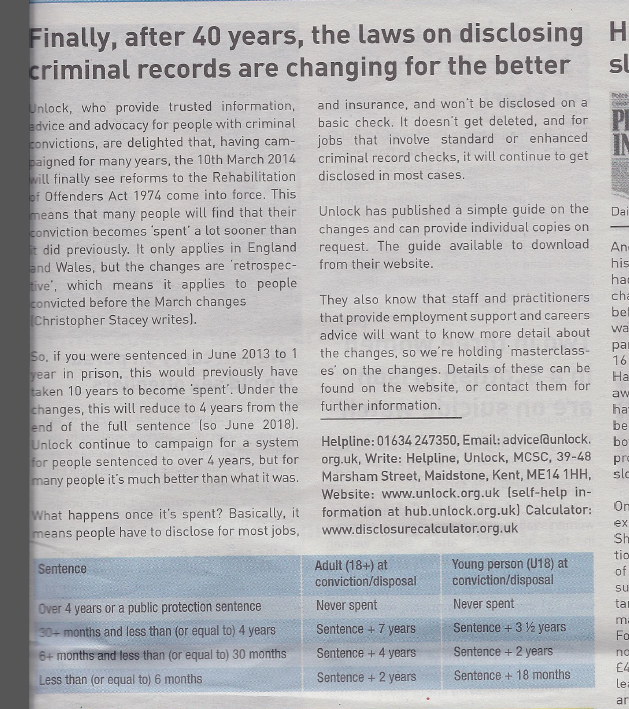
Firstly, we wrote a news piece for the March 2014 edition of Inside Time. A copy of the news piece is below.

We’ve also recorded a piece for the Prison Radio Associations’ ‘Outside In’ programme, which is done in partnership with Radio 4 and recorded by former prisoners. A copy of the audio will be available here shortly.

insidetimeroa

Criminals get better insurance – but not speeding motorists

The Telegraph’s Money section has published a very interesting article about the changes to the ROA and how these do (or don’t) impact on people with motoring offences.

We spoke with the journalist as she was developing this piece, although we’re not specifically referenced.

This article highlights a number of issues that we’re taking forward as part of our ongoing work around the ROA.

You can read the article here.

Raising awareness of the changes to the ROA

In the last couple of days, we’ve been very busy. We’ve been working hard to raise awareness of the changes to the ROA.

Yesterday (10th March) we appeared on BBC Breakfast.

We also took part in a number of regional radio discussions, including BBC London, BBC Radio 5 Live, BBC Leeds, BBC Coventry, BBC West Midlands, BBC Merseyside and BBC Kent.

We also worked with ITN News to provide them with a case study of somebody who’s convictions became spent as of yesterday. This was briefly featured in their lunchtime news programme.

More broadly, we wrote an article for Open Democracy (The right of offenders to get back on track) and an article for Criminal Law and Justice Weekly (Changing laws on disclosure)

An update on today’s historic changes to the Rehabilitation of Offenders Act 1974

Today is an historic day for Unlock. We’ve campaigned for many years to see changes to the Rehabilitation of Offenders Act. It’s the first time in nearly 40 years since the legislation has been reformed in this way. It’s been quite a wait since the law received Royal Assent in 2012, but we’re delighted that we’ve finally got there.

Since we got notice of the implementation date, we’ve been working hard behind the scenes to make sure that we do all that we can to prepare for the changes.

We are also firmly of the belief that the changes don’t go far enough, and we’ve been doing a lot of work to try and make this clear.

The reason for this message is to set out the various things we’ve been working on. An ongoing update on the changes, in terms of what’s happening, is available at unlock.devchd.com/information-and-advice//changestotheroa/.

Updating our guidance

We’ve produced detailed guidance on the law as it now stands. This is quite lengthy, and focuses on some of the more technical aspects of the changes. We will be regularly reviewing and updating this as and when appropriate.

Producing practical materials

We’ve also produced practical materials that help to explain the changes to the Rehabilitation of Offenders Act which came into force on the 10th March 2014. These resources will help you to understand whether convictions are now regarded as ‘spent’ under the reforms. They include:

  1. An ‘Is it spent?’ poster
  2. A brief guide

These are available to view online on our information hub, and you can download copies free of charge from the downloads section of our information hub.

Updating our Disclosure Calculator

We have updated our online tool, www.disclosurecalculator.org.uk, which helps people to work out whether their convictions are spent under the Act.

We’re still working on improving it further, so that it works better under the new law. For example, at the moment, it can only calculator prison sentences using months (not days or weeks) but we hope to rectify this soon. More details of some of the outstanding technical queries are explained below.

Raising awareness

We have been doing our best to try and make people aware of these changes, both in terms of how people will benefit and how the changes could (and should) got further.

Late last week, we issued a press release, and we’re keen to take part in any opportunities that are available where we can spread the word about these changes so that people understand their legal rights.

We’ve written articles for Criminal Law & Justice Weekly and Open Democracy. We’ve also written a blog for our online magazine, theRecord, asking whether the changes are enough.

For prisons in particular, we’ve recorded a piece for National Prison Radio, which will go out in the Prime Time slot. We’ve also submitted something for the next issue of Inside Time.

More broadly, we’re sending out our materials to prisons, probation areas, job centres, employment support programmes and voluntary agencies. You can download copies free of charge from the downloads section of our information hub, where you can also find out how to get hold of hard-copies.

If you know of people and organisations that might value this information, please forward them a link to this update.

Supporting practitioners and organisations – Running ‘Masterclasses’

To help share our knowledge and understanding of these changes, we’re running various masterclasses for practitioners and organisations. The one we’re holding in March is now sold out, and we’ve only got a few places left on our one on the 7th May, so book your place before you miss out. More details can be found here.

If you’re part of a project or service that has a number of people providing advice and support to people who have convictions, you might want to organise an ‘in-house’ masterclass, which can be for up to 10 individuals and works out cheaper per person that the bookable sessions. We’ve already got a number of these arranged for the coming months. More details can be found here.

Information session

We were delighted to run an information session in Maidstone last week, where we had various people turn up who, as a result of these changes, have found that their convictions will become spent much earlier. Quite a few found that their convictions become spent on the 10th March itself.

Technical queries

We are keeping a track of the technical elements to the Act that we are awaiting clarification from the Ministry of Justice on. This is a useful reference when reading our guidance or using our Disclosure Calculator. We will be adding to this based on the queries that we receive, and providing updates as and when we have them available.

Working with others

Business in the Community

We’ve worked with Business in the Community, who has produced a Guide and Top Tips for telling an employer about your criminal record

This guidance is for people with criminal convictions and their advisers. If you (or the person you support) want to get back to work but are worried about disclosing a criminal conviction, this accessible guidance helps you to:

  • Understand your criminal record
  • Check when you need to tell an employer about your criminal conviction(s)
  • Decide how you will tell an employer about your conviction(s)

Download the resources from the Business in the Community website (link with be live at some point on Monday 10th).

Ministry of Justice

We have been working closely with the Ministry of Justice on their guidance on the changes to the ROA. Although it’s not written in the style that we would choose, we provided comments on earlier draft versions to make sure that it was as clear as possible, and will continue to raise queries on an ongoing basis in the hope that they will clarify their guidance further (see outstanding technical queries below).

We want to make sure that our website is as helpful as possible.

Letting us know if you easily found what you were looking for or not enables us to continue to improve our service for you and others.

Was it easy to find what you were looking for?

Thank you for your feedback.

12.5 million people have criminal records in the UK. We need your help to help them.

Help support us now